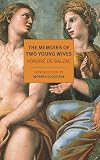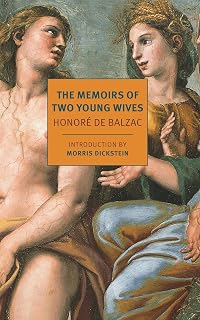
Letters of Two Brides
by Honoré de Balzac
Studies of Manners (3), Scenes from Private Life (3), The Human Comedy (Études de Moeurs - Scènes de la vie privée II | 11)
On This Page
Description
This richly drawn epistolary tale recounts the correspondence between two young women whose friendship evolves as they embark on marriage and motherhood. Although both have a distinctly different outlook, their shared observations and memories bring the beauty and difficulty of these experiences vividly to life.Tags
Recommendations













Member Reviews
The third book of Balzac's La Comédie Humaine, Letters of Two Brides is an epistolary tale told in the letters between two young women after leaving their convent. The correspondence between the two women details their diverging attitude and philosophies towards marriage and love, with one seeking passion and romance, and the other devoting herself to selfless familial servitude. Things don't end well for one of them.
This third story in the Scenes From a Private Life section of La Comédie Humaine, like the previous two, focuses on women seeking happiness in love and marriage. While these stories have the flavor of a morality play, Balzac doesn't feel as if he is preaching a specific virtue or moral as much as he is characterizing how show more life often plays out in spite of our best laid plans, and how obtaining happiness can be more complicated than most perceive. show less
This third story in the Scenes From a Private Life section of La Comédie Humaine, like the previous two, focuses on women seeking happiness in love and marriage. While these stories have the flavor of a morality play, Balzac doesn't feel as if he is preaching a specific virtue or moral as much as he is characterizing how show more life often plays out in spite of our best laid plans, and how obtaining happiness can be more complicated than most perceive. show less
Doubt is a duel fought within the soul, which causes horrid self-inflicted wounds.
This epistolary novel is often dismissed as light melodrama but I was engaged by it as a dialogue on the ambitions of marriage and maternity. The titular brides struggle in terms of maintenance and identity. This is depicted rather objectively in the letters of each protagonist.
Two best friends leave a convent and embark on quests for love and purpose. [a snide Goodreads reviewer in 2019 might scoff at such misogyny] There’s a malice at play in the letters, each questions the utility of the other’s motives. [some would snipe that this anticipates Fanon on the colonized] Should one look for security, hoping love comes later? [Solzhenitsyn by way of Tina show more Turner/] Should one devote oneself entirely to parenting? What about younger artists? Are they worth marrying?
Alas, it all ends in tears with characters from Lost Illusions making key cameos. show less
This epistolary novel is often dismissed as light melodrama but I was engaged by it as a dialogue on the ambitions of marriage and maternity. The titular brides struggle in terms of maintenance and identity. This is depicted rather objectively in the letters of each protagonist.
Two best friends leave a convent and embark on quests for love and purpose. [a snide Goodreads reviewer in 2019 might scoff at such misogyny] There’s a malice at play in the letters, each questions the utility of the other’s motives. [some would snipe that this anticipates Fanon on the colonized] Should one look for security, hoping love comes later? [Solzhenitsyn by way of Tina show more Turner/] Should one devote oneself entirely to parenting? What about younger artists? Are they worth marrying?
Alas, it all ends in tears with characters from Lost Illusions making key cameos. show less
Morris Dickstein writes, in his introduction, that this book is "not exactly a masterpiece." But really it is not even remotely a masterpiece. Balzac excels in writing about external events pushing people in directions they don't want to go. Epistolary novels are good at giving authors a way to focus, instead, on the thoughts of the people being pushed; there's a reason Richardson wrote ever-longer epistolary novels, and Fielding's masterpiece was narrated rather than epistled. Balzac should have stuck with the narration: the two young wives aren't interesting, or smart, or attractive, and that's entirely because Balzac wasn't smart, or attractive, or interesting, when he wasn't narrating the brutality of the nineteenth century in show more blockish, fist-smashing prose.
I wish Jordan Stump had spent his time translating a better book. show less
I wish Jordan Stump had spent his time translating a better book. show less
An epistolary novel of two women educated in the same convent. one , is independently wealthy and finally gives up her society life for supporting a younger poet, who finally, exploits her for the sake of his sister in law. the other becomes a staid mother, who eventually aids a geay deal in the success of her husband's political career, and creates a stable family. both are admirable characters and the art of the contrasts is well done.
Pas passionnant.
Dec 9, 2022French
Ratings
Members
- Recently Added By
Lists

Epistolary Books
105 works; 27 members

French Fiction of the 18th and 19th Centuries in English Translation
169 works; 3 members

la comédie humaine
47 works; 1 member
Author Information

Born on May 20, 1799, Honore de Balzac is considered one of the greatest French writers of all time. Balzac studied in Paris and worked as a law clerk while pursuing an unsuccessful career as an author. He soon accumulated enormous debts that haunted him most of his life. A prolific writer, Balzac would often write for 14 to-16 hours at a time. show more His writing is marked by realistic portrayals of ordinary, but exaggerated characters and intricate detail. In 1834, Balzac began organizing his works into a collection called The Human Comedy, an attempt to group his novels to present a complete social history of France. Characters in this project reappeared throughout various volumes, which ultimately consisted of approximately 90 works. Some of his works include Cesar Birotteau, Le Cousin Pons, Seraphita, and Le Cousine Bette. Balzac wed his lifelong love, Eveline Hanska in March 1850 although he was gravely ill at the time. Balzac died in August of that year. (Bowker Author Biography) show less
Some Editions
Series

Studies of Manners
60 works (3)

Scenes from Private Life
24 works (3)

The Human Comedy
94 works (Études de Moeurs - Scènes de la vie privée II | 11)
Belongs to Publisher Series
Work Relationships
Is contained in
At the Sign of the Cat and Racket; The Sceaux Ball, The Purse, The Vendetta, Madame Firmiani, A Daughter of Eve, Letters of Two Brides by Honoré de Balzac
La Comédie humaine, Tome 9 : La maison du chat-qui-pelote ; Un début dans la vie by Honoré de Balzac
Common Knowledge
- Canonical title
- Letters of Two Brides
- Original title
- Mémoires de deux jeunes mariées
- Alternate titles
- The Memoirs of Two Young Wives
- Original publication date
- 1842
- People/Characters*
- Armande-Louise-Marie de Chaulieu; Renée de Maucombe; Louis de l'Estorade (mari de René | e de Maucombe); Don Felipe Hénarez, baron de Macumer (mari de Louise de Chaulieu); Duc Fernand de Soria (frè | re de Don Felipe)
- Important places*
- Couvent des Carmélites de Blois; Paris, Île-de-France, France
- Related movies*
- Mémoires de deux jeunes mariées (1981 | IMDb)
- Dedication
- To George Sand.
Your name, dear George, while casting a reflected radiance on my
book, can gain no new glory from this page. And yet it is neither
self-interest nor diffidence which has led me to place it t... (show all)here,
but only the wish that it should bear witness to the solid
friendship between us, which has survived our wanderings and
separations, and triumphed over the busy malice of the world. This
feeling is hardly likely now to change. The goodly company of
friendly names, which will remain attached to my works, forms an
element of pleasure in the midst of the vexation caused by their
increasing number. Each fresh book, in fact, gives rise to fresh
annoyance, were it only in the reproaches aimed at my too prolific
pen, as though it could rival in fertility the world from which I
draw my models! Would it not be a fine thing, George, if the
future antiquarian of dead literatures were to find in this
company none but great names and generous hearts, friends bound by
pure and holy ties, the illustrious figures of the century? May I
not justly pride myself on this assured possession, rather than on
a popularity necessarily unstable? For him who knows you well, it
is happiness to be able to sign himself, as I do here,
Your friend,
DE BALZAC.
PARIS, June 1840. - First words
- Sweetheart, I too am free!
- Original language
- French
*Some information comes from Common Knowledge in other languages. Click "Edit" for more information.
Classifications
Statistics
- Members
- 275
- Popularity
- 117,856
- Reviews
- 5
- Rating
- (3.51)
- Languages
- 7 — English, French, German, Italian, Spanish, Swedish, Turkish
- Media
- Paper, Audiobook, Ebook
- ISBNs
- 46
- ASINs
- 14