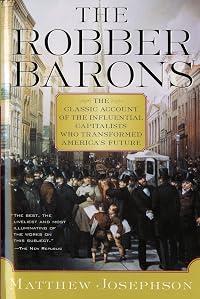
The Robber Barons: The Great American Capitalists, 1861-1901
by Matthew Josephson
On This Page
Description
John D. Rockefeller, J. P. Morgan, Cornelius Vanderbilt, Andrew Carnegie, E. H. Harriman, Jay Gould, Henry Clay F their names carry a powerful historical ring, still echoing today in the countless institutions that are part of their legacy, from universities to museums to banks. But who were the people behind the legends, and how did they rise to their positions of vast wealth and influence in the latter half of the nineteenth century? The Robber Barons is a classic work on the financiers show more and industrialists of the Gilded Age, who shaped their own era as well as the future of the United States. show lessTags
Recommendations










Member Reviews
Where I got the book: purchased used on Amazon.
The Robber Barons was written in 1934, but there’s not much that seems dated about this enjoyable popular history. I bought it to get a better idea of what the industrial leaders of the late nineteenth century were like; usually I like to look for the most modern source on the assumption that they will have done more extensive research, but there’s something to be said for the argument that a writer closer in time to the actual events will have a more intimate perspective on them.
All historians, of course, have a bias, and Josephson’s is pretty clear. He clearly admires what was going on in Russia at the time of writing, and he has read and thoroughly digested Marx’s writings. He show more was writing at a time when the pendulum had swung the other way from where it had been at the turn of the century—after the stock market crash and the Great Depression, moves were being made to ensure that corporations no longer had the freedom they’d once had and there was a trend toward enacting laws in favor of the ordinary worker, using taxation and legislation to slow down the rapid acquisition of personal and corporate fortunes.
But Josephson was looking back to the period that began with the Civil War, when there was little in the way of regulation and a number of individuals, often from very humble origins, were able to use their tenacity and shrewdness to build an enormous power base in their own fields, aided by the massive expansion of the United States at that time. The names are familiar ones: Carnegie, Rockefeller, Morgan, Gould, Armour, Astor, Vanderbilt—men whose ambitions not only built them fortunes beyond imagining, but brought about America’s second industrial revolution on a scale as vast as the country.
The process was one not just of tremendous battles in the stock market, but actual battles on the ground, with bloodshed in many cases. Josephson tells some thrilling tales of men struggling to lay track ahead of their competitors, engaging in bloody battles over a railroad line or its cargo, ruining their own health by empire-building, manufacturing fortunes out of nothing by a cunning process of borrowing and inflating.
I’ll admit it, I was enthralled. And it all seemed very familiar—corporate greed built on ever-lowering wages and long hours, headed by men who could look you straight in the eye and tell you they were doing this for the good of the country. Josephson goes into detail about the purchasing of politicians, evidently by the bushel, and the tactics deployed to ensure the failure of the nascent unions in their attempts to alter the balance of power. In the 1870s and 1880s such maneuvers were carried out quite openly and gleefully—it was only as the twentieth century neared, Josephson shows, that the next generation of barons began turning to the professional lobbyist and the public relations expert to obfuscate their own involvement in bending the rules to suit themselves.
I’ve been trying to learn more about the period between the Civil War and the Gilded Age of the 1890s, and this book has probably supplied me with more useful information on that under-studied period than any other I’ve read so far. It may be an older title, but I’d recommend it to students of American history without hesitation. show less
The Robber Barons was written in 1934, but there’s not much that seems dated about this enjoyable popular history. I bought it to get a better idea of what the industrial leaders of the late nineteenth century were like; usually I like to look for the most modern source on the assumption that they will have done more extensive research, but there’s something to be said for the argument that a writer closer in time to the actual events will have a more intimate perspective on them.
All historians, of course, have a bias, and Josephson’s is pretty clear. He clearly admires what was going on in Russia at the time of writing, and he has read and thoroughly digested Marx’s writings. He show more was writing at a time when the pendulum had swung the other way from where it had been at the turn of the century—after the stock market crash and the Great Depression, moves were being made to ensure that corporations no longer had the freedom they’d once had and there was a trend toward enacting laws in favor of the ordinary worker, using taxation and legislation to slow down the rapid acquisition of personal and corporate fortunes.
But Josephson was looking back to the period that began with the Civil War, when there was little in the way of regulation and a number of individuals, often from very humble origins, were able to use their tenacity and shrewdness to build an enormous power base in their own fields, aided by the massive expansion of the United States at that time. The names are familiar ones: Carnegie, Rockefeller, Morgan, Gould, Armour, Astor, Vanderbilt—men whose ambitions not only built them fortunes beyond imagining, but brought about America’s second industrial revolution on a scale as vast as the country.
The process was one not just of tremendous battles in the stock market, but actual battles on the ground, with bloodshed in many cases. Josephson tells some thrilling tales of men struggling to lay track ahead of their competitors, engaging in bloody battles over a railroad line or its cargo, ruining their own health by empire-building, manufacturing fortunes out of nothing by a cunning process of borrowing and inflating.
I’ll admit it, I was enthralled. And it all seemed very familiar—corporate greed built on ever-lowering wages and long hours, headed by men who could look you straight in the eye and tell you they were doing this for the good of the country. Josephson goes into detail about the purchasing of politicians, evidently by the bushel, and the tactics deployed to ensure the failure of the nascent unions in their attempts to alter the balance of power. In the 1870s and 1880s such maneuvers were carried out quite openly and gleefully—it was only as the twentieth century neared, Josephson shows, that the next generation of barons began turning to the professional lobbyist and the public relations expert to obfuscate their own involvement in bending the rules to suit themselves.
I’ve been trying to learn more about the period between the Civil War and the Gilded Age of the 1890s, and this book has probably supplied me with more useful information on that under-studied period than any other I’ve read so far. It may be an older title, but I’d recommend it to students of American history without hesitation. show less
Josephson tells the story of the massive industrialisation of America that occurred in the last quarter of the 19th century. It was the greatest boom of them all, generating a giant interlocking system that covered steel, oil, railways, coal, food processing and banking.
The book looks at this phenomenon through the eyes of the men that came out on top in the frenzied and unstructured rush for development, and it becomes in part the biographies of Rockefeller (oil), Carnegie (steel), Gould and Vanderbilt (railways) and Morgan (banking) among others.
It's difficult not to be fascinated by the picture of capitalism (enterprise or any other word you prefer) at it's raw essence. The opportunities were vast and the modern restraints of show more anti-monopoly law, social legislation, taxation, judicial/editorial independence were feeble or non-existent.
Apart from being an excellent writer Josephson is also an honest reporter, showing the undeniable achievements of these men alongside the serious instabilities that they started to produce in society. On the one hand there are the largest modern industries and America's acceleration towards the position of leading world power and on the other the fact that the essential institutions of society were collapsing.
As Vanderbilt said, "What do I care about the law? Hain't I got the power?"
The effect was to put a monopoly lock on the large number of wealth creating technologies that appeared at the time and to become as Josephson puts it, " the ancient barons-of-the-crags - who, by force of arms, instead of corporate combinations, monopolized strategic valley roads or mountain passed through which commerce flowed."
For example Rockefeller's switch from being the largest to the only oil refiner came in secret agreements with the Erie, Pennsylvania, and New York Central railroad "pools" whereby he and refiners invited to join the Standard Oil Trust (they received half the real value of their assets) had freight rates reduced by up to 50% whereas competing refiners had their rates increased by 100% with half of this being paid straight back to Standard Oil (drawback) by the railroads. Within three months his remaining 25 competitors surrendered to him and he fixed all U.S. oil sales at a new high price.
Marx developed his theory of Communism as a peoples Trust at this time and the more emotional outrage of Americans at awful working conditions and the wrecking of the legal and political system is captured for example in Jack Londons "The Iron Heel" (1906). show less
The book looks at this phenomenon through the eyes of the men that came out on top in the frenzied and unstructured rush for development, and it becomes in part the biographies of Rockefeller (oil), Carnegie (steel), Gould and Vanderbilt (railways) and Morgan (banking) among others.
It's difficult not to be fascinated by the picture of capitalism (enterprise or any other word you prefer) at it's raw essence. The opportunities were vast and the modern restraints of show more anti-monopoly law, social legislation, taxation, judicial/editorial independence were feeble or non-existent.
Apart from being an excellent writer Josephson is also an honest reporter, showing the undeniable achievements of these men alongside the serious instabilities that they started to produce in society. On the one hand there are the largest modern industries and America's acceleration towards the position of leading world power and on the other the fact that the essential institutions of society were collapsing.
As Vanderbilt said, "What do I care about the law? Hain't I got the power?"
The effect was to put a monopoly lock on the large number of wealth creating technologies that appeared at the time and to become as Josephson puts it, " the ancient barons-of-the-crags - who, by force of arms, instead of corporate combinations, monopolized strategic valley roads or mountain passed through which commerce flowed."
For example Rockefeller's switch from being the largest to the only oil refiner came in secret agreements with the Erie, Pennsylvania, and New York Central railroad "pools" whereby he and refiners invited to join the Standard Oil Trust (they received half the real value of their assets) had freight rates reduced by up to 50% whereas competing refiners had their rates increased by 100% with half of this being paid straight back to Standard Oil (drawback) by the railroads. Within three months his remaining 25 competitors surrendered to him and he fixed all U.S. oil sales at a new high price.
Marx developed his theory of Communism as a peoples Trust at this time and the more emotional outrage of Americans at awful working conditions and the wrecking of the legal and political system is captured for example in Jack Londons "The Iron Heel" (1906). show less
A well written and comprehensive book on the Barons of Industry from the early 19th century with Cornelius Vanderbilt to the time of Theodore Roosevelt and the busting of the Trusts. Speaks quite a bit about Vanderbilt, Jay Gould, John Rockefeller, Andrew Carnegie and J.P. Morgan and their acquisitions. but also goes into others of this age who were smaller in scale, especially out west but still examples of the age. I would recommend this for those interested in the history of this period and of early business.
448. The Robber Barons: The Great American Capitalists 1861-1901, by Matthew Josephson (read 8 Nov 1952) The author has a Marxist view of capitalism but the book seems pretty factual.
Ratings
Members
- Recently Added By
Lists

Best Books of 1926-1935
403 works; 10 members
Author Information

27+ Works 1,231 Members
Matthew Josephson (1899-1978) was an American journalist known for his work in American economic history and French literature. In addition to being a regular contributor to The New Republic, The New Yorker, and The Nation, he is the author of numerous books, including The Money Lords, The Great Finance Capitalists, 1925-1950, and Life Among the show more Surrealists. show less
Common Knowledge
- Canonical title
- The Robber Barons: The Great American Capitalists, 1861-1901
- Alternate titles
- The Robber Barons: The Story of the Great American Capitalists 1861–1901
- Original publication date
- 1934
- People/Characters
- Samuel Gompers; Charles Francis Adams, Jr.; Henry Adams; Benjamin Altman; Oakes Ames; Honoré de Balzac (show all 28); Alexander Graham Bell; Alexander Berkman; Louis D. Brandeis; James Brooks; Moses Brown; Obadiah Brown; James D. Cameron; Simon Cameron; Addison Cammack; W. B. Carr; A. J. Cassatt; John J. Cisco; Horace F. Clark; M. B. Clark; William A. Clark; Mark Twain; Charles Coffin; William T. Coleman; Schuyler Colfax; David D. Colton; John R. Commons; Eugene V. Debs
- Important places
- USA
- Important events
- American Civil War
- Epigraph
- There are never wanting some persons of violent and undertaking natures, who, so they may have power and business, will take it at any cost. Francis Bacon
- Dedication
- To Charles A. Beard and Mary R. Beard
- First words
- The cannonading that began at Charleston with the dawn of April 12,1861, sounded the tocsin for the men of the new American union.
- Last words
- (Click to show. Warning: May contain spoilers.)Than in the days when the busy workers of our cities were turned into idle and hungry louts, and our once patriotic farmers into rebels and lawbreakers, there would arise hosts of men and women, numerous enough who knew that " They could no longer live in a world where such things can be..."
Classifications
Statistics
- Members
- 461
- Popularity
- 66,297
- Reviews
- 4
- Rating
- (3.68)
- Languages
- Chinese, English, Italian
- Media
- Paper, Ebook
- ISBNs
- 8
- ASINs
- 16