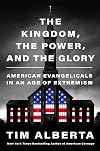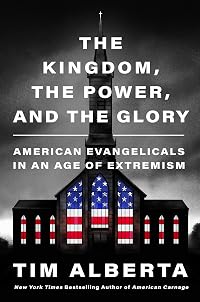
The Kingdom, the Power, and the Glory: American Evangelicals in an Age of Extremism
by Tim Alberta
On This Page
Description
The award-winning journalist and staff writer for The Atlantic follows up his New York Times bestseller American Carnage with this timely, rigorously reported, and deeply personal examination of the divisions that threaten to destroy the American evangelical movement. Evangelical Christians are perhaps the most polarizing-and least understood-people living in America today. In his seminal new book, The Kingdom, the Power, and the Glory, journalist Tim Alberta, himself a practicing Christian show more and the son of an evangelical preacher, paints an expansive and profoundly troubling portrait of the American evangelical movement. Through the eyes of televangelists and small-town preachers, celebrity revivalists and everyday churchgoers, Alberta tells the story of a faith cheapened by ephemeral fear, a promise corrupted by partisan subterfuge, and a reputation stained by perpetual scandal. For millions of conservative Christians, America is their kingdom-a land set apart, a nation uniquely blessed, a people in special covenant with God. This love of country, however, has given way to right-wing nationalist fervor, a reckless blood-and-soil idolatry that trivializes the kingdom of Jesus Christ. Alberta retraces the arc of the modern evangelical movement, placing political and cultural inflection points in the context of church teachings and traditions, explaining how Donald Trump's presidency and the Covid-19 pandemic only accelerated historical trends that long pointed toward disaster. Reporting from half-empty sanctuaries and standing-room-only convention halls across the country, the author documents a growing fracture inside American Christianity, journeying with readers through this strange new environment in which loving your enemies is "woke" and owning the libs is the answer to WWJD. Accessing the highest echelons of the American evangelical movement, Alberta investigates the ways in which conservative Christians have pursued, exercised, and often abused power in the name of securing this earthly kingdom. He highlights the battles evangelicals are fighting-and the weapons of their warfare-to demonstrate the disconnect from scripture: Contra the dictates of the New Testament, today's believers are struggling mightily against flesh and blood, eyes fixed on the here and now, desperate for a power that is frivolous and fleeting. Lingering at the intersection of real cultural displacement and perceived religious persecution, Alberta portrays a rapidly secularizing America that has come to distrust the evangelical church, and weaves together present-day narratives of individual pastors and their churches as they confront the twin challenges of lost status and diminished standing. Sifting through the wreckage-pastors broken, congregations battered, believers losing their religion because of sex scandals and political schemes-Alberta asks: If the American evangelical movement has ceased to glorify God, how long can it survive? show lessTags
Recommendations





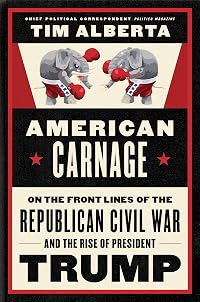

















Member Recommendations
M_Clark The Russel Moore and Tim Alberta books provide different perspectives on the same issue: the politicization of the evangelical movement. Moore is a main figure in Alberta's book.
Member Reviews
Having grown up attending church regularly in a denomination that's main message was 'God is love', I've been perplexed to witness the amount of support that evangelical churches have been giving to a political candidate who, from my viewpoint, is dishonest, immoral, untrustworthy and self-serving, and whose behavior is in every way un-Christian. This confusion on my part led me to this book, purportedly a conservative Christian's study of the politicization of modern American churches. I'm very glad I did.
Tim Alberta is clearly more conservative than I am and did explain his views on occasion in the book, often views that I disagree with. I have no problem with that. People can disagree with each other and can still respect their show more opinions. But where Alberta and I strongly agree is on the roll of the church in society. He sees the rise of Christian Nationalism as an evolutionary process, having arisen largely in the past few decades. Per Alberta,
While much of his book focuses on the church, he does make sure to express his views on politicians who try to use the church’s influence to further their agendas. He described Colorado congresswoman Lauren Boebert as
Alberta ultimately holds out hope that the church will come to its senses and return to the rock on which it was founded. I took some comfort that on the day I finished this book, I read a Bloomberg article headlined Trumpism Is Emptying Churches that laid ‘the drop in the percentage of Americans saying religion is important in their lives’ largely at the feet of the MAGA movement and the gaudy corruption of Trumpism.
Alberta condemns the very notion of Christian nationalism by quoting scripture.
FYI: On a 5-point scale I assign stars based on my assessment of what the book needs in the way of improvements:
*5 Stars – Nothing at all. If it ain’t broke, don’t fix it.
*4 Stars – It could stand for a few tweaks here and there but it’s pretty good as it is.
*3 Stars – A solid C grade. Some serious rewriting would be needed in order for this book to be considered great or memorable.
*2 Stars – This book needs a lot of work. A good start would be to change the plot, the character development, the writing style and the ending.
*1 Star – The only thing that would improve this book is a good bonfire. show less
Tim Alberta is clearly more conservative than I am and did explain his views on occasion in the book, often views that I disagree with. I have no problem with that. People can disagree with each other and can still respect their show more opinions. But where Alberta and I strongly agree is on the roll of the church in society. He sees the rise of Christian Nationalism as an evolutionary process, having arisen largely in the past few decades. Per Alberta,
There was a reason Christian views writ large were now summarily dismissed as “inherently intolerant and undemocratic.” for generations, white evangelicals had been overwhelmingly supportive of both immigrants and refugees entering the United States; by 2020 they were, far and away, the least likely of any religious subgroup to advocate for either one. And this was not some outlying development. In the year after Trump left office, polling repeatedly showed there was one demographic group most likely to believe that the election had been stolen, that vaccines were dangerous, that globalists were controlling the U.S. population, that liberal celebrities were feasting on the blood of infants, that resorting to violence might be necessary to save the country: white evangelicals.But he still holds out hope that these radical elements are the exception, rather than the rule. I’m not sure I believe this but I’ll grant that he has an insider’s vantage point that I lack. In his opinion,
None of this justified the sweeping censure of tens of millions of people. Having spent Trump’s presidency traveling the country, meeting religious voters in small towns and big cities alike, I knew how many serious, sane evangelicals were still out there. These people have no place in the left-wing fever dreams that inform cable news punditry and op-ed pages. They are reasonable and realistic, making prudential political judgments that often reflect something quite limited about their core values, their commitment to others, their complex set of religious convictions. They are dismayed by the hysteria and hyperbole that has captured their movement and want nothing more than to reclaim it.
While much of his book focuses on the church, he does make sure to express his views on politicians who try to use the church’s influence to further their agendas. He described Colorado congresswoman Lauren Boebert as
"A small-town restaurant owner who’d been arrested four times in the decade before seeking political office, Boebert was fond of boasting that God told her to run for Congress because her unlikely victory 'would be a sign and a wonder to the unbeliever.' If the unbeliever paid attention to Boebert, the only signs they saw were of psychosis. "He called Florida Governor Ron DeSantis to account for
frequently invoked the Book of Ephesians while traveling the country in 2022 to raise money and rally the conservative base. “Put on the full armor of God,” DeSantis would say, “and take a stand against the left’s schemes.” In substituting “the left” for “the devil,” DeSantis wasn’t just counting on the biblical illiteracy of his listeners. He was banking on a nationalist fervor that rendered scriptural restraint irrelevant. He was confident that evangelicals in the audience would agree that he knew better than Paul; that the real enemy is the left; that the real struggle is against flesh and blood; that the real power belongs to a politician who can ignore Anthony Fauci’s coronavirus protocols and eliminate Disney World’s tax exemptions.He also spoke at length about how the Christian Nationalists were “glorifying Donald Trump like he was an idol.”
Alberta ultimately holds out hope that the church will come to its senses and return to the rock on which it was founded. I took some comfort that on the day I finished this book, I read a Bloomberg article headlined Trumpism Is Emptying Churches that laid ‘the drop in the percentage of Americans saying religion is important in their lives’ largely at the feet of the MAGA movement and the gaudy corruption of Trumpism.
Alberta condemns the very notion of Christian nationalism by quoting scripture.
Champions of Christian nationalism would have you believe that these efforts to rule the country are inherently theological; that they are in service of a broader effort to reclaim America for God. This is a lie. Christian nationalism is a contradiction in terms: Paul told the Galatians, “There is neither Jew nor Gentile, neither slave nor free, nor is there male and female, for you are all one in Christ Jesus. This assurance—transcends all known racial, ethnic, and national identities.
FYI: On a 5-point scale I assign stars based on my assessment of what the book needs in the way of improvements:
*5 Stars – Nothing at all. If it ain’t broke, don’t fix it.
*4 Stars – It could stand for a few tweaks here and there but it’s pretty good as it is.
*3 Stars – A solid C grade. Some serious rewriting would be needed in order for this book to be considered great or memorable.
*2 Stars – This book needs a lot of work. A good start would be to change the plot, the character development, the writing style and the ending.
*1 Star – The only thing that would improve this book is a good bonfire. show less
I’m going to open what is likely to be a very long review (I was highlighting, with positive emotions this time) with an anecdote.
I was born to parents uninterested in raising me in the church. My father, like me, was raised by former church-goers who were disenchanted with organized religion and what it had to offer. He was and is a Christian, but also was deeply interested in the study of religion and found little on offer in my small town.
My mother is slightly more interesting. She was raised by two Southern Baptists who were devout in every sense of the word. She attended Baylor for college in the late eighties and early nineties, but became disillusioned with the sexism and judgmental nature of the church and stopped attending a show more church regularly before I was born. She didn’t want to pass that to her daughters, so I was raised, as I put it, Christian but outside the church.
Because of this, I had two lines to organized religion: my great-grandmother on my dad’s side, a Church of Christ woman since birth and until death, and my grandparents on my mom’s side, who took us to their Southern Baptist church whenever humanly possible. That church was the main place I engaged with organized religion, and where I went when I began regularly attending church in middle school.
None of this is the anecdote. This is background for the anecdote. The anecdote is as follows:
When I was either in the end of my seventh grade year or beginning of my eighth grade year, I was becoming warmer to the concept of queer people and beginning to realize I was one myself. My realization I was attracted to women wouldn’t come for several more months, and the realization it was exclusively women would take until junior year of college, but I had completely gotten on board with queer people being Cool.
One Sunday, I was sitting in the pew my grandparents have probably sat in since they moved to my hometown. It is three rows back from the front on the right side of the church, as looking out from the alter. Two rows up from us, in the first pew in the row, sat a woman in a pink tracksuit. I had never seen her before.
My grandmother leaned over to me and said, in a tone that left no room to question that this wasn’t a hostility, “I can’t believe someone like her would come here.”
I never saw that woman again.
I know the hostility was because the woman was queer. To this day, I don’t know if she was a lesbian or transgender or something else entirely. It doesn’t really matter. What mattered was that these people who I knew to be devout churchgoers, who sat there and listened to a sermon on loving thy neighbor, were ready to turn and spew hate at a moment’s notice. This was in 2017.
I drifted away from Evangelical Christianity after that, slowly and then quickly. However, was and always will be a huge part of my life. There is no ignoring that. And the cycles discussed in this book were so reminiscent of that time in my life and the way I see that kind of hate infecting those I love it was shocking.
The first passage in this book that really, truly shocked me was in Chapter 5. At this point, a statistic is mentioned: in 2011, only 30% of white evangelicals agreed a politician could have corrupt personal moral values and perform public duties morally. This was the lowest in the country. In 2016, 72% agreed. This was the highest in the country.
It was shocking, and it hit so close to home. I was only 8 in 2011, but it was that 2016 election that really made me stare down my grandmother and go “Why do you think this? Aren’t you supposed to be a Christian?”
At one point, a woman asks a conference organizer what topics she should speak on, which he very willingly lists out to her, then she says “Whatever He gives me to say [will be great]”. This was so shocking to me. Here is a (presumably) Christian woman allowing another person to control her speech and then giving the credit for that to God. Someone is certainly speaking through you, but it sure isn’t God.
Really good book, great look into American evangelicalism in its modern form. Alberta does try to leave us on a high note, mentioning that in talking to leaders in the (still conservative, still republican) evangelical resistance they bring up time and time again that young people are pushing back, are trying too deprogram their parents and grandparents. But I’ve seen young people get pulled into the quagmire, and I don’t know if that wave pushing back will be enough.
Highly recommend if you are interested in very specifically the evangelical right in America. Not much discussion beyond that, but as Alberta lays out in the beginning of the book, that is on purpose. He didn’t want to muddy the waters by tackling the entirety of American Christianity. show less
I was born to parents uninterested in raising me in the church. My father, like me, was raised by former church-goers who were disenchanted with organized religion and what it had to offer. He was and is a Christian, but also was deeply interested in the study of religion and found little on offer in my small town.
My mother is slightly more interesting. She was raised by two Southern Baptists who were devout in every sense of the word. She attended Baylor for college in the late eighties and early nineties, but became disillusioned with the sexism and judgmental nature of the church and stopped attending a show more church regularly before I was born. She didn’t want to pass that to her daughters, so I was raised, as I put it, Christian but outside the church.
Because of this, I had two lines to organized religion: my great-grandmother on my dad’s side, a Church of Christ woman since birth and until death, and my grandparents on my mom’s side, who took us to their Southern Baptist church whenever humanly possible. That church was the main place I engaged with organized religion, and where I went when I began regularly attending church in middle school.
None of this is the anecdote. This is background for the anecdote. The anecdote is as follows:
When I was either in the end of my seventh grade year or beginning of my eighth grade year, I was becoming warmer to the concept of queer people and beginning to realize I was one myself. My realization I was attracted to women wouldn’t come for several more months, and the realization it was exclusively women would take until junior year of college, but I had completely gotten on board with queer people being Cool.
One Sunday, I was sitting in the pew my grandparents have probably sat in since they moved to my hometown. It is three rows back from the front on the right side of the church, as looking out from the alter. Two rows up from us, in the first pew in the row, sat a woman in a pink tracksuit. I had never seen her before.
My grandmother leaned over to me and said, in a tone that left no room to question that this wasn’t a hostility, “I can’t believe someone like her would come here.”
I never saw that woman again.
I know the hostility was because the woman was queer. To this day, I don’t know if she was a lesbian or transgender or something else entirely. It doesn’t really matter. What mattered was that these people who I knew to be devout churchgoers, who sat there and listened to a sermon on loving thy neighbor, were ready to turn and spew hate at a moment’s notice. This was in 2017.
I drifted away from Evangelical Christianity after that, slowly and then quickly. However, was and always will be a huge part of my life. There is no ignoring that. And the cycles discussed in this book were so reminiscent of that time in my life and the way I see that kind of hate infecting those I love it was shocking.
The first passage in this book that really, truly shocked me was in Chapter 5. At this point, a statistic is mentioned: in 2011, only 30% of white evangelicals agreed a politician could have corrupt personal moral values and perform public duties morally. This was the lowest in the country. In 2016, 72% agreed. This was the highest in the country.
It was shocking, and it hit so close to home. I was only 8 in 2011, but it was that 2016 election that really made me stare down my grandmother and go “Why do you think this? Aren’t you supposed to be a Christian?”
At one point, a woman asks a conference organizer what topics she should speak on, which he very willingly lists out to her, then she says “Whatever He gives me to say [will be great]”. This was so shocking to me. Here is a (presumably) Christian woman allowing another person to control her speech and then giving the credit for that to God. Someone is certainly speaking through you, but it sure isn’t God.
Really good book, great look into American evangelicalism in its modern form. Alberta does try to leave us on a high note, mentioning that in talking to leaders in the (still conservative, still republican) evangelical resistance they bring up time and time again that young people are pushing back, are trying too deprogram their parents and grandparents. But I’ve seen young people get pulled into the quagmire, and I don’t know if that wave pushing back will be enough.
Highly recommend if you are interested in very specifically the evangelical right in America. Not much discussion beyond that, but as Alberta lays out in the beginning of the book, that is on purpose. He didn’t want to muddy the waters by tackling the entirety of American Christianity. show less
As a person of faith, the evangelical allegiance to a a politician who represents the worst in humanity in his behavior, speech, and thought is extremely difficult to understand. Alberta felt the same way, examining the 2016 election with his book, [American Carnage]. When his father dies, Alberta returns home for the funeral. During the service, several members from the congregation his father presided over, and where Alberta grew up, approach him and openly shun him for his work. Looking around the congregation, Alberta senses a problem in the ranks and decides to research the shift toward white/Christian nationalism.
There are fewer books on politics in general, and its current state specifically, more illuminating than Alberta's. He show more traces the seeds of the current malaise in religious America back to the moral majority in the 80's and shoot-from-the-hip Ronnie's use of it to rise to power. I've often told friends that they need look no further back than the Reagan years to better explain the current state of cage-match politics. It's nice to have an exegesis of the history supporting that notion from Alberta. Reagan's family values was little more than trigger words to get Sunday church attenders to pull the lever for the extreme right in the voting booth.
Highly recommended for anyone wanting to better understand the pairing of religion to extreme politics, and for anyone who wonders where religious America went off the rails. I really can't recommend this book highly enough.
5+ bones!!!!! show less
There are fewer books on politics in general, and its current state specifically, more illuminating than Alberta's. He show more traces the seeds of the current malaise in religious America back to the moral majority in the 80's and shoot-from-the-hip Ronnie's use of it to rise to power. I've often told friends that they need look no further back than the Reagan years to better explain the current state of cage-match politics. It's nice to have an exegesis of the history supporting that notion from Alberta. Reagan's family values was little more than trigger words to get Sunday church attenders to pull the lever for the extreme right in the voting booth.
Highly recommended for anyone wanting to better understand the pairing of religion to extreme politics, and for anyone who wonders where religious America went off the rails. I really can't recommend this book highly enough.
5+ bones!!!!! show less
Summary: A several years-long study of why much of the evangelical movement turned to hard right, nationalist politics, ignoring character and embracing the pursuit of power to enforce its vision of American greatness.
Tim Alberta, a writer for The Atlantic, who had written articles critical of the former president, was stunned in the summer of 2019 when his father, an evangelical pastor outside Detroit, died suddenly of a heart attack. What stunned him even more was that a number of people at his father’s funeral, instead of offering comfort and condolences, took him to task for what he had written. One, a family friend, left him a letter accusing him of being a traitor. Subsequently, conversations with his father’s successor, Chris show more Winans, told a tale of controversy during COVID over church closures, mask mandates and more. Winans watched many depart for a church down the road preaching a political gospel people wanted to hear instead of the counter-cultural gospel of Jesus Pastor Winans preached.
All this set Alberta on a cross-country quest to understand what was happening in much of American evangelicalism, from a tent church in the South, to the ministry of Robert Jeffress, to the campus of Liberty University. Alberta remains a faithful Christian and this book is not an exvangelical hatchet job. Much of the book allows leaders in their own words to talk about their embrace of an American greatness gospel, motivated by an idea of reclaiming a white vision of America in the 1950’s, even as boomers from that era began to die off and the actual population of the country became far more culturally diverse. He questions the flip-flop from the excoriation of Bill Clinton for his moral failures to the embrace of a president just as flawed, if not more so. He received no good answers, just the justification that the needs of the hour required such a man. Some interviewees expressed quiet reservations not reflected in their subsequent public rhetoric.
He also chronicles the stories of the wounded. Russell Moore was a former leader of the Ethics and Religious Liberty Commission of the Southern Baptist Church, a man of impeccable religious conservatism who nevertheless opposed the former president and also stood up against sexual abuse in the church against its executive leadership. He was forced out and left the denomination. David French, fought for religious liberty cases on university campuses and at one time wrote for the National Review. When he wrote against the former president, the threats became so bad, both he and his wife began carrying firearms. One of the most courageous was a Liberty University professor, popular with students being fired for not obeying the administration. He refused to resign, accept a severance package and sign a non-disclosure agreement. He offers an account of Rachael Denhollander, fighting for anti-abuse policies in the Southern Baptist Church while forced out of her own congregation.
He portrays his own father’s embrace of the culture wars and efforts to reclaim American greatness, and how the seeds that bore fruit in 2015 were sown many years earlier through Falwell’s Moral Majority and Ralph Reed’s Christian Coalition. Combine that with congregations nourished on talk radio and conservative cable news networks and you had a populace discipled, not by the gospel of Jesus but by the gospel of America. Instead of a vision for a global kingdom of God, what mattered was the kingdom of America. Instead of zeal for the greatness of God, it was zeal for the greatness of America. In short, what Alberta portrays is political idolatry in the guise of Christianity.
What’s troubling to see is people from rural pastors to Jerry Falwell, Jr., using this gospel to build their own kingdoms, drawing off people from other congregations with the lure of their false gospel. For some, there is power and glory in their nearness to earthly political power. And while all this is happening, many Gen Z children are heading for the exits, and many others as well.
Alberta concludes where he began, at the church his father once pastored. He’s heartened to find that, despite all the wounds, Chris Winans has persisted, pursuing a strategy of “pull, don’t push” with his people, offering sound teaching to make them question their own beliefs. The church had replaced its losses and was leaning into a vision of faithful presence in the culture rather than “owning the libs.” He entertains the hope, even as he wonders how this all will work out that this “hidden gospel,” hidden in quiet acts of everyday faithfulness will lead to a new revealing of Christ.
Jesus said we cannot believe in both God and Mammon. This is the kind of choice and the kind of divide that runs through the accounts of this book. I’m increasingly struck through recent reading that the draw of Mammon is the belief that it works. That seems the only justification people offer for embracing a political faith so opposite the teaching of scripture. What is not said is that in so doing we are saying that we don’t believe in the way of Jesus, the way of loving enemies, of expanding the reach of his rule to “sinners,” Samaritans, and even Gentiles, and walking the way of the cross. Are we willing to persist in what is foolish and weak, believing it reflects the power and wisdom of God?
Part of the challenge is that our attention, on social and news media, is on the gospel of Mammon. During his remarks at his father’s funeral, and in a recent interview, Alberta repeatedly offers the challenge that if we claim to place Jesus first, that we spend more time in scripture, in reading nourishing Christian books and taking in podcasts and sermons, than listening to the media of Mammon. Perhaps, in this season of Lent, fasting from this media and feasting on the word of God may be a start. Hopefully, it will remind us whose kingdom, power, and glory we are called to seek. show less
Tim Alberta, a writer for The Atlantic, who had written articles critical of the former president, was stunned in the summer of 2019 when his father, an evangelical pastor outside Detroit, died suddenly of a heart attack. What stunned him even more was that a number of people at his father’s funeral, instead of offering comfort and condolences, took him to task for what he had written. One, a family friend, left him a letter accusing him of being a traitor. Subsequently, conversations with his father’s successor, Chris show more Winans, told a tale of controversy during COVID over church closures, mask mandates and more. Winans watched many depart for a church down the road preaching a political gospel people wanted to hear instead of the counter-cultural gospel of Jesus Pastor Winans preached.
All this set Alberta on a cross-country quest to understand what was happening in much of American evangelicalism, from a tent church in the South, to the ministry of Robert Jeffress, to the campus of Liberty University. Alberta remains a faithful Christian and this book is not an exvangelical hatchet job. Much of the book allows leaders in their own words to talk about their embrace of an American greatness gospel, motivated by an idea of reclaiming a white vision of America in the 1950’s, even as boomers from that era began to die off and the actual population of the country became far more culturally diverse. He questions the flip-flop from the excoriation of Bill Clinton for his moral failures to the embrace of a president just as flawed, if not more so. He received no good answers, just the justification that the needs of the hour required such a man. Some interviewees expressed quiet reservations not reflected in their subsequent public rhetoric.
He also chronicles the stories of the wounded. Russell Moore was a former leader of the Ethics and Religious Liberty Commission of the Southern Baptist Church, a man of impeccable religious conservatism who nevertheless opposed the former president and also stood up against sexual abuse in the church against its executive leadership. He was forced out and left the denomination. David French, fought for religious liberty cases on university campuses and at one time wrote for the National Review. When he wrote against the former president, the threats became so bad, both he and his wife began carrying firearms. One of the most courageous was a Liberty University professor, popular with students being fired for not obeying the administration. He refused to resign, accept a severance package and sign a non-disclosure agreement. He offers an account of Rachael Denhollander, fighting for anti-abuse policies in the Southern Baptist Church while forced out of her own congregation.
He portrays his own father’s embrace of the culture wars and efforts to reclaim American greatness, and how the seeds that bore fruit in 2015 were sown many years earlier through Falwell’s Moral Majority and Ralph Reed’s Christian Coalition. Combine that with congregations nourished on talk radio and conservative cable news networks and you had a populace discipled, not by the gospel of Jesus but by the gospel of America. Instead of a vision for a global kingdom of God, what mattered was the kingdom of America. Instead of zeal for the greatness of God, it was zeal for the greatness of America. In short, what Alberta portrays is political idolatry in the guise of Christianity.
What’s troubling to see is people from rural pastors to Jerry Falwell, Jr., using this gospel to build their own kingdoms, drawing off people from other congregations with the lure of their false gospel. For some, there is power and glory in their nearness to earthly political power. And while all this is happening, many Gen Z children are heading for the exits, and many others as well.
Alberta concludes where he began, at the church his father once pastored. He’s heartened to find that, despite all the wounds, Chris Winans has persisted, pursuing a strategy of “pull, don’t push” with his people, offering sound teaching to make them question their own beliefs. The church had replaced its losses and was leaning into a vision of faithful presence in the culture rather than “owning the libs.” He entertains the hope, even as he wonders how this all will work out that this “hidden gospel,” hidden in quiet acts of everyday faithfulness will lead to a new revealing of Christ.
Jesus said we cannot believe in both God and Mammon. This is the kind of choice and the kind of divide that runs through the accounts of this book. I’m increasingly struck through recent reading that the draw of Mammon is the belief that it works. That seems the only justification people offer for embracing a political faith so opposite the teaching of scripture. What is not said is that in so doing we are saying that we don’t believe in the way of Jesus, the way of loving enemies, of expanding the reach of his rule to “sinners,” Samaritans, and even Gentiles, and walking the way of the cross. Are we willing to persist in what is foolish and weak, believing it reflects the power and wisdom of God?
Part of the challenge is that our attention, on social and news media, is on the gospel of Mammon. During his remarks at his father’s funeral, and in a recent interview, Alberta repeatedly offers the challenge that if we claim to place Jesus first, that we spend more time in scripture, in reading nourishing Christian books and taking in podcasts and sermons, than listening to the media of Mammon. Perhaps, in this season of Lent, fasting from this media and feasting on the word of God may be a start. Hopefully, it will remind us whose kingdom, power, and glory we are called to seek. show less
I’ve admired Tim Alberta’s work in the Atlantic for some time. I didn’t know a lot about Alberta’s personal life, especially his devotion to his religion and his knowledge of the Bible and the clerical world in general. I felt a bit like an interloper reading this book since I’ve not been a religious person since saying goodbye to the Catholic schools of my youth. One thing about this book is certain: critics can’t claim the Alberta is a “woke” lefty non-believing journalist out to do a hit job on the corrupt evangelical world. The man could step into a pulpit of any church in America and preach a kick a….well, suffice it to say he knows what he’s talking about in his revelations about the seedy evangelical world. show more What struck me most is Alberta’s observation that the teachings of Jesus are the antithesis of the combative, take no prisoners attacks of so many of those on the religious right. Alberta’s statistics (from reputable sources) should give the evangelical world a wake up call to realizing that they are about one generation away from extinction. The only disappointment about this book is that the very people who need it most aren’t likely to pick it up. They wouldn’t want to be accused of being…..”woke.” show less
I had some concerns beginning this book. It’s been an overwhelming election year—practically an election decade—and I was afraid this book would just add to that stress. Somewhat amazingly it managed to do the opposite. Evangelicals were no longer a monolithic mass all voting mindlessly one way but instead a complicated mosaic of people at odds with each other over the direction of their church (which is likely in the process of becoming two separate churches). The history of this schism does not go that far back—pretty much born out of the Reagan era—so stemming from politics & power and not religion & faith. Deep research and dozens of interviews synthesized through the author’s personal life in and out of the church show more create a fantastic overview and detailed analysis of the Evangelical Church and how it became what it is.
I have never been a fan of organized religion—preferring instead nature based belief systems.
While I consider traditional Christian myths to have value, I have always felt let down by those delivering the message. So imagine my surprise when finding myself moved by the passion of the author and some interviewed for this book. I was not moved by those who consider America their Kingdom on earth. I find them short sighted and empty hearted. I was moved by those who consider the Kingdom they seek not of this earth or this life. They had the courage of a faith not designed for an immediate payout. Realizing the difference between these two groups helped the whole book fall into place. It also spurred a compassion for those fighting to hold onto a genuine faith in the face of golden calf idolatry. Or at least a spray tanned idolatry. show less
I have never been a fan of organized religion—preferring instead nature based belief systems.
While I consider traditional Christian myths to have value, I have always felt let down by those delivering the message. So imagine my surprise when finding myself moved by the passion of the author and some interviewed for this book. I was not moved by those who consider America their Kingdom on earth. I find them short sighted and empty hearted. I was moved by those who consider the Kingdom they seek not of this earth or this life. They had the courage of a faith not designed for an immediate payout. Realizing the difference between these two groups helped the whole book fall into place. It also spurred a compassion for those fighting to hold onto a genuine faith in the face of golden calf idolatry. Or at least a spray tanned idolatry. show less
The past ten years have been quite extraordinary in American history, especially as it relates to the condition and situation of white American Evangelicalism. It’s been difficult to get a good handle because so many of those in the midst of it prove reticent at anything resembling introspection and self-critique, and many of those well trained in the secular environment are at a significant remove from the white American Evangelical community.
But Tim Alberta is a white American Evangelical; his father was a prominent pastor of a politically conservative Evangelical church in the Detroit area. And Tim Alberta is well trained in the secular environment. To this end his The Kingdom, the Power, and the Glory: American Evangelicals in an show more Age of Extremism is one of the better and compelling investigations into what has been going on in white American Evangelicalism over the past decade, and what it means for the future of American Evangelicalism and America in general.
As might be noticeable, my one overarching critique is his equation of white American Evangelicalism with American Evangelicalism writ large. There are still plenty of non-white American Evangelicals in America, and they have not been the major supporters of the MAGA phenomenon as seen in this work. The trends Alberta experiences and notes are very real in white American Evangelicalism; not so much everywhere else. It is always good to be reminded there is more to Evangelicalism than white American Evangelicalism.
Alberta writes as part of the in-group but as one whose credentials and loyalties are rendered suspect because he is less than enthusiastic about Rush Limbaugh and Donald Trump. He profiles his experience of speaking to his church, the one in which his father preached for years, at his father’s funeral, and the furor it caused. The book is full of interviews with all sorts of people in the world of conservative politics, MAGA, and American Evangelicalism: Jerry Falwell, Jr.; Ralph Reed; Robert Jeffress; Stephen Strang; David French; Russell Moore; and many others. The author visits churches which gained significant membership increases with MAGA political flair as well as the high profile MAGA conferences and rallies.
And what is seen is a crude politicization of religion, a MAGA tribalism with a Christian nationalist veneer, leaving many who held conservative political views but a robust faith in Jesus aghast and marginalized. Churches which attempted to navigate COVID-19 and the trials and tribulations of 2020 in ways which took seriously the ways of Jesus found themselves shrinking, while churches loudly defying local health guidelines and promoting MAGA in the pulpit swelled. Many white American Evangelicals of note found themselves closer to political power than they could have imagined, and were captivated by it. Plenty of white American Evangelicals in the pews were swayed by the fearmongering and nostalgia for an imagined past inherent in the MAGA movement.
Christians seem concerned about persecution but do not seem to give thought to the power they have and how they’re leveraging that power, and what they may end up reaping because of what they have sown. Grifters are gonna grift; their marks will continue to be deceived. And 2 Timothy 4:2-3 is more accurate than we might have imagined:
For there will be a time when people will not tolerate sound teaching. Instead, following their own desires, they will accumulate teachers for themselves, because they have an insatiable curiosity to hear new things. And they will turn away from hearing the truth, but on the other hand they will turn aside to myths.
Paul was never as concerned about the dangers from without which Christians could clearly perceive. The pernicious danger has always been from within; the messages, the ones we want to believe and make us feel better about ourselves. The problem was always the false prophets; the challenge is to remain faithful in proclaiming the Gospel of Jesus, especially when those who need to hear it most assume their faithfulness to its message.
There have been various forms of reckoning. This crisis, too, shall pass. The Church of Christ endures; it has since Jesus ascended, and it will beyond His return.
Alberta is able to bring the story back to his home church in Michigan and its reinvigorated pastor who endured the difficult days and was emboldened to stand on even more faithful ground.
But white American Evangelicalism will not be what it once was. If defined in terms of the statistics about belief and church participation in America, especially among its younger crowd, the white American Evangelicalism investment in political conservatism is one of the biggest and most disastrous failures in history. This is a time of reckoning, a revelation of hearts and minds, and it is not pleasant. White American Christians might well have to learn a lot of humility and to respond appropriately. It will feel entirely novel and contrary to all they had come to experience and believe; yet it will ultimately prove more faithful to the ways of Jesus than the fearmongering power politics of our present age. show less
But Tim Alberta is a white American Evangelical; his father was a prominent pastor of a politically conservative Evangelical church in the Detroit area. And Tim Alberta is well trained in the secular environment. To this end his The Kingdom, the Power, and the Glory: American Evangelicals in an show more Age of Extremism is one of the better and compelling investigations into what has been going on in white American Evangelicalism over the past decade, and what it means for the future of American Evangelicalism and America in general.
As might be noticeable, my one overarching critique is his equation of white American Evangelicalism with American Evangelicalism writ large. There are still plenty of non-white American Evangelicals in America, and they have not been the major supporters of the MAGA phenomenon as seen in this work. The trends Alberta experiences and notes are very real in white American Evangelicalism; not so much everywhere else. It is always good to be reminded there is more to Evangelicalism than white American Evangelicalism.
Alberta writes as part of the in-group but as one whose credentials and loyalties are rendered suspect because he is less than enthusiastic about Rush Limbaugh and Donald Trump. He profiles his experience of speaking to his church, the one in which his father preached for years, at his father’s funeral, and the furor it caused. The book is full of interviews with all sorts of people in the world of conservative politics, MAGA, and American Evangelicalism: Jerry Falwell, Jr.; Ralph Reed; Robert Jeffress; Stephen Strang; David French; Russell Moore; and many others. The author visits churches which gained significant membership increases with MAGA political flair as well as the high profile MAGA conferences and rallies.
And what is seen is a crude politicization of religion, a MAGA tribalism with a Christian nationalist veneer, leaving many who held conservative political views but a robust faith in Jesus aghast and marginalized. Churches which attempted to navigate COVID-19 and the trials and tribulations of 2020 in ways which took seriously the ways of Jesus found themselves shrinking, while churches loudly defying local health guidelines and promoting MAGA in the pulpit swelled. Many white American Evangelicals of note found themselves closer to political power than they could have imagined, and were captivated by it. Plenty of white American Evangelicals in the pews were swayed by the fearmongering and nostalgia for an imagined past inherent in the MAGA movement.
Christians seem concerned about persecution but do not seem to give thought to the power they have and how they’re leveraging that power, and what they may end up reaping because of what they have sown. Grifters are gonna grift; their marks will continue to be deceived. And 2 Timothy 4:2-3 is more accurate than we might have imagined:
For there will be a time when people will not tolerate sound teaching. Instead, following their own desires, they will accumulate teachers for themselves, because they have an insatiable curiosity to hear new things. And they will turn away from hearing the truth, but on the other hand they will turn aside to myths.
Paul was never as concerned about the dangers from without which Christians could clearly perceive. The pernicious danger has always been from within; the messages, the ones we want to believe and make us feel better about ourselves. The problem was always the false prophets; the challenge is to remain faithful in proclaiming the Gospel of Jesus, especially when those who need to hear it most assume their faithfulness to its message.
There have been various forms of reckoning. This crisis, too, shall pass. The Church of Christ endures; it has since Jesus ascended, and it will beyond His return.
Alberta is able to bring the story back to his home church in Michigan and its reinvigorated pastor who endured the difficult days and was emboldened to stand on even more faithful ground.
But white American Evangelicalism will not be what it once was. If defined in terms of the statistics about belief and church participation in America, especially among its younger crowd, the white American Evangelicalism investment in political conservatism is one of the biggest and most disastrous failures in history. This is a time of reckoning, a revelation of hearts and minds, and it is not pleasant. White American Christians might well have to learn a lot of humility and to respond appropriately. It will feel entirely novel and contrary to all they had come to experience and believe; yet it will ultimately prove more faithful to the ways of Jesus than the fearmongering power politics of our present age. show less
Members
- Recently Added By
Lists

Obama Reads
181 works; 3 members

Books recommended by Barack Obama
295 works; 28 members

Real Good Religion
32 works; 1 member

Books Read in 2024
4,623 works; 126 members

Favorite Books 2024
25 works; 1 member

Kindle Non-Fiction
221 works; 1 member
Author Information

2 Works 961 Members
Some Editions
Awards and Honors
Common Knowledge
- Original publication date
- 2023
- People/Characters
- Tim Alberta; Richard J. Alberta; Chris Winans; Billy Graham; Franklin Graham; Donald Trump (show all 51); Mike Pence; Russell D. Moore; Jerry Falwell (Sr.); Jerry Falwell, Jr.; John Torres; Doug Olson; Robert Jeffress; John Dickson; Philip Ryken; Charlie Dates; Laurel Bunker; Ed Stetzer; Vincent Bacote; Bill Bolin; Gary Click; Chad Connelly; Josiah Kagan; Byron Fox; David Barton; Jim Wright; Matthew Shepherd; Chris Toma; Donald Eason; Jeffrey Hall; Dominic Burkhard; Ralph Eugene Reed, Jr.; Leo Terrell; Richard Lee; Stella Immanuel; Paula White; Herschel Walker; Jim Jordan; Cal Thomas; Ed Dobson; Adam Kinzinger; Stephen E. Strang; Doug Mastriano; Al Mohler; Jonathan Wagner; Brian Gibson; Michael Flynn; Clay Clark; Mike Lindell; Brian Zahnd; Raphael Warnock
- Important places
- United States of America
- First words
- It was July 29, 2019 - the worst day of my life, though I didn't know that quite yet.
The traffic in downtown Washington D.C. was inching along. The mid-Atlantic humidity was sweating through the windows of my chauf... (show all)feured car. I was running late and fighting to stay awake. For two weeks I'd been sprinting between television and radio studies up and down the East Coast, promoting my new book on the collapse of the post-George W. Bush Republican Party and the ascent of Donald Trump. -Prologue
Chris Winans was in trouble.
It was a frigid afternoon in February 2021, and Winans, the senior pastor of Cornerstone Evangelical Presbyterian Church, sat down across from me in a booth at the Brighton Bar and Grill... (show all). It's a comfortable little haunt on Main Street in my hometown, backing up to a wooden playground and a mill pond. But Winans didn't look comfortable. He looked panicked, even a big paranoid, glancing around him as we began to speak. Soon, I would understand why. -Chapter One: Brighton, Michigan - Quotations
- It got to the point where I had to take a walk. Here, in our house of worship, people were taunting me about politics as I tried to mourn my father. I was in the company of certain friends that day who would not claim to know... (show all) Jesus, yet they shrouded me in peace and comfort. Some of these card-carrying evangelical Christians? Not so much. They didn't see a hurting son; they saw a vulnerable adversary.
[...]
Inside was a full-page-long, handwritten screed. It was from a longtime Cornerstone elder, someone my dad had called a friend, a man who'd mentored me in the youth group and had known me for most of my life.
He had composed this note, on the occasion of my father's death, to express just how disappointed he was in me. I was part of an evil plot, [...] My criticisms of President Trump were tantamount to treason—against both God and country—and I should be ashamed of myself.
I felt sick. Silently, I passed the letter to my wife. She scanned it without expression. Then she flung the piece of paper into the air and, with a shriek that made the church ladies jump out of their cardigans, cried out: “What the hell is wrong with these people?” (Prologue)
What did surprise him [Professor John Dickson] was the rationale being presented by his opponents for opposing Christianity, and how thoroughly it resonated with the broader public.
"Whereas it used to be quite ... (show all)popular for people to say the problem with Christianity is that it's too self-righteous," Dickson concluded, "it was now far more common for people to say, 'Actually, the problem with Christianity is that it's wicked.'" (Chapter Six: "Wheaton, Illinois")
He [Aaron Werner] knew too many Liberty graduates who had drifted from their faith, or abandoned it altogether, after leaving Lynchburg. However naïve they might have been while in school, the eyes of many an alumnus were ... (show all)soon opened. The painful realization they would reach wasn't simply that Liberty was no better - no holier, no more Christlike - than what they encountered in secular spaces. It was that Liberty was worse than the secular world. (Chapter Twenty-One : Lynchburg, Virginia) - Original language
- English
- Canonical DDC/MDS
- 270.82
- Canonical LCC
- BR1642.U6
Classifications
- Genres
- Religion & Spirituality, Nonfiction, General Nonfiction, Politics and Government, History
- DDC/MDS
- 270.82 — Religion History of Christianity History, geographic treatment, biography of Christianity Modern; Rationalistic (1789-)
- LCC
- BR1642 .U6 — Philosophy, Psychology and Religion Christianity Christianity
- BISAC
Statistics
- Members
- 664
- Popularity
- 43,381
- Reviews
- 20
- Rating
- (4.38)
- Languages
- English
- Media
- Paper, Audiobook, Ebook
- ISBNs
- 8
- ASINs
- 3