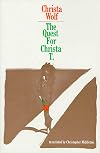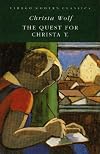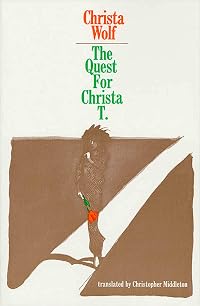
The Quest for Christa T.
by Christa Wolf
On This Page
Description
Christa is a young girl in Hitler's Germany; she survives to embrace the new order but her idealism withers as crass materialists corrode its dream. Her story is the story of a whole generation, and a celebration of the unique value of each human being and all human life.Tags
Recommendations














Member Recommendations

Member Reviews
"Every system has its logic, once you've accepted its premises, don’t you find?"
This was a difficult read, it required relatively more concentration than usual and one or two sentences hastily read forced me to go back. A story that is meant to piece together a dead friend and bring to life her story through fragments of her writing and memories of friends.
The second world war is nearly ending as we meet two German girls, our unnamed narrator and Christa T. Christa T. is the new girl in school that stands out for her refusal to blend in and refuses to automatically follow the path laid out. Our unnamed narrator is drawn to her despite initial efforts to be indifferent to the new girl. Years pass, the friends lose touch and find each show more other by chance in university.
After the war has ended those who've survived the war have to reinvent themselves, remake is the specific word the writer uses. Their system, specifically their school system in this book, had made them unquestionably loyal to a government and system that committed horrors. And so this generation going into adulthood becomes rigid with responsibility, and yet Christa T. still struggles to find her self, "a coming into herself", and thrive amidst a collective sense of duty.
"Nothing is so difficult as turning one's attention to things as they really are, to events as they really occur, after one has spent a long time not doing so and has mistaken their reflection in wishes, beliefs, and judgements for things and events themselves. Christa T. realized that we all had to accept a share in the mistakes we'd made, otherwise we'd have no shares in the truth."
As the narrator works to shape the life of Christa T. we're led to an examination of life, responsibility, individuality, art, work, illness, friendship, accomplishment and failure. show less
This was a difficult read, it required relatively more concentration than usual and one or two sentences hastily read forced me to go back. A story that is meant to piece together a dead friend and bring to life her story through fragments of her writing and memories of friends.
The second world war is nearly ending as we meet two German girls, our unnamed narrator and Christa T. Christa T. is the new girl in school that stands out for her refusal to blend in and refuses to automatically follow the path laid out. Our unnamed narrator is drawn to her despite initial efforts to be indifferent to the new girl. Years pass, the friends lose touch and find each show more other by chance in university.
After the war has ended those who've survived the war have to reinvent themselves, remake is the specific word the writer uses. Their system, specifically their school system in this book, had made them unquestionably loyal to a government and system that committed horrors. And so this generation going into adulthood becomes rigid with responsibility, and yet Christa T. still struggles to find her self, "a coming into herself", and thrive amidst a collective sense of duty.
"Nothing is so difficult as turning one's attention to things as they really are, to events as they really occur, after one has spent a long time not doing so and has mistaken their reflection in wishes, beliefs, and judgements for things and events themselves. Christa T. realized that we all had to accept a share in the mistakes we'd made, otherwise we'd have no shares in the truth."
As the narrator works to shape the life of Christa T. we're led to an examination of life, responsibility, individuality, art, work, illness, friendship, accomplishment and failure. show less
I have found The Quest for Christa T a difficult book to review, it’s a delicately nuanced, complex novel, and the writing is very beautiful. It is a multi-layered novel, at times it is really quite difficult, but the reader is rewarded for their concentration. Ultimately I was left with a tantalising jumble of images; village school rooms, German countryside, sick rooms and trains.
Christa Wolf was one of the best known novelists to emerge from East Germany. Born in 1929 Wolf went on to be awarded a host of international awards throughout her writing career, The Quest for Christa T. was her second published novel.
“Then she began to blow, or to shout, there’s no proper word for it. It was this I reminded her of, or wanted to, in show more my last letter, but she wasn’t reading any more letters, she was dying. She was always tall, and thin, until the last years, after she’d had the children. So there she was, walking along in front, stalking head-in-air along the curb, and suddenly she put a rolled up newspaper to her mouth and let go with her shout: HOOOHAAHOOO –something like that. She blew her trumpet and the off duty sergeants and corporals of the local defense corps stopped and stared and shook their heads at her. Well, she’s cuckoo, that’s for sure. Now you see what she can be like, one of the other girls said to me.”
Our unnamed narrator becomes somewhat fascinated and inexplicably drawn to Christa T. when they are both still school girls. In the street one day, toward the end of the Second World War, Christa T. puts a rolled up newspaper to her mouth, trumpet like – and yells through it – it is an action which seems to speak particularly of Christa T’s spirit, her independence and slight daring. For our narrator this moment – one she returns to again and again in retrospect – heralds the start of their friendship, and ultimately the “quest” to understand Christa. This friendship is interrupted when Christa’s family leave the area during an evacuation in 1945. It is seven years before our narrator sees Christa again in a university classroom.
Christa’s story is told in retrospect, the structure of this novel is non-linear, and the story of the seven missing years and those that follow weave in and out of each other. In a sense, Christa’s story is a simple enough one, toward the end of the war two young girls meet, are separated, meet again some years later, living in a part of Germany under soviet control. Christa attends university, works as a village school teacher, has men fall in love with her, eventually she marries has children, moves to a new home, and dies of Leukaemia when only in her thirties. Yet there is something quite different in the telling of this story, part of which is told by our narrator through the scraps of words left behind, the notes, stories and letters, left behind by Christa, and examined and quoted by her friend as she tries to understand Christa now that she is gone.
“The quest for her: in the thought of her. And of the attempt to be oneself. She speaks of this in her diaries, which we have, on the loose manuscript pages that have been found, and between the lines of those letters of her that are known to me. I must forget my memory of Christa T. – that is what these documents have taught me. Memory puts a deceptive colour on things”
Yet Christa T. remains really rather elusive, throughout this brilliant novel, she is something of a shadow, someone who is both fascinating while remaining difficult to get a handle on. As our narrator moves back and forth telling the story of herself and Christa in her own disjointed fashion, we catch glimpses of the people, places and events in a life cut tragically short. This is the story of a search for the truth of a person, but it also helps to remind us of the difficult, new world of East Germany that the author herself was living in. The Quest for Christa T. however isn’t an obviously political novel, although it is tempting to look for clues to the author’s own political leanings, a woman who watched by the Stasi for thirty years, actually opposed the reunification of Germany.
The narrative is often obscure – for example in the references to the times in which these women live – Christa and her husband visit a cousin on the “other side”. Initially both women appear happy with their way of life, while embracing the new order of their world; they seem to reject the values of the west. Yet the book also speaks of the dangers of totalitarianism – as Christa T. appears to be destroyed; her desire for the new home by the lake that she and her husband are building at odds with the Soviet ideal.
witmonthThis novel is about a friendship, but more than that it is about the truth, the search for truth, and memory and how memory can sometimes let us down. Sometimes we have to readjust our memories of people in what we learn of them later, memory can be false or inaccurate.
I have already said that the writing is beautiful, and it is, and hats off to the translator of this novel – whose poetic, elusive prose suits perfectly the unique narrative. There were moments when the elusive, obscurity of the novel frustrated me a little (I am sure this is a novel which is improved upon with subsequent reading) – but I think the reader has to just go with it, allow the language and the images to envelop you without trying too hard to work out what exactly is going on. show less
Christa Wolf was one of the best known novelists to emerge from East Germany. Born in 1929 Wolf went on to be awarded a host of international awards throughout her writing career, The Quest for Christa T. was her second published novel.
“Then she began to blow, or to shout, there’s no proper word for it. It was this I reminded her of, or wanted to, in show more my last letter, but she wasn’t reading any more letters, she was dying. She was always tall, and thin, until the last years, after she’d had the children. So there she was, walking along in front, stalking head-in-air along the curb, and suddenly she put a rolled up newspaper to her mouth and let go with her shout: HOOOHAAHOOO –something like that. She blew her trumpet and the off duty sergeants and corporals of the local defense corps stopped and stared and shook their heads at her. Well, she’s cuckoo, that’s for sure. Now you see what she can be like, one of the other girls said to me.”
Our unnamed narrator becomes somewhat fascinated and inexplicably drawn to Christa T. when they are both still school girls. In the street one day, toward the end of the Second World War, Christa T. puts a rolled up newspaper to her mouth, trumpet like – and yells through it – it is an action which seems to speak particularly of Christa T’s spirit, her independence and slight daring. For our narrator this moment – one she returns to again and again in retrospect – heralds the start of their friendship, and ultimately the “quest” to understand Christa. This friendship is interrupted when Christa’s family leave the area during an evacuation in 1945. It is seven years before our narrator sees Christa again in a university classroom.
Christa’s story is told in retrospect, the structure of this novel is non-linear, and the story of the seven missing years and those that follow weave in and out of each other. In a sense, Christa’s story is a simple enough one, toward the end of the war two young girls meet, are separated, meet again some years later, living in a part of Germany under soviet control. Christa attends university, works as a village school teacher, has men fall in love with her, eventually she marries has children, moves to a new home, and dies of Leukaemia when only in her thirties. Yet there is something quite different in the telling of this story, part of which is told by our narrator through the scraps of words left behind, the notes, stories and letters, left behind by Christa, and examined and quoted by her friend as she tries to understand Christa now that she is gone.
“The quest for her: in the thought of her. And of the attempt to be oneself. She speaks of this in her diaries, which we have, on the loose manuscript pages that have been found, and between the lines of those letters of her that are known to me. I must forget my memory of Christa T. – that is what these documents have taught me. Memory puts a deceptive colour on things”
Yet Christa T. remains really rather elusive, throughout this brilliant novel, she is something of a shadow, someone who is both fascinating while remaining difficult to get a handle on. As our narrator moves back and forth telling the story of herself and Christa in her own disjointed fashion, we catch glimpses of the people, places and events in a life cut tragically short. This is the story of a search for the truth of a person, but it also helps to remind us of the difficult, new world of East Germany that the author herself was living in. The Quest for Christa T. however isn’t an obviously political novel, although it is tempting to look for clues to the author’s own political leanings, a woman who watched by the Stasi for thirty years, actually opposed the reunification of Germany.
The narrative is often obscure – for example in the references to the times in which these women live – Christa and her husband visit a cousin on the “other side”. Initially both women appear happy with their way of life, while embracing the new order of their world; they seem to reject the values of the west. Yet the book also speaks of the dangers of totalitarianism – as Christa T. appears to be destroyed; her desire for the new home by the lake that she and her husband are building at odds with the Soviet ideal.
witmonthThis novel is about a friendship, but more than that it is about the truth, the search for truth, and memory and how memory can sometimes let us down. Sometimes we have to readjust our memories of people in what we learn of them later, memory can be false or inaccurate.
I have already said that the writing is beautiful, and it is, and hats off to the translator of this novel – whose poetic, elusive prose suits perfectly the unique narrative. There were moments when the elusive, obscurity of the novel frustrated me a little (I am sure this is a novel which is improved upon with subsequent reading) – but I think the reader has to just go with it, allow the language and the images to envelop you without trying too hard to work out what exactly is going on. show less
I'm pretty sure that Christa Wolf is incapable of producing a bad book. This one was fantastic in its exploration of keeping memory and people honest, struggling against nostalgic distortions, and trying to get at the truth of larger matters, all while fighting never to lose sight of The Human in general.
I stumbled across this in a charity shop, and since Wolf was a name I’d come across in my search for postwar British women writers (even though she’s German), I decide to buy it. Besides, you just don’t see enough of those green Virago paperbacks in charity shops. The title character and the narrator meet while at school during World War II. They go their separate ways, but meet up again at university in the early nineteen-fifties. The book then follow them through to the nineteen-sixties. It all takes place in East Germany. The story is phrased as a commentary on Christa T by the narrator, almost as if she’s telling it to someone. It’s a style that takes some getting used to, especially in these times of immersive prose; and show more although it’s considered “experimental” I have to wonder if it’s not how stories were originally told before the advent of the realist novel. I can’t say I’ll be hunting down any more of Wolf’s work – although I’ll keep an eye open for green Virago paperbacks, of course – but I’m glad I read The Quest For Christa T.. show less
The best book I have read in a long while. Perhaps a bit too melancholic at times, what Wolf does with language and story arc is mesmerizing. I don;t need to say more.
To some, the way it is written may be inaccessible. This book requires focus, attention, and an understanding that you have to let go of understanding everything right away, that things will be revealed in good time. (That said, I read it during my commute in the subway, so certainly not too hard to understand or read by any means.)
Recommended to those who like to contemplate life, existence, and death.
To some, the way it is written may be inaccessible. This book requires focus, attention, and an understanding that you have to let go of understanding everything right away, that things will be revealed in good time. (That said, I read it during my commute in the subway, so certainly not too hard to understand or read by any means.)
Recommended to those who like to contemplate life, existence, and death.
don't know what to say. interesting but i couldn't focus or remember very well. what is she driving at? does it all mean something else? isn't this supposed to be one of her best books? look at the ratings!
I guess at my age, it's inevitable that you'll know you read a book in college but forget every single other thing about it. This is one of those.
Members
- Recently Added By
Lists

1001 Books You Must Read Before You Die
1,448 works; 1,135 members

David Bowie's Top 100
97 works; 23 members

German Literature
518 works; 56 members
1,001 BYMRBYD Concensus
723 works; 27 members

Books Read in 2016
4,666 works; 197 members
David Bowie's List of Top 100 Books
94 works; 6 members

Around the World in 80 Books
79 works; 4 members

Best Sellers / Popular 1968
237 works; 5 members
David Bowie’s Top 100 Favourite Reads
100 works; 3 members
Author Information

115+ Works 5,641 Members
Christa Wolf was born on March 18, 1929, in Landsberg, which is now Gorzow, Poland. Her father joined the Nazi Party and she became a member of the girls' version of the Hitler Youth. In 1949, she joined the Socialist Unity Party and studied German literature at universities in Jena and Leipzig. She wrote numerous novels during her lifetime show more including The Divided Heaven, The Quest for Christa T., A Model Childhood, and Cassandra. She won several awards including the Heinrich Mann Prize in 1963 and Thomas Mann Prize for literature in 2010. She died on December 1, 2011 at the age of 82. (Bowker Author Biography) show less
Some Editions
Awards and Honors
Notable Lists
Series
Belongs to Publisher Series
Common Knowledge
- Canonical title
- The Quest for Christa T.
- Original title
- Nachdenken über Christa T.
- Original publication date
- 1968; 1970 (English trans.) (English trans.)
- People/Characters
- Christa T.
- Important places
- German Democratic Republic
- Epigraph
- This coming-to-oneself - what is it?
Johannes R. Becher - First words*
- Nachdenken, ihr nach - denken.
- Last words*
- (Click to show. Warning: May contain spoilers.)Wann, wenn nicht jetzt?
- Blurbers
- Webb, W L
- Original language
- German
*Some information comes from Common Knowledge in other languages. Click "Edit" for more information.
Classifications
Statistics
- Members
- 666
- Popularity
- 43,344
- Reviews
- 11
- Rating
- (3.58)
- Languages
- 13 — Danish, Dutch, English, Finnish, French, German, Hungarian, Italian, Polish, Portuguese (Brazil), Russian, Slovenian, Spanish
- Media
- Paper, Audiobook, Ebook
- ISBNs
- 36
- ASINs
- 13