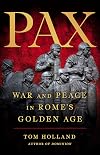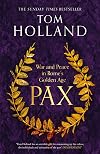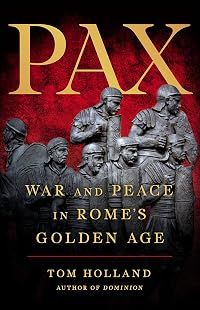
Pax: War and Peace in Rome's Golden Age
by Tom Holland
On This Page
Description
"Beginning in 69AD, the so-called Year of the Four Emperors and spanning to 138AD, the death of Hadrian, Pax presents a narrative history of Rome at the height of its power. From the gilded capital to the barbarous realms beyond the frontier, historian Tom Holland offers a tour of the most famous episodes in Roman history"--Tags
Recommendations








Member Reviews
August 2024: I've just finished Tom Holland's latest book, Pax, subtitled War and Peace in Rome's Golden Age which covers the period from the demise of Nero through the subsequent year of four emperors (69) and on through to the end of the reign of Hadrian (138). It's a general history and so he presents the most interesting bits. I was surprised to see no mention of Domitian's persectuion of the Christians. Otherwise there are plenty of historical sidelights for anyone interested in the New Testament and early church history. Tom Holland writes quite well and this is an easy way to catch up on Roman history you may have missed. Understandably there are details that are quite coarse and debauched but these are handled fairly well. He show more also goes some way to explaining what the Pax Romana was. show less
Ancient Roman "peace" involved a lot of violence: intermittent territorial rebellions as well as the regularly occurring phenomena of slavery, gladiator/animal fight shows, and domestic violence. The author seems to relish the complexities of warfare, which hold no appeal for me. I do, however, appreciate his assertion that the conditions of peace and prosperity ensured that "even the most flyblown settlement might boast a library."
A fairly tough read, not least because of the complexity of the changes in the early period. Unsurprisingly, 69 AD - the year of four emperors - is complicated to read, Holland gives a sense of how chaotic it must have been to live through.
Many fascinating insights into famous events - Pompeii in particular. Trajan and Hadrian make for a grand finale to the book.
If I had noticed/read the appended timeline at the start, it may have helped.
Many fascinating insights into famous events - Pompeii in particular. Trajan and Hadrian make for a grand finale to the book.
If I had noticed/read the appended timeline at the start, it may have helped.
Excellent. Description of Vesuvius overwhelming Herculaneum and Pompeii is masterly. Mainly from th PoV of the 2 Plinys. Overall gives a good sens of numerous emperors of whose names are familiar enough but I didn't really know their stories ( Domitian Trajan Hadrian, even Nero who tends just to be a caricature and is mainly in the previuous volume)
I acquired this book while in holiday in Italy. Accordingly it was good to read another book of roman history set in a truly transformative period of the Roman Empire during the fractuous Year of The Four Emperors to the beginning of the commencement of the tenure of the Five Great Emperors; Nerva, Trajan, Hadrian, Antonius Pius and Marcus Aurelius. The book borrows a lot from the writings of Livy but is very discursive ang provides the reader (even unknowledgeable ones about Roman history of the period) of excellent maps showing the growth of the extent of the Empire throughout their tenure and how important and critical military might and control of the populace and the economy were central to the expansion of the Empire which was at show more the time an actual optimum currency area using a homogeneous traded and used coinage, law and military system and language, ironically in much of the same territory which then became the Euro Area project.
The fall of the Roman Empire gave way to the Dark Ages so understanding the period of the Five Great Empires, other than on TV or in film, is critical to understanding the true essence of Roman culture and how various monuments across the world have withstood the test of time. show less
The fall of the Roman Empire gave way to the Dark Ages so understanding the period of the Five Great Empires, other than on TV or in film, is critical to understanding the true essence of Roman culture and how various monuments across the world have withstood the test of time. show less
Halfway up the inside of a church tower in central Italy, upside-down, is an epitaph of a ‘T. Flavius Clymenus’. A freedman of the imperial household, a former slave, his middle name indicates who had owned and freed him: one of the ‘Flavian Emperors’, Vespasian, Titus or Domitian, who ruled Rome at the end of the first century. Not far from Antrodoco, where the church of Santa Maria Extra Moenia stands, stood a villa at Cutiliae where Vespasian was in the habit of spending the summer months, and indeed both Vespasian and his elder son Titus died there. This is no doubt where T. Flavius Clymenus had been employed.
Cutiliae was situated in the rural territory east of Rome known as the Sabina. Vespasian himself, with his rustic show more accent and manners, was considered a bit of a country bumpkin, and might seem an improbable emperor from an improbable source. But in the Roman imaginary the Sabina evoked tough and thrifty peasants and solid, old-fashioned values. Tom Holland’s Pax, the third instalment of his Roman trilogy, describes the collapse of the Julio-Claudian dynasty with the assassination of Nero, the civil conflict that followed, the Flavians who emerged from it, and the ‘Spanish Emperors’, Trajan and Hadrian, to whom has been attributed the settled heyday of the Roman Empire, the Pax, ‘peace’, of Holland’s title. A persistent theme is how the various contenders for power presented their credentials to the Romans. In Vespasian’s case, his origins in a part of Italy that might appear a few hundred years behind Rome, appealing in itself, also complemented the blunt, no-nonsense military manner he cultivated. ‘Woe is me, I think I’m becoming a god!’, he joked on his deathbed, while a response to his son Titus when he questioned the propriety of a new tax on toilets has resulted in the French word for a public urinal, vespasienne.
But authenticity could take many forms in Rome. When Vespasian’s second son Domitian succeeded to the throne after Titus’ premature death, having hitherto acted, arguably, like the archetypal spare, his approach was to style himself as censor. This was a time-honoured role in Rome that encompassed not only morals (though he did bury alive a Vestal Virgin convicted of adultery) but also enhancement of the physical city (‘a lunatic desire to build’, as one author described it), and increasing the silver content of the coinage. As well as being an impeccably traditional office, the censorship was an ideal vehicle for an emperor whose talent was micromanagement. Domitian was also an emperor, it is fair to say, who had little time for the polite fiction, maintained since the first emperor Augustus, that any institution other than the army (the Praetorian Guard in Rome and the legions scattered around the Empire) was necessary for establishing and maintaining imperial authority.
Read the rest at HistoryToday.com
Llewelyn Morgan is Professor of Classics at Brasenose College, Oxford. show less
Cutiliae was situated in the rural territory east of Rome known as the Sabina. Vespasian himself, with his rustic show more accent and manners, was considered a bit of a country bumpkin, and might seem an improbable emperor from an improbable source. But in the Roman imaginary the Sabina evoked tough and thrifty peasants and solid, old-fashioned values. Tom Holland’s Pax, the third instalment of his Roman trilogy, describes the collapse of the Julio-Claudian dynasty with the assassination of Nero, the civil conflict that followed, the Flavians who emerged from it, and the ‘Spanish Emperors’, Trajan and Hadrian, to whom has been attributed the settled heyday of the Roman Empire, the Pax, ‘peace’, of Holland’s title. A persistent theme is how the various contenders for power presented their credentials to the Romans. In Vespasian’s case, his origins in a part of Italy that might appear a few hundred years behind Rome, appealing in itself, also complemented the blunt, no-nonsense military manner he cultivated. ‘Woe is me, I think I’m becoming a god!’, he joked on his deathbed, while a response to his son Titus when he questioned the propriety of a new tax on toilets has resulted in the French word for a public urinal, vespasienne.
But authenticity could take many forms in Rome. When Vespasian’s second son Domitian succeeded to the throne after Titus’ premature death, having hitherto acted, arguably, like the archetypal spare, his approach was to style himself as censor. This was a time-honoured role in Rome that encompassed not only morals (though he did bury alive a Vestal Virgin convicted of adultery) but also enhancement of the physical city (‘a lunatic desire to build’, as one author described it), and increasing the silver content of the coinage. As well as being an impeccably traditional office, the censorship was an ideal vehicle for an emperor whose talent was micromanagement. Domitian was also an emperor, it is fair to say, who had little time for the polite fiction, maintained since the first emperor Augustus, that any institution other than the army (the Praetorian Guard in Rome and the legions scattered around the Empire) was necessary for establishing and maintaining imperial authority.
Read the rest at HistoryToday.com
Llewelyn Morgan is Professor of Classics at Brasenose College, Oxford. show less
It’s not you, Tom, it’s me. Your discursive style, the endless loops of speculative references, makes me cry out for some hard facts.
Members
- Recently Added By
Published Reviews
ThingScore 95
"Throughout his meticulous narrative, Holland demonstrates how the stability of the so-called peace was maintained through martial violence both in Rome and abroad. Roman history buffs will want to take a look."
added by bookfitz
"A capably rendered history of Rome’s more-or-less golden age."
added by bookfitz
"Holland’s superb storytelling takes us right into this era as viewed from every standpoint (including our own), offering fresh and vivid insights into well-worn history."
added by bookfitz
Author Information

30+ Works 14,184 Members
Common Knowledge
- Canonical title
- Pax: War and Peace in Rome's Golden Age
- Original title
- Pax: War and Peace in Rome's Golden Age
- Original publication date
- 2023
- People/Characters
- Vespasian; Titus; Domitian; Agricola; Herod the Great; Decebalus (show all 22); Mithridates; Boudica; Marcus Cocceius Nerva; Trajan; Hadrian; Marcus Salvius Otho; Marcus Antonius Primus; Servius Sulpicius Galba; Flavius Josephus; Vitellius; Nero; Poppaea Sabina; Sporus; Mariccus; Pliny the Younger; Suetonius
- Important places
- Rome, Roman Empire; Jerusalem; Sarmizegetusa Regia; Pompeii, Italy
- Important events
- Eruption of Mount Vesuvius
- Dedication
- To Bill Heald:
without whom the writing of this book would have been very much more of a challenge - First words
- In AD 122, the world's most powerful man arrived on the banks of the Tyne.
- Last words
- (Click to show. Warning: May contain spoilers.)It was a soldier in the wilds beyond Palestine, scratching on a rock face, who put it best, perhaps: 'The Romans always win.'
- Blurbers
- Frankopan, Peter; Goldsworthy, Adrian
- Original language
- English
- Canonical LCC
- DG286 .H65 2023
Classifications
- Genres
- History, General Nonfiction, Nonfiction
- DDC/MDS
- 937.07 — History & geography History of ancient world (to ca. 499) Italian Peninsula to 476 and adjacent territories to 476 Constitutional 31 B.C.-284 A.D.
- LCC
- DG286 .H65 — History of Europe, Asia, Africa and Oceania City History of Italy Ancient Italy. Rome to 476 History By period Empire, 27 B.C. - 476 A.D. Constitutional Empire, 27 B.C. - 284 A.D.
- BISAC
Statistics
- Members
- 476
- Popularity
- 63,994
- Reviews
- 9
- Rating
- (3.83)
- Languages
- 6 — Danish, Dutch, English, German, Polish, Spanish
- Media
- Paper, Audiobook, Ebook
- ISBNs
- 15
- ASINs
- 7