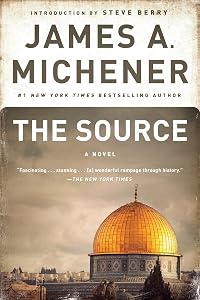
The Source
by James A. Michener
On This Page
Description
HTML:In his signature style of grand storytelling, James A. Michener transports us back thousands of years to the Holy Land. Through the discoveries of modern archaeologists excavating the site of Tell Makor, Michener vividly re-creates life in an ancient city and traces the profound history of the Jewish people—from the persecution of the early Hebrews, the rise of Christianity, and the Crusades to the founding of Israel and the modern conflict in the Middle East. An epic tale of love, show more strength, and faith, The Source is a richly written saga that encompasses the history of Western civilization and the great religious and cultural ideas that have shaped our world.BONUS: This edition includes an excerpt from James A. Michener's Hawaii.
Praise for The Source
“Fascinating . . . stunning . . . [a] wonderful rampage through history . . . Biblical history, as seen through the eyes of a professor who is puzzled, appalled, delighted, enriched and impoverished by the spectacle of a land where all men are archeologists.”—The New York Times
“A sweeping [novel] filled with excitement—pagan ritual, the clash of armies, ancient and modern: the evolving drama of man’s faith.”—The Philadelphia Inquirer
“Magnificent . . . a superlative piece of writing both in scope and technique . . . one of the great books of this generation.”—San Francisco Call Bulletin. Historical Fiction. Literature. Fiction. show less
Tags
Recommendations






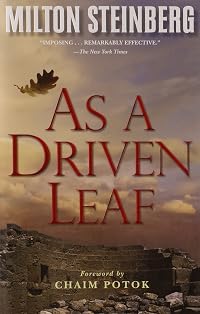
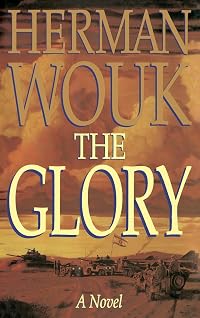


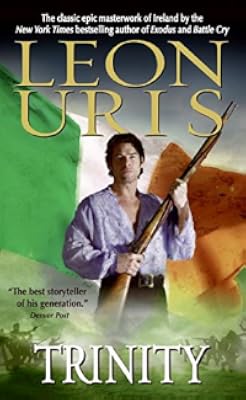


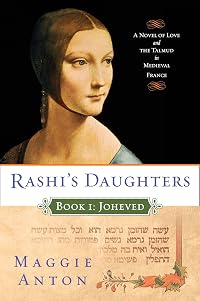











Member Recommendations

karatelpek Epic and in-depth look at another key region of the world and world culture.
20
Member Reviews
How do you write a historical fiction novel about the Holy Land that is fair to the diverse and often clashing histories of Jews, Christian, Muslims and atheists alike? Perhaps it takes Michener's historical style of leaping forward by decades or centuries between chapters, presenting sequential scenes that relate to one another in place and maybe in ancestry but never overlapping in time. It's still an uneven reading experience in some transitions (e.g. first a rationalizing of the basis for religion, then in the next chapter God's voice issuing from a bush) but acceptable in its recognition of these multiple faiths' multiple truths.
Michener is utterly fearless with his material, plunging into the backgrounds and history of one show more religion after another, but this is predominately the story of the Jewish people. As a consequence, you might say, the atmosphere leans toward oppressive tragedy. Terrible, horrifying things happen to good people over and over, no matter what century it is or what god they worship. If I'd not read a lot of Michener already I'd suspect him of overindulging in this aspect, but even with his detailed asides about Jewish persecutions in Spain, Germany, etc. I believe he is only bearing witness to history that deserves to be highlighted. It does all link back to his story, demonstrating the tenaciousness with which Judaism has clung to its existence.
I love the concept behind the framing story, an archeological dig that unearths all of the layers before touring us through them from bottom up. It is the perfect choice for a massive journey-through-the-ages tome spanning literally thousands of years. Unfortunately, the framing story also contains the novel's worst feature. The attitude towards women in the "present day" (1960s) episodes will make your toes curl. It's only made palatable when viewed as just another layer of history. Sixty years and counting later, what was first-hand sentiment for the author has become only sediment.
For this novel's scope, the depth of research behind it (he must have had sensitivity readers before that was a thing), effort at fairness (I can't find anyone on the Internet up in arms about this novel, which is kind of surprising), its careful analysis of opposing viewpoints both within and between faiths, the heart-rending drama that rivals Game of Thrones (I imagine Michener saying, "you thought that last chapter was cruel, wait'll you read this episode"), the historical analysis ... warts, wars and all, it gets a perfect score from me. show less
Michener is utterly fearless with his material, plunging into the backgrounds and history of one show more religion after another, but this is predominately the story of the Jewish people. As a consequence, you might say, the atmosphere leans toward oppressive tragedy. Terrible, horrifying things happen to good people over and over, no matter what century it is or what god they worship. If I'd not read a lot of Michener already I'd suspect him of overindulging in this aspect, but even with his detailed asides about Jewish persecutions in Spain, Germany, etc. I believe he is only bearing witness to history that deserves to be highlighted. It does all link back to his story, demonstrating the tenaciousness with which Judaism has clung to its existence.
I love the concept behind the framing story, an archeological dig that unearths all of the layers before touring us through them from bottom up. It is the perfect choice for a massive journey-through-the-ages tome spanning literally thousands of years. Unfortunately, the framing story also contains the novel's worst feature. The attitude towards women in the "present day" (1960s) episodes will make your toes curl. It's only made palatable when viewed as just another layer of history. Sixty years and counting later, what was first-hand sentiment for the author has become only sediment.
For this novel's scope, the depth of research behind it (he must have had sensitivity readers before that was a thing), effort at fairness (I can't find anyone on the Internet up in arms about this novel, which is kind of surprising), its careful analysis of opposing viewpoints both within and between faiths, the heart-rending drama that rivals Game of Thrones (I imagine Michener saying, "you thought that last chapter was cruel, wait'll you read this episode"), the historical analysis ... warts, wars and all, it gets a perfect score from me. show less
In the introduction to the 2013 reprint of James Michener’s The Source, Steve Berry (an author himself), explains why he’s grateful that Michener wrote most of his novels before the Internet age narrowed our collective interest in “thousand-page epics” involving “hundreds of characters.” Essentially, Berry is suggesting that today’s conditions don’t allow writers to make ‘em like they used to.
But after my second read of The Source, I think it’s fair to ask how many authors ever crafted fiction like Michener.
Many of his works were generational tales that featured a place—like Hawaii or South Africa—and worked through its chronology by loosely following a single family’s evolution through the centuries. show more Characters came and went, starring in their own novella-length chapter before fading into memory; rather than focusing on a single protagonist, Michener foregrounded a region’s history. His scope was immense.
But one of the reasons I like The Source so much is that it starts by setting up a frame story: in 1964, an international team of archaeologists begin excavating the “tell” of Makor, a mound that marks a former node of civilization in the Middle East. The tell is barren, but its seventy-one-foot height represents “the patiently accumulated residue of one abandoned settlement after another, each resting upon the ruins of its predecessor.” The team takes two cross-sections of this cultural lineage by digging a pair of trenches and identifying fifteen layers of interest, the first stretching to prehistoric times and the last dating to the 1948 Arab-Israeli War. In each layer, the archaeologists unearth an artifact that speaks to some of the corresponding era’s ideas and conflicts.
With that narrative scaffolding in place, Michener rewinds to Makor’s origins and proceeds in his usual sequential style, giving us the story behind each artifact and its appearance at the tell—an exploration that also suggests how the settlement’s fortunes (and by extension, those of the larger area) waxed and waned with the flow of time. But the archaeologists still have a role to play. Many of the flashbacks are interspersed with the excavators’ debates, conversations that Michener uses to surface key issues. For example, at one point, the leader of the dig reflects on “the struggles [another archaeologist] had summarized: Egypt versus Babylonia; Greece crashing against Persia; Rome vanquishing the east; Crusader fighting infidel; and finally Jew battling Arab. ‘All right,’ he conceded, ‘this is where violence met violence. What am I supposed to conclude?’”
Michener offers a number of theories, many of them about religion. In the first few chapters, he proposes that early humans’ adoption of agriculture initiated a spiritual transition. As hunter-gatherers, they’d likely conceived of the metaphysical in terms of an “I-It” relationship, with people representing the “I” while the forces of nature (wind, fire, etc.) represented a collective, impersonal “It.” But once men and women turned to farming and became reliant on regular rainfall to nourish their crops, they may have tried to articulate a more intimate connection in times of need, such as instances of flood or drought. “This,” Michener speculates at one point, “was the first fumbling effort to evoke the I-You relationship—‘I am begging You, my partner, for mercy’—under which society would henceforth live, until the multitude of gods would become more real than sentient human beings.”
From there, Michener illustrates a potential progression from polytheism to monotheism by centering the Jewish experience. (Characters nearer the beginning of the book’s timeline worship deities like Melak, Baal, and Astarte; characters in the latter chapters follow “various Els—the Elohims, the Elyons and the El-Shaddais” which eventually are “happily merged into the great successor,” i.e., Yahweh, or God.) Michener also relates—in often horrific detail—how the Hebrew peoples were persecuted through the ages. Makor is periodically “stripped of Jews” as various conquerors enslave or slaughter those who refuse to bend the knee. Some portions of the book range further afield and describe how European countries heaped additional indignities on their Jewish inhabitants, including forcing them to live in ghettos and participate in competitions that demeaned their faith.
But one of The Source’s most overt themes is that the Jewish faith survived because of the rigid strictures it developed. Several chapters repeat this argument in various forms, including a passage midway through the novel that depicts a group of rabbis engaged in the formative debates that would give rise to the text known as the Talmud. “… what the rabbis were doing, in part consciously and in part unconsciously, was to create a body of law that would bind the Jews together as they went into exile to the Diaspora. Without a homeland the Jews would live within their law and become a nation mightier than those which had oppressed them.”
Yet as much as Michener seems to respect this resilience, he doesn’t lionize its source. Other chapters key on the often-unjust applications of the Talmud’s many rules. One boy is denied access to the Jewish congregation because he was born a bastard; a widow is told she must marry her rapist because tradition demands it. Many characters acknowledge the absurdity of these judgments, but few reject them outright. “I’m a Jew,” one says near the end of The Source, “and I come from a most ancient people with most ancient laws.” Michener’s contention seems to be that this history is both Judaism’s enduring strength and a built-in constraint that prevented the religion from cultivating the wider audience of its primary successors (Christianity and Islam).
I can’t speak to the scholarship behind all this, although I imagine some of it (inevitably) hasn’t aged well since Michener published The Source in 1965. The book definitely feels like an artifact in other ways, though. The point-of-view characters skew male, their female counterparts are almost always described in terms of the shapeliness of their figures, and the only woman among the senior archaeologists is generally treated as a prize to be won. (Although to be fair, Michener toys with some of this sexism by having one of his male archaeologists assume it must have been a man who “first brought wheat into cultivation” and tamed “a wild dog,” while in the accompanying flashback, The Source shows these seminal acts being carried out by a woman. Here, Michener is acknowledging his character’s male gaze; elsewhere, he seems unaware of his own.)
But I enjoyed how the frame story ties everything together. Two of the archaeologists are Jewish and one is Muslim. All of them fought in the Arab-Israeli War, living out the historic tensions explored in earlier chapters. One of these characters is also a distant relative of the first flashback’s cave-dwelling protagonist. These throughlines give the interludes at the excavation an additional weight; of the many stories in The Source, those that take place during the dig are my favorite.
Michener is also clear-eyed about the obstacles facing modern Israel, particularly its internal conflicts. “Israel’s custodianship of people, of human rights, is going to be spectacular,” one of the Jewish archaeologists proclaims during an after-hours conversation. “I want a state which preaches morality to practice it,” the Muslim archaeologist counters in another. In the latter exchange, they’re discussing whether and how to welcome back Palestinian Arab refugees who fled during the fighting in 1948. Present-day corollaries include the ongoing Israeli blockade of the Gaza Strip and the resulting human rights crisis.
Michener doesn’t offer any quick fixes. But if he were alive today—and his publisher ignored prevailing trends toward brevity and approved an even longer version of The Source—I’d love to read an extra chapter or two that extended the book’s analysis into the 21rst century. That’d likely swell the page count to 1,600 or more, making for the type of sweeping epic only Michener could write. But the current version already stands at a towering 1,400 pages; like many of the other novels in his bibliography, The Source is a remarkable—and practically inimitable—work of historical fiction.
(For more reviews like this one, visit www.nickwisseman.com) show less
But after my second read of The Source, I think it’s fair to ask how many authors ever crafted fiction like Michener.
Many of his works were generational tales that featured a place—like Hawaii or South Africa—and worked through its chronology by loosely following a single family’s evolution through the centuries. show more Characters came and went, starring in their own novella-length chapter before fading into memory; rather than focusing on a single protagonist, Michener foregrounded a region’s history. His scope was immense.
But one of the reasons I like The Source so much is that it starts by setting up a frame story: in 1964, an international team of archaeologists begin excavating the “tell” of Makor, a mound that marks a former node of civilization in the Middle East. The tell is barren, but its seventy-one-foot height represents “the patiently accumulated residue of one abandoned settlement after another, each resting upon the ruins of its predecessor.” The team takes two cross-sections of this cultural lineage by digging a pair of trenches and identifying fifteen layers of interest, the first stretching to prehistoric times and the last dating to the 1948 Arab-Israeli War. In each layer, the archaeologists unearth an artifact that speaks to some of the corresponding era’s ideas and conflicts.
With that narrative scaffolding in place, Michener rewinds to Makor’s origins and proceeds in his usual sequential style, giving us the story behind each artifact and its appearance at the tell—an exploration that also suggests how the settlement’s fortunes (and by extension, those of the larger area) waxed and waned with the flow of time. But the archaeologists still have a role to play. Many of the flashbacks are interspersed with the excavators’ debates, conversations that Michener uses to surface key issues. For example, at one point, the leader of the dig reflects on “the struggles [another archaeologist] had summarized: Egypt versus Babylonia; Greece crashing against Persia; Rome vanquishing the east; Crusader fighting infidel; and finally Jew battling Arab. ‘All right,’ he conceded, ‘this is where violence met violence. What am I supposed to conclude?’”
Michener offers a number of theories, many of them about religion. In the first few chapters, he proposes that early humans’ adoption of agriculture initiated a spiritual transition. As hunter-gatherers, they’d likely conceived of the metaphysical in terms of an “I-It” relationship, with people representing the “I” while the forces of nature (wind, fire, etc.) represented a collective, impersonal “It.” But once men and women turned to farming and became reliant on regular rainfall to nourish their crops, they may have tried to articulate a more intimate connection in times of need, such as instances of flood or drought. “This,” Michener speculates at one point, “was the first fumbling effort to evoke the I-You relationship—‘I am begging You, my partner, for mercy’—under which society would henceforth live, until the multitude of gods would become more real than sentient human beings.”
From there, Michener illustrates a potential progression from polytheism to monotheism by centering the Jewish experience. (Characters nearer the beginning of the book’s timeline worship deities like Melak, Baal, and Astarte; characters in the latter chapters follow “various Els—the Elohims, the Elyons and the El-Shaddais” which eventually are “happily merged into the great successor,” i.e., Yahweh, or God.) Michener also relates—in often horrific detail—how the Hebrew peoples were persecuted through the ages. Makor is periodically “stripped of Jews” as various conquerors enslave or slaughter those who refuse to bend the knee. Some portions of the book range further afield and describe how European countries heaped additional indignities on their Jewish inhabitants, including forcing them to live in ghettos and participate in competitions that demeaned their faith.
But one of The Source’s most overt themes is that the Jewish faith survived because of the rigid strictures it developed. Several chapters repeat this argument in various forms, including a passage midway through the novel that depicts a group of rabbis engaged in the formative debates that would give rise to the text known as the Talmud. “… what the rabbis were doing, in part consciously and in part unconsciously, was to create a body of law that would bind the Jews together as they went into exile to the Diaspora. Without a homeland the Jews would live within their law and become a nation mightier than those which had oppressed them.”
Yet as much as Michener seems to respect this resilience, he doesn’t lionize its source. Other chapters key on the often-unjust applications of the Talmud’s many rules. One boy is denied access to the Jewish congregation because he was born a bastard; a widow is told she must marry her rapist because tradition demands it. Many characters acknowledge the absurdity of these judgments, but few reject them outright. “I’m a Jew,” one says near the end of The Source, “and I come from a most ancient people with most ancient laws.” Michener’s contention seems to be that this history is both Judaism’s enduring strength and a built-in constraint that prevented the religion from cultivating the wider audience of its primary successors (Christianity and Islam).
I can’t speak to the scholarship behind all this, although I imagine some of it (inevitably) hasn’t aged well since Michener published The Source in 1965. The book definitely feels like an artifact in other ways, though. The point-of-view characters skew male, their female counterparts are almost always described in terms of the shapeliness of their figures, and the only woman among the senior archaeologists is generally treated as a prize to be won. (Although to be fair, Michener toys with some of this sexism by having one of his male archaeologists assume it must have been a man who “first brought wheat into cultivation” and tamed “a wild dog,” while in the accompanying flashback, The Source shows these seminal acts being carried out by a woman. Here, Michener is acknowledging his character’s male gaze; elsewhere, he seems unaware of his own.)
But I enjoyed how the frame story ties everything together. Two of the archaeologists are Jewish and one is Muslim. All of them fought in the Arab-Israeli War, living out the historic tensions explored in earlier chapters. One of these characters is also a distant relative of the first flashback’s cave-dwelling protagonist. These throughlines give the interludes at the excavation an additional weight; of the many stories in The Source, those that take place during the dig are my favorite.
Michener is also clear-eyed about the obstacles facing modern Israel, particularly its internal conflicts. “Israel’s custodianship of people, of human rights, is going to be spectacular,” one of the Jewish archaeologists proclaims during an after-hours conversation. “I want a state which preaches morality to practice it,” the Muslim archaeologist counters in another. In the latter exchange, they’re discussing whether and how to welcome back Palestinian Arab refugees who fled during the fighting in 1948. Present-day corollaries include the ongoing Israeli blockade of the Gaza Strip and the resulting human rights crisis.
Michener doesn’t offer any quick fixes. But if he were alive today—and his publisher ignored prevailing trends toward brevity and approved an even longer version of The Source—I’d love to read an extra chapter or two that extended the book’s analysis into the 21rst century. That’d likely swell the page count to 1,600 or more, making for the type of sweeping epic only Michener could write. But the current version already stands at a towering 1,400 pages; like many of the other novels in his bibliography, The Source is a remarkable—and practically inimitable—work of historical fiction.
(For more reviews like this one, visit www.nickwisseman.com) show less
On a book about a topic this massive and complicated, it is hard to know where to begin. I’ll just say that Michener’s legendary research skills are on full display and he manages to tell a history through the stories of some truly interesting, frustrating, lovable, and despicable people. The last chapter, on The Tell was immensely satisfying as a microcosm and outcome of the complicated historical, religious, political, economic, and social threads that the previous 1000 pages of the book separated out and then followed as they wove together.
Once I got to the 2nd chapter I was turned off. The people were described as if they were Neanderthals. Perhaps believable if it was set a million years ago. This set just a few thousand years ago and current research indicates that people have hardly changed at all in physique or intelligence over that period. All very patronising.
Well, I started reading this on March 17, 2006, and I finished it today. Overall, it was a great book - lots of history, and a great view into the live of one town. I enjoyed the snapshots of Makor during the various eras - they were very colourful.
One of the problems that I have with this kind of book is becoming vested in the families that are central to the area. Its always hard to follow who is from what family, and to get to care about them. I didn't feel any emotional connection to the characters. I also could have done without the many theological discussions, although I understand the relevance when talking about Israel and its history.
One of the problems that I have with this kind of book is becoming vested in the families that are central to the area. Its always hard to follow who is from what family, and to get to care about them. I didn't feel any emotional connection to the characters. I also could have done without the many theological discussions, although I understand the relevance when talking about Israel and its history.
i seriously love the idea behind this. what a great way to explore a history - pick a spot in a land known to have been populated for tens of thousands of years, create a large hill there with resources to make it attractive for farming/living/fortressing, and in modern times bring over an archaeologist to discover the narrative of the land and the people who were there throughout history. fascinating.
michener takes us back about 12000 years and through examples of what life was like in 15 different time periods in this fictional spot in what is now northern israel. he speculates about the birth of religion (the entire book is even more a narrative of how religion developed throughout history) and how people lived in each of those time show more periods. i love reading about the development of human existence and how things were or could have been in ancient times.
it's interesting to me that when i last read this book a number of years ago, as a jew, i remember being proud of the way, in general, that he portrayed the jews and the jewish religion. reading it this time, as an atheist, i'm struck by how he often portrays religion as absurd and foolish, while sometimes giving it a credence i wasn't expecting. (for example he writes as fact that people heard the voice of god speaking to them, and takes the story from there.) just goes to show how much of ourselves we bring to the books we read, and how that affects where our focus lays while reading.
i particularly enjoyed the time periods of 9800 bce, 2200 bce, and especially 960 bce. (this last is the only thing i really remembered from my last read.) the more recent periods (herod, the crusades) were also interesting and showed just how many people were massacred in the name of religion. i was also intrigued by the recent time period (1550 ce) where the kabbalah was "revealed." all of the historic periods he visits in this book are engaging, but these more than others, for me.
his current period, 1964, was less so for me. i understand that he had to use it as both the vantage point of history, the way to discuss the history and make sense of it, and as the place of a current religious debate in the new state of israel. but i wasn't as interested those discussions and i thought the way he handled the personal relationships in that time period was completely lacking. (i know it's more than 50 years later but i can't give him a pass for the way he wrote vered's relationship with eliav and cullinane, and the way they deigned to decide between themselves who vered would marry, as if she had no part in the decision or the marriage. drove me crazy throughout. ex: "You marry that girl ... or I'm taking her with me.") but the excavation was used well as a way to reorient between each time period and to elucidate points made or discovered in history. in spite of my feeling that these parts of the book weren't as well done as the rest, i really liked this. it's a slow read, but fascinating. i'm drawn to this book because i'm particularly interested in the land and its history, as i have an affinity for israel, but even more this book is about religion and how it's morphed and grown, contracted and changed, over history.
"...a leading German had confessed that his nation had 'treated the Jew rather badly.' He had fallen back upon this inoffensive term to cover the destruction of a people. Judaism would simply not permit its rabbis to come up with solutions like that. Judaism can be understood, it seems to me, only as if it's seen as a fundamental philosophy directed to the greatest of all problems; how can men live together in an organized society?'
'I would have thought,' Cullinane suggested, 'that the real religious problem is always 'How can man come to know God?'
'There's the difference between us,' Eliav said. 'There's the difference between the Old Testament and the New. The Christian discovers the spirit of God, and the reality is so blinding that you go right out, build a cathedral and kill a million people. The Jew avoids this intimacy and lives year after year in his ghetto, in a grubby little synagogue, working out the principles whereby men can live together.'"
the draw of the kabbalah: "There was an evil in the world which God was powerless to combat without the help of men: a mystical partnership was being offered, stunning in concept and its power to elicit the best in life. Like thousands of other Jews who in these years were piercing the mysteries of Zohar, Zaki discovered that he was not the kind of man to find spiritual solace through routine memorizing of Talmud or a sterile codification of law. He could find that mystical solace only through the Kabbala." show less
michener takes us back about 12000 years and through examples of what life was like in 15 different time periods in this fictional spot in what is now northern israel. he speculates about the birth of religion (the entire book is even more a narrative of how religion developed throughout history) and how people lived in each of those time show more periods. i love reading about the development of human existence and how things were or could have been in ancient times.
it's interesting to me that when i last read this book a number of years ago, as a jew, i remember being proud of the way, in general, that he portrayed the jews and the jewish religion. reading it this time, as an atheist, i'm struck by how he often portrays religion as absurd and foolish, while sometimes giving it a credence i wasn't expecting. (for example he writes as fact that people heard the voice of god speaking to them, and takes the story from there.) just goes to show how much of ourselves we bring to the books we read, and how that affects where our focus lays while reading.
i particularly enjoyed the time periods of 9800 bce, 2200 bce, and especially 960 bce. (this last is the only thing i really remembered from my last read.) the more recent periods (herod, the crusades) were also interesting and showed just how many people were massacred in the name of religion. i was also intrigued by the recent time period (1550 ce) where the kabbalah was "revealed." all of the historic periods he visits in this book are engaging, but these more than others, for me.
his current period, 1964, was less so for me. i understand that he had to use it as both the vantage point of history, the way to discuss the history and make sense of it, and as the place of a current religious debate in the new state of israel. but i wasn't as interested those discussions and i thought the way he handled the personal relationships in that time period was completely lacking. (i know it's more than 50 years later but i can't give him a pass for the way he wrote vered's relationship with eliav and cullinane, and the way they deigned to decide between themselves who vered would marry, as if she had no part in the decision or the marriage. drove me crazy throughout. ex: "You marry that girl ... or I'm taking her with me.") but the excavation was used well as a way to reorient between each time period and to elucidate points made or discovered in history. in spite of my feeling that these parts of the book weren't as well done as the rest, i really liked this. it's a slow read, but fascinating. i'm drawn to this book because i'm particularly interested in the land and its history, as i have an affinity for israel, but even more this book is about religion and how it's morphed and grown, contracted and changed, over history.
"...a leading German had confessed that his nation had 'treated the Jew rather badly.' He had fallen back upon this inoffensive term to cover the destruction of a people. Judaism would simply not permit its rabbis to come up with solutions like that. Judaism can be understood, it seems to me, only as if it's seen as a fundamental philosophy directed to the greatest of all problems; how can men live together in an organized society?'
'I would have thought,' Cullinane suggested, 'that the real religious problem is always 'How can man come to know God?'
'There's the difference between us,' Eliav said. 'There's the difference between the Old Testament and the New. The Christian discovers the spirit of God, and the reality is so blinding that you go right out, build a cathedral and kill a million people. The Jew avoids this intimacy and lives year after year in his ghetto, in a grubby little synagogue, working out the principles whereby men can live together.'"
the draw of the kabbalah: "There was an evil in the world which God was powerless to combat without the help of men: a mystical partnership was being offered, stunning in concept and its power to elicit the best in life. Like thousands of other Jews who in these years were piercing the mysteries of Zohar, Zaki discovered that he was not the kind of man to find spiritual solace through routine memorizing of Talmud or a sterile codification of law. He could find that mystical solace only through the Kabbala." show less
I opted to read this novel because the premise sounded like one I would enjoy. I had read two previous novels by Michener. Centennial was one of my favorite books of all times. Conversely, I so intensely hated The Drifters that in protest I refused to read the last 20 pages. I figured The Source couldn’t be any worse than The Drifters and was maybe as good as Centennial. In reality, my enjoyment fell somewhere between the two.
For me, parts of the book dragged – a lot! No thousand page novel can afford to drag much. Thankfully I found most parts sufficiently readable to keep pressing forward.
The story was less cohesive than the traditional saga I had anticipated. I’m not criticizing it for this reason; simply stating that the show more story was not what I expected. I was frequently unable to differentiate fact from fiction. I found myself wondering from time to time whether a passage was historically accurate or drawn from Michener’s rich imagination.
Nevertheless, the story has evoked unexpected reflection in me. While reading the novel I found myself listening more intently to the Old Testament readings in church. Michener did an outstanding job of conveying insight into what being a Jew represents. No matter how religious or secular an individual Jew is, he or she inherits the collective history of a singular people. For some reason, I find that both ennobling and humbling. I gained an awareness of the contention between the political state of Israel and the spiritual responsibilities of Judaism. Is an Israeli a patriot first, or a Jew first?
I was appalled and embarrassed by the Catholic Church’s oppression of the Jews during the Middle Ages. (I wanted that part to be fiction knowing full well it was spot on accurate.) As a Christian I bear a personal sense of shame, just as I do a white person towards slavery, or would-be settler towards Native Americans.
While my feelings towards it are ambivalent, the book was worth the time. show less
For me, parts of the book dragged – a lot! No thousand page novel can afford to drag much. Thankfully I found most parts sufficiently readable to keep pressing forward.
The story was less cohesive than the traditional saga I had anticipated. I’m not criticizing it for this reason; simply stating that the show more story was not what I expected. I was frequently unable to differentiate fact from fiction. I found myself wondering from time to time whether a passage was historically accurate or drawn from Michener’s rich imagination.
Nevertheless, the story has evoked unexpected reflection in me. While reading the novel I found myself listening more intently to the Old Testament readings in church. Michener did an outstanding job of conveying insight into what being a Jew represents. No matter how religious or secular an individual Jew is, he or she inherits the collective history of a singular people. For some reason, I find that both ennobling and humbling. I gained an awareness of the contention between the political state of Israel and the spiritual responsibilities of Judaism. Is an Israeli a patriot first, or a Jew first?
I was appalled and embarrassed by the Catholic Church’s oppression of the Jews during the Middle Ages. (I wanted that part to be fiction knowing full well it was spot on accurate.) As a Christian I bear a personal sense of shame, just as I do a white person towards slavery, or would-be settler towards Native Americans.
While my feelings towards it are ambivalent, the book was worth the time. show less
Members
- Recently Added By
Lists

Recommend the 20 best books you've read in the last five years
2,168 works; 609 members

Best Historical Fiction
620 works; 262 members

Favourite Books
1,820 works; 316 members
Historical Fiction
889 works; 91 members

Stories set in the Middle East
14 works; 2 members
discontinued
24 works; 4 members

Publisher's Weekly Bestsellers - Part II - 1940 - 1979
355 works; 6 members

Time-Sweep Novels
28 works; 3 members

Ten books that most shaped your view of history
101 works; 13 members

Blue Pyramid 1,276 Best Books of All Time
1,248 works; 32 members

Books Read in 2024
4,727 works; 128 members

Arab and Arab Diaspora Literature We Recommend
112 works; 53 members

Books We Love to Reread
695 works; 299 members

The Five Books That Represent Us
391 works; 150 members
Author Information

213+ Works 49,519 Members
James A. Michener, 1907 - 1997 James Albert Michener was born on February 3, 1907 in Doylestown, Pa. He earned an A.B. from Swarthmore College, an A.M. from Colorado State College of Education, and an M.A. from Harvard University. He taught for many years and was an editor for Macmillan Publishing Company. His first book, "Tales of the South show more Pacific," derived from Michener's service in the Pacific in World War II, won the 1947 Pulitzer Prize for Fiction and was the basis for the Rodgers and Hammerstein Broadway musical South Pacific, which won the 1950 Pulitzer Prize for Drama. Michener completed close to 40 novels. Some other epic works include "Hawaii," "Centennial," "Space," and "Caribbean." He also wrote a significant amount of nonfiction including his autobiography "The World Is My Home." Among his many other honors, James Michener received the Presidential Medal of Freedom in 1977. He was married to Patti Koon in 1935; they divorced in 1948. He married Vange Nord in 1948 (divorced 1955) and Mari Yoriko Sabusawa in 1955 (deceased 1994). He died in 1997 in Austin, Texas. (Bowker Author Biography) show less
Some Editions
Awards and Honors
Distinctions
Work Relationships
Is contained in
Contains
Common Knowledge
- Canonical title
- The Source
- Original title
- The Source
- Original publication date
- 1965
- People/Characters
- Ilan Eliav; Vered Bar-El; Jemial Tabari
- Important places
- Israel; Tell Makor, Israel (imaginary); Akko, Israel; Zefat, Israel; Tiberias, Israel
- First words
- On Tuesday the freighter steamed through the Straits of Gibraltar and for five days plowed eastward through the Mediterranean, past islands and peninsulas rich in history, so that on Saturday night the steward advised Dr. Cul... (show all)linane, "If you wish an early sight of the Holy Land you must be up at dawn."
- Last words
- (Click to show. Warning: May contain spoilers.)From where he stood at that moment he could see the spot in Tiberias where he blew up the English lorry, the streets of Zefat in which he had used his machine gun, and he vowed that violence was behind him; he would try to be the kind of Jew that Akiba had been, a peasant who had passed the age of forty before learning how to read, a self-taught man who had become the legal master of his day, a man who at seventy launched a whole new way of life and who, when the Romans finally executed him by tearing away his flesh with hot pincers—a man ninety-five years old and perhaps not legally a Jew, for it was believed that he descended from Sisera, that lascivious general whom Jael had slain with a tent pin—proved himself so dedicated to God that when the Roman soldiers gripped the flesh near his heart, he forced himself to stay alive until he could finish his defiant cry, "Hear, O Israel, the Lord our God, the Lord is one," to die on the long, wailing pronunciation of the word "one."
- Original language*
- Anglais (Etats-Unis) (Etats-Unis)
*Some information comes from Common Knowledge in other languages. Click "Edit" for more information.
Classifications
- Genres
- General Fiction, Fiction and Literature, Historical Fiction
- DDC/MDS
- 813.54 — Literature & rhetoric American literature in English American fiction in English 1900-1999 1945-1999
- LCC
- PZ3 .M583 — Language and Literature Fiction and juvenile belles lettres Fiction and juvenile belles lettres Fiction in English
- BISAC
Statistics
- Members
- 4,386
- Popularity
- 3,438
- Reviews
- 64
- Rating
- (4.10)
- Languages
- 10 — Danish, Dutch, English, French, German, Hungarian, Italian, Korean, Spanish, Swedish
- Media
- Paper, Audiobook, Ebook
- ISBNs
- 48
- UPCs
- 1
- ASINs
- 43