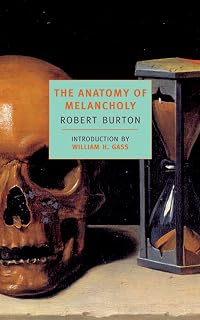
The Anatomy of Melancholy
by Robert Burton
On This Page
Description
This is the fourth volume of the Clarendon edition of Robert Burton's the "Anatomy of Melancholy" and the first of three volumes of commentary. It contains commentary on the text up to page 327 of Volume One.Tags
Recommendations









































Member Recommendations



Member Reviews
Qui la malinconia sta anche per ipocondria. Questa è la recensione che ho fatto alla versione in lingua inglese.
Se in terra c'è un inferno, si trova certamente nel cuore di un uomo melanconico.
Gli uomini sono malvagi, maliziosi, traditori, e insignificanti, non si amano l'un l'altro né amano sé stessi, non sono ospitali, caritatevoli o socievoli come dovrebbero essere, ma falsi, dissimulatori, doppiogiochisti, disposti a tutto per raggiungere i loro fini, senza pietà, senza compassione, e per trarre un beneficio non esitano a procurar danno al prossimo.
Tutti i poeti sono pazzi.
Chi vive secondo le prescrizioni del medico, vive infelicemente.
La cucina è diventata un'arte, una scienza nobile; i cuochi sono dei gentiluomini.
L'ozio è show more un'appendice della nobiltà.
È chiaro quanto di più crudele è la penna che la spada.
Una religione è tanto vera quanto un'altra.
Una coscienza a posto è una festa continua.
Queste sono soltanto alcune citazioni tratte dal libro di cui intendo occuparmi in questo post. Posseggo l'edizione inglese che vedete riprodotta qui sopra. Un volume di ben 1342 pagine, pubblicato qualche tempo fa dalla "New York Review Books" in versione economica. La prima edizione della versione originale venne pubblicata in Inghilterra nell'anno del Signore 1621.
Ne vennero stampate diverse edizioni. L'opera di Robert Burton è un affresco enciclopedico di ciò che è stato detto e scritto sulla malinconia, a cominciare dagli autori più antichi. La malinconia, in questo testo, è una malattia universale e l'angoscia esistenziale del soggetto malinconico diventa l'emblema della condizione umana: l'anatomia della malinconia è dunque anatomia dell'uomo e anatomia del mondo.
Questo è un libro che, come bibliomane, ho tenuto per diverso tempo sotto osservazione, bene in vista sullo scaffale di fronte al tavolo dove scrivo, riservandomi di leggerlo e parlarne appena mi afferrava la "malinconia". In effetti la patologia di cui si occupa questo pastore anglicano non era la malinconia come la intendiamo noi oggi.
Malinconia deriva dal tardo latino "melancholia" e, questo, dal greco "melankholia", composto da "melas", "nero", e "khole", "bile". "Bile nera", quindi. Uno dei quattro umori sempre presenti nel corpo umano e dalla cui combinazione dipendeva la salute o la malattia. Il suo, quindi, si rivela essere, a mio parere, uno straordinario studio sulla condizione umana.
Questo libro non è un libro, un trattato, un romanzo, un poema epico, una storia, è piuttosto la negazione dell'idea di libro e di tutti i libri possibili che erano stati scritti fino ad allora. Ricordate che siamo agli inizi del seicento, la stampa del tempo era una attività commerciale e culturale ancora giovane, pensate alle comunicazioni dell'epoca. Burton voleva spiegare, facendone un resoconto, quelle che erano per lui le emozioni umane. Non si tratta solo di malinconia, depressione, tristezza. Si tratta di tutta la condizione umana.
Sono le ragioni della malinconia ad interessare lo scrittore, le motivazioni, le basi della malinconia, quali ad esempio, la bellezza, la geografia, la digestione, le passioni, le bevande, la gelosia, il bacio e così via. Occasioni, situazioni che danno origine e scatenano la malinconia. Sotto le spoglie di Democrito, Robert Burton sorridendo dice che su questa terra tutti e ognuno o è stupido o è folle, lui stesso incluso.
Questo è un libro che non si legge tutto intero, dall'inizio alla fine. Esiste anche la traduzione in italiano e salva il lettore dalla prosa inglese del seicento non sempre digeribile. E' un non-libro, lo si gusta a pezzettini, scegliendosi un argomento, un sintomo, una situazione, uno stato d'animo, una sensazione.
La bravura dello scrittore si esprime interamente per mezzo della sua penna graffiante e dell’ironia al limite del sarcasmo. La penna è la spada con cui il melanconico pastore anglicano vibra terribili stoccate che non risparmiano nessuno. Dei suoi colleghi scrittori, Burton dice: “[…] lardellano i loro magri libri col grasso delle opere degli altri. "Inediti fures" [ladri illetterati] Una colpa che tutti gli scrittori considerano tale e di cui tuttavia sono colpevoli essi stessi, "trium literarum homines" (uomini di tre lettere, fur = ladro) sono tutti ladri. Rubacchiano dalle opere degli autori antichi per riempire i loro nuovi commenti; scrostano i letamai di Ennio e il pozzo di Democrito, come ho fatto io. Lo dice lui stesso!
Per cui succede «che non solo biblioteche e negozi sono pieni delle nostre putride cartacce, ma anche seggette e latrine», "Scribunt carmina quae legunt cacantes".” Burton ci ha negato la traduzione di questa frase, che potrebbe suonare all’incirca così: Scrivono versi che vengono letti mentre si defeca, (pag. 58,59). Sui magistrati egli afferma: “Vedere un agnello giustiziato, un lupo pronunciare sentenze, latro [un rapinatore] chiamato in giudizio e fur [un ladro] seduto sul seggio; il giudice punire severamente gli altri e comportarsi peggio lui stesso, eundem furtum facere et punire, rapinam plectere, cuum sit ipse raptor [lo stesso uomo commettere il furto e punirlo, punire una rapina ed essere lui stesso un rapinatore!]. (pag. 102)
E che cosa pensare degli avvocati? “Che ora si sono moltiplicati come tante cavallette, non i padri ma le pesti del paese, e in gran parte una genia di uomini superbi, malvagi, aridi, litigiosi "crumenimulga natio" ecc., un gruppo di spremi quattrini, una compagnia di parolai, di avvoltoi con la toga, "qui ex injuria vivent et sanguine civium" [che vivono derubando e uccidendo i loro concittadini], ladri e seminatori di discordie.
Essi sono peggiori di qualsiasi predatore di strada "auri accipitres, auri exterebronides, pecuniarum hamiolae, quadruplatores, curiae harpagones, fori tintinnabula, monstra hominum, mangones" ecc.: si assumono l’incarico di fare la pace, mentre in verità sono i veri disturbatori della nostra pace, una compagnia di gente avida, senza religione, di esattori sanguisughe e opprimenti, comuni legulei famelici, "rabulas forenses", che contemporaneamente amano e onorano le nostre buone leggi, i nostri degni avvocati, che sono tanti oracoli e piloti di buon governo”. (pag. 126)
Ce n’è poi in abbondanza anche per poeti, retori, oratori, innamorati, librai, cattolici e protestanti, e non mancano i politici. Insomma, questo libro è "uno dei più pazzi e più perfettamente organizzati assalti paranoici alla concentrazione umana che sia mai stata fatta", come si è espresso il critico Angus Fletcher. show less
Se in terra c'è un inferno, si trova certamente nel cuore di un uomo melanconico.
Gli uomini sono malvagi, maliziosi, traditori, e insignificanti, non si amano l'un l'altro né amano sé stessi, non sono ospitali, caritatevoli o socievoli come dovrebbero essere, ma falsi, dissimulatori, doppiogiochisti, disposti a tutto per raggiungere i loro fini, senza pietà, senza compassione, e per trarre un beneficio non esitano a procurar danno al prossimo.
Tutti i poeti sono pazzi.
Chi vive secondo le prescrizioni del medico, vive infelicemente.
La cucina è diventata un'arte, una scienza nobile; i cuochi sono dei gentiluomini.
L'ozio è show more un'appendice della nobiltà.
È chiaro quanto di più crudele è la penna che la spada.
Una religione è tanto vera quanto un'altra.
Una coscienza a posto è una festa continua.
Queste sono soltanto alcune citazioni tratte dal libro di cui intendo occuparmi in questo post. Posseggo l'edizione inglese che vedete riprodotta qui sopra. Un volume di ben 1342 pagine, pubblicato qualche tempo fa dalla "New York Review Books" in versione economica. La prima edizione della versione originale venne pubblicata in Inghilterra nell'anno del Signore 1621.
Ne vennero stampate diverse edizioni. L'opera di Robert Burton è un affresco enciclopedico di ciò che è stato detto e scritto sulla malinconia, a cominciare dagli autori più antichi. La malinconia, in questo testo, è una malattia universale e l'angoscia esistenziale del soggetto malinconico diventa l'emblema della condizione umana: l'anatomia della malinconia è dunque anatomia dell'uomo e anatomia del mondo.
Questo è un libro che, come bibliomane, ho tenuto per diverso tempo sotto osservazione, bene in vista sullo scaffale di fronte al tavolo dove scrivo, riservandomi di leggerlo e parlarne appena mi afferrava la "malinconia". In effetti la patologia di cui si occupa questo pastore anglicano non era la malinconia come la intendiamo noi oggi.
Malinconia deriva dal tardo latino "melancholia" e, questo, dal greco "melankholia", composto da "melas", "nero", e "khole", "bile". "Bile nera", quindi. Uno dei quattro umori sempre presenti nel corpo umano e dalla cui combinazione dipendeva la salute o la malattia. Il suo, quindi, si rivela essere, a mio parere, uno straordinario studio sulla condizione umana.
Questo libro non è un libro, un trattato, un romanzo, un poema epico, una storia, è piuttosto la negazione dell'idea di libro e di tutti i libri possibili che erano stati scritti fino ad allora. Ricordate che siamo agli inizi del seicento, la stampa del tempo era una attività commerciale e culturale ancora giovane, pensate alle comunicazioni dell'epoca. Burton voleva spiegare, facendone un resoconto, quelle che erano per lui le emozioni umane. Non si tratta solo di malinconia, depressione, tristezza. Si tratta di tutta la condizione umana.
Sono le ragioni della malinconia ad interessare lo scrittore, le motivazioni, le basi della malinconia, quali ad esempio, la bellezza, la geografia, la digestione, le passioni, le bevande, la gelosia, il bacio e così via. Occasioni, situazioni che danno origine e scatenano la malinconia. Sotto le spoglie di Democrito, Robert Burton sorridendo dice che su questa terra tutti e ognuno o è stupido o è folle, lui stesso incluso.
Questo è un libro che non si legge tutto intero, dall'inizio alla fine. Esiste anche la traduzione in italiano e salva il lettore dalla prosa inglese del seicento non sempre digeribile. E' un non-libro, lo si gusta a pezzettini, scegliendosi un argomento, un sintomo, una situazione, uno stato d'animo, una sensazione.
La bravura dello scrittore si esprime interamente per mezzo della sua penna graffiante e dell’ironia al limite del sarcasmo. La penna è la spada con cui il melanconico pastore anglicano vibra terribili stoccate che non risparmiano nessuno. Dei suoi colleghi scrittori, Burton dice: “[…] lardellano i loro magri libri col grasso delle opere degli altri. "Inediti fures" [ladri illetterati] Una colpa che tutti gli scrittori considerano tale e di cui tuttavia sono colpevoli essi stessi, "trium literarum homines" (uomini di tre lettere, fur = ladro) sono tutti ladri. Rubacchiano dalle opere degli autori antichi per riempire i loro nuovi commenti; scrostano i letamai di Ennio e il pozzo di Democrito, come ho fatto io. Lo dice lui stesso!
Per cui succede «che non solo biblioteche e negozi sono pieni delle nostre putride cartacce, ma anche seggette e latrine», "Scribunt carmina quae legunt cacantes".” Burton ci ha negato la traduzione di questa frase, che potrebbe suonare all’incirca così: Scrivono versi che vengono letti mentre si defeca, (pag. 58,59). Sui magistrati egli afferma: “Vedere un agnello giustiziato, un lupo pronunciare sentenze, latro [un rapinatore] chiamato in giudizio e fur [un ladro] seduto sul seggio; il giudice punire severamente gli altri e comportarsi peggio lui stesso, eundem furtum facere et punire, rapinam plectere, cuum sit ipse raptor [lo stesso uomo commettere il furto e punirlo, punire una rapina ed essere lui stesso un rapinatore!]. (pag. 102)
E che cosa pensare degli avvocati? “Che ora si sono moltiplicati come tante cavallette, non i padri ma le pesti del paese, e in gran parte una genia di uomini superbi, malvagi, aridi, litigiosi "crumenimulga natio" ecc., un gruppo di spremi quattrini, una compagnia di parolai, di avvoltoi con la toga, "qui ex injuria vivent et sanguine civium" [che vivono derubando e uccidendo i loro concittadini], ladri e seminatori di discordie.
Essi sono peggiori di qualsiasi predatore di strada "auri accipitres, auri exterebronides, pecuniarum hamiolae, quadruplatores, curiae harpagones, fori tintinnabula, monstra hominum, mangones" ecc.: si assumono l’incarico di fare la pace, mentre in verità sono i veri disturbatori della nostra pace, una compagnia di gente avida, senza religione, di esattori sanguisughe e opprimenti, comuni legulei famelici, "rabulas forenses", che contemporaneamente amano e onorano le nostre buone leggi, i nostri degni avvocati, che sono tanti oracoli e piloti di buon governo”. (pag. 126)
Ce n’è poi in abbondanza anche per poeti, retori, oratori, innamorati, librai, cattolici e protestanti, e non mancano i politici. Insomma, questo libro è "uno dei più pazzi e più perfettamente organizzati assalti paranoici alla concentrazione umana che sia mai stata fatta", come si è espresso il critico Angus Fletcher. show less
Had to spend a while googling to make sure this wasn't an elaborate 21st century literary hoax. Apart from having aged surprisingly well (yes, he thinks depression is caused by demonic possession or unbalanced bodily fluids, but the way he both describes it, sympathises with it and discusses its treatment is remarkably modern) Burton's all-out rant on mental health, with enough asides to make Sterne's head spin, is just so much fun to read.
The penultimate Self-Help book. The medical man's history primer of Galen and Astrology. The completionist's guide to a completely exhaustive and exhausting compendium of (now) obscure references, to Latin, and frankly inexplicable inclusions.
If he went out of his way to design for us a perfect way to exhaust us with his knowledge of poverty, nobility, love, the Humors, the Galenic qualities of all kinds of foodstuffs, and do it with more in-text annotations than actual text, doing it all in that peculiar idiom common to any English text coming out before the advent of the DICTIONARY, then I think he succeeded. Admirably.
And let me tell you... Robert Burton defeated me.
He set out to give us the full wide range of depression in this show more academic treatise that fills to the height of 1620's modern medicine, stoops to the depths of hundreds of poetical sources, revolts us in explaining just HOW one might get depressed... and teaches us how to fight our own depression by making us come up with a thousand and one reasons why we ought to stop this FREAKING ENORMOUS BOOK and JUST STOP... thereby relieving our -- by now -- enormous melancholy.
I made it half-way through. I found myself negatively enjoying practically every new step in this amazingly long-winded treatise. I could not find a single aspect about it that made me want to continue.
Not the science, not the beginnings of psychology, not the weird historical curiosity.
I was defeated. I am sad to say, after 29 hours of Librivox and epub slogging, that I will now DNF.
Goodnight.
I may laugh myself to sleep. The relief is palpable. show less
If he went out of his way to design for us a perfect way to exhaust us with his knowledge of poverty, nobility, love, the Humors, the Galenic qualities of all kinds of foodstuffs, and do it with more in-text annotations than actual text, doing it all in that peculiar idiom common to any English text coming out before the advent of the DICTIONARY, then I think he succeeded. Admirably.
And let me tell you... Robert Burton defeated me.
He set out to give us the full wide range of depression in this show more academic treatise that fills to the height of 1620's modern medicine, stoops to the depths of hundreds of poetical sources, revolts us in explaining just HOW one might get depressed... and teaches us how to fight our own depression by making us come up with a thousand and one reasons why we ought to stop this FREAKING ENORMOUS BOOK and JUST STOP... thereby relieving our -- by now -- enormous melancholy.
I made it half-way through. I found myself negatively enjoying practically every new step in this amazingly long-winded treatise. I could not find a single aspect about it that made me want to continue.
Not the science, not the beginnings of psychology, not the weird historical curiosity.
I was defeated. I am sad to say, after 29 hours of Librivox and epub slogging, that I will now DNF.
Goodnight.
I may laugh myself to sleep. The relief is palpable. show less
I have finally finished a careful reading of Robert Burton's "Anatomy of Melancholy," along with a wonderful book by Ruth Fox, "The Tangled Chain: The Structure of Disorder in the Anatomy of Melancholy."
This is part of my ongoing project to read maximalist fiction -- really, to read the longest, most complex books I can find. There is a tradition according to which Burton belongs with Milton and Shakespeare in the 17th century canon. I haven't been able to discover the origins of this judgment (I suspect someone like Harold Bloom) but it seems wholly appropriate. Even though Burton's book is nominally what is now called nonfiction, it is an act of imagination absolutely comparable to Milton and Shakespeare. If it's read as a show more first-person text, and not a 17th century medical treatise, it can sound to 21st century ears as a memoir, or a "theory-text," or a kind of "essay-novel" in the tradition of Musil. (Autobiographical voicing is intermittent throughout; see for example 1.2.2.6, 1.4.1.) In other words: there is no reason not to include it in the roster of indispensable English writing.
(And before I begin: the NYRB edition pictured here is not a good one to read. The print is small and the margins are clipped. After a lot of searching I found the Tudor Publishing edition edited by Dell and Jordan-Smith, printed in 1927, in hardcover. I bought a copy for only $10. It's well printed and easy to read; it's 1,000 pages long, so it's bulky but not difficult to hold. There are also editions with Burton's extensive Latin intact, but unless you are fluent in Latin, those are only impediments; Burton did not imagine his Latin guarded his text against anyone -- except in one passage, where he makes fun of scholars by putting a page in Latin, pretending they couldn't read it. There is also the multi-volume Cambridge Press edition, which is madly expensive, and not at all necessary unless you're interested in looking up Burton's sources, almost all of which were also written in Latin.)
Perhaps an initial thing to say about the book is that it cannot be read without laughing, and that the comedy is unintended. It's an inevitable effect of the three centuries that have passed since the book was written. It's absolutely full of outlandish, crazy, unbelievable anecdotes and odd usages of English.
The book is as prodigious as Shakespeare or Milton in striking ideas and writing, and I annotated nearly every one of my edition's 1,000 pages. Most of those passages are also inadvertently funny. To cure rabies, it's only necessary to go to a bath and picture a dog in the bath: the conceit (why would a dog bathe?) is enough to overcome the insanity of rabies (1.2.6.1). A good cure for farting is to put a bellows "into a clyster pipe" and pump the wind out (2.5.3.2). Horse leeches are good for hemorrhoids (2.4.3). These days people can hardly be bled, but it was once possible to take "six pounds of blood" and people wouldn't mind (1.2.1.4).
A full engagement with the book has to acknowledge that it is ridiculous at many points. Personally I did not find any of those passages detrimental to a more serious reading. And the language and ideas are often stupendous. At one point he argues that it is no harm to be a stranger who travels and has no home, and he gives a list of things that are strangers to one another, including rain, which is "a stranger to the earth" (2.3.4). Later he remarks that the ground "covets" showers, because it loves them (3.1.1.2). He has a barely controlled fascination with stagnant water, which is expressed dozens of times in the book, each time with a different poetry:
"The worst... is a thick, cloudy, misty, foggy air, or such as comes from fens, moorish grounds, lakes, muckhills, draughts, sinks, where any carcasses or carrion lies, or from whence any stinking fulsome smell comes" [1.2.2.5]
And he is of course wonderful in his repeated conjurings of different kinds of melancholics:
"...little by little... Melancholy, this feral friend, is drawn on, & as far as it reaches its branches toward the heavens, so far does it plunge its roots to the depths beneath; it was not so delicious at first, as now it is bitter and harsh: a cankered soul macerated with cares and discontents, a being tired of life, impatience, agony, inconstancy, irresolution, precipitate... into unspeakable miseries. They cannot endure company, light, or life itself... Their bodies are lean and dried up, withered, ugly, their looks harsh, very dull, and their souls tormented, as they are more or less intangled..." [1.3.1.4]
It would be possible to go on quoting until I'd quoted most of the book: the same would be true of Milton or Shakespeare. For me, however, the principal interest of the book for me is its structure. Burton offers a "Synopsis" at the start of each of the book's three "Partitions" (parts). The Synopsis is in the form of an outline organized in bracketed paragraphs { { {. If the three Synopses were printed all together, in a reasonable font size, they might be 10 feet long. He divides each of his Partitions into Sections, each Section into Members, each Member into Subsections, and in the text, each Subsection has a number and a title (some fairly long). (It is worth remarking that the famous frontispiece is a simple-minded and inaccurate synopsis: I studied it as a student, because it's the book's only visual element, but it doesn't begin to approach the text's concerns.)
This is daunting enough, but the interest comes in the fact that these Synopses do not make logical sense. In a rationally organized table of contents, each division (here, for example, each Section) would be equal to each other Section. But in Burton's Synopsis, some Sections are subheadings of other Sections. The entire organization is a chaos, and it is therefore impossible to use as a guide in reading: instead a reader is at the mercy of Burton's often unconvincing synopses and introductions.
Ruth Fox's book is a brilliant untangling of Burton's sense of reason and logic: it belongs in the tradition of Empson in that every sentence counts, and the book is argued from first to last. In that sense it's a sort of antidote to Burton: slim, well-organized, nothing superfluous. She makes the fascinating point that in the Third Partition on Love-melancholy, the last of the book's three parts, Burton inverts his own system of organization. Here is part of her analysis:
"...the logic of the first two Partitions is one of cause an effect, of action and reaction, so that Partition I states the thesis--definition, causes, symptoms, and prognostics--of the disease, while Partition II--under its single topic, cure--provides the antithesis to all of the topics of I. In I and II the three kinds of 'definite' melancholy are treated as subtopics of the cause-cure analysis.... But in Partition III he changes the base of his analysis, using now as his major organizational scheme not the logic of thesis and antithesis, but that of division... To put it another way, the roman numerals of the outline of Partitions I and II become the arabic numerals in the outline of Partition III." [pp. 124-25]
The entire structure and logic of the outline is inverted: subheading become headings.
This is an important example of the way the book is continuously getting away from Burton. Fox concludes: "Burton's book sets out to cure melancholy, and does so by being an ordered form of disorder, an answer to imperfection which contains imperfection but defines it by art." (pp. 271-72)
I could literally go on for several hundred pages on this topic. There are more logical issues in this book than any other I know, including Wittgenstein's "Tractatus." Burton tries desperately hard, in as many ways as he can, to control his subject, but melancholy keeps spreading: in one passage, everyone is a melancholic and "no mortal man is free" from it (1.2.3.1); in another, melancholy and madness are nearly equated; in another, all of melancholy is a fault of love.
The fact that Burton probably died by suicide necessarily haunts all readings of this book. In the book, suicide comes up several times (see for example 1.4.1), but most especially toward the end, where he speaks of despair. For him that is a special condition, particularly hard to bear, because the person who experiences it suffers from a partial, and therefore faulty, understanding of god. He may be able to reason very well, in fact better than anyone around him, and that makes his condition especially intractable. One woman "rose from her bed, and out of the window broke her neck into the street" (3.2.4.5). Another, a lawyer from Padua, out-argued his doctors, arguing "against himself, and so he desperately died" (3.2.4.4).
"The Anatomy of Melancholy" is a labyrinth that shifts and changes as it is read. (For Fox, this organic, unfinished quality is what makes it, paradoxically, able to present itself as a cure.) As a document of a fierce struggle against solitude, despair, unreason, confusion, depression, and suicide, it has no rival. show less
This is part of my ongoing project to read maximalist fiction -- really, to read the longest, most complex books I can find. There is a tradition according to which Burton belongs with Milton and Shakespeare in the 17th century canon. I haven't been able to discover the origins of this judgment (I suspect someone like Harold Bloom) but it seems wholly appropriate. Even though Burton's book is nominally what is now called nonfiction, it is an act of imagination absolutely comparable to Milton and Shakespeare. If it's read as a show more first-person text, and not a 17th century medical treatise, it can sound to 21st century ears as a memoir, or a "theory-text," or a kind of "essay-novel" in the tradition of Musil. (Autobiographical voicing is intermittent throughout; see for example 1.2.2.6, 1.4.1.) In other words: there is no reason not to include it in the roster of indispensable English writing.
(And before I begin: the NYRB edition pictured here is not a good one to read. The print is small and the margins are clipped. After a lot of searching I found the Tudor Publishing edition edited by Dell and Jordan-Smith, printed in 1927, in hardcover. I bought a copy for only $10. It's well printed and easy to read; it's 1,000 pages long, so it's bulky but not difficult to hold. There are also editions with Burton's extensive Latin intact, but unless you are fluent in Latin, those are only impediments; Burton did not imagine his Latin guarded his text against anyone -- except in one passage, where he makes fun of scholars by putting a page in Latin, pretending they couldn't read it. There is also the multi-volume Cambridge Press edition, which is madly expensive, and not at all necessary unless you're interested in looking up Burton's sources, almost all of which were also written in Latin.)
Perhaps an initial thing to say about the book is that it cannot be read without laughing, and that the comedy is unintended. It's an inevitable effect of the three centuries that have passed since the book was written. It's absolutely full of outlandish, crazy, unbelievable anecdotes and odd usages of English.
The book is as prodigious as Shakespeare or Milton in striking ideas and writing, and I annotated nearly every one of my edition's 1,000 pages. Most of those passages are also inadvertently funny. To cure rabies, it's only necessary to go to a bath and picture a dog in the bath: the conceit (why would a dog bathe?) is enough to overcome the insanity of rabies (1.2.6.1). A good cure for farting is to put a bellows "into a clyster pipe" and pump the wind out (2.5.3.2). Horse leeches are good for hemorrhoids (2.4.3). These days people can hardly be bled, but it was once possible to take "six pounds of blood" and people wouldn't mind (1.2.1.4).
A full engagement with the book has to acknowledge that it is ridiculous at many points. Personally I did not find any of those passages detrimental to a more serious reading. And the language and ideas are often stupendous. At one point he argues that it is no harm to be a stranger who travels and has no home, and he gives a list of things that are strangers to one another, including rain, which is "a stranger to the earth" (2.3.4). Later he remarks that the ground "covets" showers, because it loves them (3.1.1.2). He has a barely controlled fascination with stagnant water, which is expressed dozens of times in the book, each time with a different poetry:
"The worst... is a thick, cloudy, misty, foggy air, or such as comes from fens, moorish grounds, lakes, muckhills, draughts, sinks, where any carcasses or carrion lies, or from whence any stinking fulsome smell comes" [1.2.2.5]
And he is of course wonderful in his repeated conjurings of different kinds of melancholics:
"...little by little... Melancholy, this feral friend, is drawn on, & as far as it reaches its branches toward the heavens, so far does it plunge its roots to the depths beneath; it was not so delicious at first, as now it is bitter and harsh: a cankered soul macerated with cares and discontents, a being tired of life, impatience, agony, inconstancy, irresolution, precipitate... into unspeakable miseries. They cannot endure company, light, or life itself... Their bodies are lean and dried up, withered, ugly, their looks harsh, very dull, and their souls tormented, as they are more or less intangled..." [1.3.1.4]
It would be possible to go on quoting until I'd quoted most of the book: the same would be true of Milton or Shakespeare. For me, however, the principal interest of the book for me is its structure. Burton offers a "Synopsis" at the start of each of the book's three "Partitions" (parts). The Synopsis is in the form of an outline organized in bracketed paragraphs { { {. If the three Synopses were printed all together, in a reasonable font size, they might be 10 feet long. He divides each of his Partitions into Sections, each Section into Members, each Member into Subsections, and in the text, each Subsection has a number and a title (some fairly long). (It is worth remarking that the famous frontispiece is a simple-minded and inaccurate synopsis: I studied it as a student, because it's the book's only visual element, but it doesn't begin to approach the text's concerns.)
This is daunting enough, but the interest comes in the fact that these Synopses do not make logical sense. In a rationally organized table of contents, each division (here, for example, each Section) would be equal to each other Section. But in Burton's Synopsis, some Sections are subheadings of other Sections. The entire organization is a chaos, and it is therefore impossible to use as a guide in reading: instead a reader is at the mercy of Burton's often unconvincing synopses and introductions.
Ruth Fox's book is a brilliant untangling of Burton's sense of reason and logic: it belongs in the tradition of Empson in that every sentence counts, and the book is argued from first to last. In that sense it's a sort of antidote to Burton: slim, well-organized, nothing superfluous. She makes the fascinating point that in the Third Partition on Love-melancholy, the last of the book's three parts, Burton inverts his own system of organization. Here is part of her analysis:
"...the logic of the first two Partitions is one of cause an effect, of action and reaction, so that Partition I states the thesis--definition, causes, symptoms, and prognostics--of the disease, while Partition II--under its single topic, cure--provides the antithesis to all of the topics of I. In I and II the three kinds of 'definite' melancholy are treated as subtopics of the cause-cure analysis.... But in Partition III he changes the base of his analysis, using now as his major organizational scheme not the logic of thesis and antithesis, but that of division... To put it another way, the roman numerals of the outline of Partitions I and II become the arabic numerals in the outline of Partition III." [pp. 124-25]
The entire structure and logic of the outline is inverted: subheading become headings.
This is an important example of the way the book is continuously getting away from Burton. Fox concludes: "Burton's book sets out to cure melancholy, and does so by being an ordered form of disorder, an answer to imperfection which contains imperfection but defines it by art." (pp. 271-72)
I could literally go on for several hundred pages on this topic. There are more logical issues in this book than any other I know, including Wittgenstein's "Tractatus." Burton tries desperately hard, in as many ways as he can, to control his subject, but melancholy keeps spreading: in one passage, everyone is a melancholic and "no mortal man is free" from it (1.2.3.1); in another, melancholy and madness are nearly equated; in another, all of melancholy is a fault of love.
The fact that Burton probably died by suicide necessarily haunts all readings of this book. In the book, suicide comes up several times (see for example 1.4.1), but most especially toward the end, where he speaks of despair. For him that is a special condition, particularly hard to bear, because the person who experiences it suffers from a partial, and therefore faulty, understanding of god. He may be able to reason very well, in fact better than anyone around him, and that makes his condition especially intractable. One woman "rose from her bed, and out of the window broke her neck into the street" (3.2.4.5). Another, a lawyer from Padua, out-argued his doctors, arguing "against himself, and so he desperately died" (3.2.4.4).
"The Anatomy of Melancholy" is a labyrinth that shifts and changes as it is read. (For Fox, this organic, unfinished quality is what makes it, paradoxically, able to present itself as a cure.) As a document of a fierce struggle against solitude, despair, unreason, confusion, depression, and suicide, it has no rival. show less
Reality should be snared, at least where it is convenient. Burton demanded browsers and I obliged. I did not read this book sequentially. Nor was any effort made to complete this book cover-to-cover. It was read in a flourish of skips and delights: anti-oedpian piercing and parsing. Gazes, gouges and gatherings, baby. I will return to this for the rest of my life.
Where to begin discussing this book? How about again and again? For it begs never to be put down, and if finished (as if that's even possible) to be picked up again and pored over. Again. And again. And again . . .
It got Samuel Jonson out of bed earlier than he wished. It kept me up later than I wished, and still "reading" it in my mind over and over again, musing on the insanity of it - the brilliant, always entertaining, enlightening, LIGHTING bolts of language and thought crammed so mercilessly between two covers. It won't drive you mad, though, or mess with your humours, unless, of course, a sense of one you don't have - a bricolage (I think) to be devoured ravenously and chewed interminably like an everlasting gobstopper - a joy show more to exhaust your mind and body by . . . show less
It got Samuel Jonson out of bed earlier than he wished. It kept me up later than I wished, and still "reading" it in my mind over and over again, musing on the insanity of it - the brilliant, always entertaining, enlightening, LIGHTING bolts of language and thought crammed so mercilessly between two covers. It won't drive you mad, though, or mess with your humours, unless, of course, a sense of one you don't have - a bricolage (I think) to be devoured ravenously and chewed interminably like an everlasting gobstopper - a joy show more to exhaust your mind and body by . . . show less
I've been reading the Anatomy for years off and on and I don't doubt that I'll continue reading it off and on for many years to come. It's really a world unto itself -- and not a small world at that, even though it is very much the picture of one man's mind. And it's a world that's strange and wonderful, confusing and infuriating, fascinating and boring, but one that I wouldn't want to have not known.
A note on the edition: The Folio edition of the Anatomy is well worth owning, if you like spending time with Burton and plan to continue the relationship. Besides all of the usual niceties of the usual run of Folio editions, there's something here that's particularly useful: the typesetting. With all of the quotations and notes that are an show more integral part of this sprawling text, it's much easier to read when it's properly set. show less
A note on the edition: The Folio edition of the Anatomy is well worth owning, if you like spending time with Burton and plan to continue the relationship. Besides all of the usual niceties of the usual run of Folio editions, there's something here that's particularly useful: the typesetting. With all of the quotations and notes that are an show more integral part of this sprawling text, it's much easier to read when it's properly set. show less
Members
- Recently Added By
Published Reviews
Definire che cosa effettivamente sia e a quale genere letterario appartenga The Anatomy of Melancholy (Anatomia della melanconia) di Robert Burton, che ebbe una grandissima diffusione, non solo in Inghilterra e ben oltre la vita dell’autore - è attività in cui si è esercitata per secoli la critica, giungendo, infine, alla conclusione, che quest’opera i generi letterari li sperimenta show more tutti, dall’enciclopedia al centone, dal trattato di medicina o di retorica alla satira menippea, senza che l’autore ritenga che adottare con coerenza una ben definita tipologia di scrittura sia sufficientemente efficace a dare una sistemazione logica alle varie manifestazioni della malattia melanconica e a mostrarne la complessità. Uno dei principi fondamentali dell’opera di Burton è, infatti, che la melanconia sia una patologia estremamente diffusa, quasi connaturata con il genere umano e che possa quindi assumere forme anche molto diverse. Dietro la maschera di Democrito - il filosofo di cui si dice che sezionasse piccoli animali per trovare la sede della melanconia - e con lo pseudonimo di Democrito iunior, vale a dire di colui che intende proseguirne l’opera con lo studio e la scrittura, il narratore, con reminiscenza shakespeariana, osserva il mondo come teatro e, incurante del paradosso, conclude che la follia, (una condizione in parte sovrapponibile allo stato melanconico, anche se nel corso del trattato finirà col differenziarli almeno in parte) è ovunque, negli individui come nelle città e negli stati e che, quindi, tutti sono matti.
Seguendo il modello delle fonti mediche principali, tra tutti Galeno e, indirettamente, Ippocrate, l’autore divide il trattato in Ripartizioni in cui le cause, i sintomi e i possibili interventi terapeutici sono analizzati separatamente, per confluire poi in una interpretazione globale della malattia. Il punto su cui Burton insiste in tutto il trattato è che la melanconia riguardi sia la vita fisica che quella psichica del melanconico, e che lo studio filosofico-psicologico della malattia debba affiancare quello puramente clinico - ed è per questo che l’autore, ecclesiastico e non medico, si sente legittimato a trattare l’argomento. Le sue fonti e le sue auctoritates, numerosissime, sono infatti sia medici che filosofi o retori, dell’antichità o a lui contemporanei, le cui opinioni sono accostate, a volte semplicemente giustapposte, anche se in contrasto tra loro. Inoltre, accanto ad opere di carattere scientifico, vengono citati testi di magia, trattati di astrologia, racconti fantastici, per cui, per esempio, una diagnosi di André du Laurens, medico illustre, un vaticinio di Apollo e una citazione da Ermete Trismegisto sono posti uno accanto all’altro senza troppa preoccupazione.
La teoria degli umori, di antica origine ippocratica, e ancora largamente insegnata nelle Università, dove le scoperte di Harvey, di Vesalio, di Ambroise Paré faticavano a farsi strada, è alla base della trattazione dal punto di vista medico e quindi la melanconia è vista soprattutto come il prevalere della bile nera (mélaina kholé) sugli altri umori. Ma sottolineando l’interazione tra il fisico e lo spirituale (oggi diremmo psichico) che egli ritiene all’origine della malattia melanconica, Burton insiste molto sul fatto che a causare la patologia sia un difetto della facoltà che egli chiama indifferentemente “fantasia” o “immaginazione”, che è da un lato, etimologicamente, quella che presiede alla formazione delle immagini, dall’altro ha la funzione di discernere e selezionare gli stimoli che vengono dagli oggetti e penetrano nell’occhio: l’eccesso di bile nera, soprattutto se adusta, portato dagli spiriti vitali verso il cervello, la corrompe. Se la capacità di discernere si altera, la fantasia malata prevale sulla ragione e impedisce alla persona di tenere sotto controllo le proprie passioni. Il rapporto tra ragione e immaginazione è, dunque, quello che rende la persona sana o melanconica. Poiché l’immaginazione può alterarsi in molti modi, molti sono gli eventi della vita di una persona che possono provocare la malattia. L’ozio e la solitudine sono i più importanti: pensare ossessivamente a qualcosa, la fa sembrare diversa da com’è, le attribuisce un’importanza eccessiva, toglie spazio ad altri pensieri e genera sofferenza; anche alcuni cibi possono avere lo stesso effetto. Le passioni, quelli che comunemente chiamiamo “vizi”, come l’ira, l’invidia, la gelosia, ecc sono causa e conseguenza dell’alterazione della fantasia.
La passione che più di tutte produce la malattia e ne rende difficile la cura è l’amore. Burton dedica a questo tutto il terzo trattato e con grande ricchezza di citazioni, lo analizza da ogni punto di vista, insistendo soprattutto sul modo in cui la malattia altera l’immagine che chi è innamorato forma dell’oggetto del suo amore. L’immaginazione malata fa apparire la persona amata molto diversa da come è effettivamente, la passione genera ansia, per esempio, se gli innamorati sono lontani, e immaginano pericoli inesistenti o tradimenti e alla fine la malattia si manifesta.
Le terapie della melanconia sono prima di tutto “psicologiche”: non lasciare troppo a lungo sole le persone, evitare che stiano in ozio, cercare di correggere le percezioni distorte del melanconico; ma occorre anche evitare determinati cibi, le spezie, per esempio, vivere in zone salubri e, se è possibile, all’aria aperta ecc; poi, se tutto è inutile, devono intervenire i farmaci, principalmente l’elleboro, sostanza di elezione per la malattia, ma anche composti di erbe che gli studiosi ritengono di provata efficacia, oltre ad alcuni stravaganti rimedi, legati alla fantasia popolare o alla magia. Ancora, i salassi e vari modi di purificare il corpo possono essere parte della terapia. La prognosi è favorevole se si tratta di malattia sporadica, meno se la patologia data da molto ed è divenuta, per così dire, cronica. L’esigenza di tenere sotto controllo una mole imponente di dati e una grande varietà di argomenti, l’ansia di chiarezza e di completezza rendono la prosa di Burton una macchina retorica pletorica e di grande complessità, ma non per questo priva di vivacità e di ironia. Lo scrittore privilegia periodi lunghi e contorti, con scarsi segni di interpunzione (il punto fermo è raramente usato), in cui la continuità del discorso è sistematicamente interrotta da citazioni da fonti disparate, da lunghe digressioni, da elenchi interminabili di nomi, di oggetti, di sentimenti, di caratteristiche fisiche dei personaggi, in una sorta di horror vacui che gli fa riempire la pagina di ogni genere di osservazioni, spesso in contraddizione tra loro, in cui risultati scientifici e racconto fantastico sono accostati senza soluzione di continuità. L’esempio più significativo è la lunghissima digressione sull’aria che mette insieme, con l’ironico pretesto di volerle verificare in un immaginario viaggio interplanetario, ipotesi scientifiche, leggende, narrazioni mitologiche e finisce per apparire una ipertrofica summa dello scibile umano e delle tradizioni popolari.
L’andamento non lineare del periodo, la ricchezza della retorica, se da un lato mimano la varietà e la difficoltà degli argomenti, hanno tuttavia un significato più profondo, che inserisce pienamente questo scrittore nella cultura che chiamiamo “barocca”. Arrivare ad un concetto per strade non rettilinee arricchisce la conoscenza e potenzia una qualità cara a questa cultura, cioè il wit, l’arguzia, l’intelligenza che consente di percepire e indagare la complessità infinita del mondo. Le figure del discorso, la metafora in particolare, ricreano nel linguaggio quell’affinità tra le cose che non è più possibile rintracciare nella natura. Di lì a poco Emanuele Tesauro nel suo Cannocchiale aristotelico, paragonerà la metafora, che crea relazioni tra cose che di solito sono separate, al cannocchiale, che fa vedere le cose lontane come se fossero vicine. Forse l’importanza e l’originalità di Burton stanno proprio nell’avere applicato questo modello culturale all’analisi “scientifica” della melanconia. show less
Seguendo il modello delle fonti mediche principali, tra tutti Galeno e, indirettamente, Ippocrate, l’autore divide il trattato in Ripartizioni in cui le cause, i sintomi e i possibili interventi terapeutici sono analizzati separatamente, per confluire poi in una interpretazione globale della malattia. Il punto su cui Burton insiste in tutto il trattato è che la melanconia riguardi sia la vita fisica che quella psichica del melanconico, e che lo studio filosofico-psicologico della malattia debba affiancare quello puramente clinico - ed è per questo che l’autore, ecclesiastico e non medico, si sente legittimato a trattare l’argomento. Le sue fonti e le sue auctoritates, numerosissime, sono infatti sia medici che filosofi o retori, dell’antichità o a lui contemporanei, le cui opinioni sono accostate, a volte semplicemente giustapposte, anche se in contrasto tra loro. Inoltre, accanto ad opere di carattere scientifico, vengono citati testi di magia, trattati di astrologia, racconti fantastici, per cui, per esempio, una diagnosi di André du Laurens, medico illustre, un vaticinio di Apollo e una citazione da Ermete Trismegisto sono posti uno accanto all’altro senza troppa preoccupazione.
La teoria degli umori, di antica origine ippocratica, e ancora largamente insegnata nelle Università, dove le scoperte di Harvey, di Vesalio, di Ambroise Paré faticavano a farsi strada, è alla base della trattazione dal punto di vista medico e quindi la melanconia è vista soprattutto come il prevalere della bile nera (mélaina kholé) sugli altri umori. Ma sottolineando l’interazione tra il fisico e lo spirituale (oggi diremmo psichico) che egli ritiene all’origine della malattia melanconica, Burton insiste molto sul fatto che a causare la patologia sia un difetto della facoltà che egli chiama indifferentemente “fantasia” o “immaginazione”, che è da un lato, etimologicamente, quella che presiede alla formazione delle immagini, dall’altro ha la funzione di discernere e selezionare gli stimoli che vengono dagli oggetti e penetrano nell’occhio: l’eccesso di bile nera, soprattutto se adusta, portato dagli spiriti vitali verso il cervello, la corrompe. Se la capacità di discernere si altera, la fantasia malata prevale sulla ragione e impedisce alla persona di tenere sotto controllo le proprie passioni. Il rapporto tra ragione e immaginazione è, dunque, quello che rende la persona sana o melanconica. Poiché l’immaginazione può alterarsi in molti modi, molti sono gli eventi della vita di una persona che possono provocare la malattia. L’ozio e la solitudine sono i più importanti: pensare ossessivamente a qualcosa, la fa sembrare diversa da com’è, le attribuisce un’importanza eccessiva, toglie spazio ad altri pensieri e genera sofferenza; anche alcuni cibi possono avere lo stesso effetto. Le passioni, quelli che comunemente chiamiamo “vizi”, come l’ira, l’invidia, la gelosia, ecc sono causa e conseguenza dell’alterazione della fantasia.
La passione che più di tutte produce la malattia e ne rende difficile la cura è l’amore. Burton dedica a questo tutto il terzo trattato e con grande ricchezza di citazioni, lo analizza da ogni punto di vista, insistendo soprattutto sul modo in cui la malattia altera l’immagine che chi è innamorato forma dell’oggetto del suo amore. L’immaginazione malata fa apparire la persona amata molto diversa da come è effettivamente, la passione genera ansia, per esempio, se gli innamorati sono lontani, e immaginano pericoli inesistenti o tradimenti e alla fine la malattia si manifesta.
Le terapie della melanconia sono prima di tutto “psicologiche”: non lasciare troppo a lungo sole le persone, evitare che stiano in ozio, cercare di correggere le percezioni distorte del melanconico; ma occorre anche evitare determinati cibi, le spezie, per esempio, vivere in zone salubri e, se è possibile, all’aria aperta ecc; poi, se tutto è inutile, devono intervenire i farmaci, principalmente l’elleboro, sostanza di elezione per la malattia, ma anche composti di erbe che gli studiosi ritengono di provata efficacia, oltre ad alcuni stravaganti rimedi, legati alla fantasia popolare o alla magia. Ancora, i salassi e vari modi di purificare il corpo possono essere parte della terapia. La prognosi è favorevole se si tratta di malattia sporadica, meno se la patologia data da molto ed è divenuta, per così dire, cronica. L’esigenza di tenere sotto controllo una mole imponente di dati e una grande varietà di argomenti, l’ansia di chiarezza e di completezza rendono la prosa di Burton una macchina retorica pletorica e di grande complessità, ma non per questo priva di vivacità e di ironia. Lo scrittore privilegia periodi lunghi e contorti, con scarsi segni di interpunzione (il punto fermo è raramente usato), in cui la continuità del discorso è sistematicamente interrotta da citazioni da fonti disparate, da lunghe digressioni, da elenchi interminabili di nomi, di oggetti, di sentimenti, di caratteristiche fisiche dei personaggi, in una sorta di horror vacui che gli fa riempire la pagina di ogni genere di osservazioni, spesso in contraddizione tra loro, in cui risultati scientifici e racconto fantastico sono accostati senza soluzione di continuità. L’esempio più significativo è la lunghissima digressione sull’aria che mette insieme, con l’ironico pretesto di volerle verificare in un immaginario viaggio interplanetario, ipotesi scientifiche, leggende, narrazioni mitologiche e finisce per apparire una ipertrofica summa dello scibile umano e delle tradizioni popolari.
L’andamento non lineare del periodo, la ricchezza della retorica, se da un lato mimano la varietà e la difficoltà degli argomenti, hanno tuttavia un significato più profondo, che inserisce pienamente questo scrittore nella cultura che chiamiamo “barocca”. Arrivare ad un concetto per strade non rettilinee arricchisce la conoscenza e potenzia una qualità cara a questa cultura, cioè il wit, l’arguzia, l’intelligenza che consente di percepire e indagare la complessità infinita del mondo. Le figure del discorso, la metafora in particolare, ricreano nel linguaggio quell’affinità tra le cose che non è più possibile rintracciare nella natura. Di lì a poco Emanuele Tesauro nel suo Cannocchiale aristotelico, paragonerà la metafora, che crea relazioni tra cose che di solito sono separate, al cannocchiale, che fa vedere le cose lontane come se fossero vicine. Forse l’importanza e l’originalità di Burton stanno proprio nell’avere applicato questo modello culturale all’analisi “scientifica” della melanconia. show less
added by AntonioGallo
Robert Burton's The anatomy of melancholy, first completed in 1621, appears to be a medical work, but is described in the Tudor edition of 1927 by Floyd Dell and Paul Jordan-Smith (Tudor Publishing Company, New York) as 'a sort of literary cosmos, an omnium gatherum, a compendium of everything that caught the fancy of the scholar.. . abounding in quaint conceits, excerpts and quotations'. The show more 52-page index to the 984-page text reflects this anecdotal profusion. show less
added by KayCliff
Lists

100 Books to Read in a Lifetime (That Are Older Than 200 Years)
415 works; 175 members

So you want to get into medicine
29 works; 6 members

Blue Pyramid 1,276 Best Books of All Time
1,248 works; 32 members

Harold Bloom - The Western Canon: B. The Aristocratic Age
231 works; 13 members

Backlisted
109 works; 9 members

Mustich's 1000 Books to Read Before You Die: A Life Changing List
1,001 works; 19 members

Reading LIst
648 works; 1 member

To read
39 works; 1 member
Author Information

21+ Works 2,854 Members
Some Editions
Awards and Honors
Awards
Series
Belongs to Publisher Series
Work Relationships
Contains
The Anatomy of Melancholy: Volume VI: Commentary on the Third Partition, together with Biobibliographical and Topical Indexes by Robert Burton
Is abridged in
Has as a commentary on the text
Common Knowledge
- Canonical title
- The Anatomy of Melancholy
- Alternate titles
- Burton's Anatomy of Melancholy
- Original publication date
- 1621; 1624; 1628; 1632; 1638; 1651
- People/Characters
- Julius Caesar Scaliger; Democritus; Socrates (469-399 BC); Plato; Aristotle (384-322 BC); Leucippus of Abdera (show all 32); Hippocrates; Marcus Tullius Cicero (106-43 BC/BCE); Augustine of Hippo (saint, 354-430); Galen; Theophrastus Paracelsus (1493? to 1541); Ercole Sassonia; Al-Rhasis; Claudius Galen; Jean Bodin; Philip Melanchthon (1497-1560); Lucian; Aelianus Montaltus; Girolamo Cardano; Victor Trincavellius; Seneca the Younger; Jerome (331-420); Marsilio Ficino; Pliny; Achilles Tatius; Boethius; Felix Plater; Joanna, Queen of Castile and Aragon; Jerome Zanchius; Theodore Beza (1519-1605); Robert Burton; Jan Zizka
- First words
- Gentle Reader, I presume thou wilt be very inquisitive to know what antic or personate actor this is, that so insolently intrudes upon this common theatre of the world's view, arrogating another man's name; whence he is, why ... (show all)he doth it, and what he hath to say.
- Quotations*
- L'art, du moins, nous apprend que l'homme ne se résume pas seulement à J'histoire et qu'il trouve aussi une raison d'être dans l'ordre de la nature. Le grand Pan, pour lui, n'est pas mort. Sa révolte la plus instinctive, ... (show all)en même temps qu'elle affirme la valeur, la dignité commune à tous, revendique obstinément, pour en assouvir sa faim d'unité,' une part intacte du réel dont le nom est la beauté. On peut' refuser toute l'histoire et s'accorder pourtant au monde des étoiles et de la mer. Les révoltés qui veulent ignorer la nature et la beauté se condamnent à exiler de l'histoire qu'ils veulent faire la dignité du travail et de l'être. Tous les grands réformateurs essaient de bâtir dans l'histoire ce que Shakespeare, Cervantes, Molière, Tolstoï ont su créer : un monde toujours prêt à assouvir la faim de liberté et de dignité qui est au coeur de chaque homme. La beauté, sans doute, ne fait pas les révolutions. Mais un jour vient où les révolutions ont besoin d'elle. Sa règle qui conteste le réel en même temps qu'elle lui donne son unité est aussi celle de la révolte. Peut-on, éternellement, refuser l'injustice sans cesser de saluer la nature de l'homme et la beauté du monde? Notre réponse est oui. Cette morale, en même temps insoumise et fidèle, est en tout cas la seule à éclairer le chemin d'une révolution vraiment réaliste. En maintenant la beauté, nous préparons ce jour de renaissance où la civilisation mettra au centre de sa réflexion, loin des principes formels et des valeurs dégradées de l'histoire, cette vertu vivante qui fonde la commune dignité du monde et de l'homme, et que nous avons maintenant à définir en face d'un monde qui l'insulte. p. 344
- Disambiguation notice
- Written by Robert Burton as Democritus Junior
*Some information comes from Common Knowledge in other languages. Click "Edit" for more information.
Classifications
- Genres
- Nonfiction, Philosophy, General Nonfiction
- DDC/MDS
- 616.89 — Applied science & technology Medicine & health Diseases, Allergies, Skin Conditions Nervous Disorders: Autism, Anorexia, OCD Mental disorders: bi-polar/schizophrenia
- LCC
- PR2223 .A1 — Language and Literature English English Literature English renaissance (1500-1640)
- BISAC
Statistics
- Members
- 2,457
- Popularity
- 7,889
- Reviews
- 38
- Rating
- (4.27)
- Languages
- 12 — Czech, English, French, German, Greek, Italian, Norwegian (Bokmål), Polish, Portuguese, Spanish, Swedish, Turkish
- Media
- Paper, Audiobook, Ebook
- ISBNs
- 78
- ASINs
- 61