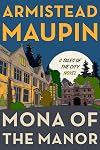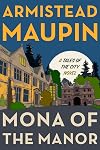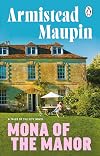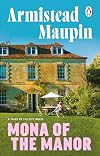
On This Page
Description
"The long-awaited tenth novel in Maupin's beloved and bestselling Tales of the City series, Mona of the Manor follows the adventures of Mona Ramsey--now the widowed Lady of a glorious old manor in the Cotswolds--and her fabulous butler-slash-adopted-son Wilfred, as they work to help an American visitor who has gotten herself in trouble"--Tags
Recommendations

















Member Reviews
Tenth in the Tales of the City series.
Maupin has announced at least twice that this series was finished, including after the previous book, The Days of Anna Madrigal. (The jacket flap copy identifies this one, too, as the "final episode.") And perhaps this time he really doesn't mean to carry his characters beyond where Days of Anna ended, because this volume is a flashback, filling in a piece of the story from earlier years.
It's set in the early 1990s, during the years that Mona Ramsey lived in England after marrying Lord Teddy Raughton. As we begin, Lord Teddy has died, and while he left her a lovely country manor, there wasn't much money. So Mona and her adopted son, Wilfrid, have turned Easley House into a glorified B&B, leaning show more heavily on the "stay at the home of an actual British Lady" angle.
We follow Mona and Wilfrid through several weeks at Easley House. They host a vacationing couple from North Carolina, and prepare for their annual Midsummer Festival open house/party. And this year, some of Mona's old friends from Barbaby Lane will be coming to visit for Midsummer.
These novels are comfort food for me. I enjoy the way Maupin combines deep, thoughtful consideration of emotional relationships with melodramatic, occasionally absurd plot twists. (As Mona reminds us in passing in this volume, this is a series in which one character spent several years artificially darkening her skin in order to pass for Black because "exotic" fashion models were in style at the time.)
Maupin is, I think, a more skilled writer than he generally gets credit for. He's often dismissed as a writer of pleasant fluff. But look at how quickly the first chapter of this book establishes the relationship between the arriving guests from North Carolina, or the precision of the dialogue in a conversation that exposes a deep divide in attitudes between Mona and her on-again, off-again girlfriend. Light entertainment is harder to pull off than it might seem, and very few do it as well as Maupin. show less
Maupin has announced at least twice that this series was finished, including after the previous book, The Days of Anna Madrigal. (The jacket flap copy identifies this one, too, as the "final episode.") And perhaps this time he really doesn't mean to carry his characters beyond where Days of Anna ended, because this volume is a flashback, filling in a piece of the story from earlier years.
It's set in the early 1990s, during the years that Mona Ramsey lived in England after marrying Lord Teddy Raughton. As we begin, Lord Teddy has died, and while he left her a lovely country manor, there wasn't much money. So Mona and her adopted son, Wilfrid, have turned Easley House into a glorified B&B, leaning show more heavily on the "stay at the home of an actual British Lady" angle.
We follow Mona and Wilfrid through several weeks at Easley House. They host a vacationing couple from North Carolina, and prepare for their annual Midsummer Festival open house/party. And this year, some of Mona's old friends from Barbaby Lane will be coming to visit for Midsummer.
These novels are comfort food for me. I enjoy the way Maupin combines deep, thoughtful consideration of emotional relationships with melodramatic, occasionally absurd plot twists. (As Mona reminds us in passing in this volume, this is a series in which one character spent several years artificially darkening her skin in order to pass for Black because "exotic" fashion models were in style at the time.)
Maupin is, I think, a more skilled writer than he generally gets credit for. He's often dismissed as a writer of pleasant fluff. But look at how quickly the first chapter of this book establishes the relationship between the arriving guests from North Carolina, or the precision of the dialogue in a conversation that exposes a deep divide in attitudes between Mona and her on-again, off-again girlfriend. Light entertainment is harder to pull off than it might seem, and very few do it as well as Maupin. show less
I was in high school when the first Tales of the City was released as a serial in the San Francisco Chronicle in 1976. My little crowd of misfits, who may or may have not known we would grow up to be the people we are, would gather in the locker area before classes started to discuss each day's installment. Regardless of how we identified at the time, having that story and the individuals who peopled it, gave us a sense that not only was it OK that we were who we were—whatever that was— but also that, dammit, we were kind of interesting. Maybe even marginally hip.
The central character of Mona of the Manor is, no surprise, Mona, a noncomformist, potty-mouthed lesbian who, via a brokered marriage with a Lord who longed to move to San show more Francisco, has become Lady of a manor. The manor is huge and crumbling, but not so crumbling that emergency evacuations need to be ordered. Mona offers a small B and B service and has generally had enough guests to allow her to manage the kind of bills that can crop up in a home originally built 400+ years ago. Some weekenders = a new water heater. A honeymoon = one more round of patching on the roof. Running the manor with Mona is her adopted son, Wilfred, who grew up in Britain, but is of aboriginal heritage. (For more of Wilfred's story, see Babycakes, the fourth volume in the series.) He's been looking for love, but it's hard going in the countryside where most of the gay men are halves of happy, retired couples.
Maupin is never shy about taking on issues in this series. In Mona of the Manor, Mona and Wilfred share the process of grieving friends who are dying of AIDS, get involved in scheming to protect a woman in a violent marriage, and plan a major Pagan summer solstice party. And more.
You can enter the Tales of the City series anywhere, and Mona of the Manor could be a good place to start since it moves back in time to the middle period of the series, so new readers can pick up a bit of background. To be honest, though, I would suggest reading the full series in order. I can absolutely assure you that time invested in Tales of the City is time very well spent. Oh hell, just ead whichever ones you can get your hands on—stat!
I received a free electronic review copy of this title from the publisher via Edelweiss; the opinions are my own. show less
The central character of Mona of the Manor is, no surprise, Mona, a noncomformist, potty-mouthed lesbian who, via a brokered marriage with a Lord who longed to move to San show more Francisco, has become Lady of a manor. The manor is huge and crumbling, but not so crumbling that emergency evacuations need to be ordered. Mona offers a small B and B service and has generally had enough guests to allow her to manage the kind of bills that can crop up in a home originally built 400+ years ago. Some weekenders = a new water heater. A honeymoon = one more round of patching on the roof. Running the manor with Mona is her adopted son, Wilfred, who grew up in Britain, but is of aboriginal heritage. (For more of Wilfred's story, see Babycakes, the fourth volume in the series.) He's been looking for love, but it's hard going in the countryside where most of the gay men are halves of happy, retired couples.
Maupin is never shy about taking on issues in this series. In Mona of the Manor, Mona and Wilfred share the process of grieving friends who are dying of AIDS, get involved in scheming to protect a woman in a violent marriage, and plan a major Pagan summer solstice party. And more.
You can enter the Tales of the City series anywhere, and Mona of the Manor could be a good place to start since it moves back in time to the middle period of the series, so new readers can pick up a bit of background. To be honest, though, I would suggest reading the full series in order. I can absolutely assure you that time invested in Tales of the City is time very well spent. Oh hell, just ead whichever ones you can get your hands on—stat!
I received a free electronic review copy of this title from the publisher via Edelweiss; the opinions are my own. show less
One of the most enjoyable and memorable reading experiences I’ve EVER had began back in the late 1980s when I first discovered Armistead Maupin’s series, TALES OF THE CITY.* At the time, he had written five or six books in the series and I must have gone through ALL of them in little more than two weeks. Periodically, over the following years, Maupin has dropped another novel and each time, I've rushed to the library to join the waiting list. The newest one, MONA OF THE MANOR (2024), is the tenth novel in the TALES series.
The books began as newspaper columns Maupin wrote for the San Francisco Chronicle, following a group of fictional 20-somethings as they establish adult lives in that city in the 1970s. Many of the characters show more identify as LGBTQIA, making Maupin one the first writers to normalize gender identify and sexual preference stories to a wide public audience.
The novels follow these same individuals over the years — as they age, build relationships, fall in love, confront an AIDS epidemic, marry, etc. The characters Maupin creates are rich, distinctive, flawed, fallible, and loving. Also, completely believable. And there’s enormous warmth, humanity, and humor in his writing.
With that as background, you will understand that as each new book in the series came along, reading it gave me another chance to reconnect with old friends and catch up on their changing lives -- just as mine was changing, sometimes in a parallel way. Some of these characters I have now loved for decades. And if there are any more books in the future, I will continue to follow these lives that have been part of my own for so long.
MONA OF THE MANOR centers on Mona Ramsey, now the widow of Lord Teddy Roughton, who is struggling to hold onto the beautiful but dilapidated Roughton country estate in the picturesque Cotswolds region of England. By opening her home as a B&B and treating travelers as family — she is just barely managing to stay ahead of expenses. When an American couple, the Blaylocks, arrive for a three-day stay — Mona, her adopted son Wilfred, and family dog play the perfect hosts. But almost immediately, the hosts get drawn into drama when Mrs. Blaylock reveals a secret about her marriage. And the plot takes off toward a suspenseful conclusion.
While this was not one of my favorite books in the series, it was nevertheless delightful to see what Mona was up to. And (if you’re familiar with the original Maupin group) to visit with Michael Tolliver and Anna Madrigal.
I cannot recommend the entire series highly enough. But please, for maximum enjoyment, read them in order. show less
The books began as newspaper columns Maupin wrote for the San Francisco Chronicle, following a group of fictional 20-somethings as they establish adult lives in that city in the 1970s. Many of the characters show more identify as LGBTQIA, making Maupin one the first writers to normalize gender identify and sexual preference stories to a wide public audience.
The novels follow these same individuals over the years — as they age, build relationships, fall in love, confront an AIDS epidemic, marry, etc. The characters Maupin creates are rich, distinctive, flawed, fallible, and loving. Also, completely believable. And there’s enormous warmth, humanity, and humor in his writing.
With that as background, you will understand that as each new book in the series came along, reading it gave me another chance to reconnect with old friends and catch up on their changing lives -- just as mine was changing, sometimes in a parallel way. Some of these characters I have now loved for decades. And if there are any more books in the future, I will continue to follow these lives that have been part of my own for so long.
MONA OF THE MANOR centers on Mona Ramsey, now the widow of Lord Teddy Roughton, who is struggling to hold onto the beautiful but dilapidated Roughton country estate in the picturesque Cotswolds region of England. By opening her home as a B&B and treating travelers as family — she is just barely managing to stay ahead of expenses. When an American couple, the Blaylocks, arrive for a three-day stay — Mona, her adopted son Wilfred, and family dog play the perfect hosts. But almost immediately, the hosts get drawn into drama when Mrs. Blaylock reveals a secret about her marriage. And the plot takes off toward a suspenseful conclusion.
While this was not one of my favorite books in the series, it was nevertheless delightful to see what Mona was up to. And (if you’re familiar with the original Maupin group) to visit with Michael Tolliver and Anna Madrigal.
I cannot recommend the entire series highly enough. But please, for maximum enjoyment, read them in order. show less
One of the most enjoyable and memorable reading experiences I’ve EVER had began back in the late 1980s when I first discovered Armistead Maupin’s series, TALES OF THE CITY.* At the time, he had written five or six books in the series and I must have gone through ALL of them in little more than two weeks. Periodically, over the following years, Maupin has dropped another novel and each time, I've rushed to the library to join the waiting list. The newest one, MONA OF THE MANOR (2024), is the tenth novel in the TALES series.
The books began as newspaper columns Maupin wrote for the San Francisco Chronicle, following a group of fictional 20-somethings as they establish adult lives in that city in the 1970s. Many of the characters show more identify as LGBTQIA, making Maupin one the first writers to normalize gender identify and sexual preference stories to a wide public audience.
The novels follow these same individuals over the years — as they age, build relationships, fall in love, confront an AIDS epidemic, marry, etc. The characters Maupin creates are rich, distinctive, flawed, fallible, and loving. Also, completely believable. And there’s enormous warmth, humanity, and humor in his writing.
With that as background, you will understand that as each new book in the series came along, reading it gave me another chance to reconnect with old friends and catch up on their changing lives -- just as mine was changing, sometimes in a parallel way. Some of these characters I have now loved for decades. And if there are any more books in the future, I will continue to follow these lives that have been part of my own for so long.
MONA OF THE MANOR centers on Mona Ramsey, now the widow of Lord Teddy Roughton, who is struggling to hold onto the beautiful but dilapidated Roughton country estate in the picturesque Cotswolds region of England. By opening her home as a B&B and treating travelers as family — she is just barely managing to stay ahead of expenses. When an American couple, the Blaylocks, arrive for a three-day stay — Mona, her adopted son Wilfred, and family dog play the perfect hosts. But almost immediately, the hosts get drawn into drama when Mrs. Blaylock reveals a secret about her marriage. And the plot takes off toward a suspenseful conclusion.
While this was not one of my favorite books in the series, it was nevertheless delightful to see what Mona was up to. And (if you’re familiar with the original Maupin group) to visit with Michael Tolliver and Anna Madrigal.
I cannot recommend the entire series highly enough. But please, for maximum enjoyment, read them in order. show less
The books began as newspaper columns Maupin wrote for the San Francisco Chronicle, following a group of fictional 20-somethings as they establish adult lives in that city in the 1970s. Many of the characters show more identify as LGBTQIA, making Maupin one the first writers to normalize gender identify and sexual preference stories to a wide public audience.
The novels follow these same individuals over the years — as they age, build relationships, fall in love, confront an AIDS epidemic, marry, etc. The characters Maupin creates are rich, distinctive, flawed, fallible, and loving. Also, completely believable. And there’s enormous warmth, humanity, and humor in his writing.
With that as background, you will understand that as each new book in the series came along, reading it gave me another chance to reconnect with old friends and catch up on their changing lives -- just as mine was changing, sometimes in a parallel way. Some of these characters I have now loved for decades. And if there are any more books in the future, I will continue to follow these lives that have been part of my own for so long.
MONA OF THE MANOR centers on Mona Ramsey, now the widow of Lord Teddy Roughton, who is struggling to hold onto the beautiful but dilapidated Roughton country estate in the picturesque Cotswolds region of England. By opening her home as a B&B and treating travelers as family — she is just barely managing to stay ahead of expenses. When an American couple, the Blaylocks, arrive for a three-day stay — Mona, her adopted son Wilfred, and family dog play the perfect hosts. But almost immediately, the hosts get drawn into drama when Mrs. Blaylock reveals a secret about her marriage. And the plot takes off toward a suspenseful conclusion.
While this was not one of my favorite books in the series, it was nevertheless delightful to see what Mona was up to. And (if you’re familiar with the original Maupin group) to visit with Michael Tolliver and Anna Madrigal.
I cannot recommend the entire series highly enough. But please, for maximum enjoyment, read them in order. show less
Armistead Maupin has got to the logical end of the Tales of the City series and stopped several times before, but his readers — or his publishers — have never let him get away with abandoning Anna Madrigal and the wonderful people who rented rooms in her house on Barbary Lane back in the seventies. Understandable when we had so much fun with those characters in the first few books, but perhaps we really ought to let Maupin move on to something else after nearly fifty years…
In real time the original characters would now all be far too old to have the sort of interesting comic adventures we look for in a Maupin story. Since the younger generation he introduced in the last couple of books are fine for Netflix but a bit out of the show more range of interest of Maupin and the boomers who actually buy his books, he has now resorted to breaking the sequence and setting this latest instalment thirty years ago, ten years after the events of Babycakes, with Mona and her adopted son Wilfred running a stately home in the Cotswolds. Mona is dallying with Poppy the sub-postmistress, and there’s a vaguely Hitchcockian plot (with shades of Wicker Man) involving some paying guests from North Carolina.
AIDS, Maupin’s old boss Jesse Helms, Thatcher and Clause 28 are still dominant themes (the actual Prime Minister, John Major, doesn’t rate a mention), but the Tories of the 1990s are sometimes clearly just stand-ins for the Tories of the 2020s, and there is a significant sidestep into the very 2020s theme of transphobia, a topic that has never crossed anyone’s mind before in nine books with a main character who is a trans woman.
Obviously, as an American — and worse, as an American now settled in London — writing about Britain, Maupin lays himself open to British readers crowing “Ha-ha!, that’s not how Britain works,” but he’s no Elizabeth George, he has obviously got his British friends to proof-read the manuscript and taken note of their comments, so there are only minor and very unimportant deviations from British reality (e.g. Mona going to the Post Office to collect her mail). He may well have left those in deliberately to tease us.
Of course, it’s nice to meet Mona again — I always felt Maupin pushed her off into the background too quickly in the early books — and to see walk-ons from some of the other core characters, but the plot doesn’t feel as well-engineered as usual, and the dialogue lacks the comic bite of Maupin’s best writing. If you’re already a Maupin fan, you will have bought this book anyway, but if you haven’t met him yet, go and read the early stuff, not this. It doesn’t do him justice. show less
In real time the original characters would now all be far too old to have the sort of interesting comic adventures we look for in a Maupin story. Since the younger generation he introduced in the last couple of books are fine for Netflix but a bit out of the show more range of interest of Maupin and the boomers who actually buy his books, he has now resorted to breaking the sequence and setting this latest instalment thirty years ago, ten years after the events of Babycakes, with Mona and her adopted son Wilfred running a stately home in the Cotswolds. Mona is dallying with Poppy the sub-postmistress, and there’s a vaguely Hitchcockian plot (with shades of Wicker Man) involving some paying guests from North Carolina.
AIDS, Maupin’s old boss Jesse Helms, Thatcher and Clause 28 are still dominant themes (the actual Prime Minister, John Major, doesn’t rate a mention), but the Tories of the 1990s are sometimes clearly just stand-ins for the Tories of the 2020s, and there is a significant sidestep into the very 2020s theme of transphobia, a topic that has never crossed anyone’s mind before in nine books with a main character who is a trans woman.
Obviously, as an American — and worse, as an American now settled in London — writing about Britain, Maupin lays himself open to British readers crowing “Ha-ha!, that’s not how Britain works,” but he’s no Elizabeth George, he has obviously got his British friends to proof-read the manuscript and taken note of their comments, so there are only minor and very unimportant deviations from British reality (e.g. Mona going to the Post Office to collect her mail). He may well have left those in deliberately to tease us.
Of course, it’s nice to meet Mona again — I always felt Maupin pushed her off into the background too quickly in the early books — and to see walk-ons from some of the other core characters, but the plot doesn’t feel as well-engineered as usual, and the dialogue lacks the comic bite of Maupin’s best writing. If you’re already a Maupin fan, you will have bought this book anyway, but if you haven’t met him yet, go and read the early stuff, not this. It doesn’t do him justice. show less
Seemingly effortless and so good, sweet and tart, like homemade lemonade. As well as all the sunlight, there is always a little darkness in this American confection of the Cotswolds with characters from the Tales of the City books.
With Mona Ramsey having lived for about ten years as “Lady of the Manor” at a fictionalised Jacobean house in the Cotswolds, not far from Moreton-in-the-Marsh, her latest paying guests create the slight plot of the novel, with her good friend Michael Tolliver and her mother, Anna Madrigal, visiting to provide a sense of conclusion.
To be read after the first six Tales of the City books to savour to the fullest richness of characterisation and references to earlier books (set in 1993, this tenth book about show more characters from Tales of the City comes before books 7-9 in publication order). show less
With Mona Ramsey having lived for about ten years as “Lady of the Manor” at a fictionalised Jacobean house in the Cotswolds, not far from Moreton-in-the-Marsh, her latest paying guests create the slight plot of the novel, with her good friend Michael Tolliver and her mother, Anna Madrigal, visiting to provide a sense of conclusion.
To be read after the first six Tales of the City books to savour to the fullest richness of characterisation and references to earlier books (set in 1993, this tenth book about show more characters from Tales of the City comes before books 7-9 in publication order). show less
I think I have the first six Tales of the City novels but reading the whole series isn't required to dip into the latest instalment. I was confused as to the date, however, assuming that the story is also set recently but actually takes place in 1993, which makes more sense!
The 'original' characters - Mona, Michael, Anna Madrigal - still hold up, although it's been a while. I did feel that the lecturing about transphobia and the Roma was quite forced, especially as 'transphobia' was first coined in 1992 (I looked it up). The discussion of HIV/AIDS was more relevant, considering the first ART was used around the time of the novel. And the subplot with the Blaylocks just sort of got in the way for me. That said, I did enjoy reuniting show more with familiar characters on English ground and the book was a quick read, which always helps! show less
The 'original' characters - Mona, Michael, Anna Madrigal - still hold up, although it's been a while. I did feel that the lecturing about transphobia and the Roma was quite forced, especially as 'transphobia' was first coined in 1992 (I looked it up). The discussion of HIV/AIDS was more relevant, considering the first ART was used around the time of the novel. And the subplot with the Blaylocks just sort of got in the way for me. That said, I did enjoy reuniting show more with familiar characters on English ground and the book was a quick read, which always helps! show less
Members
- Recently Added By
Lists

Books Read in 2024
4,623 works; 126 members
Author Information

40+ Works 24,031 Members
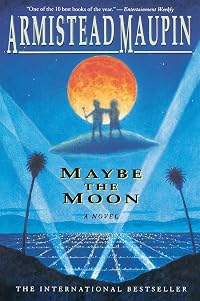
Armistead Maupin was born in Washington D.C. on May 13, 1944. He received a B.A. from the University of North Carolina at Chapel Hill. He served as a naval officer in the Mediterranean and with the River Patrol Force in Vietnam. He worked as a reporter for a newspaper in Charleston, South Carolina, before being assigned to the San Francisco bureau show more of the Associated Press in 1971. In 1976, he launched his groundbreaking Tales of the City serial in the San Francisco Chronicle. The series describes a group of characters that live together in a boarding house in San Francisco. Eventually, these Tales were collected into a series of six novels. In 1993, the British Broadcasting Company adapted them for a television series that aired on PBS in 1994. His other works include Maybe the Moon, Michael Tolliver Lives, and The Days of Anna Madrigal. The Night Listener was adapted into a movie starring Robin Williams and Toni Collette. (Bowker Author Biography) show less
Awards and Honors
Distinctions
The Guardian Book of the Day (2024-03-13)
Notable Lists
Series

Common Knowledge
- Canonical title
- Mona of the Manor
Classifications
Statistics
- Members
- 188
- Popularity
- 173,754
- Reviews
- 8
- Rating
- (3.76)
- Languages
- English, French, German
- Media
- Paper, Audiobook, Ebook
- ISBNs
- 15
- ASINs
- 4