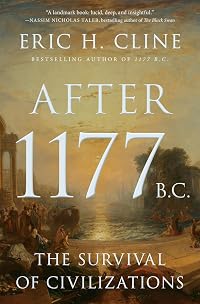
After 1177 B.C. : The Survival of Civilizations
by Eric H. Cline
On This Page
Description
In this gripping sequel to his bestselling 1177 B.C., Eric Cline tells the story of what happened after the Bronze Age collapsed--why some civilizations endured, why some gave way to new ones, and why some disappeared forever "A landmark book: lucid, deep, and insightful. . . . You cannot understand human civilization and self-organization without studying what happened on, before, and after 1177 B.C."--Nassim Nicholas Taleb, bestselling author of The Black Swan At the end of the acclaimed show more history 1177 B.C., many of the Late Bronze Age civilizations of the Aegean and Eastern Mediterranean lay in ruins, undone by invasion, revolt, natural disasters, famine, and the demise of international trade. An interconnected world that had boasted major empires and societies, relative peace, robust commerce, and monumental architecture was lost and the so-called First Dark Age had begun. Now, in After 1177 B.C., Eric Cline tells the compelling story of what happened next, over four centuries, across the Aegean and Eastern Mediterranean world. It is a story of resilience, transformation, and success, as well as failures, in an age of chaos and reconfiguration. After 1177 B.C. tells how the collapse of powerful Late Bronze Age civilizations created new circumstances to which people and societies had to adapt. Those that failed to adjust disappeared from the world stage, while others transformed themselves, resulting in a new world order that included Phoenicians, Philistines, Israelites, Neo-Hittites, Neo-Assyrians, and Neo-Babylonians. Taking the story up to the resurgence of Greece marked by the first Olympic Games in 776 B.C., the book also describes how world-changing innovations such as the use of iron and the alphabet emerged amid the chaos. Filled with lessons for today's world about why some societies survive massive shocks while others do not, After 1177 B.C. reveals why this period, far from being the First Dark Age, was a new age with new inventions and new opportunities. show lessTags
Recommendations









Member Reviews
Written in the spirit of it can happen here too, Cline follows up his account of the collapse of the Late Bronze Age world of the Mediterranean with a consideration of what happened next, why some cultures went on to new heights, some muddled along, and some just failed.
Here's the thing, very few specialists really believe in a post-1177 BC "dark age" anymore, at least in the pejorative sense. Cline would rather speak of the Early Iron Age and be done with it, though there is no denying that some organized states, particularly the Hittites and the Mycenaean Greeks took it in the neck. If nothing else, Cline would like to disabused the general reader about some old thinking, and enlighten them about new research.
Apart from that, Cline is show more haunted about the potential collapse of the current world system, particularly due to climate change and plague (what likely did in the complex of Late Bronze Age polities), and does use the example of the past to try and illuminate the present, and encourage his readers to take these issues seriously while there is still time.
I thought this was good stuff, but Cline is very cautious about his findings and I can see where the reader who wants a little more surety might be frustrated. show less
Here's the thing, very few specialists really believe in a post-1177 BC "dark age" anymore, at least in the pejorative sense. Cline would rather speak of the Early Iron Age and be done with it, though there is no denying that some organized states, particularly the Hittites and the Mycenaean Greeks took it in the neck. If nothing else, Cline would like to disabused the general reader about some old thinking, and enlighten them about new research.
Apart from that, Cline is show more haunted about the potential collapse of the current world system, particularly due to climate change and plague (what likely did in the complex of Late Bronze Age polities), and does use the example of the past to try and illuminate the present, and encourage his readers to take these issues seriously while there is still time.
I thought this was good stuff, but Cline is very cautious about his findings and I can see where the reader who wants a little more surety might be frustrated. show less
Dr. Eric H. Cline’s second book on the Late Bronze Age Collapse, called “After 1177 BC,” follows up his popular 2014 chronicle of the Late Bronze Age Collapse, “1177 BC.” In the previous volume he adopted an arbitrary date for the well-known calamity that brought several ancient civilizations to their knees, and others to the dustbin of history. In his new compendium Dr. Kline picks eight flourishing, civilized Eastern Mediterranean cultures and provides serious, nuanced accounts of which these civilizations adapted and thrived, which survived but barely, and which simply disappeared. It is a highly illuminating read.
As you might expect in an academic treatise, he lays out the facts of dates, regimes, industrial and trade show more practices, migration, and warfare methodically. He always couches his facts in terms of reliable sources, and where his sources lead to doubt, Dr. Cline faithfully reports the reasons for and the extent of the uncertainty. The result is a closely reasoned, well-organized recounting, that gains credibility as we go along.
At volume’s end, he presents a table to list the ancient civilizations and the fate of each in the wake of the Late Bronze Age Collapse. He presupposes that the reader is aware of the episode, but in case you need a refresher: early in the 12th Century BCE some combination of unanticipated forces: a spate of powerful earthquakes, climate change leading to drought and famine, and/or multiple waves of mysterious invaders from faraway lands, resulted in the simultaneous collapse of trade, economic depression, war, revolution, the splintering of populations, and the retrogression of technological standards. It was the end of the world as the well-established cultures of the ancient Eastern Mediterranean knew it.
But Professor Cline’s mission is to provide a closer, more nuanced look at the effects of the calamity, and his combination of rigorous analysis and careful filling-in-the-blanks works superbly. His ultimate recap, a carefully laid-out table featuring the cultures of the time and how each weathered, or failed to weather, the Collapse, adds to the general public’s understanding, and provides a nexus for the professional archeological and historical work which will follow. (I will quibble with the professor’s use of the term BC instead of the more current BCE to describe the time period. Presumably the title of the initial volume of 11 years ago led to the practice, but it’s too bad.)
In the end, Professor Cline urges the general public to drop the idea that the period led to an early Dark Age, and simply refer to the emerging epoch as the Iron Age. His book is at once encyclopedic and daringly speculative. A terrific effort from a foremost expert.
https://bassoprofundo1.blogspot.com/2025/12/after-1177-bc-by-eric-h-cline-phd.ht... show less
As you might expect in an academic treatise, he lays out the facts of dates, regimes, industrial and trade show more practices, migration, and warfare methodically. He always couches his facts in terms of reliable sources, and where his sources lead to doubt, Dr. Cline faithfully reports the reasons for and the extent of the uncertainty. The result is a closely reasoned, well-organized recounting, that gains credibility as we go along.
At volume’s end, he presents a table to list the ancient civilizations and the fate of each in the wake of the Late Bronze Age Collapse. He presupposes that the reader is aware of the episode, but in case you need a refresher: early in the 12th Century BCE some combination of unanticipated forces: a spate of powerful earthquakes, climate change leading to drought and famine, and/or multiple waves of mysterious invaders from faraway lands, resulted in the simultaneous collapse of trade, economic depression, war, revolution, the splintering of populations, and the retrogression of technological standards. It was the end of the world as the well-established cultures of the ancient Eastern Mediterranean knew it.
But Professor Cline’s mission is to provide a closer, more nuanced look at the effects of the calamity, and his combination of rigorous analysis and careful filling-in-the-blanks works superbly. His ultimate recap, a carefully laid-out table featuring the cultures of the time and how each weathered, or failed to weather, the Collapse, adds to the general public’s understanding, and provides a nexus for the professional archeological and historical work which will follow. (I will quibble with the professor’s use of the term BC instead of the more current BCE to describe the time period. Presumably the title of the initial volume of 11 years ago led to the practice, but it’s too bad.)
In the end, Professor Cline urges the general public to drop the idea that the period led to an early Dark Age, and simply refer to the emerging epoch as the Iron Age. His book is at once encyclopedic and daringly speculative. A terrific effort from a foremost expert.
https://bassoprofundo1.blogspot.com/2025/12/after-1177-bc-by-eric-h-cline-phd.ht... show less
The Bronze Age Collapse and the development of the Early Iron Age has proven fundamental - and haunting - for Western civilization. It has proven no less interesting ever since we have explored these matters archaeologically.
Eric Cline well narrated the story of the Bronze Age Collapse in 1177 B.C. His highly anticipated sequel, After 1177 B.C.: The Survival of Civilizations, certainly delivers.
The author surveys our current understanding of the history of the Early Iron Age, from 1200 BCE until something like 700ish BCE, by considering archaeological discoveries and what later textual evidence can be brought to bear on this time period throughout the ancient Near East. The author wisely approaches the subject by general geographic show more area and not according to time.
There’s no doubt major changes took place in the couple of centuries following 1200 BCE throughout the region. No area remains unaffected.
But the level and duration of impact would vary significantly throughout the region. The southern Levant, including the area of Israel, seemed to have increased in population and saw the development of many small independent kingdoms; if anything, this area flourished during the Early Iron Age. Phoenicia and Cyprus took full advantage of the situation and developed their maritime exploits. Assyria and Babylon went through a period of relative instability, but by the 10th century BCE the king lists and records exist again, displaying a significant amount of continuity in Assyria, and despite a different population in Babylon, the societal traditions continued as they had in the Bronze Age.
Others did not fare as well. Egypt perhaps maintained the most cultural continuity, but the political and economic strength of the Late Bronze Age would never be replicated. They managed but never adapted, and thus were eliminated as a going concern in 525 BCE. The Hittite Empire completely disintegrated, but Neo-Hittite rulers persevered in Carchemish, and many of the Luwian speaking people continued to uphold Hittite culture and traditions for centuries; the Luwians and Aramaeans developed all sorts of little kingdoms throughout the northern Levant and eastern Asia Minor, all of which would eventually be overrun by Assyria.
Yet perhaps no group fell as spectacularly as the Mycenaean Greeks. Their palace civilization, or at least the highest echelons of it, were gone by the middle of the twelfth century BCE. Within two hundred years, many of the most prominent Mycenaean cities were depopulated. The author, as well as many others, remain dismissive of the “Dorian invasion” later Greeks spoke of at this time, but without a doubt there was significant population movement, and the population of central and southern Greece was cut in half. Archaic and Classical Greeks would still serve the same gods, or at least gods with the same names; they championed the Iliad and the Odyssey as their origin stories; they spoke a later version of Greek; but otherwise they maintained almost no continuity with the Mycenaeans, using a different alphabet and maintaining completely different political and economic structures, all of which developed during this Early Iron Age.
Previous generations spoke of this period as the Dark Age, and they meant it primarily in terms of the Greeks. Israel would never consider this period a Dark Age; if anything, it was their Golden Age, the halcyon days of David and Solomon to which they would ever aspire afterward. The author represents the current consensus view, however, that “Dark Age” was a bit too much as a description. Over the past few years there have been significant archaeological finds dating from this period of 1177-776 BCE, and these finds attest to a changed situation in Greece, but not entirely dismal. There is still trade with the Mediterranean world; there are still quality grave goods.
And so we do best to speak of it as the Early Iron Age without prejudice. As is often pointed out, the crisis of the collapse of the Bronze Age led to developments which allowed for the Classical world, and thus the world as we know it, to develop and flourish, and such would have been far less likely if the Bronze Age hegemons did not experience a time of collapse or retreat. It allowed for state creation in the Levant; it led to the development of the constellation of the Greek poleis and their constant competition.
The book concludes with the author’s assessments of the evidence as well as consideration according to the 2012 IPCC adaptation and resilience frameworks. This speaks to the modern obsession with the collapse of the Late Bronze Age: we are haunted by the prospect of our own collapse and fear it greatly. We would do well to become more adaptive and resilient, but it will likely have to be imposed on us by circumstances, and those circumstances will test and prove us as it did those in the days of the Late Bronze Age and afterward. show less
Eric Cline well narrated the story of the Bronze Age Collapse in 1177 B.C. His highly anticipated sequel, After 1177 B.C.: The Survival of Civilizations, certainly delivers.
The author surveys our current understanding of the history of the Early Iron Age, from 1200 BCE until something like 700ish BCE, by considering archaeological discoveries and what later textual evidence can be brought to bear on this time period throughout the ancient Near East. The author wisely approaches the subject by general geographic show more area and not according to time.
There’s no doubt major changes took place in the couple of centuries following 1200 BCE throughout the region. No area remains unaffected.
But the level and duration of impact would vary significantly throughout the region. The southern Levant, including the area of Israel, seemed to have increased in population and saw the development of many small independent kingdoms; if anything, this area flourished during the Early Iron Age. Phoenicia and Cyprus took full advantage of the situation and developed their maritime exploits. Assyria and Babylon went through a period of relative instability, but by the 10th century BCE the king lists and records exist again, displaying a significant amount of continuity in Assyria, and despite a different population in Babylon, the societal traditions continued as they had in the Bronze Age.
Others did not fare as well. Egypt perhaps maintained the most cultural continuity, but the political and economic strength of the Late Bronze Age would never be replicated. They managed but never adapted, and thus were eliminated as a going concern in 525 BCE. The Hittite Empire completely disintegrated, but Neo-Hittite rulers persevered in Carchemish, and many of the Luwian speaking people continued to uphold Hittite culture and traditions for centuries; the Luwians and Aramaeans developed all sorts of little kingdoms throughout the northern Levant and eastern Asia Minor, all of which would eventually be overrun by Assyria.
Yet perhaps no group fell as spectacularly as the Mycenaean Greeks. Their palace civilization, or at least the highest echelons of it, were gone by the middle of the twelfth century BCE. Within two hundred years, many of the most prominent Mycenaean cities were depopulated. The author, as well as many others, remain dismissive of the “Dorian invasion” later Greeks spoke of at this time, but without a doubt there was significant population movement, and the population of central and southern Greece was cut in half. Archaic and Classical Greeks would still serve the same gods, or at least gods with the same names; they championed the Iliad and the Odyssey as their origin stories; they spoke a later version of Greek; but otherwise they maintained almost no continuity with the Mycenaeans, using a different alphabet and maintaining completely different political and economic structures, all of which developed during this Early Iron Age.
Previous generations spoke of this period as the Dark Age, and they meant it primarily in terms of the Greeks. Israel would never consider this period a Dark Age; if anything, it was their Golden Age, the halcyon days of David and Solomon to which they would ever aspire afterward. The author represents the current consensus view, however, that “Dark Age” was a bit too much as a description. Over the past few years there have been significant archaeological finds dating from this period of 1177-776 BCE, and these finds attest to a changed situation in Greece, but not entirely dismal. There is still trade with the Mediterranean world; there are still quality grave goods.
And so we do best to speak of it as the Early Iron Age without prejudice. As is often pointed out, the crisis of the collapse of the Bronze Age led to developments which allowed for the Classical world, and thus the world as we know it, to develop and flourish, and such would have been far less likely if the Bronze Age hegemons did not experience a time of collapse or retreat. It allowed for state creation in the Levant; it led to the development of the constellation of the Greek poleis and their constant competition.
The book concludes with the author’s assessments of the evidence as well as consideration according to the 2012 IPCC adaptation and resilience frameworks. This speaks to the modern obsession with the collapse of the Late Bronze Age: we are haunted by the prospect of our own collapse and fear it greatly. We would do well to become more adaptive and resilient, but it will likely have to be imposed on us by circumstances, and those circumstances will test and prove us as it did those in the days of the Late Bronze Age and afterward. show less
I really liked 1177 B.C.: The Year Civilization Collapsed, I thought it added a lot of clarity to a confused debate about the bronze age collapse, and systematically went through the leading theories, settling on a "bit of everything" answer.
With this book it felt like the inverse, taking a fairly defined dark age and adding scraps of finds and fragments of writing, along with a string of might, may, can have to inject mostly confusion - to the point Cline is questioning the depiction of this period as a dark age at all. Which undermines his previous book's whole point.
Now I appreciate that there's always debates ongoing, and that the drop in sources make it harder to give definite answers, and easier to suggest rival theories. But show more according to Cline's preface this is aimed at a general audience, and not the scholars ready to rake him over the coals for not having enough detail. What is the takeaway here really? I read it twice and I still don't have a good idea.
The attempts to tie the narrative of collapse (or resilience) to current day issues like climate change, the corona pandemic and Taleb's Antifragile felt more tacked on than in the previous book. Jared Diamond wrote a whole book about it in Collapse: How Societies Choose to Fail or Succeed, which although it also has problems actually makes this discussion the central point, with examples from more information rich eras to draw lessons from. Cline never really manages to tie that thread together other than as a vague warning of "things I read in the news sure remind me of the bronze age". Actual lessons for resilience can't really be created when the main narrative is so full of maybes. show less
With this book it felt like the inverse, taking a fairly defined dark age and adding scraps of finds and fragments of writing, along with a string of might, may, can have to inject mostly confusion - to the point Cline is questioning the depiction of this period as a dark age at all. Which undermines his previous book's whole point.
Now I appreciate that there's always debates ongoing, and that the drop in sources make it harder to give definite answers, and easier to suggest rival theories. But show more according to Cline's preface this is aimed at a general audience, and not the scholars ready to rake him over the coals for not having enough detail. What is the takeaway here really? I read it twice and I still don't have a good idea.
The attempts to tie the narrative of collapse (or resilience) to current day issues like climate change, the corona pandemic and Taleb's Antifragile felt more tacked on than in the previous book. Jared Diamond wrote a whole book about it in Collapse: How Societies Choose to Fail or Succeed, which although it also has problems actually makes this discussion the central point, with examples from more information rich eras to draw lessons from. Cline never really manages to tie that thread together other than as a vague warning of "things I read in the news sure remind me of the bronze age". Actual lessons for resilience can't really be created when the main narrative is so full of maybes. show less
I acknowledge that I was very negative about Cline’s first book “1177 BC, the Collapse of Civilization”: although his detailed account was quite nuanced, he completely missed the mark with the title, the introductory chapters and his conclusion. Yes, there was definitely something going on in the Late Bronze Age (between 1200 and 1100 bce), in the Aegean and the Eastern Mediterranean. But no, this was not a collapse of civilization, not completely in that area, and certainly not outside of it. With this sequel, “After 1177 bc”, Cline actually proves me right (not that he necessarily had to): this book is full of nuances on his previous book. Progressive insight, shall we say?
More in my History account on Goodreads: show more target="_top">https://www.goodreads.com/review/show/6156600070. show less
More in my History account on Goodreads: show more target="_top">https://www.goodreads.com/review/show/6156600070. show less
Ten years after detailing the collapse of, among others, the Egyptian, Assyrian, and Minoan trading civilizations at the end of the twelfth century BCE, Eric H. Cline tells us how the late Bronze Age morphed into the Iron Age, how some cultures recovered and while others failed. The Egyptian civilization never fully recovered. The Assyrians migrated out of Anatolia. Israel and Judah had a complex history that Cline gives a book of its own. Babylonians became Neo-Babylonians. Minoan and Mycenaean cultures disappeared, while the Mediterranean became a “Phoenician lake.” Cultures collapsed for different reasons and recovered to varying degrees for various reasons. The message for us is to prepare for the worst and be as flexible as show more possible when it happens. show less
After collapse, people were still around, albeit usually living in smaller communities with less complex political structures—including not having public buildings, an interesting detail. Some civilizations disappeared, like the Minoans, and some retreated, like Egypt (which was never again as great a power and often had multiple rulers in different parts), while some ultimately reconfigured (Greece and Rome).
Members
- Recently Added By
Published Reviews
ThingScore 100
With 14 illustrations, 8 useful tables, a dramatis personae, excellent notes, an exhaustive bibliography, and index, After 1177 B.C.—well written in a clear, engaging, even witty style, using archaeology with sensitivity and lightness of touch—is a tour de force, heartily to be recommended to anyone interested not only in antiquity but in the present and potential future.
added by bookfitz
"What did the dawning Iron Age do for us? Monotheism, coinage, innovations in iron-working, the Greek alphabet, the polis (city-state), the origins of democracy in Athens and the nation-state in Jerusalem, and, as Mr. Cline’s expert, ingenious and endlessly fascinating book shows, an ancient lesson in the lately rediscovered virtue of “resilience.”"
added by ndara
Cline distills an immense amount of material into a highly readable narrative that in its conclusion draws startling parallels with contemporary climate change. It’s a dizzying feat of scholarship.
added by bookfitz
Author Information

33+ Works 4,106 Members
Eric H. Cline is professor of classics and anthropology and director of the Capitol Archaeological Institute George Washington University.
Awards and Honors
Series
Belongs to Publisher Series
Common Knowledge
- Canonical title
- After 1177 B.C. : The Survival of Civilizations
- Original title
- After 1177 B.C. : The Survival of Civilizations
- Original publication date
- 2024
- People/Characters
- Ramses XI; Assurnasirpal II
- Important places
- Egypt; Greece; Assyria; Phonenicia; Mycenae
- Epigraph
- Someone once said that his favorite times in history
were when things were collapsing,
because that meant something new was being born.
- Julian Barnes, The Sense of an Ending (2011) - Dedication
- Dedicated to
Diane Harris Cline
Classicist and Cellist - First words
- Sweeping down from the north, wielding gleaming weapons of sharp iron, the fierce Dorian warriors brought a quick end to the Mycenaean civilization shortly after 1200 BC.
- Last words
- (Click to show. Warning: May contain spoilers.)As the alpha phase of the adaptive cycle in this area, rather than a dark age, this period was the start of something new, a set of ideas and cultures that ultimately resulted in the world to which we now belong.
- Blurbers
- Taleb, Nassim Nicholas; Morris, Ian; Parcak, Sarah; Quinn, Josephine; Papadopoulos, John K.
- Original language
- English
Classifications
- Genres
- History, Anthropology, Nonfiction, General Nonfiction
- DDC/MDS
- 937.01 — History & geography History of ancient world (to ca. 499) Italian Peninsula to 476 and adjacent territories to 476 Kings 753-509 B.C.
- LCC
- GN780.25 .C55 — Geography, Anthropology and Recreation Anthropology Anthropology Prehistoric archaeology
- BISAC
Statistics
- Members
- 356
- Popularity
- 88,341
- Reviews
- 9
- Rating
- (3.65)
- Languages
- 6 — English, French, German, Italian, Spanish, Turkish
- Media
- Paper, Audiobook, Ebook
- ISBNs
- 10
- ASINs
- 5