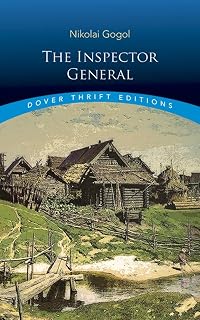
The Inspector General
by Nikolai Gogol
On This Page
Description
Although it may read to modern audiences like a hilarious slapstick comedy, The Inspector-General is actually much more than that. Famed Russian writer Nikolai Gogol intended it to be a veiled but pointed satire of the ineptitude, corruption, and greed that exemplified the Russian bureaucracy in the nineteenth century. The witty play was later used as the basis for a movie version starring Danny Kaye (1949)..
Tags
Recommendations











Member Recommendations
Member Reviews
I taught Gogol's Dead Souls a few times, but have just re-read this, a book I bought at a Princeton postdoc seminar in 1978, with the noted Russian scholar Kathryn Szczepanska (Hunter Coll) in it.
Gogol's comedy satirizes the ranks of Czarist government, where a “federal” inspector is rumored to be looking into this rural town, and the fearful residents seize on a slim college-age gambler passing through as the great authority because he exhibits classy manners from St Petersburg. Hilarious because so precisely observed from life: the “types,” first, the unimaginative Superintendent of Schools, Luka; 2) the Judge, named “Bungle-Steal,” who has read six books, a bit of a Freethinker, who lets the courtroom janitors raise geese show more in his court;3) the Town Manager/ Police Chief, center of the play, takes bribes (of course, but he asserts mostly hunting dog puppies) and worries about complaints; 4) the simple Postmaster, who opens every letter, out of traditional curiosity and caution; and 5) the Supervisor of Charitable Institutions (the hospital and prison), corpulent and awkward, but still a schemer. Lower on the hierarchy of power, Tweedle-dee and Tweedle-dum, Bobchinsky and Dubchinsky, both fat gesticulators; various functionaries and cops, like the one who’s sent into the suburbs to break up a fight, and comes back near sunrise drunk. Boozing or alcoholism features as a running theme, along with Bribery or Corruption.
In the last page the Police Chief recognizes he has made a complete fool of himself, but blames the tattling young Whiper-Snapper who “skims along the road with his bells jingling! He’ll spread the story all over the earth!” Gogol’s Chichikov in Dead Souls, six years later, travels the vast country in a tax scam, amassing peasants and wealth from illiterates. (Other traveller-satirists: Faulkner’s Ratliffe in his trilogy, as well as Tom Sawyer.) The Police Chief, on his rung in the top-down government, compares the young tale-teller to journalists, “You quill-drivers, you damned Liberals! you devil’s breed”(230).
Talk about continuing relevance. And get this: Gogol is from Ukraine, where the college he attended now bears his name, a Nizhyn Gogol State University. If Manaford had been studying Gogol in Ukraine, I would be his chief supporter; but curiously, “plus ça change” Putin’s Russia has the same top-down hierarchy of Czarist, and even Soviet Russia.
Wonderfully, as the Police Chief’s wife looks forward to the Capital City, she anticipates “all sorts of delicate soups” and I was told decades ago that beside blintzes, Russian cuisine has only two high points, bread and soup. In fact, in first year Russian we were taught, ordering food, to order soup: Я хочу супу (soupu).
When deciding how to bribe the young Inspector, direct money may be frowned on, so “how about an offering from the nobility for a monument of some kind?” Then the Postmaster offers, “here is some money left unclaimed at the Post Office”(199). Think of the US fight over Confederate monuments today, and of course the tearing down of Soviet monuments by Eastern European cities free from Moscow’s yoke—for how much longer?
The issue of memorializing Confederate White Supremacy brings us to the caution that Gogol, as arguably Shakespeare, assumes a casual anti-Semitism. Probably both derive from ignorance, having met precious few Jews—whom I must add, have formed most of my lifelong friends. Additionally, with Gogol, a comic master has to build on common assumptions. (Occasionally Gogol contradicts himself on this, noting that the anti-Police Chief complaints issue from the illiterate businessmen, who are Jews. Even the anti-Semitic would admit Jews are enviably literate.)
In one last 21st C US parallel, Gogol was converted by an Elder, to see his comic writing as sin. He burned most of the MS to his Dead Souls, part 2 (Purgatory, on the model of Dante's Divina Commedia.) The house where he burned his MS still stands, in Moscow.
And like Griboyedov, Gogol died young, only eight years older, at 42, largely of self-induced ascetic malnourishment. show less
Gogol's comedy satirizes the ranks of Czarist government, where a “federal” inspector is rumored to be looking into this rural town, and the fearful residents seize on a slim college-age gambler passing through as the great authority because he exhibits classy manners from St Petersburg. Hilarious because so precisely observed from life: the “types,” first, the unimaginative Superintendent of Schools, Luka; 2) the Judge, named “Bungle-Steal,” who has read six books, a bit of a Freethinker, who lets the courtroom janitors raise geese show more in his court;3) the Town Manager/ Police Chief, center of the play, takes bribes (of course, but he asserts mostly hunting dog puppies) and worries about complaints; 4) the simple Postmaster, who opens every letter, out of traditional curiosity and caution; and 5) the Supervisor of Charitable Institutions (the hospital and prison), corpulent and awkward, but still a schemer. Lower on the hierarchy of power, Tweedle-dee and Tweedle-dum, Bobchinsky and Dubchinsky, both fat gesticulators; various functionaries and cops, like the one who’s sent into the suburbs to break up a fight, and comes back near sunrise drunk. Boozing or alcoholism features as a running theme, along with Bribery or Corruption.
In the last page the Police Chief recognizes he has made a complete fool of himself, but blames the tattling young Whiper-Snapper who “skims along the road with his bells jingling! He’ll spread the story all over the earth!” Gogol’s Chichikov in Dead Souls, six years later, travels the vast country in a tax scam, amassing peasants and wealth from illiterates. (Other traveller-satirists: Faulkner’s Ratliffe in his trilogy, as well as Tom Sawyer.) The Police Chief, on his rung in the top-down government, compares the young tale-teller to journalists, “You quill-drivers, you damned Liberals! you devil’s breed”(230).
Talk about continuing relevance. And get this: Gogol is from Ukraine, where the college he attended now bears his name, a Nizhyn Gogol State University. If Manaford had been studying Gogol in Ukraine, I would be his chief supporter; but curiously, “plus ça change” Putin’s Russia has the same top-down hierarchy of Czarist, and even Soviet Russia.
Wonderfully, as the Police Chief’s wife looks forward to the Capital City, she anticipates “all sorts of delicate soups” and I was told decades ago that beside blintzes, Russian cuisine has only two high points, bread and soup. In fact, in first year Russian we were taught, ordering food, to order soup: Я хочу супу (soupu).
When deciding how to bribe the young Inspector, direct money may be frowned on, so “how about an offering from the nobility for a monument of some kind?” Then the Postmaster offers, “here is some money left unclaimed at the Post Office”(199). Think of the US fight over Confederate monuments today, and of course the tearing down of Soviet monuments by Eastern European cities free from Moscow’s yoke—for how much longer?
The issue of memorializing Confederate White Supremacy brings us to the caution that Gogol, as arguably Shakespeare, assumes a casual anti-Semitism. Probably both derive from ignorance, having met precious few Jews—whom I must add, have formed most of my lifelong friends. Additionally, with Gogol, a comic master has to build on common assumptions. (Occasionally Gogol contradicts himself on this, noting that the anti-Police Chief complaints issue from the illiterate businessmen, who are Jews. Even the anti-Semitic would admit Jews are enviably literate.)
In one last 21st C US parallel, Gogol was converted by an Elder, to see his comic writing as sin. He burned most of the MS to his Dead Souls, part 2 (Purgatory, on the model of Dante's Divina Commedia.) The house where he burned his MS still stands, in Moscow.
And like Griboyedov, Gogol died young, only eight years older, at 42, largely of self-induced ascetic malnourishment. show less
A corrupt governor and his cadre of equally inefficient officials in a small Russian provincial town mistake the protagonist to be an esteemed Inspector General. Despite being a 19th century Russian novel, the English version still translates well enough to convey a funny, sarcastic view of the sycophantic nature of lower-level officials in the huge Russian bureaucratic machinery.
This was an O Level in English literature. Really. In 1968. Gogol born in 1809. Superb analysis of human race - how stupid we can all be, at every level. Last sentence, perfect.
В книгу вошли драматические произведения Н.В.Гоголя (1809-1852) и "Выбранные места из переписки с друзьями". Комедия "Ревизор" (1836) - вершина творчества Гоголя-драматурга, в пьесе соединены критика российской общественной жизни XIX века, сатирическое изображение русских характеров и трагическое повествование о "заблудших душах" в преддверии Страшного суда. "Выбранные места из переписки с друзьями" (1847) - духовное show more завещание Гоголя, главная тема которого - соотношение Церкви и культуры. show less
The Government Inspector is a short, fast-paced satirical farce. I felt like it lacked some of Gogol's habitual mystic insanity, but as a comedy it fits neatly into the vein of its contemporaries.
Almost George-Bernard-Shaw-esque. With a lot of potential for physical comedy.
The inevitable question becomes-- how does this compare with the Danny Kaye film of the same name? And, like most adaptations, my answer would be: there are good points to both.
The inevitable question becomes-- how does this compare with the Danny Kaye film of the same name? And, like most adaptations, my answer would be: there are good points to both.
Brilliant comedy by one of the masters of Russian lit. Pokes fun at mistaken identities and foolishness of Imperial Russian society.
Members
- Recently Added By
Lists

Plays I Like
230 works; 31 members

Russian Literature
184 works; 35 members

Harold Bloom - The Western Canon: C. The Democratic Age
336 works; 15 members

Favourite Books
1,820 works; 308 members

Books Read in 2018
4,360 works; 110 members

19th Century
190 works; 16 members
My Play Collection
769 works; 3 members

Books Read in 2025
4,128 works; 98 members
Author Information

600+ Works 29,088 Members
Nikolai Vasilevich Gogol was born in 1809 in the Ukraine. His father was an amateur playwright who had a small estate with a number of serfs. From the ages of 12 to 19, young Gogol attended a boarding school where he became known for his sharp wit and ability to amuse his classmates. After school he worked as a government clerk. He soon began show more writing memories of his childhood. His quaint depictions of the Ukrainian countryside marked his style and helped to make him famous. Gogol quickly gained fame and formed a friendship with the influential poet, Aleksandr Pushkin. Gogol is largely remembered for his realistic characterizations, his rich imagination, and his humorous style. His works include Mirgorod, a collection of short stories including Taras Bulba. Gogol's wit is evident in his short story, The Nose, where a man's nose wanders off around town in a carriage. Gogol's masterpiece is the novel Dead Souls. In this work, a swindler plots to buy from landowners their dead serfs. Towards the end of Gogol's life, his creative powers faded and he fled to Moscow. Here, he came under the power of a fanatical priest. Ten days before his death he burned some manuscripts of the second part of Dead Souls. He died of starvation in 1852, on the cusp of madness. (Bowker Author Biography) show less
Some Editions
Awards and Honors
Series
Belongs to Publisher Series
Work Relationships
Is contained in
Has the adaptation
Has as a student's study guide
Common Knowledge
- Canonical title
- The Inspector General
- Original title
- Ревизор
- Alternate titles
- The Inspector General; The Inspector
- Original publication date
- 1836; 2014 (English translation) (English translation)
- Related movies
- Wishbone" Rushin' to the Bone (IMDb); The Inspector General (1949 | IMDb)
- Epigraph
- Dont blame the mirror if your mug's askew.
Popular saying
Don't blame the looking-glass if your mug is crooked.
POPULAR PROVERB - First words
- CHIEF OF POLICE: I have invited you here, gentlemen, in order to communicate to you a most unpleasant piece of news: a government inspector is coming to visit us.
- Last words
- (Click to show. Warning: May contain spoilers.)For nearly a minute and a half the group remains in this position.
THE CURTAIN FALLS
Classifications
- Genre
- Fiction and Literature
- DDC/MDS
- 891.73 — Literature & rhetoric Literatures of other languages East Indo-European and Celtic literatures Russian and East Slavic languages Russian fiction
- LCC
- PG3333 .R4 — Language and Literature Slavic languages and literatures. Baltic languages. Albanian language Slavic. Baltic. Albanian Russian literature Individual authors and works 1800-1870 Gogol'
- BISAC
Statistics
- Members
- 1,081
- Popularity
- 23,768
- Reviews
- 10
- Rating
- (4.07)
- Languages
- 24 — Catalan, Czech, Danish, Dutch, English, Esperanto, Estonian, Finnish, French, German, Greek, Hungarian, Italian, Norwegian (Bokmål), Polish, Russian, Serbian, Slovenian, Spanish, Swahili, Swedish, Turkish, Welsh, Portuguese (Portugal)
- Media
- Paper, Audiobook, Ebook
- ISBNs
- 147
- UPCs
- 1
- ASINs
- 35