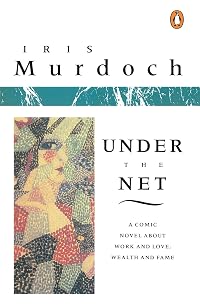
Under the Net
by Iris Murdoch 
On This Page
Description
Iris Murdoch's debut--a comic novel about work and love, wealth and fame Jake Donaghue, garrulous artist, meets Hugo Bellfounder, silent philosopher. Jake, hack writer and sponger, now penniless flat-hunter, seeks out an old girlfriend, Anna Quentin, and her glamorous actress sister, Sadie. He resumes acquaintance with the formidable Hugo, whose 'philosophy' he once presumptuously dared to interpret. These meetings involve Jake and his eccentric servant-companion, Finn, in a series of show more adventures that include the kidnapping of a film-star dog and a political riot on a film set of ancient Rome. Jake, fascinated, longs to learn Hugo's secret. Perhaps Hugo's secret is Hugo himself? Admonished, enlightened, Jake hopes at last to become a real writer. show lessTags
Recommendations










Member Reviews
Murdoch writes about seekers, about people who are attempting to understand the circumstances that they find themselves in, whether in stories about love, ambition, jealousy, and understanding. She concerns herself with how characters see what is true and choose paths of action that seem productive and virtuous. Often, characters get things wrong. They misunderstand the world, see it without clarity, misattribute motives, make bad decisions and then double down on the bad decisions because they misunderstand what made them bad to begin with. People are imperfect reasoners in Murdoch’s world, often because they see the world not as it is but as they want it to be. They see the world filtered through desire and through the imposition of show more their will, which allows them (and us) to bend the world into what they want it to be, into a shape that makes sense given what they want to be true about it. And language is no help as a medium of reasoning because, as one character in this novel points out, words are bad at either capturing internal feels and states of emotion or at giving objective accounts of things in and of themselves. For this reason, the main character, clearing invoking Wittgenstein’s Tractatus proclaims “in that case one oughtn’t to talk” (60) and in fact goes on to write a book called The Silencer which becomes a central plot point.
Those who, finally, find themselves confronted with the bias of their perception can, if they are paying attention, get a glimpse of the world outside of the cave (references to Plato’s cave are all over this book). And in the light outside the cave of our ego, people may see as the main character does: “The sun began to rise over my intellectual landscape and I saw at last, in an outburst of clarity, the real shape of that which had so obscurely compelled me to what seemed to be a senseless decision” (183). Working toward this clarity is a challenge but it is a craft (techne) that can be developed. Murdoch sees this craft developed in art, and maybe it is no surprise that she so often chooses to write about artists who pursue truth through iterative attempts at seeing and capturing it. It’s especially interesting to add that Murdoch’s artists are often frustrated artists who have trouble practicing their particular techne. A techne is a way of doing, but it is also a way of seeing that guides the doing. In this novel, the manifestation of craft that she focuses her attention on is translation what translation does to the vision of the source material.
This might be my new favorite among Murdoch’s books, but that opinion could very well be influenced by having just read her essay collection The Sovereignty of Good, which gave me a better appreciation what I think she was attempting to do or say in her work. Regardless, the book is very good. The characters are exasperating but likable. The tensions are well conceived and meaningful in both literal and figurative ways. The descriptions provide unusual but compelling sense of space. It was just truly a delight to read. show less
Those who, finally, find themselves confronted with the bias of their perception can, if they are paying attention, get a glimpse of the world outside of the cave (references to Plato’s cave are all over this book). And in the light outside the cave of our ego, people may see as the main character does: “The sun began to rise over my intellectual landscape and I saw at last, in an outburst of clarity, the real shape of that which had so obscurely compelled me to what seemed to be a senseless decision” (183). Working toward this clarity is a challenge but it is a craft (techne) that can be developed. Murdoch sees this craft developed in art, and maybe it is no surprise that she so often chooses to write about artists who pursue truth through iterative attempts at seeing and capturing it. It’s especially interesting to add that Murdoch’s artists are often frustrated artists who have trouble practicing their particular techne. A techne is a way of doing, but it is also a way of seeing that guides the doing. In this novel, the manifestation of craft that she focuses her attention on is translation what translation does to the vision of the source material.
This might be my new favorite among Murdoch’s books, but that opinion could very well be influenced by having just read her essay collection The Sovereignty of Good, which gave me a better appreciation what I think she was attempting to do or say in her work. Regardless, the book is very good. The characters are exasperating but likable. The tensions are well conceived and meaningful in both literal and figurative ways. The descriptions provide unusual but compelling sense of space. It was just truly a delight to read. show less
”It’s hard to think of a modern British novelist who made a bolder, more brilliant debut than Iris Murdoch did with “Under the net”. At least that is the opinion of Kiernan Ryan in his introduction of the Vintage edition.
“Under the Net”, written in 1954, is still much acclaimed today in reviews and comments and so my expectations were quite high. And indeed, the story relating a young writer’s quest through London and Paris, is very well written, often funny and entertaining and interesting enough to captivate the reader till the last pages.
But still, I could not free myself of the feeling that the content of the book, like a summer wine, has badly aged.
“Under the Net”, is the first book I read written by Iris show more Murdoch. The Irish “Dame of Literature” has been on my TBR list since I planned to tackle all the Booker Prize winners in a futile attempt to get an overview of contemporary English fiction. Murdoch won the Booker in 1978 with another book, “The Sea, the Sea”, but I decided to tackle “Under the Net”, first, because it was thinner, looked less brainy and that it had been advised by friends as “the best Murdoch”.
The story told in “Under the Net”, is quite straightforward. A young intellectual Jake Donaghue, a part-time translator of French literature, has been kicked out of the London apartment of his (now former) girlfriend Madge. This seems to come as a chock to Jake, who is a bit down on his luck, but he is forced to look for a new place to stay. But this quest for a new dwelling turns also into a quest for love, a search for the meaning of life, a purpose, a sense. In his Odyssey, Jake crisscrosses London and Paris, looks up old friends, incidentally makes new friends, breaks into houses, steals, kidnaps a famous dog and frees somebody out of the hospital. In depicting one incident after another, the novel grabs and keeps the reader’s attention.
There is a more profound understanding to the book, but I will not give it away, you have to read it for yourself.
Now back to my remark about the novel’s “bad ageing”. It is a similar remark I have when looking at the French “nouvelle vague” movies or reading other post-war cult books like for example from that other “Wunderkind”, Françoise Sagan. I am from one generation later than the fifties and sixties, so everything which is acclaimed as bold, new or revolutionary, in books and movies from these times are in my eyes already “passé”.
A feeling I do not have with other timeless writers like Gogol, Hoffman or Diderot. It seems that there must be a greater time difference between a book and the reader to appreciate a permanent reputation as “revolutionary”
The humor, story and actions of Donaghue might have been experienced as bold by the fifties generation, for one of the 80’s it is outdated.
Nothing irritated me more for example in Jake’s as his indifference for financial or social security. He is offered a job, receives money, rich and famous women are ready to set up a relation with him and “picky” Jake rejects it all for… for what..? He and I don’t now. The generation of the fifties, emerging from that disaster of WWII, seems to be more at ease with insecurity as the generation of young people of the ‘80s who thirty years later grew up with the effects of mass-unemployment, Thatcherism and social indifference.
Like in La Fontaine’s fable “the cricket and the ant”, Donaghue is a cricket, because the fifties was the spring time for that young European post – war generation, the glorious sixties were the summer, but the eighties were definitely the winter. And I, of that last generation, can be quite an ant sometimes.
Good book, but not a timeless classic, I am afraid. show less
“Under the Net”, written in 1954, is still much acclaimed today in reviews and comments and so my expectations were quite high. And indeed, the story relating a young writer’s quest through London and Paris, is very well written, often funny and entertaining and interesting enough to captivate the reader till the last pages.
But still, I could not free myself of the feeling that the content of the book, like a summer wine, has badly aged.
“Under the Net”, is the first book I read written by Iris show more Murdoch. The Irish “Dame of Literature” has been on my TBR list since I planned to tackle all the Booker Prize winners in a futile attempt to get an overview of contemporary English fiction. Murdoch won the Booker in 1978 with another book, “The Sea, the Sea”, but I decided to tackle “Under the Net”, first, because it was thinner, looked less brainy and that it had been advised by friends as “the best Murdoch”.
The story told in “Under the Net”, is quite straightforward. A young intellectual Jake Donaghue, a part-time translator of French literature, has been kicked out of the London apartment of his (now former) girlfriend Madge. This seems to come as a chock to Jake, who is a bit down on his luck, but he is forced to look for a new place to stay. But this quest for a new dwelling turns also into a quest for love, a search for the meaning of life, a purpose, a sense. In his Odyssey, Jake crisscrosses London and Paris, looks up old friends, incidentally makes new friends, breaks into houses, steals, kidnaps a famous dog and frees somebody out of the hospital. In depicting one incident after another, the novel grabs and keeps the reader’s attention.
There is a more profound understanding to the book, but I will not give it away, you have to read it for yourself.
Now back to my remark about the novel’s “bad ageing”. It is a similar remark I have when looking at the French “nouvelle vague” movies or reading other post-war cult books like for example from that other “Wunderkind”, Françoise Sagan. I am from one generation later than the fifties and sixties, so everything which is acclaimed as bold, new or revolutionary, in books and movies from these times are in my eyes already “passé”.
A feeling I do not have with other timeless writers like Gogol, Hoffman or Diderot. It seems that there must be a greater time difference between a book and the reader to appreciate a permanent reputation as “revolutionary”
The humor, story and actions of Donaghue might have been experienced as bold by the fifties generation, for one of the 80’s it is outdated.
Nothing irritated me more for example in Jake’s as his indifference for financial or social security. He is offered a job, receives money, rich and famous women are ready to set up a relation with him and “picky” Jake rejects it all for… for what..? He and I don’t now. The generation of the fifties, emerging from that disaster of WWII, seems to be more at ease with insecurity as the generation of young people of the ‘80s who thirty years later grew up with the effects of mass-unemployment, Thatcherism and social indifference.
Like in La Fontaine’s fable “the cricket and the ant”, Donaghue is a cricket, because the fifties was the spring time for that young European post – war generation, the glorious sixties were the summer, but the eighties were definitely the winter. And I, of that last generation, can be quite an ant sometimes.
Good book, but not a timeless classic, I am afraid. show less
Crushing disappointment. If this is one of the great novels of the twentieth century, it makes me despair for that century. All the characters are Mary Sues or the male equivalent. The lunkhead lead somehow has a support structure of a mousy girlfriend who cleans up to a trophy gal, two plain sisters who morph into internationally sought-after singers or actresses, a philosphically-minded tinkerer whose every invention and every venture turns to gold, and a sporting bookie who repays theft with hot tips. Add to these a Man Friday who appears when needed and disappears after, a politician whose oratory can rouse the dead, and Keystone Kops who let all the above get away with larcenies petit and grand. Somehow, this putz is pulled out of show more every jam whether it be financial, spiritual, or moral at the right time by ... forces.
There's supposed to be philosophy (there isn't) and keen observations (there aren't). This is a book for the middle-class who have traveled to London and Paris and have fallen in love with being fleeced for it. Murdoch slathers the travelogue with a trowel. None of it serves any purpose except to make punters reminisce about their mind and world expanding jaunts to tourist roach motels. If you've seen Monty Python, you can't take any of this tripe at face value let alone seriously.
There is a friendly dog so, 1/2 star for that. show less
There's supposed to be philosophy (there isn't) and keen observations (there aren't). This is a book for the middle-class who have traveled to London and Paris and have fallen in love with being fleeced for it. Murdoch slathers the travelogue with a trowel. None of it serves any purpose except to make punters reminisce about their mind and world expanding jaunts to tourist roach motels. If you've seen Monty Python, you can't take any of this tripe at face value let alone seriously.
There is a friendly dog so, 1/2 star for that. show less
I enjoyed this so much more the second time around. And I use the word enjoyed, rather than liked, on purpose—it was a thoroughly fun read and I did like it, but I'm also fascinated by Murdoch's talents for: plotting (especially set pieces), description, evoking characters (I won't say character development because most of them don't develop anywhere, but she certainly can set them up), and one of the best dog/human relationships I've read in a while. You could say that's actually the central love story, since Murdoch's human affairs aren't particularly touching—think Shakespeare's characters all running around in the woods hooking up with the wrong people (thanks, Iris Murdoch Fan Girls Book Club, for that image). And the nominal show more sex is awful. But everything else is pretty wonderful, and it's interesting to see how Murdoch pieces all together. The ending is more uplifting than I remembered, too, and sweeter in general.
Though speaking of pacing, one thing that I get a kick out of is the way she interjects these little philosophical treatises into the narrative. It reminds me, if Ms. Murdoch will beg my pardon, of the way middling erotica is set up: you have the story line, and then the doorbell rings and it's the plumber, which sets the scene so everyone can have sex, and then they're done and the rest of the story goes ahead until there's another bit set up for the express purpose of more sex—or in Murdoch's case, more philosophical discussion—etc. It's quite charming. show less
Though speaking of pacing, one thing that I get a kick out of is the way she interjects these little philosophical treatises into the narrative. It reminds me, if Ms. Murdoch will beg my pardon, of the way middling erotica is set up: you have the story line, and then the doorbell rings and it's the plumber, which sets the scene so everyone can have sex, and then they're done and the rest of the story goes ahead until there's another bit set up for the express purpose of more sex—or in Murdoch's case, more philosophical discussion—etc. It's quite charming. show less
One of the queerest, most manic, most wonderful books I have read in a long time.
Iris Murdoch's debut novel is a disconcerting, shabby picaresque novel following the young hack writer Jake Donahue through a series of adventures. For the most part, it falls into my particular favourite type of picaresque: the adventure novel largely set over a few days. Murdoch is already comfortably inhabiting the body of a downtrodden, almost-broken, deeply strange protagonist, whose voice we can never entirely trust (Jake is keen to narrate his own story - a little too keen), and whose world seems to be a series of set-pieces that emerge out of otherwise ordinary life.
What is the plot? This is the kind of novel where certain literary snobs would say show more "the plot doesn't matter" but, reader, do not listen to them. In this case, the plot is precisely point. In a nutshell: Jake is kicked out by a woman, goes fawning back to two actress sisters from his past, uncovers a potential conspiracy involving a screenplay secretly adapted from a translation of a French novel he wrote some time ago, goes on a mad pub crawl with his gadabout mates, steals a film star dog who subsequently saves him from a police raid in the aftermath of a socialist party riot amidst an Ancient Roman film set in the middle of London, is mistaken for an escaped mental patient by an alley full of suburban gossips, pursues his lady love through Paris on Bastille Day, takes an unexpected job as a hospital orderly where his doubts and concerns come back to haunt him during a daring midnight visit to an incapacitated friend, and must consider whether he will position himself high(brow) or low on the unsteady rope ladder that is a literary career - or whether he even has the chops to climb the ladder at all. Throw in some Plato and a dash of Wittgenstein, a starling invasion straight out of Hitchcock's The Birds, and an avant-garde mime theatre, and you have Under the Net.
Murdoch's novel, first published in 1957, seems to sit quite comfortably within the (poorly named) 'Angry Young Man' cultural epoch - although Jake is not so much a victim of society as a personal exploration of those who exist comfortably in the margins. He has never held a job aside from writing until he signs up as an orderly, and is impressed by how easily he gets this one given how much his friends complain about the process. ("You will point out, and quite rightly", Jake says in one of Murdoch's moments of wry hilarity, that hospital orderly is perhaps a job where supply eclipses demand, "whereas what my friends were finding it so difficult to become was higher civil servants, columnists of the London dailies, officials of the British Council, fellows of colleges, or governors of the BBC. That is true.") Whereas her fellow novelists were interested in the temporal, Murdoch constantly allows us to see the metaphysical moments, the sublime and the ridiculous. But she is not writing, contrary to the philosophers who want to claim this text as their own, about what lies beyond the plot; Murdoch is finding the sublime within what is taking place, within human interaction and yearning.
And there is so much yearning. Although we have reason to doubt some of Jake's suspicions very early, he is a man easily compelled to new feeling: sudden love, sudden self-doubt, convinced he has destroyed a friendship or is under attack from the slightest of impulses. He is a fascinating character and, while I might concede that I'm not sure Murdoch entirely captures what it is like to be a male, the fulcrum around which her fairytale-like world rotates. (On a more terrestrial note, how times have changed - Jake tells us on the first page that his friend-cum-assistant Finn usually waits for him in bed, and later spends much of the book deeply pining for an old friend named Hugo. I had to separate myself entirely from 2020 to see these as the perfectly normal actions of a sensitive and impoverished heterosexual man!)
It is clear that one of my great projects for the 2020s will be to read all twenty-six of Murdoch's novels in order. I listened to the audiobook narrated by the pitch-perfect Samuel West, and I heartily recommend it for the way that West teases out both the uproarious comedy and the more delicate variety, yet I found myself returning to my copy of the book often to reread paragraphs or phrases just to let the author wash over me. I suspect that, structurally, or literarily, Under the Net is not one of Murdoch's greatest novels. (As her debut, it hardly could be!) But clearly from the Top 100 lists it frequently appears on, the novel has a place in the heart of many writers, and is perhaps an easier access point to her oeuvre than most.
Such fun. show less
Iris Murdoch's debut novel is a disconcerting, shabby picaresque novel following the young hack writer Jake Donahue through a series of adventures. For the most part, it falls into my particular favourite type of picaresque: the adventure novel largely set over a few days. Murdoch is already comfortably inhabiting the body of a downtrodden, almost-broken, deeply strange protagonist, whose voice we can never entirely trust (Jake is keen to narrate his own story - a little too keen), and whose world seems to be a series of set-pieces that emerge out of otherwise ordinary life.
What is the plot? This is the kind of novel where certain literary snobs would say show more "the plot doesn't matter" but, reader, do not listen to them. In this case, the plot is precisely point. In a nutshell: Jake is kicked out by a woman, goes fawning back to two actress sisters from his past, uncovers a potential conspiracy involving a screenplay secretly adapted from a translation of a French novel he wrote some time ago, goes on a mad pub crawl with his gadabout mates, steals a film star dog who subsequently saves him from a police raid in the aftermath of a socialist party riot amidst an Ancient Roman film set in the middle of London, is mistaken for an escaped mental patient by an alley full of suburban gossips, pursues his lady love through Paris on Bastille Day, takes an unexpected job as a hospital orderly where his doubts and concerns come back to haunt him during a daring midnight visit to an incapacitated friend, and must consider whether he will position himself high(brow) or low on the unsteady rope ladder that is a literary career - or whether he even has the chops to climb the ladder at all. Throw in some Plato and a dash of Wittgenstein, a starling invasion straight out of Hitchcock's The Birds, and an avant-garde mime theatre, and you have Under the Net.
Murdoch's novel, first published in 1957, seems to sit quite comfortably within the (poorly named) 'Angry Young Man' cultural epoch - although Jake is not so much a victim of society as a personal exploration of those who exist comfortably in the margins. He has never held a job aside from writing until he signs up as an orderly, and is impressed by how easily he gets this one given how much his friends complain about the process. ("You will point out, and quite rightly", Jake says in one of Murdoch's moments of wry hilarity, that hospital orderly is perhaps a job where supply eclipses demand, "whereas what my friends were finding it so difficult to become was higher civil servants, columnists of the London dailies, officials of the British Council, fellows of colleges, or governors of the BBC. That is true.") Whereas her fellow novelists were interested in the temporal, Murdoch constantly allows us to see the metaphysical moments, the sublime and the ridiculous. But she is not writing, contrary to the philosophers who want to claim this text as their own, about what lies beyond the plot; Murdoch is finding the sublime within what is taking place, within human interaction and yearning.
And there is so much yearning. Although we have reason to doubt some of Jake's suspicions very early, he is a man easily compelled to new feeling: sudden love, sudden self-doubt, convinced he has destroyed a friendship or is under attack from the slightest of impulses. He is a fascinating character and, while I might concede that I'm not sure Murdoch entirely captures what it is like to be a male, the fulcrum around which her fairytale-like world rotates. (On a more terrestrial note, how times have changed - Jake tells us on the first page that his friend-cum-assistant Finn usually waits for him in bed, and later spends much of the book deeply pining for an old friend named Hugo. I had to separate myself entirely from 2020 to see these as the perfectly normal actions of a sensitive and impoverished heterosexual man!)
It is clear that one of my great projects for the 2020s will be to read all twenty-six of Murdoch's novels in order. I listened to the audiobook narrated by the pitch-perfect Samuel West, and I heartily recommend it for the way that West teases out both the uproarious comedy and the more delicate variety, yet I found myself returning to my copy of the book often to reread paragraphs or phrases just to let the author wash over me. I suspect that, structurally, or literarily, Under the Net is not one of Murdoch's greatest novels. (As her debut, it hardly could be!) But clearly from the Top 100 lists it frequently appears on, the novel has a place in the heart of many writers, and is perhaps an easier access point to her oeuvre than most.
Such fun. show less
Murdoch’s first novel is an irresistible mixture of philosophy and farce and with London and Paris as essential backdrops to all the crazy happenings I could not help but be bowled along by Jake Donague (Murdoch’s central character) as he searches for something, anything that will make sense to him.
Jake’s only connection with reality is the city of London, we first meet him on a return trip from Paris struggling down the Earls Court road with a heavy suitcase full of books. His friend Finn is waiting for him and his first words to Jake are “She’s thrown us out”. It transpires that their landlady has a new fiance and she wants rid of her two tenants. Jake is taken completely by surprise and we soon learn that most things and show more certainly all other people are a mystery to him. Jake is a very self absorbed individual; an intellectual who scrapes together a living by translating novels from French into English. His work makes few demands on him and this is just how he likes it, but his unexpected eviction sets him in motion, to find somewhere for him and Finn to live. His first port of call is Dave a teacher of philosophy who is far more grounded in the real world than Jake will ever be and after being asked some searching questions Jake realises he must find himself somewhere else to live. This enforced journey takes him to revisit old girlfriends and he soon gets involved in a web of intrigue involving stolen manuscripts, a canine film star, a revolutionary socialist, a firework making film director and sisters Anne and Sadie both of whom might be in love with him. He breaks into houses, gets locked into houses, breaks into and out of hospital, goes on drunken binges through London, gets caught up in Bastille day celebrations in Paris, kidnaps a dog and holds it to ransom and even gets a job.
Jake’s journey is a journey of self discovery, but of course he does not realise this and what he learns by the end of the novel is far less than what we as readers learn about him. It is written in the first person from Jake’s point of view, which in the 1950’s was a brave step for its female author to take for her first novel. Especially when her protagonist Jake has such a clouded view of all the characters around him, especially the female ones, for the most part she pulls this off with wit and understanding only occasionally giving the game away; for example when she has Madge one of the female characters say:
“You don’t understand Sammy” said Madge (to Jake), This is a standard remark made by women about men who have left them.
Jake has difficulty understanding anything about people to the extent that his old friend Hugo who Jake thought was totally out of touch with everyday life has to explain to him who is in love with whom. In the end this is why Murdoch can make her readers sympathise and empathise with Jake, for all his self absorption and all his laziness, his predicament has forced him to take stock and his actions however silly and fruitless make sense on some sort of level and one can understand why other characters in the novel can warm to him.
Murdoch’s novel at times threatens to spiral out of control, when the farcical elements take over and she goes for laughs, but it is grounded by its attention to detail and it’s depiction of life in London in the 1950’s. I was a teenager in the 1960’s and the feeling that you could live just under the net was just starting to be realised. It was a time of more freedom of thought, prosperity seemed just round the corner, jobs were easy to come by and just as easy to let go, there were milk bars and coffee shops, there was always someone who would let you a room that you could afford, there were shops like the one owned and run by Mrs Tinckham where you could leave your possessions for safe keeping and where you could go for a sympathetic ear. Smoke filled rooms, tops of buses, taxi rides, pub opening times, empty city streets in the early hours of the morning and the freedom to get drunk and blunder your way down to the River Thames in the Docklands through narrow dark alleyways to the foreshore for a dip. London and to a lesser extent Paris becomes almost as bigger character as Jake. Murdoch describes in detail routes from one section of the city to another. I know many of those trails and would have had no qualms about long hikes from Hammersmith in the West of London to Soho near the centre. I found myself walking along with Jake in a time that no longer exists but is vivid in my memory. Paris sounds just as gorgeous then as it is today.
There is hardly a dull moment in the book even when Murdoch is intent on raising philosophical questions, as for the most part they are handled with a lightness of touch that push the reader into thoughts about Jake and his world. I am sure there are characters like Jake around today, but they will have lost their innocence and this is the essential quality that shines out from this book and perhaps it is no longer there, in the meaner streets of todays world. This is a stunning first novel that I enjoyed immensely, but it is very much of it’s time and while issues raised are still relevant today I feel that those issues have moved on. Murdoch does not always get the balance right, but I would take her mixture of philosophy and storytelling over much that has been published recently and so a four star read. show less
Jake’s only connection with reality is the city of London, we first meet him on a return trip from Paris struggling down the Earls Court road with a heavy suitcase full of books. His friend Finn is waiting for him and his first words to Jake are “She’s thrown us out”. It transpires that their landlady has a new fiance and she wants rid of her two tenants. Jake is taken completely by surprise and we soon learn that most things and show more certainly all other people are a mystery to him. Jake is a very self absorbed individual; an intellectual who scrapes together a living by translating novels from French into English. His work makes few demands on him and this is just how he likes it, but his unexpected eviction sets him in motion, to find somewhere for him and Finn to live. His first port of call is Dave a teacher of philosophy who is far more grounded in the real world than Jake will ever be and after being asked some searching questions Jake realises he must find himself somewhere else to live. This enforced journey takes him to revisit old girlfriends and he soon gets involved in a web of intrigue involving stolen manuscripts, a canine film star, a revolutionary socialist, a firework making film director and sisters Anne and Sadie both of whom might be in love with him. He breaks into houses, gets locked into houses, breaks into and out of hospital, goes on drunken binges through London, gets caught up in Bastille day celebrations in Paris, kidnaps a dog and holds it to ransom and even gets a job.
Jake’s journey is a journey of self discovery, but of course he does not realise this and what he learns by the end of the novel is far less than what we as readers learn about him. It is written in the first person from Jake’s point of view, which in the 1950’s was a brave step for its female author to take for her first novel. Especially when her protagonist Jake has such a clouded view of all the characters around him, especially the female ones, for the most part she pulls this off with wit and understanding only occasionally giving the game away; for example when she has Madge one of the female characters say:
“You don’t understand Sammy” said Madge (to Jake), This is a standard remark made by women about men who have left them.
Jake has difficulty understanding anything about people to the extent that his old friend Hugo who Jake thought was totally out of touch with everyday life has to explain to him who is in love with whom. In the end this is why Murdoch can make her readers sympathise and empathise with Jake, for all his self absorption and all his laziness, his predicament has forced him to take stock and his actions however silly and fruitless make sense on some sort of level and one can understand why other characters in the novel can warm to him.
Murdoch’s novel at times threatens to spiral out of control, when the farcical elements take over and she goes for laughs, but it is grounded by its attention to detail and it’s depiction of life in London in the 1950’s. I was a teenager in the 1960’s and the feeling that you could live just under the net was just starting to be realised. It was a time of more freedom of thought, prosperity seemed just round the corner, jobs were easy to come by and just as easy to let go, there were milk bars and coffee shops, there was always someone who would let you a room that you could afford, there were shops like the one owned and run by Mrs Tinckham where you could leave your possessions for safe keeping and where you could go for a sympathetic ear. Smoke filled rooms, tops of buses, taxi rides, pub opening times, empty city streets in the early hours of the morning and the freedom to get drunk and blunder your way down to the River Thames in the Docklands through narrow dark alleyways to the foreshore for a dip. London and to a lesser extent Paris becomes almost as bigger character as Jake. Murdoch describes in detail routes from one section of the city to another. I know many of those trails and would have had no qualms about long hikes from Hammersmith in the West of London to Soho near the centre. I found myself walking along with Jake in a time that no longer exists but is vivid in my memory. Paris sounds just as gorgeous then as it is today.
There is hardly a dull moment in the book even when Murdoch is intent on raising philosophical questions, as for the most part they are handled with a lightness of touch that push the reader into thoughts about Jake and his world. I am sure there are characters like Jake around today, but they will have lost their innocence and this is the essential quality that shines out from this book and perhaps it is no longer there, in the meaner streets of todays world. This is a stunning first novel that I enjoyed immensely, but it is very much of it’s time and while issues raised are still relevant today I feel that those issues have moved on. Murdoch does not always get the balance right, but I would take her mixture of philosophy and storytelling over much that has been published recently and so a four star read. show less
Well - I don't know. I found a Book Club copy in Wellington Barracks Bury (which says a great deal for XX The Lancashire Fusiliers, whose Irishmen were Liverpudlians and didn't recognise the concept of Lancashire as necessary OR contingent) where I was doing basic National Service training in 1958 or 1959. How I found the time to read it, I don't know, but nothing would have stopped me trying after the first couple of pages. I found it then - and now - immensely funny and observant, and full of Oxford philosophy in-jokes which sent up the world of Murdoch's fellow-practitioners rotten - a glorious farce, pubcrawls, fireworks and evictions helping it all along at a breathless pace. I have a sneaking feeling it's her best book, but I may show more have given up on some of the others a little hastily. It was the perfect remedy for National Service, and you can't say that of the majority of English literature. I still remember the pale green of the morning skies after the all-night pub-crawl with its list of hostelries - an almost impossible feat for early fifties London unless you knew your way around very well indeed. show less
Members
- Recently Added By
Published Reviews
One feels uneasily that any analytic explanation of the book weighs it down, adds a portentousness to what is in fact, light, amusing and rapid. I would plead in extenuation that this, of all the books [ASB covers only the first seven novels of IM], is the most philosophic, the one where analysis of ideas, such as Miss Murdoch herself applies to Sartre's novels is the most apposite technique show more of understanding the action, and not illegitimate, Since every sentence, as is not always true in the later books, has a sense of being carefully written, 'placed'.... Relationships between characters, although they *exist*, are worked round ideas, and are in very large part relationships of ideas. show less
added by KayCliff
Lists

The Guardian's 1000 Novels Everyone Must Read
1,005 works; 552 members

1001 Books You Must Read Before You Die
1,448 works; 1,136 members

Philosophical Fiction
97 works; 26 members
20th Century Literature
1,161 works; 55 members

Time Magazine's "All-Time 100"
113 works; 15 members

Best of Irish Literature
37 works; 7 members
Time's All-Time 100 Novels
100 works; 27 members

1,001 BYMRBYD Concensus
723 works; 27 members
The Modern Library's 100 Best Novels: The Board's List
85 works; 6 members
First Novels
373 works; 17 members

Books I Own But Haven't Read
144 works; 2 members
Canon de la narrativa universal del s. XX (cicutadry)
499 works; 3 members

el
1,139 works; 1 member
Modern Library's 100 Best Novels
100 works; 2 members
Talk Discussions
Past Discussions
Group Read, July 2018: Under The Net in 1001 Books to read before you die (July 2018)
Author Information

80+ Works 29,359 Members
Iris Murdoch was one of the twentieth century's most prominent novelists, winner of the Booker Prize for The Sea. She died in 1999. (Publisher Provided) Iris Murdoch was born in Dublin, Ireland on July 15, 1919. She was educated at Badminton School in Bristol and Oxford University, where she read classics, ancient history, and philosophy. After show more several government jobs, she returned to academic life, studying philosophy at Newnham College, Cambridge. In 1948, she became a fellow and tutor at St. Anne's College, Oxford. She also taught at the Royal College of Art in London. A professional philosopher, she began writing novels as a hobby, but quickly established herself as a genuine literary talent. She wrote over 25 novels during her lifetime including Under the Net, A Severed Head, The Unicorn, and Of the Nice and the Good. She won several awards including the James Tait Black Memorial Prize for The Black Prince in 1973 and the Booker Prize for The Sea, The Sea in 1978. She died on February 8, 1999 at the age of 79. (Bowker Author Biography) show less
Iris Murdoch has a Legacy Library. Legacy libraries are the personal libraries of famous readers, entered by LibraryThing members from the Legacy Libraries group.
Some Editions
Awards and Honors
Notable Lists
Series
Belongs to Publisher Series
Work Relationships
Is contained in
Has as a student's study guide
Common Knowledge
- Canonical title*
- Onder het net
- Original title
- Under the net
- Original publication date
- 1954
- Important places
- London, England, UK; Paris, France
- Epigraph
- All, all of a piece throughout:
Thy Chase had a Beast in view:
Thy Wars brought nothing about;
Thy Lovers were all untrue,
'Tis well an old Age is out,
And time to begin a New.
DRYDEN: THE SECULAR... (show all) MASQUE - Dedication
- To: RAYMOND QUENEAU
- First words
- When I saw Finn waiting for me at the corner of the street I knew at once that something had gone wrong. Finn usually waits for me in bed, or leaning up against the side of the door with his eyes closed.
- Quotations
- Hugo noticed only details. He never classified. It was as if his vision were sharpened to the point where even classification was impossible, for each thing was seen as absolutely unique. I had the feeling that I was meeting ... (show all)for the first time an almost completely truthful man ...
Starting a novel is like opening a door on a misty landscape; you can still see very little but you can smell the earth and feel the wind blowing.
After the dignity of silence and absence, the vulgarity of speech.
If one has good reasons for an action one should not be deterred from doing it because one may also have bad reasons. - Last words
- (Click to show. Warning: May contain spoilers.)'I don't know why it is,' I said. 'It's just one of the wonders of the world.'
- Original language
- English
*Some information comes from Common Knowledge in other languages. Click "Edit" for more information.
Classifications
Statistics
- Members
- 2,366
- Popularity
- 8,335
- Reviews
- 61
- Rating
- (3.63)
- Languages
- 15 — Catalan, Chinese, Danish, Dutch, English, Estonian, French, German, Hungarian, Italian, Portuguese, Russian, Spanish, Swedish, Turkish
- Media
- Paper, Audiobook, Ebook
- ISBNs
- 36
- ASINs
- 34