On This Page
Description
A boy imagines a series of incredible sights on his way home from school so that he will have an interesting report to give his father.Tags
Recommendations






Member Reviews
Given the recent decision by Dr. Seuss Enterprises to cease publication on six Dr. Seuss picture-books that are now thought to contain outdated and offensive elements, I have been considering undertaking a Seuss retrospective as an act of personal protest against what I hold to be an absurd and ill-judged action. My initial thought had been to simply read and review the six books singled out for suppression - And to Think That I Saw It on Mulberry Street, McElligot's Pool, If I Ran the Zoo, Scrambled Eggs Super!, On Beyond Zebra! and The Cat's Quizzer - but then I thought: why not do a retrospective of all forty-four of Dr. Seuss's classic picture-books instead, reading and reviewing them chronologically, by publication date? That is show more what I have elected to do, and appropriately enough, given that it is one of the infamous six, I started with And to Think That I Saw It on Mulberry Street.
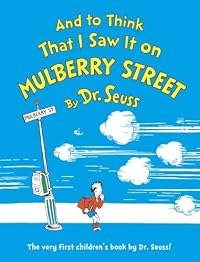
Originally published in 1937, this was the first of Dr. Seuss's picture-books, and follows young Marco as he walks down a Mulberry Street both real and imagined. Instructed by his father to keep his eyes open, but also rebuked for telling fanciful tales of what he has seen, Marco at first registers "reality," in the form of a fairly tame horse and wagon ambling down the street. Concluding that this makes for a very poor story indeed, Marco begins to embroider upon what he sees, imagining a zebra pulling the cart instead of a horse, and then pretending that it is a chariot being drawn, rather than a cart. His game of make-believe grows ever wilder, as he imagines all sorts of extraordinary embellishments, until he finally ends up with a massive brass band being pulled by a rajah-bearing elephant and two (seeming) giraffes, followed along by an old man in his trailer house, and accompanied by a police escort. This extraordinary equipage dashes past a parade stand featuring the mayor, and is feted by a confetti-dumping airplane. Despite this marvelous feat of fantasy, when Marco returns home again and faces his father, he reverts to "reality," reporting only upon the horse and cart...
Although I would not describe it as the equal of some of Seuss's later hits, like The Lorax or How the Grinch Stole Christmas (not to mention my own personal favorite, I Had Trouble Getting to Solla Sollew), And to Think That I Saw It on Mulberry Street is an astoundingly good picture-book, especially when one considers that it was its creator's debut in the form. The text hasn't quite got that rollicking rhyme I associate with Dr. Seuss, but it reads well, and it tells an engaging story. This is a story, in fact, to get the reader thinking. Marco is clearly an imaginative, creative youngster, one who can transform the ordinary, workaday world into a place of magic, of outlandish and entertaining wonder. Does he represent Seuss (Thedor Geisel), who must surely have had those same abilities, to create the work he did? Is Seuss giving us a peek into his creative process, whereby a humdrum horse-drawn wagon becomes an extravaganza of delight? Perhaps Marco is meant to represent, not Seuss, but the artistic process itself, in which storyteller and draftsman construct something from nothing? Or does Marco represent the child (any child), alive to the wonder and potential of the world, but stifled by adults who just don't understand, and can't enter into the child's-eye view of what is around them? It could be any of them, or all; it could be one at first reading, and another at the second - the reader decides, and that is as it should be.
Just as the story here is full of enchantment, so too is the artwork, starting out on a white page with some introductory text and one illustrative element, in the form of Marco himself. The blue of his shorts and the red of his jacket, socks and book provide the only color. The next two-page spread features the aforementioned horse and wagon, with yellow and green being added to the mix. The artwork grows ever more zany and colorful, and it grows larger as well, moving from a small element of one page, to dominate entire two-page spreads. This swelling of visual grandeur mirrors the growing grandiosity of Marco's make-believe description of what he saw on Mulberry Street, with text and image working smoothly together to build to a storytelling crescendo. This quality - the complementary working of text and artwork to tell a story - is the hallmark of a truly excellent picture-book, and there is no question that And to Think That I Saw It on Mulberry Street has it in spades. A truly remarkable achievement, for a first picture-book!
In reading the commentary and debate surrounding the suppression of this and the other five 'objectionable' Seuss books online, I have encountered a number of falsehoods, but none stands out more to me, now that I have read this book, than the claim that the titles in question have little artistic or literary merit, and that it would be no great loss if they disappeared. As the foregoing analysis of story and artwork should make plain, this is simply not true. There is certainly great merit in this particular book - as for the others, I will judge them as I get to them. In any case, as someone who either never read 'Mulberry Street' as a girl, or who doesn't recall reading it, I approached my reading with fresh eyes, unswayed by nostalgia or childhood loyalty, and I found it to have many excellent qualities. That does not mean, of course, that the book is without flaws, and here we get to the substance of the charges against it. There are three elements that I perceive as being potentially offensive: the appearance of two figures who might be read as eskimos (AKA Inuit); the appearance of an Indian rajah astride the elephant; and the appearance of a Chinese man, depicted in a stereotypical way and described as eating "with sticks." It is not my place to tell other readers what they should or should not find offensive and/or hurtful in the books they encounter, just as it is not their place to tell me. My own interpretation of these images and one brief bit of text, is that they could be read as racially and culturally insensitive, but don't seem to have the animus required to justify the charge of racism. Of course, this is a highly debatable point, as the current discourse around racism is being driven by those who deny that animus is necessary for it to exist. That is a philosophical question well beyond the scope of this review - suffice it to say that I do not subscribe to this revisionist (and thoroughly harmful) definition of what racism is. In any case, I do have some specific thoughts about the three images/story elements in question.
First, the depiction of the purported Eskimos (Inuits) was very ambiguous. I may be alone in this (it's entirely possible), but the image of two fur-clad individuals riding a sleigh pulled by reindeer suggested to me, not the indigenous people of North America's arctic, but the indigenous people of Europe's arctic. The figures are never identified in the text as Eskimo - they're not identified at all - and my own understanding is that the Inuit use dogs to pull their sleds, and hunt reindeer, known here in the western hemisphere as caribou. It is people like the Saami, in far northern Scandinavia, who use domesticated reindeer as draft animals. While it's possible that I am wrong, and that the Inuit have used caribou/reindeer in this way, this is the impression I have always had. Do I think Seuss was thinking of the Saami when he created his tale? Highly unlikely. He was most likely referencing the Inuit (so-called Eskimos) in his own mind, but the question of what readers take away from the image is far more complex. Even if both Seuss and the theoretical reader think "Eskimo," it isn't clear to me, looking at the image, what is objectionable about it, unless the implication is that there is something inherently derogatory about their inclusion in a young boy's wacky fantasy in the first place. If that is the case, then I'm still none the wiser, as plenty of non-Eskimos are also included in Marco's imaginary parade. Perhaps it is the pairing of (purported) Eskimos with reindeer, for precisely the reason stated above - that they don't use these animals in this way, and that the pairing is therefore misleading, conflating very different cultures, and relying upon a stereotypical vision of what Arctic people do - that makes it offensive to some?
My feelings regarding the depiction of the rajah are similar, although I think there is possibly more historical precedent for this image, than the one showing the Eskimos being pulled by reindeer. After all, there are quite a few historical paintings from India (as well as more recent photographs) showing just such a scene. There are even more such images where the rider is not a rajah. Wherein lies the offense? That rajahs aren't common occurrences, even in India, and that western storytelling is awash with a few too many of them, always treated as exotic curiosities? Perhaps so, but it bears recalling that Marco is spinning a fairy-tale, imagining the most unusual things that he can, not the most common or ordinary. Could the use of this elephant-riding rajah figure be considered rather tiresome? Yes, I suppose, but no more so, it seems to me, than the good old Irish-American as policeman figure, also on view. I probably missed all of the public outcry about Sergeant Mulvaney leading the police escort in the story, and how this reflects an overreliance on this type in the books and films of early 20th-century America. Of course, much like the elephant-riding rajah, the type has historical precedent - many Irish-Americans did enter the police force, as it was one of the few areas of employment where they didn't face discrimination - but that doesn't make its overuse feel less formulaic. My purpose here is not to defend the use of stereotype, but to demonstrate that it is clearly not stereotype itself that seems to be driving much of the outrage.
It is with the image and description of the Chinese man that I think critics of And to Think That I Saw It on Mulberry Street have their strongest argument. Apparently in the original edition this figure had bright yellow skin and a pigtail, and was described as a "Chinaman." Seuss himself changed these elements, when readers complained to him - he took out the yellow coloring and pigtail, and changed the text to "Chinese man" - which seems to indicate that his intention was not to deliberately offend or dehumanize. Despite this, many still feel that the way in which the figure is drawn and described - the slanting eyes, the fact that he eats with sticks - is problematic. It definitely strikes me as a caricature of an Asian person, and I can understand why it would make people feel uncomfortable. For my own part, I find the image more unfortunate than the text, as it doesn't seem especially offensive to say that Chinese people eat with sticks. Chopsticks might be more accurate, I suppose, but the idea is essentially the same, and the image clarifies what "sticks" means. I suppose there's something a little random, in having a chopstick-holding Chinese man watching the parade - why is he there in the first place? - but given that this is a fantasy sequence, it doesn't feel that obtrusive. The hyper-rational part of me wonders whether this depiction is any more of a caricature of an Asian person, than some of the other depictions are caricatures of European ones, but I accept that the former exists within a framework of stereotypical images that the latter weren't subjected to. All of which is to say, while I can understand why some might not see the image as offensive, I can also see why some would.
In sum: I think that And to Think That I Saw It on Mulberry Street is a wonderful picture-book, when judged from an artistic and literary perspective. It provides an entertaining and thought-provoking story and delightfully amusing artwork, and it displays excellent text-image interaction. It does have some elements that might be considered dated or offensive, which is hardly surprising, in a book from 1937. While I might not agree with every criticism of it, I can certainly understand why some people would feel uncomfortable promoting it. I have absolutely no argument with readers and critics subjecting it to every kind of critique possible - that's what we should all be doing, as readers! - and I wouldn't object to parents, teachers, librarians, and storytellers choosing not to share it with the young children in their charge, if they feel it is harmful. Where I part company with this book's critics, and with those behind this move at Dr. Seuss Enterprises, is over the idea that, because they themselves find the book objectionable, it should therefore not be published, preventing others from easily accessing it. One need only listen to the discourse about harm - the harm the book potentially causes readers - to understand that this is the explicit aim: to slowly disappear these books from the reading world. I have no patience whatsoever with the sophism of those claiming that the suppression of these Seuss titles is not a censorious act, and no sympathy whatsoever with our lamentable chattering class, as they put themselves through mental contortions to demonstrate that this really, really isn't book banning, that Seuss is absolutely not being cancelled, and that the only people objecting are racist far-right trolls intent on scoring political points.
Let me set the record straight. This book may not have been censored by any government entity, nor outright banned by any institution, but the final effect of this decision to self-censor will be the same as if it had. Publication will stop, the book will become scarce, libraries will begin removing copies from their shelves - this has already begun at some libraries - and the books will become less and less accessible, even to those who want to read them. It strikes me that the harm caused by this - authors' estates and publishers pulling their own books, libraries cooperating to purge objectionable material - will be far greater than anything these Seuss books could inflict. Truly, a sad moment for the children's literature world, and for the world of letters in general. show less
Originally published in 1937, this was the first of Dr. Seuss's picture-books, and follows young Marco as he walks down a Mulberry Street both real and imagined. Instructed by his father to keep his eyes open, but also rebuked for telling fanciful tales of what he has seen, Marco at first registers "reality," in the form of a fairly tame horse and wagon ambling down the street. Concluding that this makes for a very poor story indeed, Marco begins to embroider upon what he sees, imagining a zebra pulling the cart instead of a horse, and then pretending that it is a chariot being drawn, rather than a cart. His game of make-believe grows ever wilder, as he imagines all sorts of extraordinary embellishments, until he finally ends up with a massive brass band being pulled by a rajah-bearing elephant and two (seeming) giraffes, followed along by an old man in his trailer house, and accompanied by a police escort. This extraordinary equipage dashes past a parade stand featuring the mayor, and is feted by a confetti-dumping airplane. Despite this marvelous feat of fantasy, when Marco returns home again and faces his father, he reverts to "reality," reporting only upon the horse and cart...
Although I would not describe it as the equal of some of Seuss's later hits, like The Lorax or How the Grinch Stole Christmas (not to mention my own personal favorite, I Had Trouble Getting to Solla Sollew), And to Think That I Saw It on Mulberry Street is an astoundingly good picture-book, especially when one considers that it was its creator's debut in the form. The text hasn't quite got that rollicking rhyme I associate with Dr. Seuss, but it reads well, and it tells an engaging story. This is a story, in fact, to get the reader thinking. Marco is clearly an imaginative, creative youngster, one who can transform the ordinary, workaday world into a place of magic, of outlandish and entertaining wonder. Does he represent Seuss (Thedor Geisel), who must surely have had those same abilities, to create the work he did? Is Seuss giving us a peek into his creative process, whereby a humdrum horse-drawn wagon becomes an extravaganza of delight? Perhaps Marco is meant to represent, not Seuss, but the artistic process itself, in which storyteller and draftsman construct something from nothing? Or does Marco represent the child (any child), alive to the wonder and potential of the world, but stifled by adults who just don't understand, and can't enter into the child's-eye view of what is around them? It could be any of them, or all; it could be one at first reading, and another at the second - the reader decides, and that is as it should be.
Just as the story here is full of enchantment, so too is the artwork, starting out on a white page with some introductory text and one illustrative element, in the form of Marco himself. The blue of his shorts and the red of his jacket, socks and book provide the only color. The next two-page spread features the aforementioned horse and wagon, with yellow and green being added to the mix. The artwork grows ever more zany and colorful, and it grows larger as well, moving from a small element of one page, to dominate entire two-page spreads. This swelling of visual grandeur mirrors the growing grandiosity of Marco's make-believe description of what he saw on Mulberry Street, with text and image working smoothly together to build to a storytelling crescendo. This quality - the complementary working of text and artwork to tell a story - is the hallmark of a truly excellent picture-book, and there is no question that And to Think That I Saw It on Mulberry Street has it in spades. A truly remarkable achievement, for a first picture-book!
In reading the commentary and debate surrounding the suppression of this and the other five 'objectionable' Seuss books online, I have encountered a number of falsehoods, but none stands out more to me, now that I have read this book, than the claim that the titles in question have little artistic or literary merit, and that it would be no great loss if they disappeared. As the foregoing analysis of story and artwork should make plain, this is simply not true. There is certainly great merit in this particular book - as for the others, I will judge them as I get to them. In any case, as someone who either never read 'Mulberry Street' as a girl, or who doesn't recall reading it, I approached my reading with fresh eyes, unswayed by nostalgia or childhood loyalty, and I found it to have many excellent qualities. That does not mean, of course, that the book is without flaws, and here we get to the substance of the charges against it. There are three elements that I perceive as being potentially offensive: the appearance of two figures who might be read as eskimos (AKA Inuit); the appearance of an Indian rajah astride the elephant; and the appearance of a Chinese man, depicted in a stereotypical way and described as eating "with sticks." It is not my place to tell other readers what they should or should not find offensive and/or hurtful in the books they encounter, just as it is not their place to tell me. My own interpretation of these images and one brief bit of text, is that they could be read as racially and culturally insensitive, but don't seem to have the animus required to justify the charge of racism. Of course, this is a highly debatable point, as the current discourse around racism is being driven by those who deny that animus is necessary for it to exist. That is a philosophical question well beyond the scope of this review - suffice it to say that I do not subscribe to this revisionist (and thoroughly harmful) definition of what racism is. In any case, I do have some specific thoughts about the three images/story elements in question.
First, the depiction of the purported Eskimos (Inuits) was very ambiguous. I may be alone in this (it's entirely possible), but the image of two fur-clad individuals riding a sleigh pulled by reindeer suggested to me, not the indigenous people of North America's arctic, but the indigenous people of Europe's arctic. The figures are never identified in the text as Eskimo - they're not identified at all - and my own understanding is that the Inuit use dogs to pull their sleds, and hunt reindeer, known here in the western hemisphere as caribou. It is people like the Saami, in far northern Scandinavia, who use domesticated reindeer as draft animals. While it's possible that I am wrong, and that the Inuit have used caribou/reindeer in this way, this is the impression I have always had. Do I think Seuss was thinking of the Saami when he created his tale? Highly unlikely. He was most likely referencing the Inuit (so-called Eskimos) in his own mind, but the question of what readers take away from the image is far more complex. Even if both Seuss and the theoretical reader think "Eskimo," it isn't clear to me, looking at the image, what is objectionable about it, unless the implication is that there is something inherently derogatory about their inclusion in a young boy's wacky fantasy in the first place. If that is the case, then I'm still none the wiser, as plenty of non-Eskimos are also included in Marco's imaginary parade. Perhaps it is the pairing of (purported) Eskimos with reindeer, for precisely the reason stated above - that they don't use these animals in this way, and that the pairing is therefore misleading, conflating very different cultures, and relying upon a stereotypical vision of what Arctic people do - that makes it offensive to some?
My feelings regarding the depiction of the rajah are similar, although I think there is possibly more historical precedent for this image, than the one showing the Eskimos being pulled by reindeer. After all, there are quite a few historical paintings from India (as well as more recent photographs) showing just such a scene. There are even more such images where the rider is not a rajah. Wherein lies the offense? That rajahs aren't common occurrences, even in India, and that western storytelling is awash with a few too many of them, always treated as exotic curiosities? Perhaps so, but it bears recalling that Marco is spinning a fairy-tale, imagining the most unusual things that he can, not the most common or ordinary. Could the use of this elephant-riding rajah figure be considered rather tiresome? Yes, I suppose, but no more so, it seems to me, than the good old Irish-American as policeman figure, also on view. I probably missed all of the public outcry about Sergeant Mulvaney leading the police escort in the story, and how this reflects an overreliance on this type in the books and films of early 20th-century America. Of course, much like the elephant-riding rajah, the type has historical precedent - many Irish-Americans did enter the police force, as it was one of the few areas of employment where they didn't face discrimination - but that doesn't make its overuse feel less formulaic. My purpose here is not to defend the use of stereotype, but to demonstrate that it is clearly not stereotype itself that seems to be driving much of the outrage.
It is with the image and description of the Chinese man that I think critics of And to Think That I Saw It on Mulberry Street have their strongest argument. Apparently in the original edition this figure had bright yellow skin and a pigtail, and was described as a "Chinaman." Seuss himself changed these elements, when readers complained to him - he took out the yellow coloring and pigtail, and changed the text to "Chinese man" - which seems to indicate that his intention was not to deliberately offend or dehumanize. Despite this, many still feel that the way in which the figure is drawn and described - the slanting eyes, the fact that he eats with sticks - is problematic. It definitely strikes me as a caricature of an Asian person, and I can understand why it would make people feel uncomfortable. For my own part, I find the image more unfortunate than the text, as it doesn't seem especially offensive to say that Chinese people eat with sticks. Chopsticks might be more accurate, I suppose, but the idea is essentially the same, and the image clarifies what "sticks" means. I suppose there's something a little random, in having a chopstick-holding Chinese man watching the parade - why is he there in the first place? - but given that this is a fantasy sequence, it doesn't feel that obtrusive. The hyper-rational part of me wonders whether this depiction is any more of a caricature of an Asian person, than some of the other depictions are caricatures of European ones, but I accept that the former exists within a framework of stereotypical images that the latter weren't subjected to. All of which is to say, while I can understand why some might not see the image as offensive, I can also see why some would.
In sum: I think that And to Think That I Saw It on Mulberry Street is a wonderful picture-book, when judged from an artistic and literary perspective. It provides an entertaining and thought-provoking story and delightfully amusing artwork, and it displays excellent text-image interaction. It does have some elements that might be considered dated or offensive, which is hardly surprising, in a book from 1937. While I might not agree with every criticism of it, I can certainly understand why some people would feel uncomfortable promoting it. I have absolutely no argument with readers and critics subjecting it to every kind of critique possible - that's what we should all be doing, as readers! - and I wouldn't object to parents, teachers, librarians, and storytellers choosing not to share it with the young children in their charge, if they feel it is harmful. Where I part company with this book's critics, and with those behind this move at Dr. Seuss Enterprises, is over the idea that, because they themselves find the book objectionable, it should therefore not be published, preventing others from easily accessing it. One need only listen to the discourse about harm - the harm the book potentially causes readers - to understand that this is the explicit aim: to slowly disappear these books from the reading world. I have no patience whatsoever with the sophism of those claiming that the suppression of these Seuss titles is not a censorious act, and no sympathy whatsoever with our lamentable chattering class, as they put themselves through mental contortions to demonstrate that this really, really isn't book banning, that Seuss is absolutely not being cancelled, and that the only people objecting are racist far-right trolls intent on scoring political points.
Let me set the record straight. This book may not have been censored by any government entity, nor outright banned by any institution, but the final effect of this decision to self-censor will be the same as if it had. Publication will stop, the book will become scarce, libraries will begin removing copies from their shelves - this has already begun at some libraries - and the books will become less and less accessible, even to those who want to read them. It strikes me that the harm caused by this - authors' estates and publishers pulling their own books, libraries cooperating to purge objectionable material - will be far greater than anything these Seuss books could inflict. Truly, a sad moment for the children's literature world, and for the world of letters in general. show less
Different than really any of the other picture books I read, Street kept me thinking long after it was done. Sure I loved Subway and Crayon, but this was a story where it made me take into greater consideration the implications of the plot. More specifically, I found myself asking: what was the point of the boy not saying his fantasy to his father; could it have something to do with keeping his own sense of wonder as long as possible? Was that the lesson the father set out to teach in the first place? Even as I am revisiting my first reactions to the story, I am still trying to grapple with these ideas literally months later. As such, Street is a picture book I could definitely see as being enjoyed/analyzed by an age group beyond that show more of developing readers. show less
I have enjoyed all of Dr. Seuss’ books. I liked this story for two reasons. One reason I liked this story is for its signature rhythmic text that almost all readers can easily identify. The rhyming makes the story more fun and engaging for readers and at the same time teachers them about rhyming words. The story itself flows better when certain words rhyme with others after specific sentences. For example, the stanza “That won’t do, of course…Just a broken-down wagon that’s drawn by a horse” is very informative as well as engaging. It would be boring for the author to just say that the wagon is carried by a horse. Seuss is able to bring it to life and the rhythmic text makes it flow better. Another reason why I like this show more book is for the illustrations. His illustrations are classic and familiar everywhere. Readers are able to relate the images to other books by him as well as relate the make believe towns and animals to real life towns and animals. The pictures are also drawn with a lot of detail and fill the pages in ways that are unique to the text. For example, in order to describe how large this horse drawn wagon has become, the illustrations now cover more space on both pages. The main message of this story is to show how imagination can go a long way. show less
And to Think I Saw It on Mulberry Street is a book about imagination. Marco is a young boy that, despite seeing nothing but an ordinary horse and cart on the way home from school, uses his imagination to spin a bigger and bigger yarn to tell his dad. With each thought of how to make the horse and cart something more than what it is, his imagination runs wild.
Dr. Seuss uses repetition and rhyme to tell this lovely tale of how Marco uses his imagination. The illustrations are a delightful addition to Marco’s ever increasing creative thoughts. A great book for teaching creative writing, rhyme, or repetition.
Dr. Seuss uses repetition and rhyme to tell this lovely tale of how Marco uses his imagination. The illustrations are a delightful addition to Marco’s ever increasing creative thoughts. A great book for teaching creative writing, rhyme, or repetition.
Marco walks home from school along Mulberry Street and tries to think of something interesting to tell his dad about the sights he sees. But all he sees is a plain horse and wagon and that'll never do, so he must invent something better!
This was a Dr. Seuss title that I missed when I was a kid, but I'm sorry to say I feel like I didn't miss much as I wasn't thrilled with this title reading it as an adult. The fun imaginative parts are just okay, and then Marco's disappointment at the end of having to tell his dad he saw nothing exciting just seems like a letdown. The book was originally written in the 1930s so I have to take it as a product of its time, but I nonetheless chafed at some of the wildly "other" depictions of minorities and show more the dismissive attitude toward girls (to wit, "Say--anyone could think of that, Jack or Fred or Joe or Nat--Say, even Jane could think of that.). I read this book the first time with my 3-year-old niece and even she didn't seem hugely interested in it. She listened to it attentively but didn't ask to come back to again like some of the other books we shared that day. All in all, I might recommend this for die-hard Dr. Seuss fans, but that's about all. show less
This was a Dr. Seuss title that I missed when I was a kid, but I'm sorry to say I feel like I didn't miss much as I wasn't thrilled with this title reading it as an adult. The fun imaginative parts are just okay, and then Marco's disappointment at the end of having to tell his dad he saw nothing exciting just seems like a letdown. The book was originally written in the 1930s so I have to take it as a product of its time, but I nonetheless chafed at some of the wildly "other" depictions of minorities and show more the dismissive attitude toward girls (to wit, "Say--anyone could think of that, Jack or Fred or Joe or Nat--Say, even Jane could think of that.). I read this book the first time with my 3-year-old niece and even she didn't seem hugely interested in it. She listened to it attentively but didn't ask to come back to again like some of the other books we shared that day. All in all, I might recommend this for die-hard Dr. Seuss fans, but that's about all. show less
I absolutely fell in love with this book ! I feel like I personally related to this book because it talks about a boy that has a very wild imagination that is too big for adults to understands. As a child I too had a very wild imagination that I would try to tell my parents about and they would just look at me as if I was insane. This is why I loved this book so much. However, It was a little sad at the end of the book because he was so excited ti tell his father all about what he'd seen on Mulberry street, yet at the end he said "nothing". I felt like this book encourages children to have an imagination and embrace it, even when no one acknowledges it !
This is my favorite of all of the books by Dr. Suess. It starts off simply with a father's typical admonishment to his child...tell me what you see on the way to school. Unfortunately, all Marco sees is a plain horse and wagon on Mulberry Street. So he decides to build on this event, and the book takes off from there with the story growing more and more involved. It provides a great opportunity to talk to children about the difference between our imaginations and honesty.
Members
- Recently Added By
Lists

Favorite Childhood Books
1,602 works; 516 members

501 Must-Read Books
508 works; 71 members
Honey For a Child's Heart
1,152 works; 25 members

CCE 1000 Good Books List
1,033 works; 12 members

Romalda Spalding's Writing Road To Reading
213 works; 3 members

Books About Boys
175 works; 15 members
Banned or Challenged Books
400 works; 41 members

Books that are a victim of Cancel Culture
46 works; 3 members

1930s
262 works; 5 members

Purged Books
6 works; 1 member

1970s
657 works; 23 members

Early Picture Books
467 works; 9 members

Our Favorite Banned Books
138 works; 122 members

Cancelled Books
78 works; 2 members

Written and Illustrated By
805 works; 1 member

Books We Loved As Children
603 works; 252 members
Author Information

772+ Works 356,750 Members
Theodor Seuss Geisel was born in Springfield, Massachusetts on March 2, 1904. He wrote and illustrated more than 45 picture books under the pseudonym Dr. Seuss. His first picture book, And to Think That I Saw It on Mulberry Street, was published in 1937. His other books included The Cat in the Hat, The Butter-Battle Book, The Lorax, The Bippolo show more Seed and Other Lost Stories, Fox in Socks: Dr. Seuss's Book of Tongue Tanglers, What Pet Should I Get?, and Oh, the Places You'll Go. In 1984, he received a Pulitzer Prize for his contributions to children's literature. He died of oral cancer on September 24, 1991 at the age of 87. (Bowker Author Biography) show less
Awards and Honors
Notable Lists
Series
Belongs to Publisher Series
Work Relationships
Is contained in
Has the adaptation
Common Knowledge
- Canonical title
- And to Think That I Saw It on Mulberry Street
- Original publication date
- 1937
- People/Characters
- Marco
- Important places
- Springfield, Illinois, USA; Massachusetts, USA
- Related movies
- And to Think I Saw It on Mulberry Street (1944 | IMDb)
- Dedication
- For Helene McC. Mother of the One and Original Marco
- First words
- When I leave home to walk to school,
Dad always says to me,
"Marco, keep your eyelids up
And see what you can see." - Last words
- (Click to show. Warning: May contain spoilers.)"Nothing," I said, growing red as a beet,
"But a plain horse and wagon on Mulberry Street." - Original language
- English
Classifications
Statistics
- Members
- 5,669
- Popularity
- 2,311
- Reviews
- 90
- Rating
- (3.98)
- Languages
- English, Farsi/Persian, Spanish
- Media
- Paper, Ebook
- ISBNs
- 38
- ASINs
- 42