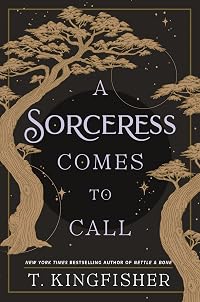
A Sorceress Comes to Call
by T. Kingfisher
On This Page
Description
Cordelia knows her mother is ... unusual. Their house doesn't have any doors between rooms-- there are no secrets in this house-- and her mother doesn't allow Cordelia to have a single friend. Unless you count Falada, her mother's beautiful white horse. The only time Cordelia feels truly free is on her daily rides with him. But more than simple eccentricity sets her mother apart. Other mothers don't force their daughters to be silent and motionless for hours, sometimes days, on end. Other show more mothers aren't evil sorcerers. When her mother unexpectedly moves them into the manor home of a wealthy older Squire and his kind but keen-eyed sister, Hester, Cordelia knows this welcoming pair are to be her mother's next victims. But Cordelia feels at home for the very first time among these people, and as her mother's plans darken, she must decide how to face the woman who raised her to save the people who have become like family. show lessTags
Recommendations






Member Reviews
Cordelia doesn't exactly know what her mother is, or how she does the things she does. Evangeline can take over Cordelia's body, forcing her into "obedience" and making her do and say only what Evangeline wills -- and it's not only Cordelia over whom she can exert such control. When Evangeline returns from the city to fetch Cordelia, stating her intention to marry a rich man and then marry Cordelia off to an even richer man, there's no way for Cordelia to resist. However, in the home of Evangeline's intended, there may be unexpected allies -- a feisty maid, a spinster sister with bad knees, even the rich man that Evangeline intends for Cordelia...
If you take a variety of fairy tales and break off some interesting bits, stir in a dash of show more body horror and a large dollop of Regency house party, and mix thoroughly, you'll get A Sorceress Comes to Call. I enjoyed it greatly. show less
If you take a variety of fairy tales and break off some interesting bits, stir in a dash of show more body horror and a large dollop of Regency house party, and mix thoroughly, you'll get A Sorceress Comes to Call. I enjoyed it greatly. show less
I’ve only read two of Kingfisher’s novels, so I wouldn’t call myself a fan just yet, but we’re quickly moving in that direction with every one of her books I finish. I expected an artful mastery of a magic system, a set of well-written and realistic characters, and narration with a hook based on what got me into Nettle and Bone, but the startling shift in genre was an unexpected and well-received surprise. Where we saw our quest through a more typical fantasy landscape previously, the sorceress in this novel - though it is far more focused on her quietly unassuming and immediately charming daughter - moves confidently through a Regency-inspired world where magic is admittedly present but something of an unspoken naughtiness. show more This woman, though, is far removed from the cheap schemes of her fellow magicians, and wields her power in a selfish manner to take exactly what she wants from the world, with nary a care for the wellbeing of anyone in her vicinity. This includes her daughter, who seems to be the byproduct of a past dalliance that she would sooner forget, and winds up coming up short of her mother’s expectations time and time again. While many stories of this sort have themes that softly explore the quiet abuses and lack of care from some parents, Kingfisher holds no punches here and makes it clear from page one that this woman was never meant to be a mother, and the comeuppance that she earns by the book’s finale is nothing less than her due. Along the way, we’re never quite sure if Cordelia will win herself free of her mother’s evil influence, as Kingfisher weaves a complicated narration that is impossible to put down. She has shifted her tone somewhat to match the English style of the tale, reminding me of Diana Wynne Jones in her moments of unexpected humour, but with a far sharper edge that takes the story well into the realm of adult storytelling despite the 16 year old protagonist. While this book leaves me with far more questions than actual answers (more about the magic system, what’s the background of the evil mother, what happens next with Cordelia’s new found-family?!?), I can definitely say that I had a great time reading this book and getting into Kingfisher’s unexpected genre mash-up! show less
Once again, in her inimitable way, T. Kingfisher has taken a (too) familiar fairy tale and transmuted it into "something rich and strange" that possibly captures a little of the uncanny feeling the tale may have had for its first listeners. I don't want to give away any surprises, but just as a taste, the goose girl is in her 50's with a bad knee, and the heroine is not who you would suspect. I loved this tale and it's meditation on abuse, control, and evil is chilling, while the humorous bits enhance and deepen the story in the way that adding a bit of salt adds richness to cooking. Highly recommend.
Rating: 4.5* of five
The Publisher Says: A dark retelling of the Brothers Grimm's "Goose Girl", rife with secrets, murder, and forbidden magic
Cordelia knows her mother is unusual. Their house doesn’t have any doors between rooms, and her mother doesn't allow Cordelia to have a single friend—unless you count Falada, her mother's beautiful white horse. The only time Cordelia feels truly free is on her daily rides with him. But more than simple eccentricity sets her mother apart. Other mothers don’t force their daughters to be silent and motionless for hours, sometimes days, on end. Other mothers aren’t sorcerers.
After a suspicious death in their small town, Cordelia’s mother insists they leave in the middle of the night, riding show more away on Falada’s sturdy back, leaving behind all Cordelia has ever known. They arrive at the remote country manor of a wealthy older man, the Squire, and his unwed sister, Hester. Cordelia’s mother intends to lure the Squire into marriage, and Cordelia knows this can only be bad news for the bumbling gentleman and his kind, intelligent sister.
Hester sees the way Cordelia shrinks away from her mother, how the young girl sits eerily still at dinner every night. Hester knows that to save her brother from bewitchment and to rescue the terrified Cordelia, she will have to face down a wicked witch of the worst kind.
I RECEIVED A DRC FROM THE PUBLISHER VIA NETGALLEY. THANK YOU.
My Review: Dark it is. A dark retelling of a fairy tale I myownself think is entirely too dark anyway. A deeply unhappy story that centers on the evil deeds and wicked heart of Evangeline (Wikipedia will tell you the roots of this name) as a sorceress, "one who influences fate or fortune," in its original meaning; the sense is always pejorative. It certainly needs to be in this case, as Evangeline (I don't trust y'all to go look it up: the mother's name Evangeline is a diminutive of Latin "evangelium" ("gospel", itself from Greek Ευαγγέλιο "gospel", meaning "good news"...the christian gospels, in other words, those horrifying fonts of millennia of misogyny and detrimental social control, applied to an appalling, cruel, controlling mother) is following the Grimm plot closely in her actions.
I don't know what to think of the inspiration of the story. I'm positive Author Vernon (real name) did not know the results of the 2024 US election as a matter of fact before this book came out in that August. I am a bit chilled by its timeliness, a story of an evil old sorcerous person manipulating a good, innocent girl to her detriment. I wish I was writing this in a spirit of "how did she know we'd defeat the evil old sorcerous party" instead of "if only we'd defeated the evil old sorcerous party" but here we are.
It felt to me, all the way through the read, as though I was being Entertained, that the trademark Vernon wittiness was deployed not organic to the story. It isn't a story where wit, comedy, humor in general, sit naturally. I was abused by a mother much like Evangeline: cold, manipulative, withholding, but always hiding behind a good god-fearing front. For me the read was a return to the times of my life where my anxiety issues were installed. It's a testament to how very effective Author Vernon's skill at storytelling is that I finished and rated the read almost five stars! It's a deeply anxious story, a mother who is not a nurturer or a caregiver in the good sense but rather one who gives her child victim cares that will last a lifetime of therapy. (Why has no fantasy novelist given their MC a therapist?)
My anxiety attacks aside, the story is true to its source material in its claustrophobia, its sense of physical as well as emotional deprivation of freedom. Cordelia's enforced motionlessness probably triggered more awful memories for me than anything else, and made me long for my Falada: The 1968 Bonneville belonging to my mother that I used to escape the misery of my "life" with her. I'm glad I don't have to re-read the book!
It sounds like I should be zero-stars-do-not-recommending it, doesn't it? So look at those almost-five stars and ask what the hell happened here.
Stories are the way people make sense of Life with the big "L" so they are good at their job when experiencing them is a powerful, bone-rattling experience. I think you can see this read rattled me! It shook my angry absorption in the horrendous return to 2016 into a new shape. It reminded me, by evoking feelings from the childhood I endured, that all things end. That even after they end, the consequences carry on...for good or ill, as we ourownselves choose to use them. That even in the midst of misery, someone we do not expect it of is aware of our problems and willing to help.
Rays of hope like this story represents are never more welcome than they are right now. show less
The Publisher Says: A dark retelling of the Brothers Grimm's "Goose Girl", rife with secrets, murder, and forbidden magic
Cordelia knows her mother is unusual. Their house doesn’t have any doors between rooms, and her mother doesn't allow Cordelia to have a single friend—unless you count Falada, her mother's beautiful white horse. The only time Cordelia feels truly free is on her daily rides with him. But more than simple eccentricity sets her mother apart. Other mothers don’t force their daughters to be silent and motionless for hours, sometimes days, on end. Other mothers aren’t sorcerers.
After a suspicious death in their small town, Cordelia’s mother insists they leave in the middle of the night, riding show more away on Falada’s sturdy back, leaving behind all Cordelia has ever known. They arrive at the remote country manor of a wealthy older man, the Squire, and his unwed sister, Hester. Cordelia’s mother intends to lure the Squire into marriage, and Cordelia knows this can only be bad news for the bumbling gentleman and his kind, intelligent sister.
Hester sees the way Cordelia shrinks away from her mother, how the young girl sits eerily still at dinner every night. Hester knows that to save her brother from bewitchment and to rescue the terrified Cordelia, she will have to face down a wicked witch of the worst kind.
I RECEIVED A DRC FROM THE PUBLISHER VIA NETGALLEY. THANK YOU.
My Review: Dark it is. A dark retelling of a fairy tale I myownself think is entirely too dark anyway. A deeply unhappy story that centers on the evil deeds and wicked heart of Evangeline (Wikipedia will tell you the roots of this name) as a sorceress, "one who influences fate or fortune," in its original meaning; the sense is always pejorative. It certainly needs to be in this case, as Evangeline (I don't trust y'all to go look it up: the mother's name Evangeline is a diminutive of Latin "evangelium" ("gospel", itself from Greek Ευαγγέλιο "gospel", meaning "good news"...the christian gospels, in other words, those horrifying fonts of millennia of misogyny and detrimental social control, applied to an appalling, cruel, controlling mother) is following the Grimm plot closely in her actions.
I don't know what to think of the inspiration of the story. I'm positive Author Vernon (real name) did not know the results of the 2024 US election as a matter of fact before this book came out in that August. I am a bit chilled by its timeliness, a story of an evil old sorcerous person manipulating a good, innocent girl to her detriment. I wish I was writing this in a spirit of "how did she know we'd defeat the evil old sorcerous party" instead of "if only we'd defeated the evil old sorcerous party" but here we are.
It felt to me, all the way through the read, as though I was being Entertained, that the trademark Vernon wittiness was deployed not organic to the story. It isn't a story where wit, comedy, humor in general, sit naturally. I was abused by a mother much like Evangeline: cold, manipulative, withholding, but always hiding behind a good god-fearing front. For me the read was a return to the times of my life where my anxiety issues were installed. It's a testament to how very effective Author Vernon's skill at storytelling is that I finished and rated the read almost five stars! It's a deeply anxious story, a mother who is not a nurturer or a caregiver in the good sense but rather one who gives her child victim cares that will last a lifetime of therapy. (Why has no fantasy novelist given their MC a therapist?)
My anxiety attacks aside, the story is true to its source material in its claustrophobia, its sense of physical as well as emotional deprivation of freedom. Cordelia's enforced motionlessness probably triggered more awful memories for me than anything else, and made me long for my Falada: The 1968 Bonneville belonging to my mother that I used to escape the misery of my "life" with her. I'm glad I don't have to re-read the book!
It sounds like I should be zero-stars-do-not-recommending it, doesn't it? So look at those almost-five stars and ask what the hell happened here.
Stories are the way people make sense of Life with the big "L" so they are good at their job when experiencing them is a powerful, bone-rattling experience. I think you can see this read rattled me! It shook my angry absorption in the horrendous return to 2016 into a new shape. It reminded me, by evoking feelings from the childhood I endured, that all things end. That even after they end, the consequences carry on...for good or ill, as we ourownselves choose to use them. That even in the midst of misery, someone we do not expect it of is aware of our problems and willing to help.
Rays of hope like this story represents are never more welcome than they are right now. show less
I have enjoyed a lot of previous books and stories by T. Kingfisher/Ursula Vernon, but this one didn't do it for me at all. I find it a bit hard to enumerate exactly why, to be honest, but I'm going to try.
The book has two protagonists. One is the daughter of a sorceress; the sorceress has (among other powers) the ability to make people "obedient," which forces them to do exactly what she wants. She often uses this on her own daughter as a form of punishment, making her do certain things she doesn't actually want to do. When the book opens, the mother decides she wants to get married, so the two of them head off to woo a rich man, the sorceress coming up with an excuse for them to be houseguests. (The book seems to take place in a place show more that is vaguely nineteenth-century Britain, though not exactly.)
The other protagonist is the middle-aged sister of the sorceress's target, who is skeptical of this woman intruding into their lives and decides to get rid of her... but also eventually realizes that this woman's daughter needs saving from her too.
In the acknowledgements, Vernon says her influence was the genre of regency romance but it more reminded me of Victorian sensation novels by Wilkie Collins or Mary Elizabeth Braddon (or later writers influenced by them, like Thomas Hardy), where the main threat is that the Wrong Marriage is going to happen with catastrophic consequences. Unfortunately, compared to these novelists, the book very much comes up short. In a book by Collins or Braddon or Hardy, one very much feels the threat of the marriage, the inexorable pull of how it's going to wreck everyone's life. But I found that the tone didn't really come across here, as the sister would talk about how big a threat the sorceress was... but then kind of just sit around and throw a big house party, which didn't seem to correlate. Tonally, the moment where the book really fails is that the sorceress succeeds in marrying the brother... but the characters don't react with horror or anything, they're just like "oh well" and continue with their plans to try to stop (now undo) the marriage. I thought it was very weirdly handled, very much a lost opportunity.
The book is, unfortunately, filled with little moments that don't quite vibe right and thus stopped me from feeling invested. The daughter's only friend in her mother's household is their family's horse; it's supposed to be a big betrayal that the horse is actually her mother's familiar and has thus been funneling information to the mother all along... but we've only just been told this about the horse, so it doesn't come across at all. I had very little sense of what the brother saw in the sorceress; the linchpin of the sorceress's plan is that the brother is in love with her but the sorceress can't use magic to make this happen, yet we don't really get to see how she wins him over. Everyone else is onto her so quickly it makes the brother seem like quite a dunderhead. The sister has this subplot about not wanting to marry the guy she's in love with, but it never clearly came across why she had turned him down.
It's a shame because the basic concept of making people obedient and using it to explore the dynamics of child abuse seems quite potent, but I felt like the book largely squandered it. I don't think there's one big way in which this book whiffed it, but add up all my complaints above, and you end up with a book I never engaged with on any level, perhaps the first time that's ever happened to me with Vernon/Kingfisher. show less
The book has two protagonists. One is the daughter of a sorceress; the sorceress has (among other powers) the ability to make people "obedient," which forces them to do exactly what she wants. She often uses this on her own daughter as a form of punishment, making her do certain things she doesn't actually want to do. When the book opens, the mother decides she wants to get married, so the two of them head off to woo a rich man, the sorceress coming up with an excuse for them to be houseguests. (The book seems to take place in a place show more that is vaguely nineteenth-century Britain, though not exactly.)
The other protagonist is the middle-aged sister of the sorceress's target, who is skeptical of this woman intruding into their lives and decides to get rid of her... but also eventually realizes that this woman's daughter needs saving from her too.
In the acknowledgements, Vernon says her influence was the genre of regency romance but it more reminded me of Victorian sensation novels by Wilkie Collins or Mary Elizabeth Braddon (or later writers influenced by them, like Thomas Hardy), where the main threat is that the Wrong Marriage is going to happen with catastrophic consequences. Unfortunately, compared to these novelists, the book very much comes up short. In a book by Collins or Braddon or Hardy, one very much feels the threat of the marriage, the inexorable pull of how it's going to wreck everyone's life. But I found that the tone didn't really come across here, as the sister would talk about how big a threat the sorceress was... but then kind of just sit around and throw a big house party, which didn't seem to correlate. Tonally, the moment where the book really fails is that the sorceress succeeds in marrying the brother... but the characters don't react with horror or anything, they're just like "oh well" and continue with their plans to try to stop (now undo) the marriage. I thought it was very weirdly handled, very much a lost opportunity.
The book is, unfortunately, filled with little moments that don't quite vibe right and thus stopped me from feeling invested. The daughter's only friend in her mother's household is their family's horse; it's supposed to be a big betrayal that the horse is actually her mother's familiar and has thus been funneling information to the mother all along... but we've only just been told this about the horse, so it doesn't come across at all. I had very little sense of what the brother saw in the sorceress; the linchpin of the sorceress's plan is that the brother is in love with her but the sorceress can't use magic to make this happen, yet we don't really get to see how she wins him over. Everyone else is onto her so quickly it makes the brother seem like quite a dunderhead. The sister has this subplot about not wanting to marry the guy she's in love with, but it never clearly came across why she had turned him down.
It's a shame because the basic concept of making people obedient and using it to explore the dynamics of child abuse seems quite potent, but I felt like the book largely squandered it. I don't think there's one big way in which this book whiffed it, but add up all my complaints above, and you end up with a book I never engaged with on any level, perhaps the first time that's ever happened to me with Vernon/Kingfisher. show less
see my video review here
My new favorite T. Kingfisher book. Perfect, no notes.
I knew I was going to love this book from the very beginning. Well, as long as it had a decent ending I would love it. It did not disappoint.
The themes about parental abuse and forced isolation really spoke to me. Cordelia was way braver and more bold than I’d expected of anyone who has been abused their whole life, but I loved it. It made it feel like there was hope for getting out of awful situations.
This book was doing so much. It was dark, and cozy, and charming. T. Kingfisher has a way of telling dark, horrible, terrifying stories in a way that feels almost cozy and charming. The middle part of this book reminded me a little of Pride and Prejudice, but show more then something would happen to remind me how dark and twisted this story actually was.
I love Heaster as a protagonist and I love that we have an older person as a main character in the story. I also love that Heaster kept referring to the sorceress as Doom in her head. She used the expectations of old people against the sorceress in the best way possible, and often in amusing ways.
Seeing from both Hester and Cordelia’s perspective really helped paint a better picture of what was going on. Cordelia is socially awkward and doesn’t know how to handle many of the situations thrust upon her, but she knows that her mother is a sorceress and she knows some of her mother’s plans. While Hester might not know everything that is going on, she has a much better grasp on the social dynamics than Cordelia. In addition, we get to see Cordelia’s awkwardness both from Cordelia herself, and from an outsider.
As painful as it was to see Cordelia try and often mess up in social situations, I also loved that she was finally getting out of the isolation she had grown up with. I also love the conflicted feelings Cordelia has when she meets another sorceress who is really nice to her. It forces Cordelia to see things from a perspective she might not have encountered otherwise.
The side characters are wonderful. Practically all of them felt very alive and real. We have so many fun characters to hang out with too!
Basically I loved everything about this book. It’s one of my favorite T. Kingfisher books, and one I will definitely be rereading.
Also Cordelia is definitely a sorceress too, but she doesn’t realize it. Aaaah!!
I received a copy of this book via Netgalley. show less
My new favorite T. Kingfisher book. Perfect, no notes.
I knew I was going to love this book from the very beginning. Well, as long as it had a decent ending I would love it. It did not disappoint.
The themes about parental abuse and forced isolation really spoke to me. Cordelia was way braver and more bold than I’d expected of anyone who has been abused their whole life, but I loved it. It made it feel like there was hope for getting out of awful situations.
This book was doing so much. It was dark, and cozy, and charming. T. Kingfisher has a way of telling dark, horrible, terrifying stories in a way that feels almost cozy and charming. The middle part of this book reminded me a little of Pride and Prejudice, but show more then something would happen to remind me how dark and twisted this story actually was.
I love Heaster as a protagonist and I love that we have an older person as a main character in the story. I also love that Heaster kept referring to the sorceress as Doom in her head. She used the expectations of old people against the sorceress in the best way possible, and often in amusing ways.
Seeing from both Hester and Cordelia’s perspective really helped paint a better picture of what was going on. Cordelia is socially awkward and doesn’t know how to handle many of the situations thrust upon her, but she knows that her mother is a sorceress and she knows some of her mother’s plans. While Hester might not know everything that is going on, she has a much better grasp on the social dynamics than Cordelia. In addition, we get to see Cordelia’s awkwardness both from Cordelia herself, and from an outsider.
As painful as it was to see Cordelia try and often mess up in social situations, I also loved that she was finally getting out of the isolation she had grown up with. I also love the conflicted feelings Cordelia has when she meets another sorceress who is really nice to her. It forces Cordelia to see things from a perspective she might not have encountered otherwise.
The side characters are wonderful. Practically all of them felt very alive and real. We have so many fun characters to hang out with too!
Basically I loved everything about this book. It’s one of my favorite T. Kingfisher books, and one I will definitely be rereading.
Also
I received a copy of this book via Netgalley. show less
A Sorceress Comes To Call by T. Kingfisher. Cordelia's mother is a sorceress. When mommy dearest connives to get them invited to stay at the manor house of a bachelor squire, his keen-eyed sister, Hester, is suspicious of the lovely "widow" and her scared-mouse daughter. Cordelia is terrified and doesn't know how to protect these new friends from her mother's machinations. I loved this. Hester and her friends are awesome. Cordelia's situation is horrific. Hits a creepy/amusing/satisfying balance and I'll want to re-read. Probably going on my top-ten list for 2024.
Members
- Recently Added By
Lists

Recommended Speculative Fiction by Women and People of Color
298 works; 45 members

Top Five Books of 2024
795 works; 264 members

2025 Hugo Awards -- Eligible Works -- Novels
33 works; 2 members

Books Read in 2025
4,091 works; 97 members

Feminism
167 works; 4 members

Favorite Fairy Tales
269 works; 103 members

Five star books
1,767 works; 110 members
Author Information

100+ Works 38,293 Members
Ursula Vernon is a freelance writer, artist and illustrator. She received an undergraduate degree in anthropology at Macalester College in Saint Paul, Minnesota. She took several art classes in college. Her first children's book, Nurk: The Strange Surprising Adventures of a (Somewhat) Brave Shrew, was published in 2008. Her other works include show more Black Dogs: The House of Diamond and the Dragonbreath series. She also writes and illustrates the webcomic Digger and the creator of The Biting Pear of Salamanca. (Bowker Author Biography) show less
Some Editions
Awards and Honors
Awards
Work Relationships
Was inspired by
Common Knowledge
- Canonical title*
- A Sorceress Comes to Call
- Original title
- A Sorceress Comes to Call
- Original publication date
- 2024-08
- People/Characters
- Cordelia; Evangeline; Hester Chatham; Squire Samuel Chatham; Lord Richard Evermore; Penelope Green (show all 8); Lady Imogene Strauss; Falada
- Dedication
- To Deb
- First words
- There was a fly walking on Cordelia's hand and she was not allowed to flick it away.
- Last words
- (Click to show. Warning: May contain spoilers.)Overhead, the cloud drifted on, brighter than any horse's white coat, and cast no shadows in the dazzling summer sky.
- Blurbers*
- Beagle, Peter S.
- Original language
- English
*Some information comes from Common Knowledge in other languages. Click "Edit" for more information.
Classifications
Statistics
- Members
- 1,829
- Popularity
- 11,888
- Reviews
- 78
- Rating
- (4.12)
- Languages
- Dutch, English, Polish
- Media
- Paper, Audiobook, Ebook
- ISBNs
- 19
- ASINs
- 5