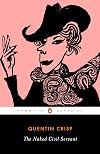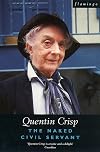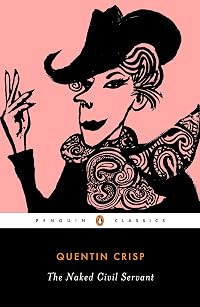
The Naked Civil Servant
by Quentin Crisp
On This Page
Description
Published at the height of the sexual revolution -- 1968, to be exact -- Crisp's memoir flaunting his homosexuality nonetheless raised plenty of eyebrows, even though he had been completely open about it for more than 30 years. Punctiliously polite and urbanely offensive, Crisp's singular vita induces a desolate shudder. A fabulously plumed and heavily mascara-ed ostrich, Quentin Crisp recounts a life spent as homosexual provocateur in the streets of London where he walked with the infinite show more care of a man deliberately adorned to attract the taunts, kicks, and blows of the uncomprehending. And in the 1920s, when Crisp first took to flaunting his sins, the uncomprehending included just about everyone. Once begun, the life could not be dropped despite the penury to which his frequently jobless condition reduced him. When he worked, it was as a commercial artist and artist's model, living in a series of rooms-to-let, cultivating by degrees the advantages of squalor, finding friends among those sufficiently reckless, curious, or down-and-out to accept his company. show lessTags
Recommendations












Member Recommendations
Member Reviews
It’s amazing the lack of interest Crisp claims to have had in books and reading, because he had literary style in piles and piles. I love a good “writer’s voice” and this author most definitely has one of the most recognizable I’ve ever come across. About halfway thru the book I took to YouTube to find a video of an interview with Crisp, and his voice and style were exactly as I imagined. This was clearly a naturally gifted writer.
So much of his life was about one century ahead of its time. Some people might claim this is why the book, told in such a wry and funny way for most of its length, ends on a rather bleak note. But I think the modern reader can be too influenced by our contemporary obsession with identity when show more considering Crisp - I sure had to avoid that pitfall. Instead of making this a book about being gay in the dark ages, It seems that the writer would rather it be a record of someone who was unabashedly unique, to the point of self endangerment. We follow the author’s life as it swings from absolute persecution to muddled acceptance (soured by what Crisp seems to feel is a kind of appropriation of the “hooligan” aesthetic by the so called counterculture) with only a brief period of “good times,” (which happened to be during the London Blitz) to bridge the two. It would have been easy for Crisp to “tone it down” in order to make his existence more tenable for others - yet he simply refused. Rather that making this book a pure paean to individuality, we instead get a realistic picture of the sacrifices you make when you can’t fit into the constraints of your time.
In the words of Thelonius Monk: “The genius is he who is most like himself.” By that criteria, Crisp would do more than qualify. show less
So much of his life was about one century ahead of its time. Some people might claim this is why the book, told in such a wry and funny way for most of its length, ends on a rather bleak note. But I think the modern reader can be too influenced by our contemporary obsession with identity when show more considering Crisp - I sure had to avoid that pitfall. Instead of making this a book about being gay in the dark ages, It seems that the writer would rather it be a record of someone who was unabashedly unique, to the point of self endangerment. We follow the author’s life as it swings from absolute persecution to muddled acceptance (soured by what Crisp seems to feel is a kind of appropriation of the “hooligan” aesthetic by the so called counterculture) with only a brief period of “good times,” (which happened to be during the London Blitz) to bridge the two. It would have been easy for Crisp to “tone it down” in order to make his existence more tenable for others - yet he simply refused. Rather that making this book a pure paean to individuality, we instead get a realistic picture of the sacrifices you make when you can’t fit into the constraints of your time.
In the words of Thelonius Monk: “The genius is he who is most like himself.” By that criteria, Crisp would do more than qualify. show less
Crisp is a more or less self-avowed narcissist, and not as witty as he thinks he is, but it's impossible not to admire his cojones and his embodiment of "be yourself, no matter who you are". He's also in the true lineage of English eccentrics, not so much because of who he was (had he been born 80 years later he'd never have risen from obscurity) but because of who he was when he was. Spending time in his autobiographical company isn't exactly pleasant, but I'm still glad I did.
I did struggle with the style. Whimsical, sometimes pedantic, it nonetheless highlighted what is most beautiful about this book: its vulnerability, authenticity and stark reality it portrays, Crisp reminds us the horrible prejudice, harm and disdain the LGBTQ community endured - and endures stil today in numerous parts of the world.
This is a practical guide on how to write a living eulogy of your Self, as though it is a martyr pretending to something else.
Crisp's wit and intelligence is his saving grace in this, his autobiography written in the middle of his life, but his despondent attitude constantly leaned me to think him a whiner. His seemingly inadvertent bravery in coming out as homosexual in the 1920s is more than remarkable, and he even stood up for in a court case where policemen accused him for attempting to prostitute himself; the case was dismissed.
Crisp's writing is at times essential and a great example of intelligence and humor intertwined, e.g.:
In short, a mostly interesting, saddening and self-made tragedy made by a man who transformed himself into a work of art and shed himself of music and love. Do see the documentary "Resident Alien" on Crisp, made as Crisp was turning 80 years of age. He moved to New York at the age of 74 and the documentary does give a few very different views on his life, at least as it was lived during the latter part, which shows this autobiography as a work of art onto itself, but knowing Crisp - and most people - how could it be anything else? show less
Crisp's wit and intelligence is his saving grace in this, his autobiography written in the middle of his life, but his despondent attitude constantly leaned me to think him a whiner. His seemingly inadvertent bravery in coming out as homosexual in the 1920s is more than remarkable, and he even stood up for in a court case where policemen accused him for attempting to prostitute himself; the case was dismissed.
Crisp's writing is at times essential and a great example of intelligence and humor intertwined, e.g.:
For about twenty years I lived in a state of intoxication with my own existence and, perhaps for thatshow more
very reason, excess of alcohol was one of the extremes to which I felt no urge to fly. I asked many people why they drank so much but never received an explanation that I fully understood. It was the tales of their escapades while under the influence of drink that brought me nearest to comprehending their need for it. It seemed to give them a few hours of freedom from rates which, during the rest of their lives, they reluctantly obeyed. If this was true, then in the example of my life lay a cure for drunkenness, though it was hardly an answer which Harley Street would have approved. The prophylactic is, never to conform at all.
In short, a mostly interesting, saddening and self-made tragedy made by a man who transformed himself into a work of art and shed himself of music and love. Do see the documentary "Resident Alien" on Crisp, made as Crisp was turning 80 years of age. He moved to New York at the age of 74 and the documentary does give a few very different views on his life, at least as it was lived during the latter part, which shows this autobiography as a work of art onto itself, but knowing Crisp - and most people - how could it be anything else? show less
This depressingly self-loathing and affected memoir had me nearly throwing the book out several times in the first 50 pages. Had I not been reading it for a bookclub, I would never have gotten that far.
Despite the historical interest of reading about the life and times of an openly homosexual man before the gay-rights movement, Crisp's writing style was extremely hard for me to bear: full of internalised homophobia, ugly and un-funny humour, and the sort of petty cattiness which he himself explains as trying to be 'feminine.' In his quest to confront the world as an overt homosexual (his word, not mine), Crisp goes out of his way to be provocative, and denigrates anyone who chooses not to.
In the end, however, I found the book to be show more deeply saddening, as beneath the façade there only appears to be a hurt, angry, self-hating little man who is by his own admission deeply incapable of feeling love for the very men he is attracted to. show less
Despite the historical interest of reading about the life and times of an openly homosexual man before the gay-rights movement, Crisp's writing style was extremely hard for me to bear: full of internalised homophobia, ugly and un-funny humour, and the sort of petty cattiness which he himself explains as trying to be 'feminine.' In his quest to confront the world as an overt homosexual (his word, not mine), Crisp goes out of his way to be provocative, and denigrates anyone who chooses not to.
In the end, however, I found the book to be show more deeply saddening, as beneath the façade there only appears to be a hurt, angry, self-hating little man who is by his own admission deeply incapable of feeling love for the very men he is attracted to. show less
There are many people famous for doing nothing or very little, who command high salaries for their appearances. Some have done nothing at all, like the entire money and fame-mad Kardashian family (but in this time of recession they are definitely doing their bit to keep the cosmetics industry afloat). Some have done just a little but their train-wreck life style continues to fascinate, like Lindsey Lohan. When interviewed they fall flat, they have nothing to say that hasn't been scripted, they have no personalities and no ambitions other than to be famous, rich, beautiful and young forever and ever. Such is their empty philosophy. What they do all have in common is spin doctors, PR companies paid to tirelessly promote these nonenties as show more products they can make a percentage from.
Quentin Crisp had done absolutely nothing at all (other than being a naked life-class model) to deserve fame, but the force of his personality and his immense moral values brought him fame on the stage, in print and on film. It takes a huge personality to have done nothing and achieve all that. No publicity machine for him.
What he had done is what we would all love to do but don't have the courage. He lived his life exactly as he wanted to, making concessions only where he had to, and then was totally honest about what he had done and why. He hid nothing, not even the sleazy times of prostitution, or worse perhaps. He didn't even hide his filthy ways - he rarely washed and never, ever cleaned his house. He did say it didn't get any worse after the first four years, but later he said he'd been wrong, and in fact it did.
In real life and on the stage he was just himself - he spoke from his heart and not from a script. The script that John Hurt followed when playing Quentin Crisp in two films had been approved by him. No script, but he did have an agenda.
He had been charged with importuning in the street. He wasn't guilty, that time, but was the victim of some nasty, homophobic policemen's stitch-up. His defence was magnificent. He laid his entire life on the line and was acquitted by a judge who had started out not just unsympathetic but actively despising this ageing queer with makeup and pastel-coloured hair. Quentin Crisp's message to the court was that morals have nothing to do with the law, if you haven't broken the law you are innocent no matter how you want to live your life. Find your own moral compass and be true to it. Help others be true to theirs.
The world was less colourful, less moral and less witty the day Quentin Crisp passed away. Read his book AND see the films to see this man and admire his strength, personality and rather witty, gay turn of phrase. show less
Quentin Crisp had done absolutely nothing at all (other than being a naked life-class model) to deserve fame, but the force of his personality and his immense moral values brought him fame on the stage, in print and on film. It takes a huge personality to have done nothing and achieve all that. No publicity machine for him.
What he had done is what we would all love to do but don't have the courage. He lived his life exactly as he wanted to, making concessions only where he had to, and then was totally honest about what he had done and why. He hid nothing, not even the sleazy times of prostitution, or worse perhaps. He didn't even hide his filthy ways - he rarely washed and never, ever cleaned his house. He did say it didn't get any worse after the first four years, but later he said he'd been wrong, and in fact it did.
In real life and on the stage he was just himself - he spoke from his heart and not from a script. The script that John Hurt followed when playing Quentin Crisp in two films had been approved by him. No script, but he did have an agenda.
He had been charged with importuning in the street. He wasn't guilty, that time, but was the victim of some nasty, homophobic policemen's stitch-up. His defence was magnificent. He laid his entire life on the line and was acquitted by a judge who had started out not just unsympathetic but actively despising this ageing queer with makeup and pastel-coloured hair. Quentin Crisp's message to the court was that morals have nothing to do with the law, if you haven't broken the law you are innocent no matter how you want to live your life. Find your own moral compass and be true to it. Help others be true to theirs.
The world was less colourful, less moral and less witty the day Quentin Crisp passed away. Read his book AND see the films to see this man and admire his strength, personality and rather witty, gay turn of phrase. show less
I first became aware of the name Quentin Crisp in the mid 1970’s when I saw ‘The Naked Civil Servant’ on television. Played excellently by John Hurt this character has always stuck in my mind.
When I saw the book on the shelf at the local charity shop I felt drawn to read it, to gain insight into the man, whose character I had only had a glimpse of many years ago.
The autobiography is an interesting read. Quentin Crisp lived his life on his own terms. His fame only really came in old age - an interesting message there
When I saw the book on the shelf at the local charity shop I felt drawn to read it, to gain insight into the man, whose character I had only had a glimpse of many years ago.
The autobiography is an interesting read. Quentin Crisp lived his life on his own terms. His fame only really came in old age - an interesting message there
Members
- Recently Added By
Lists

Best Autobiographies and Memoirs
370 works; 67 members

Top Five Books of 2013
1,562 works; 721 members

Read This Next
120 works; 3 members

Pre-1969 LGBTQ Literature
182 works; 69 members

Books Referenced by Montague's 1312: Among the Ultras
29 works; 1 member

Best Sellers / Popular 1968
237 works; 5 members

The Best LGBTQ Nonfiction
159 works; 68 members
Author Information

18+ Works 1,944 Members
Quentin Crisp was born on December 25, 1908 and attended school in Derbyshire. Following an unsuccessful attempt to become an illustrator and a designer of book covers, Crisp tried freelance writing on a variety of subjects, including window dressing and the Ministry of Labour. Crisp's most popular book was his autobiography, The Naked Civil show more Servant, which deals openly with the subject of his homosexuality. The book ultimately became a television play that has been broadcast in England, Australia, New Zealand, Canada, and the U.S. Other Crisp books include How to Have a Life-Style, Manners from Heaven, and The Wit and Wisdom of Quentin Crisp. He made his off-Broadway debut with An Evening with Quentin Crisp in 1978. He has also appeared in a variety of movies, including The Bride and Fatal Attraction, and in a video with the rock star, Sting. (Bowker Author Biography) show less
Some Editions
Awards and Honors
Series
Belongs to Publisher Series
Work Relationships
Has the (non-series) sequel
Is abridged in
Common Knowledge
- Canonical title
- The Naked Civil Servant
- Original title
- The Naked Civil Servant
- Original publication date
- 1968
- People/Characters
- Quentin Crisp; Mrs Longhurst; Tallulah Bankhead; Mr. Cross; Harold Pinter; Miss Murison (show all 27); Paul Holt; Peter Ustinov; Peter Noble; Mr. Hall; Mrs Legge; Mr. Melly; Mr. McCullough; Mr. Hofbauer; Mr. Peake; Mrs Markham; Angus McBean; Nina Hamnett; Mr. Tambimuttu; Mr. MacQueen; Mr. Palmer [The Naked Civil Servant]; Lamb Chop; Fred Urquhart; Brigitte Helm; Greta Garbo; Marlene Dietrich; Marilyn Monroe
- Important places
- London, England, UK; Sutton, Surrey, England, UK; Carshalton, Surrey, England, UK; The Black Cat (Cafe); High Wycombe, Buckinghamshire, England, UK; King's Cross, London, England, UK (show all 27); Pimlico, London, England, UK; Pentonville Labour Exchange, Islington, London, England, UK; Regent Street Polytechnic, London, England, UK; Clerkenwell, London, England, UK; Finsbury Town Hall, Islington, London, England, UK; Maida Vale, London, England, UK; Chelsea, London, England, UK; Portsmouth, Hampshire, England, UK; Belgravia, London, England, UK; Studio Film Laboratories, London, England, UK; Toynbee Hall, Tower Hamlets, London, England, UK; Charlotte Street, London, England, UK; Old Compton Street, London, England, UK; Toni's; Scala, Camden, London, England, UK (club); Putney, London, England, UK; Whitstone Pond, Hampstead Heath, London, England, UK; Hampstead Heath, London, England, UK; Fitzrovia, London, England, UK; The Alexandria; The Low Dive
- Related movies
- The Naked Civil Servant (1975 | IMDb)
- First words
- From the dawn of my history I was so disfigured by the characteristics of a certain kind of a homosexual person that, when I grew up, I realized that I could not ignore my predicament.
- Last words
- (Click to show. Warning: May contain spoilers.)I stumble towards my grave confused and hurt and hungry....
Classifications
- Genres
- Biography & Memoir, LGBTQ+, Nonfiction, General Nonfiction, Sexuality and Gender Studies
- DDC/MDS
- 306.7662092 — Society, government, & culture Social sciences, sociology & anthropology Social Behavior - Dating, Marriage, Divorce Sexual relations Sexual orientation, transgender identity, intersexuality Homosexuality Male homosexuality History, geographic treatment, biography Biography
- LCC
- HQ75.8 .C74 .A35 — Social sciences The family. Marriage, Women and Sexuality The Family. Marriage. Women Sexual life Homosexuality. Lesbianism
- BISAC
Statistics
- Members
- 930
- Popularity
- 28,700
- Reviews
- 15
- Rating
- (3.94)
- Languages
- 6 — English, French, German, Greek, Serbian, Spanish
- Media
- Paper, Audiobook, Ebook
- ISBNs
- 17
- ASINs
- 16