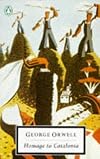
Homage to Catalonia/Looking Back on the Spanish War
by George Orwell 
On This Page
Description
Based on the original 1930's first edition and not the later 1952 edition. Homage to Catalonia is George Orwell's gripping personal account of his harrowing experiences and observations in the Spanish Civil War of the late 1930's.Tags
Recommendations




















Member Reviews
The sixties supplanted the Spanish Civil War in our collective memory of youthful revolt. But in the years 1936-39, Left-leaning youth from across the world did far more than agitate on campuses, or devolve to terrorism; they flocked to Catalonia and other Republican strongholds to put their lives on the line against Franco’s fascists. Orwell came as a journalist; he stayed on as a fighter. His experiences at the front, and in Barcelona, where Left-wing factions battled each other, pointlessly, in the streets, marked him forever. He learned the dangers of “fake news” and the treachery of elites, Left and Right. Here the piercing vision of Animal Farm and 1984 is born. Homage to Catalonia shows the hopes of youth and revolution show more subverted, and the question you are left with is whether they can ever be fulfilled in the manner dreamed. show less
What a crazy time in the world.
Orwell’s experiences during the Spanish Civil War really come through in his writing. Even though he didn’t see much action, I was never bored while reading this book. His description of coming into Spain experiencing a classless, revolutionary society looking to join the fight against Fascism and the quick dissolution of that optimism really hit home.
He also explains the very complicated political situation well, and overall I feel like I got a really good glimpse of the time frame. You can feel the tension of the world waiting to explode into WWII reading Orwell’s words.
Orwell’s experiences during the Spanish Civil War really come through in his writing. Even though he didn’t see much action, I was never bored while reading this book. His description of coming into Spain experiencing a classless, revolutionary society looking to join the fight against Fascism and the quick dissolution of that optimism really hit home.
He also explains the very complicated political situation well, and overall I feel like I got a really good glimpse of the time frame. You can feel the tension of the world waiting to explode into WWII reading Orwell’s words.
Thankfully, the edition of "Homage to Catalonia" I read includes the short essay "Looking Back on the Spanish War", which Orwell first published in 1943 and gives a different perspective of the Spanish Civil War than the one he wrote in the book, briefly after his time in Catalonia fighting with the P.O.U.M. Otherwise this book would only give a partisan view of the war -- much like most of what he himself criticized later on in the essay itself.
The book has two main narrative lines: the first being his first-hand experiences first in Barcelona and then serving at the front, then back in Barcelona during the 1937 "May Days", and then during his last period in Catalonia before escaping to France. This is as interesting as any first-hand show more account of a war and there's very little to criticize, although he could have probably done without the countless generalizations about Spain and Spanish people which, to my taste, were a bit too racist.
The second narrative line, which is mostly in two long chapters intertwined with the rest, has to do with his take on the political context and situation in the Republican side: including a description of all relevant factions on the republican side and how these related to each other, and also a description of the contradicting powers at play and perspectives on how the war was to be fought and the differing priorities and strategies that caused more than just friction in republican lines. From this, it is hard to criticize Orwell considering his place in the war itself, and one can give him credits for repeating once and again that his account is just as partial as any other, but nonetheless one cannot leave him unaccountable for the impact that his book has had in the understanding of the Spanish Civil War -- after all this is probably the most popular and read book on the topic.
Suffices to say, that part of the "Looking Back on the Spanish War" makes amends on what he had written earlier. Admitting that the war was lost not because of the divisions between anarchists and the government, but simply because the fascist side was the strongest and they had the support of Nazi Germany and Fascist Italy. Questioning the fact that the U.K. and other countries reminded neutral to the conflict when they could have done something to support the Republicans and prevent a fascist win. Taking a step back on the "theories" on the strategy of the USSR on their position in the conflict to admit that, perhaps, there was a bit too much theorization on the hows and whys on all sides. I suppose that, amid the horror of WWII it is easier to step back and realize that whatever quarrels divided forces on the Republican side, the grand conflict is one of horror and mass murder vs survival.
All in all, an interesting read, recommendable if taken with a grain of salt and not as an authoritative work on the war. But if you do read it make sure to read "Looking Back on the Spanish War", as well as this article in The Guardian. show less
The book has two main narrative lines: the first being his first-hand experiences first in Barcelona and then serving at the front, then back in Barcelona during the 1937 "May Days", and then during his last period in Catalonia before escaping to France. This is as interesting as any first-hand show more account of a war and there's very little to criticize, although he could have probably done without the countless generalizations about Spain and Spanish people which, to my taste, were a bit too racist.
The second narrative line, which is mostly in two long chapters intertwined with the rest, has to do with his take on the political context and situation in the Republican side: including a description of all relevant factions on the republican side and how these related to each other, and also a description of the contradicting powers at play and perspectives on how the war was to be fought and the differing priorities and strategies that caused more than just friction in republican lines. From this, it is hard to criticize Orwell considering his place in the war itself, and one can give him credits for repeating once and again that his account is just as partial as any other, but nonetheless one cannot leave him unaccountable for the impact that his book has had in the understanding of the Spanish Civil War -- after all this is probably the most popular and read book on the topic.
Suffices to say, that part of the "Looking Back on the Spanish War" makes amends on what he had written earlier. Admitting that the war was lost not because of the divisions between anarchists and the government, but simply because the fascist side was the strongest and they had the support of Nazi Germany and Fascist Italy. Questioning the fact that the U.K. and other countries reminded neutral to the conflict when they could have done something to support the Republicans and prevent a fascist win. Taking a step back on the "theories" on the strategy of the USSR on their position in the conflict to admit that, perhaps, there was a bit too much theorization on the hows and whys on all sides. I suppose that, amid the horror of WWII it is easier to step back and realize that whatever quarrels divided forces on the Republican side, the grand conflict is one of horror and mass murder vs survival.
All in all, an interesting read, recommendable if taken with a grain of salt and not as an authoritative work on the war. But if you do read it make sure to read "Looking Back on the Spanish War", as well as this article in The Guardian. show less
I've never fully understood how the Spanish Civil War came about, or really who could be said to have won it. I've read Hemingway's 'For Whom The Bell Tolls' and there are allusions to the period in some of the other novels I've read, but Orwell's account comes closest to filling in the gaps.
I most enjoyed the portions of the book that told about Orwell's own memories and experiences of the war. His writing is accessible and dramatic, and he paints a vivid picture of what he thought was going on around him. Although I appreciated his political discourses, I found that they were not terribly helpful, though this should be no surprise - the Spanish Civil War was very possibly the most confusing conflict of the 20th century.
I most enjoyed the portions of the book that told about Orwell's own memories and experiences of the war. His writing is accessible and dramatic, and he paints a vivid picture of what he thought was going on around him. Although I appreciated his political discourses, I found that they were not terribly helpful, though this should be no surprise - the Spanish Civil War was very possibly the most confusing conflict of the 20th century.
When I was about fourteen or fifteen I did a holiday homework history project on the Spanish Civil War. It made a big impression on me. On the first day back at school I sought out the other boy who had done his project on the same subject. Patrick Drumgoole. Now that’s name I haven’t thought of in a very long time. Full of the injustice of it all I ranted about the way the Spanish government had been left to the slavering Italian and German wolves by the lily livered democratic soon-to-be-allies, only to find he was delighted at the way the dangerous left wing anarcho-commies had been defeated by the Catholic forces of (the) right. It was the first time I had ever really encountered a political debate. If you can call telling show more Patrick Drumgoole he was a f**king t**t a political debate.
George Orwell’s experience of the Spanish Civil War, as recounted in Homage To Catalonia, seemed to have made a similarly big impression on him, albeit his was a lot more ‘first hand’ than mine in that he was actually there, being shot at whilst I was at home, er, not being shot at. Patrick Drumgoole wasn’t even a particularly big bloke.
His story is of the ‘War is Boring, Cold, Hungry, Dirty and Irritating’ kind, rather than the ‘War Is Hell’ kind. Even when recounting going over the top or actually being shot he doesn’t make it sound actually frightening. In fact the time spent behind the lines, on leave, in Barcelona where political in-fighting between the anarchists and communists led to a civil war within a civil war and a virtual police state sounded a lot more frightening. Which could explain a lot about his later fiction. show less
George Orwell’s experience of the Spanish Civil War, as recounted in Homage To Catalonia, seemed to have made a similarly big impression on him, albeit his was a lot more ‘first hand’ than mine in that he was actually there, being shot at whilst I was at home, er, not being shot at. Patrick Drumgoole wasn’t even a particularly big bloke.
His story is of the ‘War is Boring, Cold, Hungry, Dirty and Irritating’ kind, rather than the ‘War Is Hell’ kind. Even when recounting going over the top or actually being shot he doesn’t make it sound actually frightening. In fact the time spent behind the lines, on leave, in Barcelona where political in-fighting between the anarchists and communists led to a civil war within a civil war and a virtual police state sounded a lot more frightening. Which could explain a lot about his later fiction. show less
One of the guys on my course lent this to me: it's an autobiographical account of the author's experiences fighting in the Spanish Civil War. Very easy to read, despite not knowing much about the period in question; he kindly separates the political analysis from the rest of the books and asks you to feel free to skip those chapters. I believe that in later editions these two chapters are moved to the end to be appendices, but I read them where they were originally placed. These parts took me much longer to get through due to the vast number of acronyms, but were interesting nonetheless.
I thought he got across very well the way that events differed from their official versions, the general dullness of most parts of war, the problems of show more organisation and administration and so on, although he says at several points that he doesn't think he's doing it justice. It was interesting to me that the book ends before the war does; I looked up some more about it online afterwards. show less
I thought he got across very well the way that events differed from their official versions, the general dullness of most parts of war, the problems of show more organisation and administration and so on, although he says at several points that he doesn't think he's doing it justice. It was interesting to me that the book ends before the war does; I looked up some more about it online afterwards. show less
Worth reading if for nothing other than Orwell's description of being shot.
Members
- Recently Added By
Lists

Books about the Spanish Civil War
57 works; 3 members
Author Information

388+ Works 221,143 Members
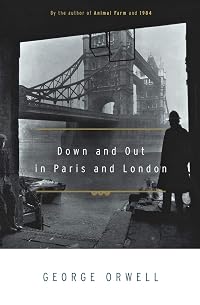
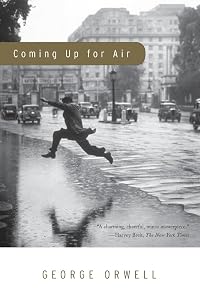
George Orwell was born Eric Arthur Blair on June 25, 1903 in Motihari in Bengal, India and later studied at Eton College for four years. He was an assistant superintendent with the Indian Imperial Police in Burma. He left that position after five years and moved to Paris, where he wrote his first two books: Burmese Days and Down and Out in Paris show more and London. He then moved to Spain to write but decided to join the United Workers Marxist Party Militia. After being decidedly opposed to communism, he served in the British Home Guard and with the Indian Service of the BBC during World War II. After the war, he wrote for the Observer and was literary editor for the Tribune. His best known works are Animal Farm and 1984. His other works include A Clergyman's Daughter, Keep the Aspidistra Flying, The Road to Wigan Pier, Homage to Catalonia, and Coming Up for Air. He died on January 21, 1950 at the age of 46. (Bowker Author Biography) show less
George Orwell has a Legacy Library. Legacy libraries are the personal libraries of famous readers, entered by LibraryThing members from the Legacy Libraries group.
Some Editions
Work Relationships
Common Knowledge
- Canonical title
- Homage to Catalonia/Looking Back on the Spanish War
- Original publication date
- 1966
- Disambiguation notice
- This work contains both Homage to Catalonia and Looking Back on the Spanish War. Do not combine with editions which contain only Homage to Catalonia.
Classifications
- Genres
- Nonfiction, Biography & Memoir, History, General Nonfiction
- DDC/MDS
- 946.081 — History & geography History of Europe Spain & Portugal Spain Second Republic; Dictatorship; Juan Carlos I; Felipe VI 1931- Second Republic; Spanish Civil War
- LCC
- DP269.9 — History of Europe, Asia, Africa and Oceania Spain – Portugal History of Spain History By period Modern Spain, 1479/1516- 20th century. 1886- Second Republic, 1931-1939 Civil War, 1936-1939
- BISAC
Statistics
- Members
- 604
- Popularity
- 48,343
- Reviews
- 9
- Rating
- (4.03)
- Languages
- English
- Media
- Paper
- ISBNs
- 2
- ASINs
- 7