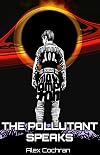
The Pollutant Speaks
by Alex Cochran
On This Page
Tags
Recommendations














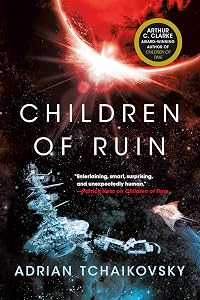



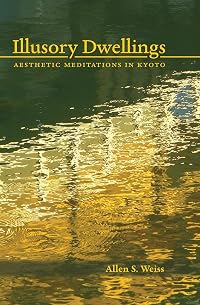

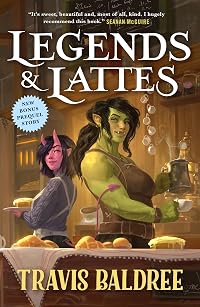
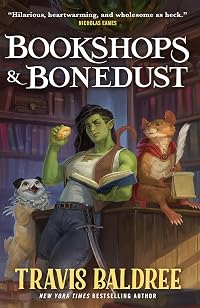

Member Recommendations
Member Reviews
This book is fantastic! The Pollutant Speaks grabbed me right from the start with the casual sense of a future lingo, about to arise from present-day trends. I was struck on the first page by “life-basic” a sort of universal basic income setup which offers “a bed, some bandwidth to the net and food”. I marvel at the practical sense that a minimal way of supporting anyone who needs it can work if you include the internet! And you pay by selling your activity and biometric information to…the Chinese-inflected company/state on Shang Lo, a Chinese-inflected planet. (Aren’t we already kind of doing that, for nothing in exchange?)
And then, almost immediately, Evans, the protagonist, has a funny, fully believable encounter with the show more bank, in which he allows the bank access to everything, including his health records via his “proxy” in order to apply for a loan. A projection of the bank's "proxy", a “comforting-looking gentleman behind a desk” serially fiddles with his office supplies until it is ready to voice the negative conclusions of the bank’s analysis.
Evans attends a “partycast” which goes viral (also already happening, altho we don’t have a word for it). The next day as he enters public transit “two linked inner eye feeds were streaming directly into the forum, and I could literally watch my own back.” It’s not only a world of fully decentralized paparazzi, but there is no need even for a device: they are built into the inner eye, enabling social media recognition and ferocious stalking by just anyone's casual glance, and also offer augmented reality advertising in the real-time experienced environment. People can appear to be “half in the net”, invisibly online and interacting there with more attention than in reality. (We definitely already see this, don’t we?)
And there is an evocative piece of slang that we could adopt: “the Crush”, a term for the feeling which affects about half of the population, “whether hypertension, or full on schizophrenia”. (Check this for a way of understanding the present day, too.)
People are sorted into tribes, with the leftovers called “Cannots”, or CBGs, short for “cannot be grouped”. Kids take “engram memetonin” to augment their feelings. You can order food from a “nom-nom bot” with digital cash that expires. A “Domestifab” 3-D printer makes fresh clothes in the morning. Everything is rented and can be “derented” if you don’t make the payments.
Just a few pages into the book and you can already feel that the world Alex Cochrane has created might be just around the corner. It is that sense of happening just slightly into the future that I also love about William Gibson.
There is a delicious irony in that Evans is a writer, a poet, who wants to observe and comment on the world, in a world of infinite observation and commentary. But he has been medically suffering with graphomania, which has left him “unfit to write”, and virtually unemployable. His previous success is entitled "The Pollutant Speaks"! It had been “re-junked...over and over”, is no longer under his control, and he has somehow offended his fans, yet been taken up by them as a prophet. Bits of spontaneous poetry, original and quoted and misquoted, run through his head as his observations become conscious.
The story is about how he saves himself by leaving the world he knows, and with that we move further into a more distant vision of the future. He is sent to encounter an multi-alien super-culture with which it has proven difficult to communicate. The idea is that his maladaptation to human communication might be a useful tool in bridging the gap. Can he possibly be the one to save humanity from itself as well? show less
And then, almost immediately, Evans, the protagonist, has a funny, fully believable encounter with the show more bank, in which he allows the bank access to everything, including his health records via his “proxy” in order to apply for a loan. A projection of the bank's "proxy", a “comforting-looking gentleman behind a desk” serially fiddles with his office supplies until it is ready to voice the negative conclusions of the bank’s analysis.
Evans attends a “partycast” which goes viral (also already happening, altho we don’t have a word for it). The next day as he enters public transit “two linked inner eye feeds were streaming directly into the forum, and I could literally watch my own back.” It’s not only a world of fully decentralized paparazzi, but there is no need even for a device: they are built into the inner eye, enabling social media recognition and ferocious stalking by just anyone's casual glance, and also offer augmented reality advertising in the real-time experienced environment. People can appear to be “half in the net”, invisibly online and interacting there with more attention than in reality. (We definitely already see this, don’t we?)
And there is an evocative piece of slang that we could adopt: “the Crush”, a term for the feeling which affects about half of the population, “whether hypertension, or full on schizophrenia”. (Check this for a way of understanding the present day, too.)
People are sorted into tribes, with the leftovers called “Cannots”, or CBGs, short for “cannot be grouped”. Kids take “engram memetonin” to augment their feelings. You can order food from a “nom-nom bot” with digital cash that expires. A “Domestifab” 3-D printer makes fresh clothes in the morning. Everything is rented and can be “derented” if you don’t make the payments.
Just a few pages into the book and you can already feel that the world Alex Cochrane has created might be just around the corner. It is that sense of happening just slightly into the future that I also love about William Gibson.
There is a delicious irony in that Evans is a writer, a poet, who wants to observe and comment on the world, in a world of infinite observation and commentary. But he has been medically suffering with graphomania, which has left him “unfit to write”, and virtually unemployable. His previous success is entitled "The Pollutant Speaks"! It had been “re-junked...over and over”, is no longer under his control, and he has somehow offended his fans, yet been taken up by them as a prophet. Bits of spontaneous poetry, original and quoted and misquoted, run through his head as his observations become conscious.
The story is about how he saves himself by leaving the world he knows, and with that we move further into a more distant vision of the future. He is sent to encounter an multi-alien super-culture with which it has proven difficult to communicate. The idea is that his maladaptation to human communication might be a useful tool in bridging the gap. Can he possibly be the one to save humanity from itself as well? show less
 This review was written for LibraryThing Early Reviewers.
What an impressive debut novel! It makes you work to get into it—the same type of "trying to understand the worldscape" that William Gibson forced upon you in the ’80s (though not at all the same). But it's entirely worth it. What emerges is a dystopian future society that, perhaps, predicts where we're headed without at all seeming like a mere transplant of twenty-first century into some science fiction setting.
From the first page, you feel like you've met Evans Ezra Evans in all his poet-mental-patient-burned-out-still-fighting color and can find some part of him you empathize with. Set him inside a good slightly-past-first-contact plot that moves along briskly, and you have something entertaining and satisfying to read. And if show more you enjoy that type of exercise, it will challenge you to find the references and allusions that are sprinkled copiously through the story.
About the only quibble I have is that it could have used a good proofreader to catch a dozen or so things ... but that is extremely small potatoes. show less
From the first page, you feel like you've met Evans Ezra Evans in all his poet-mental-patient-burned-out-still-fighting color and can find some part of him you empathize with. Set him inside a good slightly-past-first-contact plot that moves along briskly, and you have something entertaining and satisfying to read. And if show more you enjoy that type of exercise, it will challenge you to find the references and allusions that are sprinkled copiously through the story.
About the only quibble I have is that it could have used a good proofreader to catch a dozen or so things ... but that is extremely small potatoes. show less
This review was written for LibraryThing Early Reviewers.The frustrating thing about Warren Ellis et al's excellent sci-fi political satire comic Transmetropolitan is the hint of an even more interesting world beyond the pages. The very first storyline involves trade with an alien species that is almost immediately left behind to more terrestrial matters. Alex Cochran's The Pollutant Speaks swings the other way, beginning in a cyberpunk capitalist hellscape and quickly flying out into grand space opera reminiscent of Iain M. Bank's Culture novels.
Evans Ezra Evans was a poet. His epic poem 'The Pollutant Speaks' raged against the injustice subjected on the impoverished masses across the seven worlds settled by humanity, and raised him out of that poverty himself. Now, due to a traumatic show more accident, he is literally incapable of writing, and is about to fall back into the miserable universal basic subsistence he tried to end. What's worse, his magnum opus has been corrupted and turned manifesto by some who would rather burn the world down than try to alleviate suffering. And they want Evans dead. Without the protection of money, he is doomed to be killed by his own words. His only hope is the possibility that he may be one of a handful of humans capable of learning a new language. One spoken by the Paraunion, a galaxy-wide collective of alien species who are considering allowing humans entry into a larger world. Evans has the chance to see the stars, but no guarantee that his problems won't follow him.
The Pollutant Speaks took me by surprise. It's rare that a story gives a solution to a grim cyberpunk future, and "aliens" is a great option! Cochran's writing is sharp and engaging, with humans who feel realistic to their world and aliens who are truly alien, but also honestly benevolent. Evans' narration is shot through with poetry, both the real-life poets who must be his influences, and fragments of his The Waste Land - like masterpiece. The Pollutant Speaks deals with ethics, art, language, and what it means to live in a society. I hope Cochran gives us more like this. show less
Evans Ezra Evans was a poet. His epic poem 'The Pollutant Speaks' raged against the injustice subjected on the impoverished masses across the seven worlds settled by humanity, and raised him out of that poverty himself. Now, due to a traumatic show more accident, he is literally incapable of writing, and is about to fall back into the miserable universal basic subsistence he tried to end. What's worse, his magnum opus has been corrupted and turned manifesto by some who would rather burn the world down than try to alleviate suffering. And they want Evans dead. Without the protection of money, he is doomed to be killed by his own words. His only hope is the possibility that he may be one of a handful of humans capable of learning a new language. One spoken by the Paraunion, a galaxy-wide collective of alien species who are considering allowing humans entry into a larger world. Evans has the chance to see the stars, but no guarantee that his problems won't follow him.
The Pollutant Speaks took me by surprise. It's rare that a story gives a solution to a grim cyberpunk future, and "aliens" is a great option! Cochran's writing is sharp and engaging, with humans who feel realistic to their world and aliens who are truly alien, but also honestly benevolent. Evans' narration is shot through with poetry, both the real-life poets who must be his influences, and fragments of his The Waste Land - like masterpiece. The Pollutant Speaks deals with ethics, art, language, and what it means to live in a society. I hope Cochran gives us more like this. show less
This review was written for LibraryThing Early Reviewers.This is a truly compelling and imaginative novel that left a strong positive impression, particularly due to its phenomenal construction of setting and language.️
One of the book's greatest strengths is Cochran's vibrant and masterful writing. The prose is sharp, often lyrical, and manages to evoke the novel's strange, atmospheric world with incredible clarity. I was immediately drawn into the narrative by the quality of the sentences themselves.
The world-building is equally superb. The setting feels fully realized, haunting, and unique — a truly original vision that blends speculative elements with an unsettling familiarity. The environment and the "pollutant" itself are characters in their own right, and the way Cochran show more meticulously details this broken yet beautiful reality is a testament to their skill. It's the kind of world that sticks with you long after you've finished reading.
The novel grapples with profound and complex themes, and while I appreciate the intellectual ambition, the sections dedicated to exploring these concepts felt heavy and occasionally slowed the narrative momentum. At times, the deep dives into philosophical musings were so intricate that they became a hurdle, making it challenging to fully absorb the intended meaning without considerable effort. For me, these moments detracted slightly from the immersive experience created by the excellent world-building and narrative pacing.
The Pollutant Speaks is a highly recommended read, especially for those who appreciate beautifully crafted literary science fiction and innovative world design. Despite the philosophical weight being a little too dense for my personal taste, the sheer quality of Cochran's writing and imaginative scope makes this a standout novel. It’s a book that showcases a writer working at a very high level, delivering a distinct and memorable reading experience. show less
One of the book's greatest strengths is Cochran's vibrant and masterful writing. The prose is sharp, often lyrical, and manages to evoke the novel's strange, atmospheric world with incredible clarity. I was immediately drawn into the narrative by the quality of the sentences themselves.
The world-building is equally superb. The setting feels fully realized, haunting, and unique — a truly original vision that blends speculative elements with an unsettling familiarity. The environment and the "pollutant" itself are characters in their own right, and the way Cochran show more meticulously details this broken yet beautiful reality is a testament to their skill. It's the kind of world that sticks with you long after you've finished reading.
The novel grapples with profound and complex themes, and while I appreciate the intellectual ambition, the sections dedicated to exploring these concepts felt heavy and occasionally slowed the narrative momentum. At times, the deep dives into philosophical musings were so intricate that they became a hurdle, making it challenging to fully absorb the intended meaning without considerable effort. For me, these moments detracted slightly from the immersive experience created by the excellent world-building and narrative pacing.
The Pollutant Speaks is a highly recommended read, especially for those who appreciate beautifully crafted literary science fiction and innovative world design. Despite the philosophical weight being a little too dense for my personal taste, the sheer quality of Cochran's writing and imaginative scope makes this a standout novel. It’s a book that showcases a writer working at a very high level, delivering a distinct and memorable reading experience. show less
This review was written for LibraryThing Early Reviewers.Poetry as a misappropriated weapon. Humanity over-populated, under-resourced, and stagnating. The rich uncaring, the poor without hope.
A galactic, multi-alien civilization that may offer salvation.
Humanity has spread to multiple worlds, but overcrowding and lack of resources has resulted in many on government assistance without dignity or hope of improvement. The main character, a poet who wrote a protest of how most were being treated in mankind’s worlds, sees his words made into a violent protest against aliens, and the existing government. The radicals hope to capture him to use as a pawn for their cause. A megalomaniac behind the radicals secretly brainwashes and pulls the strings of increasing millions of the despondent show more poor.
Offered a way to be an ambassador to the alien civilization due to his ability to learn their language, the protagonist sets off to try to gain entry for humanity to the galactic fold.
The novel reads a bit like some of the science fiction from the 60’s & 70’s. Radical ideas, multi-level higher existence, and the idea that humanity is unique, offering something that is missing in the aliens’ civilization.
The novel starts a bit slow, the ideas and newspeak like words take a bit to get through, but the pace picks up. The lines of “poetry” throughout the novel distract from the plot’s progression, but do function as an example of the protagonist's thought processes. Crises develop, and the solutions form the basis of the story.
The Pollutant Speaks is a strange and engaging novel. The main character is sometimes pitiable, other times enviable, in the situations he is presented and actions he takes. It is an overall enjoyable read, though not easy. But, it has a critical element: it makes the reader ponder about what the author is saying, no matter if there is agreement. show less
A galactic, multi-alien civilization that may offer salvation.
Humanity has spread to multiple worlds, but overcrowding and lack of resources has resulted in many on government assistance without dignity or hope of improvement. The main character, a poet who wrote a protest of how most were being treated in mankind’s worlds, sees his words made into a violent protest against aliens, and the existing government. The radicals hope to capture him to use as a pawn for their cause. A megalomaniac behind the radicals secretly brainwashes and pulls the strings of increasing millions of the despondent show more poor.
Offered a way to be an ambassador to the alien civilization due to his ability to learn their language, the protagonist sets off to try to gain entry for humanity to the galactic fold.
The novel reads a bit like some of the science fiction from the 60’s & 70’s. Radical ideas, multi-level higher existence, and the idea that humanity is unique, offering something that is missing in the aliens’ civilization.
The novel starts a bit slow, the ideas and newspeak like words take a bit to get through, but the pace picks up. The lines of “poetry” throughout the novel distract from the plot’s progression, but do function as an example of the protagonist's thought processes. Crises develop, and the solutions form the basis of the story.
The Pollutant Speaks is a strange and engaging novel. The main character is sometimes pitiable, other times enviable, in the situations he is presented and actions he takes. It is an overall enjoyable read, though not easy. But, it has a critical element: it makes the reader ponder about what the author is saying, no matter if there is agreement. show less
This review was written for LibraryThing Early Reviewers.--ARC provided by Bee Orchid Press and LibraryThing.--
While this _is_ a densely-told and immersive SF novel, what it _isn't_ is highly original. This is a rich quilt of SF influences (from "A Clockwork Orange" to most of PKD's oeuvre) without a great deal of fresh voice other than the neologisms and world-creation trappings. I know I sound like the wettest blanket, but I've read a great deal of SF over the last half-century and it's all in here. The overpopulated dystopia of social-media crowd control seems to be a cyberpunk standard, but the characters, politics, and the mechanism by which the antagonist 'does his thing' are straight out of Samuel Delany's "Babel-17" from 1966. Worst of all is that the main character proceeds mostly show more through mention of his past: his agency was essentially silenced before the story begins and he sleepwalks through most of this novel, as frustrated as I at his inability to do anything significant.
I really wanted to like this, and Cochran's use of verse as political subversion and unrest if great, but the constant clamor of the Cannots was like listening to banging radiator pipes. This is a journeyman piece but hopefully not Cochran's last word.
Also, a note to Bee Orchid Press: the proofreading really broke down about halfway through and the last third of this ARC is rife with errors. show less
While this _is_ a densely-told and immersive SF novel, what it _isn't_ is highly original. This is a rich quilt of SF influences (from "A Clockwork Orange" to most of PKD's oeuvre) without a great deal of fresh voice other than the neologisms and world-creation trappings. I know I sound like the wettest blanket, but I've read a great deal of SF over the last half-century and it's all in here. The overpopulated dystopia of social-media crowd control seems to be a cyberpunk standard, but the characters, politics, and the mechanism by which the antagonist 'does his thing' are straight out of Samuel Delany's "Babel-17" from 1966. Worst of all is that the main character proceeds mostly show more through mention of his past: his agency was essentially silenced before the story begins and he sleepwalks through most of this novel, as frustrated as I at his inability to do anything significant.
I really wanted to like this, and Cochran's use of verse as political subversion and unrest if great, but the constant clamor of the Cannots was like listening to banging radiator pipes. This is a journeyman piece but hopefully not Cochran's last word.
Also, a note to Bee Orchid Press: the proofreading really broke down about halfway through and the last third of this ARC is rife with errors. show less
This review was written for LibraryThing Early Reviewers.An interestingly thought-out semi-cyberpunkish future with a rapidly degenerating socio-politcal climate, a recovering post-mental-breakdown poet finding his writings twisted and amplified by a sometimes-violent social movement with which he deeply disagrees, and an unexpected rare opportunity to learn and work with a very large and complex interstellar Union of a wide variety of alien races, all weave together into an interesting and fun read in The Pollutant Speaks.
I appreciated that the story integrated both awareness of the increasingly unrestful and violent socio-political climate and the vast alienness of the interstellar Union as the main character encountered elements of each . This kind of world-building can be difficult to do show more without a lot of info-dumping, and it was done decently well here.
I don't know if the author intends to continue the story with future volumes, but if he does, I might have to pick them up to see what follows. show less
I appreciated that the story integrated both awareness of the increasingly unrestful and violent socio-political climate and the vast alienness of the interstellar Union as the main character encountered elements of each . This kind of world-building can be difficult to do show more without a lot of info-dumping, and it was done decently well here.
I don't know if the author intends to continue the story with future volumes, but if he does, I might have to pick them up to see what follows. show less
This review was written for LibraryThing Early Reviewers.Members
- Recently Added By
Lists

Absent from the Merrimack Valley Library Consortium libraries
192 works; 1 member

Absent from Massachusetts Libraries
93 works; 1 member
Author Information
1 Work 30 Members
Common Knowledge
- Original publication date
- 2023
- People/Characters
- Evans Ezra Evans; Annie Bugatti; Professor Spindle; Nian; Rolliard; Jones (show all 9); Meletrus; G-Russ; Dr Green
Classifications
Statistics
- Members
- 30
- Popularity
- 929,570
- Reviews
- 16
- Rating
- (3.82)
- Languages
- English
- Media
- Paper, Ebook
- ISBNs
- 1
- ASINs
- 2