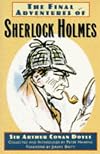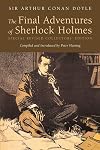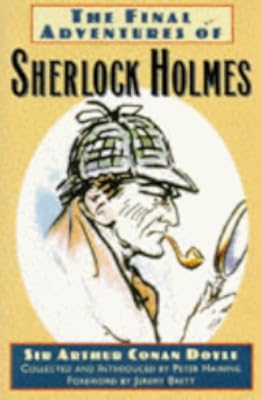
The Final Adventures of Sherlock Holmes (His Last Bow + The Valley of Fear + The Case-Book of Sherlock Holmes)
by Sir Arthur Conan Doyle, Edgar W. Smith (Editor)
On This Page
Description
A collection of 12 little-known Sherlock Holmes stories, plays and poems, unearthed from obscurity as a result of research in Britain and America. The pieces are accompanied by details such as original publication information.Tags
Recommendations















Member Reviews
Haining puts together twelve more pieces of writing by Doyle and argues they should be part of the Sherlockian canon. But reading these it's clear why they're not in the canon: They're either (1) not about Holmes; (2) not by Doyle; or (3) not any good at all.
Probably the best collection of material that should be added to the Holmes "Canon" out there. And, if you can find it at a used book store, at the right price too. It is ably edited by Peter Haining, and contains a nearly useless foreword the greatest Holmes in my lifetime (especially with David Burke during the first two seasons): Jeremy Brett.
The Final Adventures of Sherlock Holmes collects writings about the detective by Sir Arthur Conan Doyle that should be canon. If you consider the intro to the Case Book canon, then these items should be as well: "The Truth About Sherlock Holmes," "Some Personalia About Mr. Sherlock Holmes," "My Favourite Sherlock Holmes Adventures," and "A Gaudy Death: Conan Doyle Tells the True Story of show more Sherlock Holmes's End." Then there are the four stories that should be considered canon by everyone: "The Field Bazaar" and "How Watson Learned the Trick," both straightforward Holmes stories, and "The Story of the Man with the Watches" and "The Story of the Lost Special" both feature letters from Holmes. The last two, according to Haining, appear in all French editions of the recognized canon.
"The Adventures of the Tall Man" is a plot outline by the Literary Agent, and as written up in 1947 by Robert A. Cutter, not that good. The idea is nifty, though. One wishes Doyle had finished it himself. "The Case of the Man who was Wanted," perhaps edited a bit by Doyle, but written by Arthur Whitaker, is not that good. "The Case of the Inferior Sleuth," so-called is just a Holmes poem by Doyle. The Crown Diamond and The Painful Predicament of Sherlock Holmes are plays: the former by the Literary Agent (which was later turned into "The Mazarin Stone") is okay, but a bit stiff; the latter is a sparkling gem that is pure comedy, Holmes doesn't even speak a word, and betrays the hand of veteran actor William Gillette.
Finally, there are two non-Holmes stories: "The Mystery of Sasassa Valley" and "The Mystery of Uncle Jeremy's Household." The former was Doyle's first paying, published story, and is just a light piece of ephemera that graced the pages of magazines from the late Victorian era. Haining, the editor, tries to make it a Hound precursor, but it is nothing of the sort. The latter story is more interesting, though the word "amanuensis" is used entirely too much. The heroine, if it be right to call her that, is exotically (erotically?) and romantically well-drawn, and the story is neat enough. Haining is right here, as there are certain parallels between this story and Holmes. The chemistry, the "John H.," the detached reasoner (here studying to be a doctor) who attempts to solve the mystery on his own, is impervious to the woman's obvious charms, and just happens to live on Baker Street.
This is a good collection, which could only be aided by the addition of Doyle's full-length play "Sherlock Holmes" (and perhaps "Angels of Darkness," which was never supposed to see the light of day). The editor, Haining, should have paid more attention to his duty, as there is little format or structure here. He tries to go chronologically, but places two things out of order. And why are "A Gaudy Death," "The Mystery of Sasassa Valley," and "My Favourite Sherlock Holmes Adventures" relegated to an "appendix"? It makes no sense! "A Gaudy Death" and "My Favourite Sherlock Holmes Adventures" are definitely on par with "The Truth About Sherlock Holmes" or "Some Personalia About Mr. Sherlock Holmes." Why are they in an appendix? If anything, the two non-Holmes stories should be in the appendix as "interesting stories."
All in all, this is an important addition to any Holmes bookshelf. show less
The Final Adventures of Sherlock Holmes collects writings about the detective by Sir Arthur Conan Doyle that should be canon. If you consider the intro to the Case Book canon, then these items should be as well: "The Truth About Sherlock Holmes," "Some Personalia About Mr. Sherlock Holmes," "My Favourite Sherlock Holmes Adventures," and "A Gaudy Death: Conan Doyle Tells the True Story of show more Sherlock Holmes's End." Then there are the four stories that should be considered canon by everyone: "The Field Bazaar" and "How Watson Learned the Trick," both straightforward Holmes stories, and "The Story of the Man with the Watches" and "The Story of the Lost Special" both feature letters from Holmes. The last two, according to Haining, appear in all French editions of the recognized canon.
"The Adventures of the Tall Man" is a plot outline by the Literary Agent, and as written up in 1947 by Robert A. Cutter, not that good. The idea is nifty, though. One wishes Doyle had finished it himself. "The Case of the Man who was Wanted," perhaps edited a bit by Doyle, but written by Arthur Whitaker, is not that good. "The Case of the Inferior Sleuth," so-called is just a Holmes poem by Doyle. The Crown Diamond and The Painful Predicament of Sherlock Holmes are plays: the former by the Literary Agent (which was later turned into "The Mazarin Stone") is okay, but a bit stiff; the latter is a sparkling gem that is pure comedy, Holmes doesn't even speak a word, and betrays the hand of veteran actor William Gillette.
Finally, there are two non-Holmes stories: "The Mystery of Sasassa Valley" and "The Mystery of Uncle Jeremy's Household." The former was Doyle's first paying, published story, and is just a light piece of ephemera that graced the pages of magazines from the late Victorian era. Haining, the editor, tries to make it a Hound precursor, but it is nothing of the sort. The latter story is more interesting, though the word "amanuensis" is used entirely too much. The heroine, if it be right to call her that, is exotically (erotically?) and romantically well-drawn, and the story is neat enough. Haining is right here, as there are certain parallels between this story and Holmes. The chemistry, the "John H.," the detached reasoner (here studying to be a doctor) who attempts to solve the mystery on his own, is impervious to the woman's obvious charms, and just happens to live on Baker Street.
This is a good collection, which could only be aided by the addition of Doyle's full-length play "Sherlock Holmes" (and perhaps "Angels of Darkness," which was never supposed to see the light of day). The editor, Haining, should have paid more attention to his duty, as there is little format or structure here. He tries to go chronologically, but places two things out of order. And why are "A Gaudy Death," "The Mystery of Sasassa Valley," and "My Favourite Sherlock Holmes Adventures" relegated to an "appendix"? It makes no sense! "A Gaudy Death" and "My Favourite Sherlock Holmes Adventures" are definitely on par with "The Truth About Sherlock Holmes" or "Some Personalia About Mr. Sherlock Holmes." Why are they in an appendix? If anything, the two non-Holmes stories should be in the appendix as "interesting stories."
All in all, this is an important addition to any Holmes bookshelf. show less
Review: A collection of stories, plays and essays about Holmes that are not part of the Canon but certainly make nice supplementary reading. An excellent addition to any Holmes library... This book is similar to the out of print and often difficult to find Sherlock Holmes: The Published Apocrypha by Jack Tracy. Both books include the “almost Sherlock Holmes�? stories and plays that don’t fit in the Canon, but are certainly in the neighborhood.
The introduction discusses the pieces that make up the book and you will find some interesting tidbits (much of which was previously in Tracy’s book)... Peter Haining’s book is an outstanding collection that any Holmes fan should enjoy. If you already have Tracy’s Apocrypha, or vice show more versa, you will find they complement each other and you shouldn’t ignore one because you own the other.
Reviewed by: Bob Byrne, July 2003 show less
The introduction discusses the pieces that make up the book and you will find some interesting tidbits (much of which was previously in Tracy’s book)... Peter Haining’s book is an outstanding collection that any Holmes fan should enjoy. If you already have Tracy’s Apocrypha, or vice show more versa, you will find they complement each other and you shouldn’t ignore one because you own the other.
Reviewed by: Bob Byrne, July 2003 show less
Classics
contents: The truth about Sherlock Holmes -- The mystery of Uncle Jeremy's household -- The field bazaar -- The story of the man with the watches -- The story of the lost special -- The adventure of the tall man -- The painful predicament of Sherlock Holmes -- The case of the man who was wanted -- Some personalia about Sherlock Holmes -- The case of the inferior sleuth -- The crown diamond -- How Watson learned the trick -- Appendix. A gaudydeath -- The mystery of Sasassa Valley -- My favourite Sherlock Holmes adventures
May 19, 2026English (UK)
Ratings
Members
- Recently Added By
Author Information

3,998+ Works 169,674 Members
The most famous fictional detective in the world is Arthur Conan Doyle's Sherlock Holmes. However, Doyle was, at best, ambivalent about his immensely successful literary creation and, at worst, resentful that his more "serious" fiction was relatively ignored. Born in Edinburgh, Doyle studied medicine from 1876 to 1881 and received his M.D. in show more 1885. He worked as a military physician in South Africa during the Boer War and was knighted in 1902 for his exceptional service. Doyle was drawn to writing at an early age. Although he attempted to enter private practice in Southsea, Portsmouth, in 1882, he soon turned to writing in his spare time; it eventually became his profession. As a Liberal Unionist, Doyle ran, unsuccessfully, for Parliament in 1903. During his later years, Doyle became an avowed spiritualist. Doyle sold his first story, "The Mystery of the Sasassa Valley," to Chambers' Journal in 1879. When Doyle published the novel, A Study in Scarlet in 1887, Sherlock Holmes was introduced to an avid public. Doyle is reputed to have used one of his medical professors, Dr. Joseph Bell, as a model for Holmes's character. Eventually, Doyle wrote three additional Holmes novels and five collections of Holmes short stories. A brilliant, though somewhat eccentric, detective, Holmes employs scientific methods of observation and deduction to solve the mysteries that he investigates. Although an "amateur" private detective, he is frequently called upon by Scotland Yard for assistance. Holmes's assistant, the faithful Dr. Watson, provides a striking contrast to Holmes's brilliant intellect and, in Doyle's day at least, serves as a character with whom the reader can readily identify. Having tired of Holmes's popularity, Doyle even tried to kill the great detective in "The Final Problem" but was forced by an outraged public to resurrect him in 1903. Although Holmes remained Doyle's most popular literary creation, Doyle wrote prolifically in other genres, including historical adventure, science fiction, and supernatural fiction. Despite Doyle's sometimes careless writing, he was a superb storyteller. His great skill as a popular author lay in his technique of involving readers in his highly entertaining adventures. (Bowker Author Biography) show less

Arthur Conan Doyle has a Legacy Library. Legacy libraries are the personal libraries of famous readers, entered by LibraryThing members from the Legacy Libraries group.

All Editions
Some Editions
Work Relationships
Contains
BBC Sherlock Holmes Short Stories: The Adventure of the Bruce-Partington Plans Part 1 by Arthur Conan Doyle (indirect)
BBC Sherlock Holmes Short Stories: The Adventure of the Bruce-Partington Plans Part 2 by Arthur Conan Doyle (indirect)
BBC Sherlock Holmes Short Stories: The Adventure of the Bruce-Partington Plans Part 3 by Arthur Conan Doyle (indirect)
BBC Sherlock Holmes Short Stories: The Adventure of the Devil's Foot: Part 1 by Arthur Conan Doyle (indirect)
BBC Sherlock Holmes Short Stories: The Adventure of the Devil's Foot: Part 2 by Arthur Conan Doyle (indirect)
BBC Sherlock Holmes Short Stories: The Disappearance of Lady Frances Carfax: Part 1 by Arthur Conan Doyle (indirect)
BBC Sherlock Holmes Short Stories: The Disappearance of Lady Frances Carfax: Part 2 by Arthur Conan Doyle (indirect)
BBC Sherlock Holmes Short Stories: The Problem of Thor Bridge: Part 1 by Arthur Conan Doyle (indirect)
BBC Sherlock Holmes Short Stories: The Problem of Thor Bridge: Part 2 by Arthur Conan Doyle (indirect)
BBC Sherlock Holmes Short Stories: The Adventure of the Creeping Man: Part 1 by Arthur Conan Doyle (indirect)
BBC Sherlock Holmes Short Stories: The Adventure of the Creeping Man: Part 2 by Arthur Conan Doyle (indirect)
BBC Sherlock Holmes Short Stories: The Adventure of the Illustrious Client: Part 1 by Arthur Conan Doyle (indirect)
Common Knowledge
- Canonical title
- The Final Adventures of Sherlock Holmes (His Last Bow + The Valley of Fear + The Case-Book of Sherlock Holmes) (His Last Bow + The Valley of Fear + The Case-Book of Sherlock Holmes)
- Alternate titles
- The Final Adventures of Sherlock Holmes: Completing the Canon; The Final Adventures of Sherlock Holmes
- Original publication date
- 1981
- People/Characters
- Sherlock Holmes; John H. Watson
- Dedication
- For John Bennett Shaw 'Keeper of the Records' & W. O. G. Lofts 'Master of Researchers'
Classifications
Statistics
- Members
- 629
- Popularity
- 46,130
- Reviews
- 5
- Rating
- (3.90)
- Languages
- Czech, English, French, Italian
- Media
- Paper, Ebook
- ISBNs
- 17
- ASINs
- 22