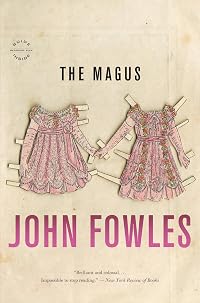
The Magus: A Revised Version
by John Fowles
On This Page
Description
Nicholas Urfe accepts a teaching post on a remote Greek island, in order to escape an unsatisfactory love affair. He meets the Maurice Conchis, who introduces him to Lily, his ideal of the perfect woman. But is she flesh or fantasy? As the past bleeds into the present, he finds it increasingly difficult to distinguish reality from imagination. Under the spell of this magic isle and its presiding spirit, he struggles to understand the rules of the mysterious game into which he is drawn.Tags
Recommendations












Member Recommendations



Member Reviews
Detta är ett mästerverk, en historia som sakta vecklas ut och drar in er djupt in i intrigernas värld. Vad är sant och vad är illusion , ett arrangerad rollspel skapad av den exentriska miljonären Mauice Conchis för att roa en en mans publik ?
Nicholas vet snart varken ut eller in, han har fastnat i ett nät av lögner eller sanningar , tappar han bort sin fria vilja i ett försök att hitta sin identitet.
Det var längesedan jag läste en bok där jag var lika förvirrad och ovetande som huvudkaraktären . Man vet inte vem man ska tro på och det bästa är att det inte går att förutse hur boken kommer att utveckla sig :
Nicholas vet snart varken ut eller in, han har fastnat i ett nät av lögner eller sanningar , tappar han bort sin fria vilja i ett försök att hitta sin identitet.
Det var längesedan jag läste en bok där jag var lika förvirrad och ovetande som huvudkaraktären . Man vet inte vem man ska tro på och det bästa är att det inte går att förutse hur boken kommer att utveckla sig :
I went into this novel with some trepidation. I was not intimidated by its doorstop size, nor by its reputation as sophisticated metafiction. But it had received a solidly negative review from my Other Reader, and the book's own author John Fowles lamented it as "haphazard ... a novel of adolescence written by a retarded adolescent" (6, 9). These worries were mitigated by two factors. First, the version I read was a "more than ... stylistic revision" (5) perpetrated over a decade after its initial publication. Second, I had encountered the two-page "fairy story" of "The Prince and the Magician" excerpted in the "Magic Shows" issue of Lapham's Quarterly (Summer 2012), and found it wonderful. I can now report that it loses none of its show more luster in its original context (550-552). There was a big twist at the end of part two (562), which I had seen coming for at least 200 pages, so that was underwhelming.
Like any "novel of adolescence," The Magus is a story of initiation, but more explicitly so than most. The fact that the ceremonial aspects of the rite are largely non-consensual, and that the candidate (i.e. the first-person narrator Nicholas) is so profoundly unlikable, were perhaps contributing factors to my Other Reader's thorough disgust with the book. There is an explicit Sadean element here, with or without sadism. It is in some respects a more naturalistic approach to the content of Bernard Noel's Castle of Communion.
In the course of the novel, an elite conspiracy perpetrating a system of "experimental" initiation has as its upshot an opposition between freedom and faith. "There is no god but man," and "Love is the law, love under will" (none of these quotes from the book). The closing epigram reminded me of the words of Liber CLXVI: "This Path is beyond Life and Death; it is also beyond Love; but that ye know not, for ye know not Love." Aleister Crowley gets one solitary name-check here, whena character in a combination of criminal trial and witches' sabbat appears in a Baphomet mask, and Nicholas (gagged) thinks sarcastically to himself, "Doctor Crowley, I presume" (502).
The magus of the title is the inscrutable psychopomp character Maurice Conchis, whom I found more reminiscent of Gurdjieff than of Crowley. The most esoteric influence mentioned by Fowles in a discussion of his sources is C.G. Jung, but it is possible that there was a Gurdjieffian element. The metaphysical concept of "hazard" emphasized by Conchis was key in the work of John G. Bennett, who was active in England promoting Gurdjieff's teachings during the extensive period of the composition of The Magus. (I synchronistically stumbled across a cheap used copy of Bennett's book on Hazard on the same day I finished reading The Magus.)
I did enjoy this book, although it does tend to have the weaker side of the comparisons in which I find myself most likely to include it, whether with Hesse's Steppenwolf, Pynchon's Vineland, or Irwin's Satan Wants Me. I'll still plead for the virtues of "The Prince and the Magician," though, a teaching story on a par with the Bektashi parable of "The Shrine." show less
Like any "novel of adolescence," The Magus is a story of initiation, but more explicitly so than most. The fact that the ceremonial aspects of the rite are largely non-consensual, and that the candidate (i.e. the first-person narrator Nicholas) is so profoundly unlikable, were perhaps contributing factors to my Other Reader's thorough disgust with the book. There is an explicit Sadean element here, with or without sadism. It is in some respects a more naturalistic approach to the content of Bernard Noel's Castle of Communion.
In the course of the novel, an elite conspiracy perpetrating a system of "experimental" initiation has as its upshot an opposition between freedom and faith. "There is no god but man," and "Love is the law, love under will" (none of these quotes from the book). The closing epigram reminded me of the words of Liber CLXVI: "This Path is beyond Life and Death; it is also beyond Love; but that ye know not, for ye know not Love." Aleister Crowley gets one solitary name-check here, when
The magus of the title is the inscrutable psychopomp character Maurice Conchis, whom I found more reminiscent of Gurdjieff than of Crowley. The most esoteric influence mentioned by Fowles in a discussion of his sources is C.G. Jung, but it is possible that there was a Gurdjieffian element. The metaphysical concept of "hazard" emphasized by Conchis was key in the work of John G. Bennett, who was active in England promoting Gurdjieff's teachings during the extensive period of the composition of The Magus. (I synchronistically stumbled across a cheap used copy of Bennett's book on Hazard on the same day I finished reading The Magus.)
I did enjoy this book, although it does tend to have the weaker side of the comparisons in which I find myself most likely to include it, whether with Hesse's Steppenwolf, Pynchon's Vineland, or Irwin's Satan Wants Me. I'll still plead for the virtues of "The Prince and the Magician," though, a teaching story on a par with the Bektashi parable of "The Shrine." show less
I have abundant respect for the Goodreads friends who adore this book or give it five stars. I also have respect for the critics who put this in the Top 100. But even John Fowles knew this was a hugely problematic, flawed book. It took him twelve years to write it, and he revised endlessly, until he even released a revised version of it in 1977, more than a decade after it was first published. And reading his foreword to that revised edition reveals an utterly charming, self-effacing man who was bewildered by and slightly embarrassed by the positive response to the Magus. I share that bewilderment.
I finished this book against my will, because I do not put books down except in the most dire circumstances. It was insufferably ponderous. show more It was written by a young man fresh off reading classics at Oxford or Cambridge, and eager to show it off. Now, I know my Greek mythology pretty well, but even I had to keep my well-worn Edith Hamilton on the bedside table. When she illuminated the Fowlian metaphor, it didn't add any resonance to the story. Every single character in this book is unlikable--the narrator intensely so. It's a classic first novel effort--the kitchen sink method in full effect.
The positive: we get the full flower of Fowles gift for landscape description, and his deep love of Greece is evident in nearly every passage of description.
I can't write more. I need more time, because the negative feelings are so intense. I take comfort, though, in knowing that many of my feelings were shared by the author himself. show less
I finished this book against my will, because I do not put books down except in the most dire circumstances. It was insufferably ponderous. show more It was written by a young man fresh off reading classics at Oxford or Cambridge, and eager to show it off. Now, I know my Greek mythology pretty well, but even I had to keep my well-worn Edith Hamilton on the bedside table. When she illuminated the Fowlian metaphor, it didn't add any resonance to the story. Every single character in this book is unlikable--the narrator intensely so. It's a classic first novel effort--the kitchen sink method in full effect.
The positive: we get the full flower of Fowles gift for landscape description, and his deep love of Greece is evident in nearly every passage of description.
I can't write more. I need more time, because the negative feelings are so intense. I take comfort, though, in knowing that many of my feelings were shared by the author himself. show less
Magic is more than deception. There is meant to be an elegance, a certain grace in the illusion that transcends mere chicanery. Nearly every boy discovers magic. That day usually comes during the same transitional adolescent period when the innocent mysticism of childhood begins to wear thin. Taking flight on the seat of a Schwin is no longer a possibility. Play-time pursuits begin to be shaped more by sport and less by imagination. Ghosts and the grotesque, slimy things under the bed are less frightening because the everyday world is more so. But then you discover that magic still exists, that, even though it is illusion, you can still conjure.
I was no different. Sometime in the awkward peak of my elementary school years, I discovered show more Harry Houdini and begin devouring every book about him I could find with wide-eyed gluttony. Maybe, if Houdini could fearlessly face and escape certain death, I could manage an equally daring and amazing escape from childhood with a sense of the fantastic intact. My mother, always quick to support any new creative endeavor, purchased an inexpensive magic set with a book describing a couple of card tricks and a few illusions managed with colorful plastic bits. One afternoon, I loaded them into a molded plastic briefcase, a relic of my ‘businessman’ period, and carried them to the law office where my sister worked. Each private performance, whether I fumbled the pieces or picked the wrong card, was rewarded with gleeful grins and wild applause. The attorneys grasped for that elegance and grace as a foil to the mundaneness, the loss of magic in their lives.
What does any of that have to do with John Fowles’ novel [The Magus]? The title suggests the connection, as it is a word that is essentially equal to magician. A quick read of the book flap offers a glimpse at the magic that the book promises – offering to pull the reader into a “saturnalian labyrinth” with “games, hallucinations, theatrical masques, riddles, and mock trials” weaving a “web of suspense and mystery.” All of that dressing, suggesting a magical journey, is rubbish. There is absolutely no magic within the pages of [The Magus] – there is only bald deception and vain, manipulative trickery, devoid of any of the sweet elegance of real magic.
Nicholas Urfe, a recent Oxford graduate, takes a job at an English prep school on the Greek island of Phraxos, hoping to escape an affair and find some inspiration for his life and his poetry. The school turns out to be a microcosm of the England he fled and the island outside the walls of the school is only an isolated, bucolic community of peasants – save one inhabitant, Conchis. Conchis is known among the villagers as an eccentric and is rumored to have collaborated with the Nazis during the islands occupation. Hungry for stimulation, Nicholas begins visiting Conchis’ villa. Soon, Nicholas begins to see ghosts or have hallucinations that mirror the conversations he has with his host. Eventually, he starts to believe that the things he is experiencing are an elaborate play, with actors and scripts, targeted to teach him a lesson of some sort.
And Nicholas is right. Everything he sees, all of his experiences with Conchis and the people that Conchis introduces him to, are all a big lie. When Nicholas begins to see through one layer of the play, the script twists with a new lie. You’ve probably read at least one novel that featured an unreliable narrator. [The Magus] is an entirely unreliable story – everyone is lying to Nichoals, all of the time. And in the end, it seems designed to destroy any idea in him that there is any unifying moral principle in the world – everything is hazard. Of course, as is common to these stories, it is suggested to Nicholas that since everything is vanity and chaos he should simply live to please himself in an honest and straightforward way – which is a unifying moral principle. Ultimately, I felt like I was reading a parable in defense of open polyamorous sexual relationships.
There was no magic, none. Every attempt at creating a mysterious or magical reality was all based in bald-faced lies and manipulative tricks. That the lies and tricks were focused on the narrator and hero of the book neither excused the device nor made the book more palatable. And the faulty circular reasoning that was meant to establish some avant garde way of life only cheapened the book further. Many of the original reviews lauded Fowles for creating such a mystical and fantastic story. But the book amounts to little more than a back-alley game of ‘Follow the Queen’ where the con man has palmed the card. Anyone can confuse and misdirect an audience if they fix the game completely – but the real magician does it with some elegance
Bottom Line: Find a different book if you’re looking for real magic.
2 bones!!!!! show less
I was no different. Sometime in the awkward peak of my elementary school years, I discovered show more Harry Houdini and begin devouring every book about him I could find with wide-eyed gluttony. Maybe, if Houdini could fearlessly face and escape certain death, I could manage an equally daring and amazing escape from childhood with a sense of the fantastic intact. My mother, always quick to support any new creative endeavor, purchased an inexpensive magic set with a book describing a couple of card tricks and a few illusions managed with colorful plastic bits. One afternoon, I loaded them into a molded plastic briefcase, a relic of my ‘businessman’ period, and carried them to the law office where my sister worked. Each private performance, whether I fumbled the pieces or picked the wrong card, was rewarded with gleeful grins and wild applause. The attorneys grasped for that elegance and grace as a foil to the mundaneness, the loss of magic in their lives.
What does any of that have to do with John Fowles’ novel [The Magus]? The title suggests the connection, as it is a word that is essentially equal to magician. A quick read of the book flap offers a glimpse at the magic that the book promises – offering to pull the reader into a “saturnalian labyrinth” with “games, hallucinations, theatrical masques, riddles, and mock trials” weaving a “web of suspense and mystery.” All of that dressing, suggesting a magical journey, is rubbish. There is absolutely no magic within the pages of [The Magus] – there is only bald deception and vain, manipulative trickery, devoid of any of the sweet elegance of real magic.
Nicholas Urfe, a recent Oxford graduate, takes a job at an English prep school on the Greek island of Phraxos, hoping to escape an affair and find some inspiration for his life and his poetry. The school turns out to be a microcosm of the England he fled and the island outside the walls of the school is only an isolated, bucolic community of peasants – save one inhabitant, Conchis. Conchis is known among the villagers as an eccentric and is rumored to have collaborated with the Nazis during the islands occupation. Hungry for stimulation, Nicholas begins visiting Conchis’ villa. Soon, Nicholas begins to see ghosts or have hallucinations that mirror the conversations he has with his host. Eventually, he starts to believe that the things he is experiencing are an elaborate play, with actors and scripts, targeted to teach him a lesson of some sort.
And Nicholas is right. Everything he sees, all of his experiences with Conchis and the people that Conchis introduces him to, are all a big lie. When Nicholas begins to see through one layer of the play, the script twists with a new lie. You’ve probably read at least one novel that featured an unreliable narrator. [The Magus] is an entirely unreliable story – everyone is lying to Nichoals, all of the time. And in the end, it seems designed to destroy any idea in him that there is any unifying moral principle in the world – everything is hazard. Of course, as is common to these stories, it is suggested to Nicholas that since everything is vanity and chaos he should simply live to please himself in an honest and straightforward way – which is a unifying moral principle. Ultimately, I felt like I was reading a parable in defense of open polyamorous sexual relationships.
There was no magic, none. Every attempt at creating a mysterious or magical reality was all based in bald-faced lies and manipulative tricks. That the lies and tricks were focused on the narrator and hero of the book neither excused the device nor made the book more palatable. And the faulty circular reasoning that was meant to establish some avant garde way of life only cheapened the book further. Many of the original reviews lauded Fowles for creating such a mystical and fantastic story. But the book amounts to little more than a back-alley game of ‘Follow the Queen’ where the con man has palmed the card. Anyone can confuse and misdirect an audience if they fix the game completely – but the real magician does it with some elegance
Bottom Line: Find a different book if you’re looking for real magic.
2 bones!!!!! show less
The Magus is a very long novel and John Fowles devoted a large chunk of his life to it. A riddle wrapped in a mystery inside an enigma it is clearly meant to have a mesmerising effect on the reader. It certainly seems to have worked the trick on Fowles himself. Throughout the 1950s and for decades beyond he kept returning to it, tinkering with it, rewriting and revising it, as if attempting to solve the mystery he had set in motion: master mesmerist enchanted by his own spell.
It works through constant surprise, revelation and sudden reversal, so it’s difficult to say much about the plot without spoiling it. I will try to tread carefully. Twenty-something Nicholas Urfe, somewhat self-centred and commitment-phobic, abandons his latest show more girlfriend in London and heads out to the Greek Island of Phraxos to teach English at an elite boys school. He meets Maurice Conchis, an elderly and reclusive millionaire who lives in a villa on the island. And then ‘the mysteries’ begin: dead people come back to life, nymphs are pursued by satyrs across the grounds of the estate and… but I did promise not to spoil it. Nicholas finds the boundaries between the real and the unreal becoming increasingly blurred.
Like the plays of Harold Pinter The Magus exploits to the maximum the potential fiction has to confuse us. It’s not so much a question of what it means as what is actually happening at any given moment. Nicholas doesn’t know and neither does the reader. As the book is Nicholas’s first-person narrative he is in effect the reader and Conchis is Fowles. Conchis plays his mystifying ‘godgame’ with Nicholas and Fowles does the same with us. It’s a dazzling performance, a conjuring trick of astonishing inventiveness combined with immense technical skill. I was quite happy to lie back and allow Fowles to work his manipulative magic on me, enjoy the baffling and duplicitous ride, and let the meaning take care of itself.
It is too long, though, and not without its longueurs. It would have been twice as good at half the length. It is so heavily dependent on narrative twists and turns that over the course of 656 pages a law of diminishing returns inevitably sets in. The unexpected tends to lose its impact when you have become accustomed to expect it. There were times when I felt the spell Fowles was weaving was about to break, or that he would fall off the tightrope he was walking (I can mix my metaphors with the best of them) and the sublimely mysterious would descend into the farcically ridiculous. There is an overcooked flavour to pretty much every ingredient of this book: the intimidating length, the allusions to Greek mythology and Shakespeare, the references to Freud, Jung and the Holocaust, the hypersensual prose, the assiduously worked at sense that matters of Great Import are at hand. The phrase ‘laying it on with a trowel’ springs to mind. Conversely, although it tests the patience at times, much of its peculiar atmosphere and undeniable power is created through this over the top quality.
John Fowles was a big deal back in the 1960s and ‘70s. A bestseller who was also critically lauded; a postmodernist whose novels were turned into Hollywood movies. His critical reputation seems to have slumped rather dramatically over the decades but, judging from this website, he continues to be read. The Magus does occupy a sweet spot between the conventional and experimental novel. A less generous impulse in me couldn’t help feeling that it also fell awkwardly somewhere between Great Novel and airport blockbuster. Some of the dialogue is so B-movie bad that it is deliciously, though entirely unintentionally, camp: ‘I’m not playing games, you moronic little fool!’ The super-intelligent, urbanely sinister, and Machiavellian Conchis is clearly Ernst Stavro Blofeld’s older brother. Nicholas is forever unsure if Conchis is truly a magus or merely a charlatan, and I came away with similarly ambivalent feelings about the book: profound or pretentious? Epic or over-egged? All of the above, perhaps.
A half-century on from publication, for all its metafictional games and existential themes - freedom and responsibility, authentic and inauthentic existence, masculine psycho-sexuality - The Magus impresses mainly for its robustly traditional virtues. Above all it is a well-crafted piece of old-fashioned storytelling. The resolution even has more than a faint whiff of the Victorian morality tale about it. It is, I think, a little too obviously contrived to be genuinely haunting or mysterious but, despite my reservations, it is a work of extraordinary imagination.
I’ve come late to John Fowles. I read The Collector - his first published novel - earlier this year, and now this. Of the two I would say The Collector, which deals with many of the same themes but at less than half the length, is the greater book. It had an emotional impact on me this one didn’t come close to. Still, I remain sufficiently intrigued to want to continue to read him in chronological order, so The French Lieutenant’s Woman next. Not just yet, though; I need to recover from this monster first. It may take some time. show less
It works through constant surprise, revelation and sudden reversal, so it’s difficult to say much about the plot without spoiling it. I will try to tread carefully. Twenty-something Nicholas Urfe, somewhat self-centred and commitment-phobic, abandons his latest show more girlfriend in London and heads out to the Greek Island of Phraxos to teach English at an elite boys school. He meets Maurice Conchis, an elderly and reclusive millionaire who lives in a villa on the island. And then ‘the mysteries’ begin: dead people come back to life, nymphs are pursued by satyrs across the grounds of the estate and… but I did promise not to spoil it. Nicholas finds the boundaries between the real and the unreal becoming increasingly blurred.
Like the plays of Harold Pinter The Magus exploits to the maximum the potential fiction has to confuse us. It’s not so much a question of what it means as what is actually happening at any given moment. Nicholas doesn’t know and neither does the reader. As the book is Nicholas’s first-person narrative he is in effect the reader and Conchis is Fowles. Conchis plays his mystifying ‘godgame’ with Nicholas and Fowles does the same with us. It’s a dazzling performance, a conjuring trick of astonishing inventiveness combined with immense technical skill. I was quite happy to lie back and allow Fowles to work his manipulative magic on me, enjoy the baffling and duplicitous ride, and let the meaning take care of itself.
It is too long, though, and not without its longueurs. It would have been twice as good at half the length. It is so heavily dependent on narrative twists and turns that over the course of 656 pages a law of diminishing returns inevitably sets in. The unexpected tends to lose its impact when you have become accustomed to expect it. There were times when I felt the spell Fowles was weaving was about to break, or that he would fall off the tightrope he was walking (I can mix my metaphors with the best of them) and the sublimely mysterious would descend into the farcically ridiculous. There is an overcooked flavour to pretty much every ingredient of this book: the intimidating length, the allusions to Greek mythology and Shakespeare, the references to Freud, Jung and the Holocaust, the hypersensual prose, the assiduously worked at sense that matters of Great Import are at hand. The phrase ‘laying it on with a trowel’ springs to mind. Conversely, although it tests the patience at times, much of its peculiar atmosphere and undeniable power is created through this over the top quality.
John Fowles was a big deal back in the 1960s and ‘70s. A bestseller who was also critically lauded; a postmodernist whose novels were turned into Hollywood movies. His critical reputation seems to have slumped rather dramatically over the decades but, judging from this website, he continues to be read. The Magus does occupy a sweet spot between the conventional and experimental novel. A less generous impulse in me couldn’t help feeling that it also fell awkwardly somewhere between Great Novel and airport blockbuster. Some of the dialogue is so B-movie bad that it is deliciously, though entirely unintentionally, camp: ‘I’m not playing games, you moronic little fool!’ The super-intelligent, urbanely sinister, and Machiavellian Conchis is clearly Ernst Stavro Blofeld’s older brother. Nicholas is forever unsure if Conchis is truly a magus or merely a charlatan, and I came away with similarly ambivalent feelings about the book: profound or pretentious? Epic or over-egged? All of the above, perhaps.
A half-century on from publication, for all its metafictional games and existential themes - freedom and responsibility, authentic and inauthentic existence, masculine psycho-sexuality - The Magus impresses mainly for its robustly traditional virtues. Above all it is a well-crafted piece of old-fashioned storytelling. The resolution even has more than a faint whiff of the Victorian morality tale about it. It is, I think, a little too obviously contrived to be genuinely haunting or mysterious but, despite my reservations, it is a work of extraordinary imagination.
I’ve come late to John Fowles. I read The Collector - his first published novel - earlier this year, and now this. Of the two I would say The Collector, which deals with many of the same themes but at less than half the length, is the greater book. It had an emotional impact on me this one didn’t come close to. Still, I remain sufficiently intrigued to want to continue to read him in chronological order, so The French Lieutenant’s Woman next. Not just yet, though; I need to recover from this monster first. It may take some time. show less
This book drove me crazy. It started out so well. A shady man with lots of money lures single men to his estate on a Greek Island for the purposes of psychological experimentation. There is a strange woman and silent servants and odd occurrences. Truth takes a vacation and the man is surrounded by lies. What is real and what is fantasy? A great set up. There are a couple of violent interludes where the man is attacked and forced to participate in strange little vignettes. Exactly what this is all supposed to mean is still hidden. The man realizes that he's being manipulated and lied to, but still he puts up with it. The mystery of why is palpable and as we find out that everyone is in on the plot, we're astonished at just how show more far-reaching this wealthy man's influence goes.
All fine and good - but then it goes too far. It leaves the bounds of plausibility behind. The dupe at the center of all this puts up with a great deal more than he ought. He's repeatedly attacked and lied to and when his former girlfriend kills herself and that event is taken into the whirling plot that surrounds him, he still believes the things people say to him. He still puts himself in situations beyond his control even knowing they will end badly. I can't imagine any sane human being putting up with this for as long as this guy has been.
As if that wasn't enough, but now the author repeats scenes over and over. The twin girls (that mysterious woman wasn't one person, but two, another little creepy aspect) seem to come clean and reveal the truth, but then are found to be duplicitous liars. There are tears and sex and strange kidnappings. Not once. Not twice. Three scenes like this. All ending in violence and the man's assertion that he won't fall for it again. But we know he will. He always does. He's an idiot and I really don't care what happens to him.
Besides that, the plot now has gotten so convoluted with all of the deceit and the liars backpedaling and forgetting their own lies. I can't keep track and I don't really care to. Which is a shame because I really wanted to like this book. Everything I've heard about it is positive, but now I am mystified as to why. Bah. show less
All fine and good - but then it goes too far. It leaves the bounds of plausibility behind. The dupe at the center of all this puts up with a great deal more than he ought. He's repeatedly attacked and lied to and when his former girlfriend kills herself and that event is taken into the whirling plot that surrounds him, he still believes the things people say to him. He still puts himself in situations beyond his control even knowing they will end badly. I can't imagine any sane human being putting up with this for as long as this guy has been.
As if that wasn't enough, but now the author repeats scenes over and over. The twin girls (that mysterious woman wasn't one person, but two, another little creepy aspect) seem to come clean and reveal the truth, but then are found to be duplicitous liars. There are tears and sex and strange kidnappings. Not once. Not twice. Three scenes like this. All ending in violence and the man's assertion that he won't fall for it again. But we know he will. He always does. He's an idiot and I really don't care what happens to him.
Besides that, the plot now has gotten so convoluted with all of the deceit and the liars backpedaling and forgetting their own lies. I can't keep track and I don't really care to. Which is a shame because I really wanted to like this book. Everything I've heard about it is positive, but now I am mystified as to why. Bah. show less
This has been a key book for me, one that dreams, and life philosophies, and real choices with real consequences (applied literature!) have been made on. First encountered in rumour and legend--our English teacher, who was a magus type himself, told us about picking it up himself at a younger age and being riveted, reading through the night and putting it down and finding that things weren't the same as before. In those days we didn't have the $ that I could just go and buy books whenever I wanted*--weird to think how substantially my reading life up till age 18 was determined by my dad's reading proclivities, ossified decades earlier but still represented by everything on the shelf at home and everything we got for Christmas. But Mr. show more Bowker's vehement rec kindled a bad desire, and when I went to university and got scholarships and could read whatever I wanted, Fowles was my first port of call. It was great timing--I'd just broken off my first great roma(h)nce, and I was a young man who loved deeply and selfishly and was as close as I would ever be, at that time, to identifying with Nicholas Urfe's vicious, reptilian sense of entitlement and fundamental inability to ever feel himself anything other than deeply, deeply clean.
I mean, this existential liquor went down smooooooth. This was to Sartre as Jameson's and water was to those scotches that pack your eyes and nose with cotton balls. Young proxy flees tiresome love affair for plausible adventure on Greek island, falls into something strange--distressing and addictive in its strangeness--instead. A mentor, a mystery, a girl. This is exactly what any young male with half a set of balls and half a book in his head and complicated resentments and a deep, deep ambivalence toward the multi-metaphoric weirdness of the idea of a "career" was looking for. As Nicholas dropped out of some shitty DH Lawrence pastiche into the magic uncertainty, jesting pleasance, safe-or-are-they risks that lie beyond the waiting-room. A masque, every night, and just for me!
A masque full of life lessons for budding lads (and, by all accounts, lasses--this is a book beloved by many--though it's SO male and if I were a woman I'd be rolling my eyes hard, but then maybe that's just my own private reductionism) lads I say not much removed from the writing-down-quotes-from-Bartleby's-in-your-diary stage. What would SPECIAL YOU do if you had to make a SPECIAL CHOICE about who would LIVE AND DIE and maybe STAIN YOUR HONOUR in DOUBLEYA DOUBLEYA TWO and maybe not be so SPECIAL AFTER ALL? I mean, this book literally has a scene where a bunch of eminent psychologists place our man on a throne and talk all about him for hours and then give him a chance to get back at the woman who's "wronged" him; Fowles's purpos is ultimately pedagogical, but the masturbatory element is undeniable.
As a novelist, Fowles is a theorist, but not a systematizer—that is, to take the inevitable permanent Sartre comparison up again, Fowles “existentials” no –ism, no thoroughgoing ethical discipline or public movement, but merely a hobbledehoy, a clapped-up compilation of cannily coordinated concepts to float the author, himself, across the uncharted waters of life and to be taken by the reader, insofar as he or she wishes, as a readymade.
Viz.! The “Godgame,” which our present generation can understand as a process essentially like unto “taking the red pill.” You know? You take the red pill, you stay in Wonderland, you take the blue pill, you wake up in your bed?** The motto of the game: Cause no unnecessary pain, and the question of whether pain is ever necessary. The “existential smile,” which is the smile that’s chewed up all the arbitrary cruelty and meaninglessness life has to offer and accepts it—spits it back like tacks and smiles nevertheless. The key difference between the two editions of this book is that in the first, the existential smile has more than a dash of cruelty in it itself—Conchis is a traumatized man with more than a hint of the “dark triad” (Machiavellianism, narcissism, psychopathy) about him, Nicholas hits Alison with a brutal fist, the ending is a simple exercise in catharsis-denial. Fowles was mistaken for a crypto-fascist of the (crypto-)Nietzschean ilk by many of his first readers, and you can understand that take from a perspective still sorta mired in the postwar hivemind and only starting to glimpse the radical new approaches to self-actualization of the decade to come. (First edition, 1965; second, 1977 ….) But as we know from reading our Nietzsche properly, the will to power is also the will to joy and the will to kindness; and Fowles took the fairly extraordinary steps for a misunderstood novelist of producing not only The Aristos, an idiosyncratic personal statement of his ideas about a higher spiritual life for humanity, but also a whole second version of The Magus that excises that unintended darkness, whether its source was a failure of art or a personal philosophy still immature. The Aristos is the hobbledehoy and The Magus is the readymade. Conchis becomes a teacher of infinite subtlety, finally earning the Prospero role; the misogyny of the fist is partially expiated, partially defused, partially sublimated into Nicholas’s now more extensively sexual relations with Lily/Julie, but certainly on the whole less objectionable; and the ending is extended, massaged and modulated, and goes from just sudden and unsatisfying to the intentional ambiguity-pathos of great art. This is the version that I love and that reminds me still that it takes strength to be gentle and kind, especially for the adventurous spirit. (I’ll cop to still slyly trying to share some corner of that umbrella; no longer the centre of the universe like one was at 19, but back still straight, still catching glimpses of oneself in the mirror and trying to embody a certain raffish pluck.)
Cras amet qui numquam amavit quique amavit cras amet. Do they end up together, or don’t they? Here is an anecdote from The French Lieutenant’s Woman’s Man, by Richard B. Stolley:
In response to a gentle letter from a New York lawyer, dying of cancer in a hospital, who said he very much wanted the couple to be reunited, Fowles wrote back, "Yes, they were." On the same day he got a "horrid" letter from an American woman who angrily demanded, "Why can't you say what you mean, and for God's sake, what happened in the end?" Fowles replied curtly: "They never saw each other again."
Philosophy in action.
*oh, and I was banned from the library because I used to wreck and lose books with perplexing regularity and couldn't pay the fees.
**ETA: Okay, let me explain that when I wrote this review in 2014 I had maybe encountered the "red pill" metaphor as appropriated by MRAs, of infamy this decade, and thought "oh yeah, that's a good one for explaining the kind of "choosing to lift the veil" scenario, obviously better than the way these MRAs are using it, ugh, let's re-appropriate," and of course I had no idea how hard their red pill thing would catch on and that fast forward a couple of years and "red pill" would just straight-up be another way of saying "dickhead misogynist," and while obviously my reading and review of the Magus have been occasion for me to grapple with some less nice things about my attitude as a man toward women, I never ever ever ever ever would have used the red pill image if I had had any inkling about its subsequent career. It's especially embarrassing because this is one of the reviews my friends in the Tropic of Ideas selected to print in our book, on paper, which as everyone knows lasts forever. show less
I mean, this existential liquor went down smooooooth. This was to Sartre as Jameson's and water was to those scotches that pack your eyes and nose with cotton balls. Young proxy flees tiresome love affair for plausible adventure on Greek island, falls into something strange--distressing and addictive in its strangeness--instead. A mentor, a mystery, a girl. This is exactly what any young male with half a set of balls and half a book in his head and complicated resentments and a deep, deep ambivalence toward the multi-metaphoric weirdness of the idea of a "career" was looking for. As Nicholas dropped out of some shitty DH Lawrence pastiche into the magic uncertainty, jesting pleasance, safe-or-are-they risks that lie beyond the waiting-room. A masque, every night, and just for me!
A masque full of life lessons for budding lads (and, by all accounts, lasses--this is a book beloved by many--though it's SO male and if I were a woman I'd be rolling my eyes hard, but then maybe that's just my own private reductionism) lads I say not much removed from the writing-down-quotes-from-Bartleby's-in-your-diary stage. What would SPECIAL YOU do if you had to make a SPECIAL CHOICE about who would LIVE AND DIE and maybe STAIN YOUR HONOUR in DOUBLEYA DOUBLEYA TWO and maybe not be so SPECIAL AFTER ALL? I mean, this book literally has a scene where a bunch of eminent psychologists place our man on a throne and talk all about him for hours and then give him a chance to get back at the woman who's "wronged" him; Fowles's purpos is ultimately pedagogical, but the masturbatory element is undeniable.
As a novelist, Fowles is a theorist, but not a systematizer—that is, to take the inevitable permanent Sartre comparison up again, Fowles “existentials” no –ism, no thoroughgoing ethical discipline or public movement, but merely a hobbledehoy, a clapped-up compilation of cannily coordinated concepts to float the author, himself, across the uncharted waters of life and to be taken by the reader, insofar as he or she wishes, as a readymade.
Viz.! The “Godgame,” which our present generation can understand as a process essentially like unto “taking the red pill.” You know? You take the red pill, you stay in Wonderland, you take the blue pill, you wake up in your bed?** The motto of the game: Cause no unnecessary pain, and the question of whether pain is ever necessary. The “existential smile,” which is the smile that’s chewed up all the arbitrary cruelty and meaninglessness life has to offer and accepts it—spits it back like tacks and smiles nevertheless. The key difference between the two editions of this book is that in the first, the existential smile has more than a dash of cruelty in it itself—Conchis is a traumatized man with more than a hint of the “dark triad” (Machiavellianism, narcissism, psychopathy) about him, Nicholas hits Alison with a brutal fist, the ending is a simple exercise in catharsis-denial. Fowles was mistaken for a crypto-fascist of the (crypto-)Nietzschean ilk by many of his first readers, and you can understand that take from a perspective still sorta mired in the postwar hivemind and only starting to glimpse the radical new approaches to self-actualization of the decade to come. (First edition, 1965; second, 1977 ….) But as we know from reading our Nietzsche properly, the will to power is also the will to joy and the will to kindness; and Fowles took the fairly extraordinary steps for a misunderstood novelist of producing not only The Aristos, an idiosyncratic personal statement of his ideas about a higher spiritual life for humanity, but also a whole second version of The Magus that excises that unintended darkness, whether its source was a failure of art or a personal philosophy still immature. The Aristos is the hobbledehoy and The Magus is the readymade. Conchis becomes a teacher of infinite subtlety, finally earning the Prospero role; the misogyny of the fist is partially expiated, partially defused, partially sublimated into Nicholas’s now more extensively sexual relations with Lily/Julie, but certainly on the whole less objectionable; and the ending is extended, massaged and modulated, and goes from just sudden and unsatisfying to the intentional ambiguity-pathos of great art. This is the version that I love and that reminds me still that it takes strength to be gentle and kind, especially for the adventurous spirit. (I’ll cop to still slyly trying to share some corner of that umbrella; no longer the centre of the universe like one was at 19, but back still straight, still catching glimpses of oneself in the mirror and trying to embody a certain raffish pluck.)
Cras amet qui numquam amavit quique amavit cras amet. Do they end up together, or don’t they? Here is an anecdote from The French Lieutenant’s Woman’s Man, by Richard B. Stolley:
In response to a gentle letter from a New York lawyer, dying of cancer in a hospital, who said he very much wanted the couple to be reunited, Fowles wrote back, "Yes, they were." On the same day he got a "horrid" letter from an American woman who angrily demanded, "Why can't you say what you mean, and for God's sake, what happened in the end?" Fowles replied curtly: "They never saw each other again."
Philosophy in action.
*oh, and I was banned from the library because I used to wreck and lose books with perplexing regularity and couldn't pay the fees.
**ETA: Okay, let me explain that when I wrote this review in 2014 I had maybe encountered the "red pill" metaphor as appropriated by MRAs, of infamy this decade, and thought "oh yeah, that's a good one for explaining the kind of "choosing to lift the veil" scenario, obviously better than the way these MRAs are using it, ugh, let's re-appropriate," and of course I had no idea how hard their red pill thing would catch on and that fast forward a couple of years and "red pill" would just straight-up be another way of saying "dickhead misogynist," and while obviously my reading and review of the Magus have been occasion for me to grapple with some less nice things about my attitude as a man toward women, I never ever ever ever ever would have used the red pill image if I had had any inkling about its subsequent career. It's especially embarrassing because this is one of the reviews my friends in the Tropic of Ideas selected to print in our book, on paper, which as everyone knows lasts forever. show less
Members
- Recently Added By
Lists

1001 Books You Must Read Before You Die
1,448 works; 1,133 members

20th Century Literature
1,161 works; 54 members

Biggest Disappointments
606 works; 163 members

Books Read in 2024
4,727 works; 128 members

Unread books
1,063 works; 87 members

Weird and Weirder Fiction
270 works; 35 members
Author Information

62+ Works 26,163 Members
John Fowles was born in Essex, England, in 1926. He attended the University of Edinburgh for a short time, left to serve in the Royal Marines, and then returned to school at Oxford University, where he received a B.A. in French in 1950. Fowles taught English in France and Greece, as well as at St. Godric's College in London. Although the main show more theme in all Fowles's fiction is freedom, there are few other similarities in his books. He has deliberately chosen to explore a different style or genre for each novel: The Collector, his first novel, is an intellectual thriller; The Magus is an adolescent learning novel, tracing the emotional development of the central character; Daniel Martin tries, in the modernist style, to depict psychological reality; Mantissa is a comedic allegory that takes place entirely inside the narrator's head; Maggot combines mystery, science fiction, and history; and The Ebony Tower is a collection of short stories. Fowles explored yet another genre, historical fiction, with his best-known novel, The French Lieutenant's Woman, which received the W. H. Smith Literary Award in 1970 and was made into a movie, starring Meryl Streep and Jeremy Irons, in 1981. An intriguing feature of this novel is that it has three different endings. Fowles's nonfiction includes Aristos: A Self Portrait in Ideas; Poems; and Wormholes: Essays and Other Occasional Writings. In addition, he has written the text for several books of photographs, including The Tree, for which Fowles received the Christopher Award in 1982. He died on November 5, 2005 at the age of 79. (Bowker Author Biography) show less
Some Editions
Awards and Honors
Series
Belongs to Publisher Series
En bok för alla (2007)
Work Relationships
Is contained in
Is a retelling of
Common Knowledge
- Canonical title
- The Magus: A Revised Version
- Original title
- The Magus: a revised version
- Original publication date
- 1977 (revised edition) (revised edition)
- People/Characters
- Nicholas Urfe; Alison Kelly; Maurice Conchis; Brigadier Urfe; Mrs. Urfe; Janet (show all 40); Miss Spencer-Haigh; Margaret; Charlie; Ann Taylor; Billy Whyte; Demetriades (Méli); Alexander Mitford; Doctor Patarescu; Sarantopoulos; Hermes Ambelas; Karazoglou; Maria (Catherine Athanasoulis); Julie Holmes (Lily); June Holmes (Rose); Doctor Joseph Harrison; Georgiou; Barba Dimitraki; Barba Vassili; Doctor Friedrich Kretschmer; Doctor Mary Marcus; Yanni Kottopoulos; Professor Mario Ciardi; Arne Helbestedt; Doctor Heinrich Mayer; Doctor Annette Kazanian; Privatdozent Thorvald Jorgensen; Androutsos; Mavromichalis; John Leverrier; Joan (Kemp); Ignaz Pruszynski; Lily de Seitas (nee Montgomery); John Briggs; Jojo
- Important places
- Phraxos, Greece; Sparta, Greece; Pyrgos, Greece; Athens, Greece; Greece; Rome, Italy (show all 10); Subiaco, Italy; Italy; London, England, UK; England, UK
- Related movies
- The Magus (1968); The Truman Show (1998 | IMDb)
- First words
- I was born in 1927, the only child of middle-class parents, both English, and themselves born in the grotesquely elongated shadow, which they never rose sufficiently above history to leave, of that monstrous dwarf Queen Victo... (show all)ria.
- Quotations
- I acquired expensive habits and affected manners. I got a third class degree and a first class illusion: that I was a poet.
Men see objects, women see the relationship between objects. ... It is an extra dimension of feeling we men are without and one that makes war abhorrent to all real women – and absurd. ... War is a psychosis caused by an in... (show all)ablity to see relationships.
This is true of all collecting. It extinguishes the moral instinct. The object finally possesses the possessor. - Last words
- (Click to show. Warning: May contain spoilers.)And somewhere the stinging smell of burning leaves.
- Canonical DDC/MDS
- 823.914
- Canonical LCC
- PR6056.O85
- Disambiguation notice
- Please do not combine the revised version of The Magus with the original version. There are some differences between these two versions of the book. This is the revised version.
Classifications
Statistics
- Members
- 5,259
- Popularity
- 2,595
- Reviews
- 97
- Rating
- (3.95)
- Languages
- 9 — English, Finnish, German, Norwegian (Bokmål), Portuguese, Russian, Serbian, Swedish, Ukrainian
- Media
- Paper, Audiobook, Ebook
- ISBNs
- 32
- UPCs
- 1
- ASINs
- 14