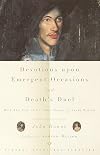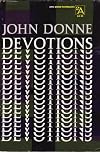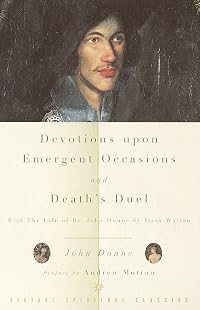
Devotions Upon Emergent Occasions and Death's Duel
by John Donne
On This Page
Description
John Donne (1572-1631) is best known as the greatest English metaphysical poet. But there was another dimension to Donne's life and writing that, if less well known, is no less profound and beautiful. Born into an aristocratic Catholic family, Donne joined the Church of England at the age of twenty-one out of fear of persecution. At the age of forty-three, he gave up his preoccupations with secular prestige and devoted himself utterly to religion. It was eight years later when, battered with show more fever, the deaths of his beloved wife, several of his children, and many dear lifelong friends, he composed Devotions upon Emergent Occasions. There is both trauma and great drama in this extended meditation on the meaning of mortality, the possibility of salvation, and the true nature of the passage of eternal life. With a new introduction by poet and biographer Andrew Motion, one of the most revered books of Christian devotion speaks to us again of the higher aspirations of man and the always-present possibility of a relationship with God. This long out of print edition also contains Donne's last sermon, "Death's Duel" as well as the short colorful biography of him written by his contemporary Izaak Walton. show lessTags
Recommendations

























Member Reviews
My own fascination with John Donne reminds me of the attempts by others to reassure their friends and family regarding death. Socrates did so in the Phaedo by describing his life as one long attempt to prepare for death. His view was echoed and enhanced by Montaigne who, In his essay titled “That to Study Philosophy is to Learn to Die,” turns to mortality and points to the understanding of death as a prerequisite for the understanding of life, for the very art of living.
"[L]et us learn bravely to stand our ground, and fight him. And to begin to deprive him of the greatest advantage he has over us, let us take a way quite contrary to the common course. Let us disarm him of his novelty and strangeness, let us converse and be familiar show more with him, and have nothing so frequent in our thoughts as death. "(Montaigne, Essays)
But one more example from my reading can be found in Rainier Maria Rilke's beautiful novel, The Notebooks of Malte Laurids Brigge. Through Rilke's fascination with faces and appearances the importance of constructing an authentic life is emphasized. This becomes a prerequisite for the prospect of a unique personal death. Death itself is a character in the novel, a "terrible rival", which may seem stronger than the living in its tolling.
The tolling of the bell in Rilke's novel signalling death brings us back to Donne who penned these famous lines:
"No man is an island, entire of itself; every man is a piece of the continent, a part of the main. If a clod be washed away by the sea, Europe is the less, as well as if a promontory were, as well as if a manor of thy friend's or of thine own were: any man's death diminishes me, because I am involved in mankind, and therefore never send to know for whom the bell tolls; it tolls for thee." (Devotions upon Emergent Occasions, 17) show less
"[L]et us learn bravely to stand our ground, and fight him. And to begin to deprive him of the greatest advantage he has over us, let us take a way quite contrary to the common course. Let us disarm him of his novelty and strangeness, let us converse and be familiar show more with him, and have nothing so frequent in our thoughts as death. "(Montaigne, Essays)
But one more example from my reading can be found in Rainier Maria Rilke's beautiful novel, The Notebooks of Malte Laurids Brigge. Through Rilke's fascination with faces and appearances the importance of constructing an authentic life is emphasized. This becomes a prerequisite for the prospect of a unique personal death. Death itself is a character in the novel, a "terrible rival", which may seem stronger than the living in its tolling.
The tolling of the bell in Rilke's novel signalling death brings us back to Donne who penned these famous lines:
"No man is an island, entire of itself; every man is a piece of the continent, a part of the main. If a clod be washed away by the sea, Europe is the less, as well as if a promontory were, as well as if a manor of thy friend's or of thine own were: any man's death diminishes me, because I am involved in mankind, and therefore never send to know for whom the bell tolls; it tolls for thee." (Devotions upon Emergent Occasions, 17) show less
These meditations and prayers of John Donne are a difficult read - but worth the effort - most of us try to deny the reality of death by almost any means - here is a man struggling to accept death - struggling to find peace while life is slipping away - drawing out important spiritual lessons in the midst of suffering.
Ratings
Members
- Recently Added By
Lists

Literary Works Read in College
316 works; 15 members

Ambleside Year 8
80 works; 1 member

In Our Time books
4,934 works; 2 members
Author Information

353+ Works 11,558 Members
Poet and churchman John Donne was born in London in 1572. He attended both the University of Oxford and the University of Cambridge, but did not receive a degree from either university. He studied law at Lincoln's Inn, London, in 1592, and was appointed private secretary to Sir Thomas Egerton, Keeper of the Great Seal, in 1598. He became an show more Anglican priest in 1615 and was appointed royal chaplain later that year. In 1621 he was named dean of St. Paul's Cathedral. Donne prepared for his own death by leaving his sickbed to deliver his own funeral sermon, "Death's Duel", and then returned home to have a portrait of himself made in his funeral shroud. He died in London on March 31, 1631. (Bowker Author Biography) show less
Series
Belongs to Publisher Series
Work Relationships
Common Knowledge
- Original publication date
- 1624
Classifications
- Genres
- Religion & Spirituality, Nonfiction, Biography & Memoir
- DDC/MDS
- 242.4 — Religion Christian practice & observance Devotional literature Devotions for Difficult Times
- LCC
- BV4831 .D6 — Philosophy, Psychology and Religion Practical Theology Practical Theology Practical religion. The Christian life Works of meditation and devotion
- BISAC
Statistics
- Members
- 338
- Popularity
- 94,009
- Reviews
- 2
- Rating
- (4.37)
- Languages
- Chinese, English, Spanish
- Media
- Paper, Ebook
- ISBNs
- 17
- ASINs
- 6