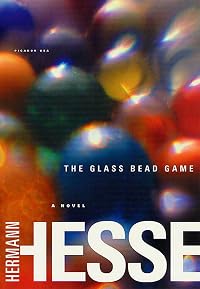
The Glass Bead Game
by Hermann Hesse
On This Page
Description
The final novel of Hermann Hesse, for which he won the Nobel Prize for Literature in 1946, The Glass Bead Game is a fascinating tale of the complexity of modern life as well as a classic of modern literature. Set in the twenty-third century, The Glass Bead Game is the story of Joseph Knecht, who has been raised in Castalia, the remote place his society has provided for the intellectual elite to grow and flourish. Since childhood, Knecht has been consumed with mastering the Glass Bead Game, show more which requires a synthesis of aesthetics and scientific arts, such as mathematics, music, logic, and philosophy, which he achieves in adulthood, becoming a Magister Ludi (Master of the Game). show lessTags
Recommendations













Member Recommendations

Member Reviews
"The summons was stronger than the warning…" (pg. 402)
Just as a bad ending can undo the good work done by a writer in a book, so too can a good ending redeem a writer who had got himself caught in the weeds. The Glass Bead Game, sometimes called Hermann Hesse's masterpiece, is by no means a bad book, but for the most part it is a very challenging one. It is only the beauty of that ending which recast my appraisal of the book, like sunlight breaking over an unpromising morning and burning away the fog.
The Glass Bead Game is the longest of any of Hermann Hesse's major novels, and completely contrary to the crystal-clear brevity evident in Siddhartha, Demian and, to a lesser extent, Steppenwolf. That wouldn't necessarily be a drawback, show more but when I described it as 'challenging' above, it was not the sort of challenge that seems rewarding as you read it. Seasoned readers of literature can enjoy getting stuck into heavy classics, but this joy wasn't present for most of the book. It can be a slog at times.
The book's premise is interesting; set in the twenty-third century, there has developed an elaborate game known as the Glass Bead Game, and an intellectual hierarchy dedicated to its development. Part university and part monastery, this aristocratic hierarchy is known as Castalia, and we follow our protagonist Joseph Knecht from his youth to his position at the top of this hierarchy. We then follow his thought process as he resigns his post and climbs down, metaphorically speaking, from his ivory tower to find his place in the regular world.
The problem, however, is that until this climbdown towards the end, the book is far from agreeable as a piece of storytelling. Its ideas are often stimulating (and this is always one of Hesse's strengths), but they are buried under a dense morass of prose. There is no flair to the writing (except on the rare occasion when you can isolate a sentence that could serve as an aphorism), and Hesse is constantly building his world, introducing us to new rules of the Glass Bead Game and the hierarchical structure of Castalia even when we're hundreds of pages in. There's no movement to the story, and the reader has to do a lot of endurance work.
I'm still not entirely sure what the Game really is; if it has a physical form, like a chess game, or a metatextual array of symbols, a concept that individual minds can play with, or if Hesse was trying to explain – as an old man in a pre-electronic age – something that we would nowadays recognise as a network, a sort of utopian Internet. Hesse alternates between keeping it vague ("the framework of a universal language… nourished by all the sciences and arts" (pg. 31)) and delving deeply into rules and minutiae that serve as walls to the reader, not gateways to understanding. (It's also worth mentioning, to avoid any doubt, that even though the book is set in the twenty-third century, the sci-fi element is non-existent.)
Knecht, too, lacks anything for the reader to invest in, or at least he lacks it until that final act. By the narrative's own admission, progress through the hierarchy is rather easy for our protagonist (pp142, 179), and so we never really warm to him. Similarly, the Game has no flavour. For all the talk of music and the love of art and science, I was surprised there was no warmth to the writing. Knecht is ill-served by the supporting characters, who are bland, and there is no playing with ideas in the dialogue. Not only is there no movement to the story, there's no movement in the reader's heart when the artistic and scientific knowledge is 'played' with. The book is written in the style of a dry academic text, when a more personal writing style that brings us closer to Knecht might have been to greater effect.
The dissatisfaction from the reader helps engage them later on (though no doubt many will have given up before then), as we share Knecht's quiet disenchantment with the structure of the Glass Bead Game. Hesse is kicking his ball in the same ballpark as Nietzsche and Jung: published in 1943, Hesse warns that "the music of decline has sounded" in society, and though it is set in the future, the academic narrative is sure to mention "the corporal who becomes a dictator overnight" in a previous era (pg. 157). Through Knecht's sometimes didactic arguments, Hesse tells us that intellectuals cannot remain aloof from the world.
But Hesse doesn't necessarily attack the 'ivory towers', and in fact he at one point provides a good riposte to the claims of intellectual arrogance and aloofness: "people in the [regular] world were no less proud of their bad manners, their meagre culture, their coarse, loud humour, the dull-witted shrewdness with which they kept themselves to practical, egotistical goals" (pg. 279). Hesse's book becomes much more interesting at this point, because the author makes his argument not as a political call to arms, but as a philosophical one. Knecht reaches the pinnacle of the Glass Bead Game's hierarchy, but is astute enough to recognise that his continued dissatisfaction needs to be addressed logically. The Game is concerned with seeking truth and knowledge, and the fact that Knecht, at the top of the Game, still wants something more means that whatever that 'something more' is, it must be a further truth, one that cannot be achieved within the Game (pg. 363).
It is impressive that the book finds a second wind, but it's even more impressive that this second wind is original. Rather than Knecht being drawn back into the regular world by a sense of nobility ("giving back" to society) or by a plot contrivance like a romantic relationship (there's scarcely a mention of a woman in the book), he is a genuine seeker, possessed by honest intellectual wanderlust. In that Nietzsche-Jung ballpark, Knecht recognises that the true individual must look backwards to the past, to conserve his culture, and also forwards to the future, the spirit of knowledge beyond the horizon (pg. 343). He develops the "cheerful serenity" (pg. 298) that characterises all the great sages and, recognising the potential for even the illustrious Game to decline and collapse (pg. 256), is determined that "no matter how it turned out, he would do it with serenity and a clean tempo" (pg. 359). That is the only solid resolution a true individual can make when he steps out onto new and uncertain ground.
It is, in truth, tough to engage with all this as you are reading Hesse's dense and esoteric book. But the ending is really rather remarkable, and it compels you to reassess everything you have read. Not as a plot twist or anything like that, but simply because the ending is done with such integrity that it imbues the reader with integrity, and makes you want to think deeply about what you have read, even when most of the book has been tough and you are glad to finish it. And once you do think deeply about the ending, you recognise that the reason it chimes so well is because Knecht has been working towards this from the start – again, not as any sort of plotting mechanism, but because he has been a true seeker. A true seeker doesn't hold themselves to a single philosophy but is open to everything, and because Knecht has always behaved with this mentality, everything that has been done honestly in his life has been seeking that underlying truth. This is what he is able to embrace at the end, with serenity and a clean tempo.
I am referring here to the ending at the lake, with Knecht swimming into truly unknown depths, not the 'Three Lives' addendum with which Hesse really ends the novel. This 'lake' ending is where the book truly ends. It recalls all of Knecht's living, evolving philosophy from the start: we are told on page 72 that "the kind of person we aim to become [in the Glass Bead Game] would at any time be able to exchange his discipline or art for any other". Knecht has become an example of this by the end, though not in the way that his fellow scholars at Castalia would have anticipated. Knecht, in coming down from his ivory tower and exchanging out the Game completely, has become the ultimate epitome of the Game.
Not only that, but this lake ending, and what it means for Knecht's companion in the final lines, shows the underlying interconnectivity between all things that the true seeker embraces. Even Knecht at the end has, in his actions and his final inaction, provided a further lesson for his companion, his student, the one who will continue on to new horizons. The way this is all phrased by Hesse is almost Hemingway-esque in its quiet devastation, reminiscent of A Farewell to Arms. It reshaped my impressions of a book that had seemed a lost cause, an errant slog, and reminded me that Hesse at his best is a quite brilliant writer. Even when that brilliance only shines at full brightness for the final few paragraphs, it proves to be worth it. A sunrise that burns away the fog is worth all the trials of the preceding night. show less
Just as a bad ending can undo the good work done by a writer in a book, so too can a good ending redeem a writer who had got himself caught in the weeds. The Glass Bead Game, sometimes called Hermann Hesse's masterpiece, is by no means a bad book, but for the most part it is a very challenging one. It is only the beauty of that ending which recast my appraisal of the book, like sunlight breaking over an unpromising morning and burning away the fog.
The Glass Bead Game is the longest of any of Hermann Hesse's major novels, and completely contrary to the crystal-clear brevity evident in Siddhartha, Demian and, to a lesser extent, Steppenwolf. That wouldn't necessarily be a drawback, show more but when I described it as 'challenging' above, it was not the sort of challenge that seems rewarding as you read it. Seasoned readers of literature can enjoy getting stuck into heavy classics, but this joy wasn't present for most of the book. It can be a slog at times.
The book's premise is interesting; set in the twenty-third century, there has developed an elaborate game known as the Glass Bead Game, and an intellectual hierarchy dedicated to its development. Part university and part monastery, this aristocratic hierarchy is known as Castalia, and we follow our protagonist Joseph Knecht from his youth to his position at the top of this hierarchy. We then follow his thought process as he resigns his post and climbs down, metaphorically speaking, from his ivory tower to find his place in the regular world.
The problem, however, is that until this climbdown towards the end, the book is far from agreeable as a piece of storytelling. Its ideas are often stimulating (and this is always one of Hesse's strengths), but they are buried under a dense morass of prose. There is no flair to the writing (except on the rare occasion when you can isolate a sentence that could serve as an aphorism), and Hesse is constantly building his world, introducing us to new rules of the Glass Bead Game and the hierarchical structure of Castalia even when we're hundreds of pages in. There's no movement to the story, and the reader has to do a lot of endurance work.
I'm still not entirely sure what the Game really is; if it has a physical form, like a chess game, or a metatextual array of symbols, a concept that individual minds can play with, or if Hesse was trying to explain – as an old man in a pre-electronic age – something that we would nowadays recognise as a network, a sort of utopian Internet. Hesse alternates between keeping it vague ("the framework of a universal language… nourished by all the sciences and arts" (pg. 31)) and delving deeply into rules and minutiae that serve as walls to the reader, not gateways to understanding. (It's also worth mentioning, to avoid any doubt, that even though the book is set in the twenty-third century, the sci-fi element is non-existent.)
Knecht, too, lacks anything for the reader to invest in, or at least he lacks it until that final act. By the narrative's own admission, progress through the hierarchy is rather easy for our protagonist (pp142, 179), and so we never really warm to him. Similarly, the Game has no flavour. For all the talk of music and the love of art and science, I was surprised there was no warmth to the writing. Knecht is ill-served by the supporting characters, who are bland, and there is no playing with ideas in the dialogue. Not only is there no movement to the story, there's no movement in the reader's heart when the artistic and scientific knowledge is 'played' with. The book is written in the style of a dry academic text, when a more personal writing style that brings us closer to Knecht might have been to greater effect.
The dissatisfaction from the reader helps engage them later on (though no doubt many will have given up before then), as we share Knecht's quiet disenchantment with the structure of the Glass Bead Game. Hesse is kicking his ball in the same ballpark as Nietzsche and Jung: published in 1943, Hesse warns that "the music of decline has sounded" in society, and though it is set in the future, the academic narrative is sure to mention "the corporal who becomes a dictator overnight" in a previous era (pg. 157). Through Knecht's sometimes didactic arguments, Hesse tells us that intellectuals cannot remain aloof from the world.
But Hesse doesn't necessarily attack the 'ivory towers', and in fact he at one point provides a good riposte to the claims of intellectual arrogance and aloofness: "people in the [regular] world were no less proud of their bad manners, their meagre culture, their coarse, loud humour, the dull-witted shrewdness with which they kept themselves to practical, egotistical goals" (pg. 279). Hesse's book becomes much more interesting at this point, because the author makes his argument not as a political call to arms, but as a philosophical one. Knecht reaches the pinnacle of the Glass Bead Game's hierarchy, but is astute enough to recognise that his continued dissatisfaction needs to be addressed logically. The Game is concerned with seeking truth and knowledge, and the fact that Knecht, at the top of the Game, still wants something more means that whatever that 'something more' is, it must be a further truth, one that cannot be achieved within the Game (pg. 363).
It is impressive that the book finds a second wind, but it's even more impressive that this second wind is original. Rather than Knecht being drawn back into the regular world by a sense of nobility ("giving back" to society) or by a plot contrivance like a romantic relationship (there's scarcely a mention of a woman in the book), he is a genuine seeker, possessed by honest intellectual wanderlust. In that Nietzsche-Jung ballpark, Knecht recognises that the true individual must look backwards to the past, to conserve his culture, and also forwards to the future, the spirit of knowledge beyond the horizon (pg. 343). He develops the "cheerful serenity" (pg. 298) that characterises all the great sages and, recognising the potential for even the illustrious Game to decline and collapse (pg. 256), is determined that "no matter how it turned out, he would do it with serenity and a clean tempo" (pg. 359). That is the only solid resolution a true individual can make when he steps out onto new and uncertain ground.
It is, in truth, tough to engage with all this as you are reading Hesse's dense and esoteric book. But the ending is really rather remarkable, and it compels you to reassess everything you have read. Not as a plot twist or anything like that, but simply because the ending is done with such integrity that it imbues the reader with integrity, and makes you want to think deeply about what you have read, even when most of the book has been tough and you are glad to finish it. And once you do think deeply about the ending, you recognise that the reason it chimes so well is because Knecht has been working towards this from the start – again, not as any sort of plotting mechanism, but because he has been a true seeker. A true seeker doesn't hold themselves to a single philosophy but is open to everything, and because Knecht has always behaved with this mentality, everything that has been done honestly in his life has been seeking that underlying truth. This is what he is able to embrace at the end, with serenity and a clean tempo.
I am referring here to the ending at the lake, with Knecht swimming into truly unknown depths, not the 'Three Lives' addendum with which Hesse really ends the novel. This 'lake' ending is where the book truly ends. It recalls all of Knecht's living, evolving philosophy from the start: we are told on page 72 that "the kind of person we aim to become [in the Glass Bead Game] would at any time be able to exchange his discipline or art for any other". Knecht has become an example of this by the end, though not in the way that his fellow scholars at Castalia would have anticipated. Knecht, in coming down from his ivory tower and exchanging out the Game completely, has become the ultimate epitome of the Game.
Not only that, but this lake ending, and what it means for Knecht's companion in the final lines, shows the underlying interconnectivity between all things that the true seeker embraces. Even Knecht at the end has, in his actions and his final inaction, provided a further lesson for his companion, his student, the one who will continue on to new horizons. The way this is all phrased by Hesse is almost Hemingway-esque in its quiet devastation, reminiscent of A Farewell to Arms. It reshaped my impressions of a book that had seemed a lost cause, an errant slog, and reminded me that Hesse at his best is a quite brilliant writer. Even when that brilliance only shines at full brightness for the final few paragraphs, it proves to be worth it. A sunrise that burns away the fog is worth all the trials of the preceding night. show less
The Glass Bead Game (the title Magister Ludi was an imposition of the first English translation) was Hesse's final novel, separated from his penultimate one Journey to the East by over a decade. I think it has been even longer for me between the reading of the two, and I wish that I had a fresher memory of the earlier book, because it's clear that they have some themes and questions in common, but possibly some different conclusions.
I have seen reviewers refer to the imagined society of Castalia that Hesse presents (set several centuries in our future) as "utopian" and as "dystopian," and I found it to be neither, although it is set at a certain extreme of social development for an intellectual aristocracy. Accordingly, the prose style show more and structure of the book is not that of a novel, but rather that of scholarship. It is easy for me to imagine this approach putting off many readers, and a quick scan of online reviews shows that it is so. The pace is slow, the narrative voice is pedantic, and the details are often not the ones in which a readerly imagination will take the most interest.
Still, I found this book enormously engaging and rewarding. It centers on the career of Joseph Knecht in the elite academy that has for its transcendent superfluity -- something between a sport, a performance art, and a scholarly discipline -- the Glass Bead Game which synthesizes cultural legacies into symbolically-integrated abstractions. The actual "rules of the game" are never presented; it is rather treated as an opaque object at the acme of a set of social and cultural concerns.
The themes of the book include aspiration, pedagogy, cultural difference, intellectual legacy, and confrontations between spiritual and material priorities. In addition, there are large pieces of end matter within the frame of the fiction: a set of poems written by Knecht in his youth, and three "lives" written during his studies. These latter are imagined prior incarnations, used to provide narrative expression of the writer's research into earlier ages and archaic cultures. Any of this material could be read with interest on its own, and it seems that much of it may have been written by Hesse before he built the larger Glass Bead Game framework into which it is now fitted. Still, read retrospectively, the end matter pieces all echo and illuminate core features of the Knecht story.
My Bantam mass market paperback copy has a foreword by Theodore Ziolkowski, ostensibly to justify the production of a new translation. This essay is interesting and enlightening, but it is replete with spoilers, and ironically enough, it subjects the text to analysis and situates it in Hesse's oeuvre, after complaining that too few people approach the book for the pleasure of reading it rather than some duty of study. One of Ziolkowski's best services in the introduction is to point out the roman a clef elements in characters based on other men of German letters, such as Nietzsche, Burkhardt, and Mann. I would recommend reading this essay after the novel itself.
The Glass Bead Game is not light or quick reading, but it has a lot to offer the reflective reader. I'm not sure that I would have appreciated it if I had read it when I was younger, but I could easily see revisiting it (along with Journey to the East) another 20 years from now. show less
I have seen reviewers refer to the imagined society of Castalia that Hesse presents (set several centuries in our future) as "utopian" and as "dystopian," and I found it to be neither, although it is set at a certain extreme of social development for an intellectual aristocracy. Accordingly, the prose style show more and structure of the book is not that of a novel, but rather that of scholarship. It is easy for me to imagine this approach putting off many readers, and a quick scan of online reviews shows that it is so. The pace is slow, the narrative voice is pedantic, and the details are often not the ones in which a readerly imagination will take the most interest.
Still, I found this book enormously engaging and rewarding. It centers on the career of Joseph Knecht in the elite academy that has for its transcendent superfluity -- something between a sport, a performance art, and a scholarly discipline -- the Glass Bead Game which synthesizes cultural legacies into symbolically-integrated abstractions. The actual "rules of the game" are never presented; it is rather treated as an opaque object at the acme of a set of social and cultural concerns.
The themes of the book include aspiration, pedagogy, cultural difference, intellectual legacy, and confrontations between spiritual and material priorities. In addition, there are large pieces of end matter within the frame of the fiction: a set of poems written by Knecht in his youth, and three "lives" written during his studies. These latter are imagined prior incarnations, used to provide narrative expression of the writer's research into earlier ages and archaic cultures. Any of this material could be read with interest on its own, and it seems that much of it may have been written by Hesse before he built the larger Glass Bead Game framework into which it is now fitted. Still, read retrospectively, the end matter pieces all echo and illuminate core features of the Knecht story.
My Bantam mass market paperback copy has a foreword by Theodore Ziolkowski, ostensibly to justify the production of a new translation. This essay is interesting and enlightening, but it is replete with spoilers, and ironically enough, it subjects the text to analysis and situates it in Hesse's oeuvre, after complaining that too few people approach the book for the pleasure of reading it rather than some duty of study. One of Ziolkowski's best services in the introduction is to point out the roman a clef elements in characters based on other men of German letters, such as Nietzsche, Burkhardt, and Mann. I would recommend reading this essay after the novel itself.
The Glass Bead Game is not light or quick reading, but it has a lot to offer the reflective reader. I'm not sure that I would have appreciated it if I had read it when I was younger, but I could easily see revisiting it (along with Journey to the East) another 20 years from now. show less
Unarguably, Hesse's Magnum Opus.
“Every age, every culture, every custom and tradition has its own character, its own weakness and its own strength, its beauties and cruelties; it accepts certain sufferings as matters of course, puts up patiently with certain evils.”
Ever wondered what a utopian dreamland filled with hermetic intellectuals that valued knowledge and inner harmony above all would be like? A land governed on Plato’s stipulations elaborated in The Republic sans the politics and governance. Where the baser concepts of possessions, economics, and social struggles are wholly absent. Such is the land of Castilia: an autonomous region that is home to a monastic order of scholars who strive to achieve intellectual and show more spiritual unity through knowledge of science, mathematics, music, and meditation. At the heart of this order is The Glass Bead Game. But is it really the utopia it is purported to be?
Having read most of Hesse’s works, with The Glass Bead Game being the concluding act of a two-month circuit which aimed at completing majority of Hesse’s oeuvre, I can wholeheartedly vouch for The Glass Bead Game or Magister Ludi being Hesse’s most ambitious work and a befitting coup de grace to his writing career (his last full-length novel). Published in 1943, it might have been pivotal in Hesse’s winning the Nobel Prize for Literature in 1946.
The novel is written in the form of a biography of Joseph Knecht, as we follow him and his rise from an elite student in one of the boarding schools within Castilia to the revered position of Magister Ludi (Master of the Game). The choice of narration in the form of a disconnected biography written deliberately in dry tones of intellectual work instead of Hesse’s other works that have heartfelt prose, seems to be a comment on the triteness of academic works. Being set in an unspecified future, the province of Castilia is located within the wider nation but is completely cut off from the outside world in its monastic traditions which places wisdom and knowledge above all. The Castilians live as scholars who never raise families and spend their lives in studying and deciphering the intellectual mysteries of the world. The interaction with the outside world and its citizens is limited to selection of promising young students who are handpicked to join one of the boarding schools within Castilia and enter its tradition as scholar citizens.
The nature of the Glass Bead Game which is the essence of what the Castilian order stands for: a form of symbolic language that aims to combine mathematics, music, philosophy, and cultural history into an impeccable intellectual harmony, is fleetingly dealt upon in the book. The Game is never explored in detail because of it is considered too sophisticated and complex for plebeians like us to comprehend. Its nature remains illusive throughout yet its impact within the Castilian order is felt through Knecht’s struggles and achievements as he tries to master the Game. There are many philosophical symbolisms and discourses within the book, some are dealt superficially while others are delved deep into. There are many allusions to the Eastern philosophies of Hinduism, Buddhism, and Taoism along with Hesse’s other book Journey to the East.
The novel shifts tone halfway; as Knecht begins to question the hallowed character of Castilia and the purported perfectionism that masks the inner decadence and hollowness of the order. The question that becomes apparent is whether the ideal of intellectual perfectionism is enough for the world or does it become degenerate through the years of avoiding life in its raw form and emotion which is represented in the outside world? Hesse hints at the answer that the true wisdom lies in integration of thought and action, spirit and body, intellect and heart. show less
“Every age, every culture, every custom and tradition has its own character, its own weakness and its own strength, its beauties and cruelties; it accepts certain sufferings as matters of course, puts up patiently with certain evils.”
Ever wondered what a utopian dreamland filled with hermetic intellectuals that valued knowledge and inner harmony above all would be like? A land governed on Plato’s stipulations elaborated in The Republic sans the politics and governance. Where the baser concepts of possessions, economics, and social struggles are wholly absent. Such is the land of Castilia: an autonomous region that is home to a monastic order of scholars who strive to achieve intellectual and show more spiritual unity through knowledge of science, mathematics, music, and meditation. At the heart of this order is The Glass Bead Game. But is it really the utopia it is purported to be?
Having read most of Hesse’s works, with The Glass Bead Game being the concluding act of a two-month circuit which aimed at completing majority of Hesse’s oeuvre, I can wholeheartedly vouch for The Glass Bead Game or Magister Ludi being Hesse’s most ambitious work and a befitting coup de grace to his writing career (his last full-length novel). Published in 1943, it might have been pivotal in Hesse’s winning the Nobel Prize for Literature in 1946.
The novel is written in the form of a biography of Joseph Knecht, as we follow him and his rise from an elite student in one of the boarding schools within Castilia to the revered position of Magister Ludi (Master of the Game). The choice of narration in the form of a disconnected biography written deliberately in dry tones of intellectual work instead of Hesse’s other works that have heartfelt prose, seems to be a comment on the triteness of academic works. Being set in an unspecified future, the province of Castilia is located within the wider nation but is completely cut off from the outside world in its monastic traditions which places wisdom and knowledge above all. The Castilians live as scholars who never raise families and spend their lives in studying and deciphering the intellectual mysteries of the world. The interaction with the outside world and its citizens is limited to selection of promising young students who are handpicked to join one of the boarding schools within Castilia and enter its tradition as scholar citizens.
The nature of the Glass Bead Game which is the essence of what the Castilian order stands for: a form of symbolic language that aims to combine mathematics, music, philosophy, and cultural history into an impeccable intellectual harmony, is fleetingly dealt upon in the book. The Game is never explored in detail because of it is considered too sophisticated and complex for plebeians like us to comprehend. Its nature remains illusive throughout yet its impact within the Castilian order is felt through Knecht’s struggles and achievements as he tries to master the Game. There are many philosophical symbolisms and discourses within the book, some are dealt superficially while others are delved deep into. There are many allusions to the Eastern philosophies of Hinduism, Buddhism, and Taoism along with Hesse’s other book Journey to the East.
The novel shifts tone halfway; as Knecht begins to question the hallowed character of Castilia and the purported perfectionism that masks the inner decadence and hollowness of the order. The question that becomes apparent is whether the ideal of intellectual perfectionism is enough for the world or does it become degenerate through the years of avoiding life in its raw form and emotion which is represented in the outside world? Hesse hints at the answer that the true wisdom lies in integration of thought and action, spirit and body, intellect and heart. show less
Unarguably, Hesse's Magnum Opus.
“Every age, every culture, every custom and tradition has its own character, its own weakness and its own strength, its beauties and cruelties; it accepts certain sufferings as matters of course, puts up patiently with certain evils.”
Ever wondered what a utopian dreamland filled with hermetic intellectuals that valued knowledge and inner harmony above all would be like? A land governed on Plato’s stipulations elaborated in The Republic sans the politics and governance. Where the baser concepts of possessions, economics, and social struggles are wholly absent. Such is the land of Castilia: an autonomous region that is home to a monastic order of scholars who strive to achieve intellectual and show more spiritual unity through knowledge of science, mathematics, music, and meditation. At the heart of this order is The Glass Bead Game. But is it really the utopia it is purported to be?
Having read most of Hesse’s works, with The Glass Bead Game being the concluding act of a two-month circuit which aimed at completing majority of Hesse’s oeuvre, I can wholeheartedly vouch for The Glass Bead Game or Magister Ludi being Hesse’s most ambitious work and a befitting coup de grace to his writing career (his last full-length novel). Published in 1943, it might have been pivotal in Hesse’s winning the Nobel Prize for Literature in 1946.
The novel is written in the form of a biography of Joseph Knecht, as we follow him and his rise from an elite student in one of the boarding schools within Castilia to the revered position of Magister Ludi (Master of the Game). The choice of narration in the form of a disconnected biography written deliberately in dry tones of intellectual work instead of Hesse’s other works that have heartfelt prose, seems to be a comment on the triteness of academic works. Being set in an unspecified future, the province of Castilia is located within the wider nation but is completely cut off from the outside world in its monastic traditions which places wisdom and knowledge above all. The Castilians live as scholars who never raise families and spend their lives in studying and deciphering the intellectual mysteries of the world. The interaction with the outside world and its citizens is limited to selection of promising young students who are handpicked to join one of the boarding schools within Castilia and enter its tradition as scholar citizens.
The nature of the Glass Bead Game which is the essence of what the Castilian order stands for: a form of symbolic language that aims to combine mathematics, music, philosophy, and cultural history into an impeccable intellectual harmony, is fleetingly dealt upon in the book. The Game is never explored in detail because of it is considered too sophisticated and complex for plebeians like us to comprehend. Its nature remains illusive throughout yet its impact within the Castilian order is felt through Knecht’s struggles and achievements as he tries to master the Game. There are many philosophical symbolisms and discourses within the book, some are dealt superficially while others are delved deep into. There are many allusions to the Eastern philosophies of Hinduism, Buddhism, and Taoism along with Hesse’s other book Journey to the East.
The novel shifts tone halfway; as Knecht begins to question the hallowed character of Castilia and the purported perfectionism that masks the inner decadence and hollowness of the order. The question that becomes apparent is whether the ideal of intellectual perfectionism is enough for the world or does it become degenerate through the years of avoiding life in its raw form and emotion which is represented in the outside world? Hesse hints at the answer that the true wisdom lies in integration of thought and action, spirit and body, intellect and heart. show less
“Every age, every culture, every custom and tradition has its own character, its own weakness and its own strength, its beauties and cruelties; it accepts certain sufferings as matters of course, puts up patiently with certain evils.”
Ever wondered what a utopian dreamland filled with hermetic intellectuals that valued knowledge and inner harmony above all would be like? A land governed on Plato’s stipulations elaborated in The Republic sans the politics and governance. Where the baser concepts of possessions, economics, and social struggles are wholly absent. Such is the land of Castilia: an autonomous region that is home to a monastic order of scholars who strive to achieve intellectual and show more spiritual unity through knowledge of science, mathematics, music, and meditation. At the heart of this order is The Glass Bead Game. But is it really the utopia it is purported to be?
Having read most of Hesse’s works, with The Glass Bead Game being the concluding act of a two-month circuit which aimed at completing majority of Hesse’s oeuvre, I can wholeheartedly vouch for The Glass Bead Game or Magister Ludi being Hesse’s most ambitious work and a befitting coup de grace to his writing career (his last full-length novel). Published in 1943, it might have been pivotal in Hesse’s winning the Nobel Prize for Literature in 1946.
The novel is written in the form of a biography of Joseph Knecht, as we follow him and his rise from an elite student in one of the boarding schools within Castilia to the revered position of Magister Ludi (Master of the Game). The choice of narration in the form of a disconnected biography written deliberately in dry tones of intellectual work instead of Hesse’s other works that have heartfelt prose, seems to be a comment on the triteness of academic works. Being set in an unspecified future, the province of Castilia is located within the wider nation but is completely cut off from the outside world in its monastic traditions which places wisdom and knowledge above all. The Castilians live as scholars who never raise families and spend their lives in studying and deciphering the intellectual mysteries of the world. The interaction with the outside world and its citizens is limited to selection of promising young students who are handpicked to join one of the boarding schools within Castilia and enter its tradition as scholar citizens.
The nature of the Glass Bead Game which is the essence of what the Castilian order stands for: a form of symbolic language that aims to combine mathematics, music, philosophy, and cultural history into an impeccable intellectual harmony, is fleetingly dealt upon in the book. The Game is never explored in detail because of it is considered too sophisticated and complex for plebeians like us to comprehend. Its nature remains illusive throughout yet its impact within the Castilian order is felt through Knecht’s struggles and achievements as he tries to master the Game. There are many philosophical symbolisms and discourses within the book, some are dealt superficially while others are delved deep into. There are many allusions to the Eastern philosophies of Hinduism, Buddhism, and Taoism along with Hesse’s other book Journey to the East.
The novel shifts tone halfway; as Knecht begins to question the hallowed character of Castilia and the purported perfectionism that masks the inner decadence and hollowness of the order. The question that becomes apparent is whether the ideal of intellectual perfectionism is enough for the world or does it become degenerate through the years of avoiding life in its raw form and emotion which is represented in the outside world? Hesse hints at the answer that the true wisdom lies in integration of thought and action, spirit and body, intellect and heart. show less
This novel has aspects of a Bildungsroman and of a novel of ideas, but is not fully successful as either. It is not as fully realized as a novel as Narziß und Goldmund, nor as rich in vivid experience and psychological power as Steppenwolf, but I enjoyed it enough to read it more than once.
The protagonist, Joseph Knecht, enters a futuristic monastic order that lives in Castalia, a province in central Europe reserved for the life of the mind. Its isolation from the world is a bit like Switzerland’s situation during World War II, when this was published.
Joseph rises to become the Magister Ludi, the master of the glass bead game played by the monks of Castalia. Although Joseph is said to grow, we are more told this than we are shown show more it. As Joseph himself concedes, “[a]n awakening, it appeared to him, was not so much a question of realizing truth but of experiencing reality and of sustaining it.” show less
The protagonist, Joseph Knecht, enters a futuristic monastic order that lives in Castalia, a province in central Europe reserved for the life of the mind. Its isolation from the world is a bit like Switzerland’s situation during World War II, when this was published.
Joseph rises to become the Magister Ludi, the master of the glass bead game played by the monks of Castalia. Although Joseph is said to grow, we are more told this than we are shown show more it. As Joseph himself concedes, “[a]n awakening, it appeared to him, was not so much a question of realizing truth but of experiencing reality and of sustaining it.” show less
The Glass Bead Game is an intellectually stimulating book that changes form as you progress through it and contemplate it in retrospect. Here Hesse has created a timeless work of science fiction where the boundary of our existence is stretched not in a technological dimension but in spiritual and epistemological ones. In this well-illustrated landscape a profoundly personal telling is given of the story of the eternal soul-seeking man and his journey towards reconciliation with the higher power — be that reason, nature, God, or all three.
(spoilers below)
The story is set some hundreds of years in the future in the province of Castalia, an idyllic embodiment of Goethe’s Pedagogical Province. Castalians are raised to venerate scholarly show more pursuit above all else and hold no other end in mind. The province exists apart from the rest of the world in an academic haven where the seven liberal arts are studied and all “applied” arts such as science, history, and politics are eschewed. Castalia is a utopia of the mind straight out of Plato’s Republic. The men of this province form an ascetic Order of secular monks who devote their lives to this endeavor, forswearing romance, procreation, worldly pleasures, artistic creation, and any relationship with God.
One bastion of creativity remains: the eponymous Game. This Game, like most other novum in science fiction, is (artfully) hand-waved into existence as an academic exercise where the complete canon of man’s creation can be drawn upon and synthesized into some unified whole. Works from astronomy to architecture to abstract algebra to the Aeneid are distilled down to their essence, represented as symbols, and pieced together during Games to elucidate the unity of knowledge. Or something like that.
The story is presented as the biography of one Joseph Knecht. The book is composed of a rather dry and academic introduction, a faithful and unimaginative (the Castalian style) account of the life of Knecht from boyhood to death, selected poems from his student years, and Knecht’s three “Lives,” fictional vignettes of reincarnation in a different era written by Knecht as a young man.
Knecht’s biography starts out relatively straightforward. In this way it’s similar to other science fiction novels with particularly splendid worlds where some time is spent exploring that world before the story starts in earnest. Simply learning about the wonderful world of Castalia and the intriguing Game and being inspired by the intensely erudite environs provides enough stimulation and tension to allow this section to stand on its own. I found this part of the book a joy to read. A deep reverence for knowledge and love for music reverberates through its pages that infected me as a reader.
On the surface Knecht is an exemplary Castalian, excelling in each phase of life and reaching the summit of Castalian society when he is selected as the Magister Ludi (Master of the Game), the official in charge of representing and advancing the Game. Slowly, however, as we become acquainted with Knecht through his own writings and correspondences, we build an awareness that our narrator is as unreliable as Nabokov’s Humbert Humbert. As Humbert can only see the events of Lolita through his own infatuated and perverse eyes, Knecht’s biographer can only tell his story through the rigid intellectual framework of Castalia where speculation on the subject’s mental state is inimical to a faithful portrayal of his life. In fact, the story opens with an outright statement to that effect:
As we realize that our narrator cannot be trusted to provide a faithful and complete account of Knecht’s life we learn that the man we are explicitly introduced to, the ideal Castalian who effortlessly climbs the ranks of the province’s hierarchy, for whom love for province and love of Game supercede all else, is a creation of fiction.
This realization can be interpreted as the main story arc in The Glass Bead Game. Knecht’s biography ends two thirds of the way through the novel but his development as a character continues on past his death. The book is arranged such that we are presented with increasingly intimate pictures of Knecht, each new piece informing our understandings and interpretations of the prior ones.
Starting with the academic introduction, we meet the man as an abstract name fitted into the history of Castalia and of the Game. We learn of him in terms of his accomplishments and his lasting impacts on the province and its people and its favored pastime.
Then we get an arms-length account of his life. We see him in each successive stage and we come to know him as a man may know his colleagues; that is, as a black box of inputs and outputs that clearly define his interactions with his surroundings but leave his inner life a mystery.
Finally, from the poems of his student years and his three published Lives, we are granted visitation rights into the man’s head. We learn that Joseph Knecht is innately discontented with the neutered secular search for knowledge promoted within Castalia. For a while he is able to satiate his hunger for spiritual development through the Game itself. A masterfully played Glass Bead Game brushes up against the divine but remains abstract, esoteric, and mired in aesthetic concerns. The chasm between Knecht and the ideal Castalian is defined by this dissatisfaction with the Game, the most perfect culmination of knowledge and creation man has yet devised. The ideal Castalian is content with this ersatz representation of heaven on Earth and Knecht is not.
These heretical thoughts lead Knecht to renounce his post and exile himself from Castalia. In doing so he seeks not to renounce his belief in the Castalian system but to take measures to protect that system from its own decadence and the long decline of senescence that only he has the foresight to see on the horizon. Influenced by a Benedictine monk under whom he studied before becoming Magister Ludi, Knecht sees the impermanence of the Castalian system and its desperate need to stand not on the banks but in the full flow of the stream of history. Viewed against that 18-century-old Benedictine Order, Knecht understands the three-century-old Castalian society as a mere sapling that will wither and die if it does not fight vehemently for its continued existence and for the ability to continue the progression of the Glass Bead Game toward the sublime.
A prominent feature of Castalian society is meditation. The brand of meditation practiced appears to lie somewhere between the Buddhist style of the undisturbed pond and the ancient Greek practice of solitary reflection. Meditation is an integral part of the Game: players and observers are encouraged to meditate after each move is played to better internalize it.
Fitting, then, that The Glass Bead Game itself should benefit from such an approach. Under an interpretation of its separate sections as standalone pieces or as pieces that relate only in subject, the story is enjoyable enough, but it truly shines with constant recompilation of all preceding material.
Every so often I read a book after which it feels wrong to pick up a new one without sitting Shiva for it to let it diffuse into my being. The Glass Bead Game is one of those. show less
(spoilers below)
The story is set some hundreds of years in the future in the province of Castalia, an idyllic embodiment of Goethe’s Pedagogical Province. Castalians are raised to venerate scholarly show more pursuit above all else and hold no other end in mind. The province exists apart from the rest of the world in an academic haven where the seven liberal arts are studied and all “applied” arts such as science, history, and politics are eschewed. Castalia is a utopia of the mind straight out of Plato’s Republic. The men of this province form an ascetic Order of secular monks who devote their lives to this endeavor, forswearing romance, procreation, worldly pleasures, artistic creation, and any relationship with God.
One bastion of creativity remains: the eponymous Game. This Game, like most other novum in science fiction, is (artfully) hand-waved into existence as an academic exercise where the complete canon of man’s creation can be drawn upon and synthesized into some unified whole. Works from astronomy to architecture to abstract algebra to the Aeneid are distilled down to their essence, represented as symbols, and pieced together during Games to elucidate the unity of knowledge. Or something like that.
The story is presented as the biography of one Joseph Knecht. The book is composed of a rather dry and academic introduction, a faithful and unimaginative (the Castalian style) account of the life of Knecht from boyhood to death, selected poems from his student years, and Knecht’s three “Lives,” fictional vignettes of reincarnation in a different era written by Knecht as a young man.
Knecht’s biography starts out relatively straightforward. In this way it’s similar to other science fiction novels with particularly splendid worlds where some time is spent exploring that world before the story starts in earnest. Simply learning about the wonderful world of Castalia and the intriguing Game and being inspired by the intensely erudite environs provides enough stimulation and tension to allow this section to stand on its own. I found this part of the book a joy to read. A deep reverence for knowledge and love for music reverberates through its pages that infected me as a reader.
On the surface Knecht is an exemplary Castalian, excelling in each phase of life and reaching the summit of Castalian society when he is selected as the Magister Ludi (Master of the Game), the official in charge of representing and advancing the Game. Slowly, however, as we become acquainted with Knecht through his own writings and correspondences, we build an awareness that our narrator is as unreliable as Nabokov’s Humbert Humbert. As Humbert can only see the events of Lolita through his own infatuated and perverse eyes, Knecht’s biographer can only tell his story through the rigid intellectual framework of Castalia where speculation on the subject’s mental state is inimical to a faithful portrayal of his life. In fact, the story opens with an outright statement to that effect:
“Certainly, what nowadays we understand by personality is something quite different from what the biographers and historians of earlier times meant by it. For them, ... the essence of a personality seems to have been deviance, abnormality, uniqueness in fact all too often the pathological. We moderns, on the other hand, do not even speak of major personalities until we encounter men who have gone beyond all original and idiosyncratic qualities to achieve the greatest possible integration into the generality, the greatest possible service to the suprapersonal.” (pg. 12)
As we realize that our narrator cannot be trusted to provide a faithful and complete account of Knecht’s life we learn that the man we are explicitly introduced to, the ideal Castalian who effortlessly climbs the ranks of the province’s hierarchy, for whom love for province and love of Game supercede all else, is a creation of fiction.
This realization can be interpreted as the main story arc in The Glass Bead Game. Knecht’s biography ends two thirds of the way through the novel but his development as a character continues on past his death. The book is arranged such that we are presented with increasingly intimate pictures of Knecht, each new piece informing our understandings and interpretations of the prior ones.
Starting with the academic introduction, we meet the man as an abstract name fitted into the history of Castalia and of the Game. We learn of him in terms of his accomplishments and his lasting impacts on the province and its people and its favored pastime.
Then we get an arms-length account of his life. We see him in each successive stage and we come to know him as a man may know his colleagues; that is, as a black box of inputs and outputs that clearly define his interactions with his surroundings but leave his inner life a mystery.
Finally, from the poems of his student years and his three published Lives, we are granted visitation rights into the man’s head. We learn that Joseph Knecht is innately discontented with the neutered secular search for knowledge promoted within Castalia. For a while he is able to satiate his hunger for spiritual development through the Game itself. A masterfully played Glass Bead Game brushes up against the divine but remains abstract, esoteric, and mired in aesthetic concerns. The chasm between Knecht and the ideal Castalian is defined by this dissatisfaction with the Game, the most perfect culmination of knowledge and creation man has yet devised. The ideal Castalian is content with this ersatz representation of heaven on Earth and Knecht is not.
These heretical thoughts lead Knecht to renounce his post and exile himself from Castalia. In doing so he seeks not to renounce his belief in the Castalian system but to take measures to protect that system from its own decadence and the long decline of senescence that only he has the foresight to see on the horizon. Influenced by a Benedictine monk under whom he studied before becoming Magister Ludi, Knecht sees the impermanence of the Castalian system and its desperate need to stand not on the banks but in the full flow of the stream of history. Viewed against that 18-century-old Benedictine Order, Knecht understands the three-century-old Castalian society as a mere sapling that will wither and die if it does not fight vehemently for its continued existence and for the ability to continue the progression of the Glass Bead Game toward the sublime.
A prominent feature of Castalian society is meditation. The brand of meditation practiced appears to lie somewhere between the Buddhist style of the undisturbed pond and the ancient Greek practice of solitary reflection. Meditation is an integral part of the Game: players and observers are encouraged to meditate after each move is played to better internalize it.
Fitting, then, that The Glass Bead Game itself should benefit from such an approach. Under an interpretation of its separate sections as standalone pieces or as pieces that relate only in subject, the story is enjoyable enough, but it truly shines with constant recompilation of all preceding material.
Every so often I read a book after which it feels wrong to pick up a new one without sitting Shiva for it to let it diffuse into my being. The Glass Bead Game is one of those. show less
This book was unbelievably boring: and I usually like classic literature. It is the fictional biography of a man in a future society where the predominant religion is "The Glass Bead Game"; which seems to be a form of board game based around finding connections between classic literature, music, and art. Christians exist in this world too, and the book spends a lot of time comparing The Glass Bead Game, Christianity, and "meditation" (Hinduism?). I would say the primary theme of the book is pedagogy; since the book spent pages and pages talking about how great teachers are, how teacher-student relationships should work, how teachers can help reluctant pupils, etc.
There are also three short stories at the end, which are fictional even show more within the context of the book, about the main character living in different time periods. I found this fact extremely annoying. I didn't care about the main character at all, and I was not interested in reading the author's fanfic of his own book. I did read them, for the sake of completeness, and they are all also about pedagogy and the effect religion has on people.
I found this book insufferably dull. None of the characters have any humanizing moments that reveal their personalities. The world building is extremely one-dimensional and lacking in scope (there is only one female character in the book, a bad mother who makes her son weak with her indulgence, despite the fact that this book was written in a time when many women were going to college and making great strides in the arts and sciences). The main character has no flaws; and whenever it seems like he has a flaw, the narration goes to great pains to explain how its totally not a flaw and he is so good and wise nobody can understand him. The ending is abrupt, and unsatisfying. I found it irritating that the narrator skipped over major portions of the main character's life because supposedly "documentation is missing"; but relates verbatim conversations, and even what he thought as he was dying. How? There is no documentation of that!
I couldn't help comparing this book to Anna Karenina; which is also very moralistic, and also contains long essays crammed into the story, but has genuine characters with personalities and motives, not just puppets to sing the praises of the main character. I think I like Tolstoy better after reading this. show less
There are also three short stories at the end, which are fictional even show more within the context of the book, about the main character living in different time periods. I found this fact extremely annoying. I didn't care about the main character at all, and I was not interested in reading the author's fanfic of his own book. I did read them, for the sake of completeness, and they are all also about pedagogy and the effect religion has on people.
I found this book insufferably dull. None of the characters have any humanizing moments that reveal their personalities. The world building is extremely one-dimensional and lacking in scope (there is only one female character in the book, a bad mother who makes her son weak with her indulgence, despite the fact that this book was written in a time when many women were going to college and making great strides in the arts and sciences). The main character has no flaws; and whenever it seems like he has a flaw, the narration goes to great pains to explain how its totally not a flaw and he is so good and wise nobody can understand him. The ending is abrupt, and unsatisfying. I found it irritating that the narrator skipped over major portions of the main character's life because supposedly "documentation is missing"; but relates verbatim conversations, and even what he thought as he was dying. How? There is no documentation of that!
I couldn't help comparing this book to Anna Karenina; which is also very moralistic, and also contains long essays crammed into the story, but has genuine characters with personalities and motives, not just puppets to sing the praises of the main character. I think I like Tolstoy better after reading this. show less
Members
- Recently Added By
Published Reviews
LE JEU DES PERLES DE VERRE, de Hermann Hesse (Calmann-Lévy), n'est pas un roman d'anticipation, mais une exploration de la vie intérieure. Il n'est pas question de savoir si la possibilité, dans un avenir proche ou lointain, de l'établissement d'une province où tous les raffinements de la culture se seraient réfugiés en une sorte de monachisme laïc est purement utopique et si, en show more n réaction contre l'effusion de bestialité et de sottise, le jeu sublime des "perles de verre" peut devenir le symbole du salut de l'esprit humain.
Une utopie contient toujours, même sur un fond de désenchantement, une bonne part d'optimisme ; il n'y en a aucun dans le roman de Hermann Hesse, et la tragédie de son héros, Joseph Valet (ce qui est la traduction du nom allemand du personnage : Knecht), ne nous laisse plus qu'un seul espoir : que toute chose soit illusion, maya, comme disent les hindous, et que l'action ait aussi peu d'importance que la non-action.
Il a paru durant les dix dernières années peu de livres aussi importants que celui-ci ; peu de livres capables de remuer aussi profondément l'inquiétude de tout homme d'aujourd'hui partagé entre la tentation de la sécurité intellectuelle, de la paix spirituelle qu'offre la province idéale de Castalie, à l'écart de tous les orages de la conscience et de la société, et la tentation de participer à la vie émouvante, impure, dangereuse, d'un monde où l'action n'est pas la soeur du rêve. show less
Une utopie contient toujours, même sur un fond de désenchantement, une bonne part d'optimisme ; il n'y en a aucun dans le roman de Hermann Hesse, et la tragédie de son héros, Joseph Valet (ce qui est la traduction du nom allemand du personnage : Knecht), ne nous laisse plus qu'un seul espoir : que toute chose soit illusion, maya, comme disent les hindous, et que l'action ait aussi peu d'importance que la non-action.
Il a paru durant les dix dernières années peu de livres aussi importants que celui-ci ; peu de livres capables de remuer aussi profondément l'inquiétude de tout homme d'aujourd'hui partagé entre la tentation de la sécurité intellectuelle, de la paix spirituelle qu'offre la province idéale de Castalie, à l'écart de tous les orages de la conscience et de la société, et la tentation de participer à la vie émouvante, impure, dangereuse, d'un monde où l'action n'est pas la soeur du rêve. show less
added by Joop-le-philosophe
Lists

The Guardian's 1000 Novels Everyone Must Read
1,005 works; 547 members

1001 Books You Must Read Before You Die
1,448 works; 1,134 members
501 Must-Read Books
529 works; 72 members

Unread books
1,063 works; 87 members

Philosophical Fiction
97 works; 27 members

German Literature
518 works; 55 members

Harold Bloom - The Western Canon: D. The Chaotic Age
833 works; 24 members

Most difficult novels
68 works; 26 members

Favorite World Literature in English Translation
22 works; 5 members
1,001 BYMRBYD Concensus
723 works; 27 members

Academia in Fiction
158 works; 23 members

Books talked about in Pamela Dean's Tam Lin
74 works; 1 member

Book Worlds We'd Like To Visit
322 works; 158 members
Canon de la narrativa universal del s. XX (cicutadry)
499 works; 3 members

Philip Ward's Lifetime Reading Plan
592 works; 22 members

Mustich's 1000 Books to Read Before You Die: A Life Changing List
1,001 works; 19 members

Mind Expanding Books by hackerkid
581 works; 8 members

1944 (2019) Retro-Hugo Eligible Novels
24 works; 1 member

Hugo Award 2019 Reading List
126 works; 4 members

Books Read in 2019
4,052 works; 110 members

Speculative Fiction from around the World
610 works; 17 members

Stories Featuring Games or Contests
28 works; 9 members

Blue Pyramid 1,276 Best Books of All Time
1,248 works; 32 members

The Essential Western Mystics
66 works; 4 members

A Novel Cure
742 works; 23 members
.
396 works; 1 member
Author Information

1,011+ Works 93,723 Members
Hermann Hesse (July 2, 1877 -- August 9, 1962) was a German poet, novelist, essayist and painter. His best-known works included Steppenwolf, Siddhartha, and The Glass Bead Game, each of which explores an individual's search for authenticity, self-knowledge and spirituality. In 1946, he received the Nobel Prize in Literature. Hess publicly show more announced his views on the savagery of World War I, and was considered a traitor. He moved to Switzerland where he eventually became a naturalized citizen. He warned of the advent of World War II, predicting that cultureless efficiency would destroy the modern world. His theme was usually the conflict between the elements of a person's dual nature and the problem of spiritual loneliness. His first novel, Peter Camenzind, was published in 1904. His masterpiece, Death and the Lover (1930), contrasts a scholarly abbot and his beloved pupil, who leaves the monastery for the adventurous world. Steppenwolf (1927), a European bestseller, was published when defeated Germany had begun to plan for another war. It is the story of Haller, who recognizes in himself the blend of the human and wolfish traits of the completely sterile scholarly project. During the 1960s Hesse became a favorite writer of the counter culture, especially in the United States, though his critical reputation has never equaled his popularity. Hermann Hesse died in 1962. (Bowker Author Biography) show less
Some Editions
Awards and Honors
Awards
Notable Lists
Series
Belongs to Publisher Series
Work Relationships
Is contained in
Has as a student's study guide
Common Knowledge
- Canonical title
- The Glass Bead Game
- Original title
- Das Glasperlenspiel. Versuch einer Lebensbeschreibung des Magister Ludi Josef Knecht samt Knechts hinterlassen Schriften
- Alternate titles
- Magister Ludi
- Original publication date
- 1943 (Fretz und Wasmuth Verlag, Zürich) (Fretz und Wasmuth Verlag, Zürich)
- People/Characters
- Joseph Knecht; The Music Master; Plinio Designori; Father Jacobus; Elder Brother; Thomas van der Trave (show all 7); Fritz Tegularius
- Important places
- Castalia
- Epigraph
- . . . For although in a certain sense and for light- minded persons non-existent things can be more easily and irresponsibly represented in words than existing things, for the serious and conscientious historian it is just th... (show all)e reverse. Nothing is harder, yet nothing is more necessary, than to speak of certain things whose existence is neither demonstrable nor probable. The very fact that serious and conscientious men treat them as existing things brings them a step closer to existence and to the possibility of being born. (From Joseph Knecht's holograph translation of Albertus Secundus tract. de cristall. spirit. ed. Clangor et Collof. lib. I, cap. 28).
- Dedication
- dedicated to the Journeyers to the East
- First words
- It is our intention to preserve in these pages what scant biographical material we have been able to collect concerning Joseph Knecht, or Ludi Magister Josephus III, as he is called in the Archives of the Glass Bead Game.
- Quotations
- But now for the first time I had heard the inner voice of the Game itself, its meaning. It had reached me and since that moment I have believed that our royal game is truly a lingua sacra, a sacred and divine language.
One who had experienced the ultimate meaning of the Game within himself would by that fact no longer be a player; he would no longer dwell in the delight in invention, construction and combination, since he would know altoget... (show all)her different joys and raptures. Because I think I have come close to the meaning of the Glass Bead Game, it will be better for me and for others if I do not make the Game my profession, but instead shift to music.
God sends us despair not to kill us; He sends it to us to awaken new life in us. - Last words
- (Click to show. Warning: May contain spoilers.)He never again left the forest.
- Original language
- German
Classifications
- Genres
- General Fiction, Fiction and Literature
- DDC/MDS
- 833.912 — Literature & rhetoric German & related literatures German fiction 1900- 1900-1990 1900-1945
- LCC
- PT2617 .E85 .G513 — Language and Literature German, Dutch and Scandinavian literatures German literature Individual authors or works 1860/70-1960
- BISAC
Statistics
- Members
- 7,684
- Popularity
- 1,477
- Reviews
- 117
- Rating
- (4.10)
- Languages
- 27 — Catalan, Chinese, Czech, Danish, Dutch, English, Estonian, Finnish, French, German, Greek, Hungarian, Italian, Korean, Latvian, Lithuanian, Norwegian (Bokmål), Norwegian, Polish, Portuguese, Romanian, Russian, Serbian, Croatian, Spanish, Swedish, Turkish
- Media
- Paper, Audiobook, Ebook
- ISBNs
- 150
- ASINs
- 99