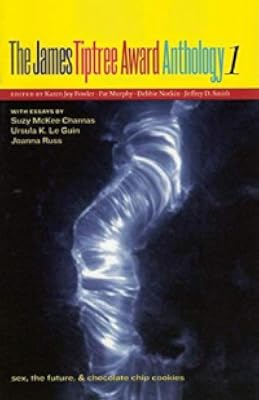
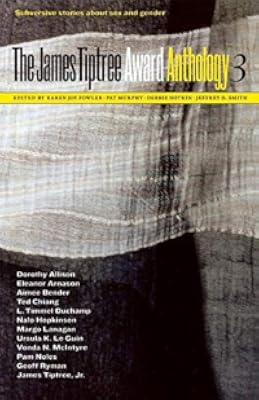
The James Tiptree Award Anthology 1: Sex, the Future, and Chocolate Chip Cookies
by Karen Joy Fowler (Editor), Pat Murphy (Editor), Debbie Notkin (Editor), Jeffrey D. Smith (Editor)
James Tiptree Anthology (1)
On This Page
Description
"Stories for women. Stories for men. And stories for the rest of us. The Triptree Award honors fiction that explores and expands gender. Fiction that seduces and repels you. Instructs and surprises you. Pushes you around a little"--Back cover.Tags
Recommendations








Member Reviews
A mixed bag of goods in terms of quality of stories (or maybe it's just that each new story trumps the previous one and sticks in your mind), but overall does exactly what the Tiptree Award aims to do: provokes thought an discussion.
The non-fiction is without exception of a very high standard: Tiptree's own "Everything but the signature is me", a wonderfully opinionated essay on genre by Ursula K. LeGuin, Suzy McKee Charnas's insights into judging the Tiptree, and Joanna Russ's brief take on Alice Sheldon's life.
Of the fiction, the highlights for me are the excerpt from Matt Ruff's "Set This House in Order" (which I'm going to have to get a copy of) and Ruth Nestvold's "Looking Through Lace". That latter one kind of sneaks up on you. It show more reads a little like something from the 1960s or 1970s throughout - all-male first contact team, entirely predictable that they've found a female-dominated society - and yet the ending threw me. I'm still struggling to put into words why: the closest I can get to is that I think of being able to read and read as part of my identity - and not being allowed to do it because of my gender would be absolutely devastating for me. And yet, the story drives home in no uncertain terms that that is what has happened in our culture for centuries, and still happens in other cultures around the world today. And the next step of thought for me is how much of women's history and identity through the ages has been absolutely obliterated by this brutal censorship.
Yes, in some ways I'm a late comer to feminism. In others, I was there, and further, long before anyone else. In some ways being a communist was much easier - and much nicer - than being a feminist. As a communist, my basic assumption was that everyone was equal and that I could do whatever I wanted, had every choice and ever option available to me. And, armed with that assumption, I spent a good 25 years of my life bulldozing over everyone who would have it otherwise, without even noticing them. Ever since I've become interested in feminism, I have started actually noticing all the crap and prejudice and inequality around me, and it's almost left me in a state of shock. I'm sure I'll recover eventually, but until then I may be a bit fragile.
One more story from this anthology deserves a mention, and that is Hans Christian Andersen's "The Snow Queen". This was one of my favourite fairy tales as a child, and I greatly enjoyed re-reading it. What struck me about the English translation, though, are the constant references to god, prayer, hymns, etc. So I dug up my Bulgarian (communist!) collection of Hans Christian Andersen fairly tales and checked a nagging suspicion I had - and yes, the Bulgarian version has been systematically purged of god. It made me incredibly happy and I've decided that my children shall have the Bulgarian version read to them. ;-) Also, in my head Gerda still lives happily ever after with the robber girl. show less
The non-fiction is without exception of a very high standard: Tiptree's own "Everything but the signature is me", a wonderfully opinionated essay on genre by Ursula K. LeGuin, Suzy McKee Charnas's insights into judging the Tiptree, and Joanna Russ's brief take on Alice Sheldon's life.
Of the fiction, the highlights for me are the excerpt from Matt Ruff's "Set This House in Order" (which I'm going to have to get a copy of) and Ruth Nestvold's "Looking Through Lace". That latter one kind of sneaks up on you. It show more reads a little like something from the 1960s or 1970s throughout - all-male first contact team, entirely predictable that they've found a female-dominated society - and yet the ending threw me. I'm still struggling to put into words why: the closest I can get to is that I think of being able to read and read as part of my identity - and not being allowed to do it because of my gender would be absolutely devastating for me. And yet, the story drives home in no uncertain terms that that is what has happened in our culture for centuries, and still happens in other cultures around the world today. And the next step of thought for me is how much of women's history and identity through the ages has been absolutely obliterated by this brutal censorship.
Yes, in some ways I'm a late comer to feminism. In others, I was there, and further, long before anyone else. In some ways being a communist was much easier - and much nicer - than being a feminist. As a communist, my basic assumption was that everyone was equal and that I could do whatever I wanted, had every choice and ever option available to me. And, armed with that assumption, I spent a good 25 years of my life bulldozing over everyone who would have it otherwise, without even noticing them. Ever since I've become interested in feminism, I have started actually noticing all the crap and prejudice and inequality around me, and it's almost left me in a state of shock. I'm sure I'll recover eventually, but until then I may be a bit fragile.
One more story from this anthology deserves a mention, and that is Hans Christian Andersen's "The Snow Queen". This was one of my favourite fairy tales as a child, and I greatly enjoyed re-reading it. What struck me about the English translation, though, are the constant references to god, prayer, hymns, etc. So I dug up my Bulgarian (communist!) collection of Hans Christian Andersen fairly tales and checked a nagging suspicion I had - and yes, the Bulgarian version has been systematically purged of god. It made me incredibly happy and I've decided that my children shall have the Bulgarian version read to them. ;-) Also, in my head Gerda still lives happily ever after with the robber girl. show less
This is an odd assortment of stories, some better than others. I liked the one about the lace and the linguist. I skipped the book excerpt (I'd already read the book, and hate book excerpts - if I want to read the book, I want the whole book) There is a Snow Queen trilogy of stories 2 out of 3 that I liked. I might read the other anthologies in the series in hopes that some of the stories are good.
A great collection of stories, excerpts. The only disappointment for me was the first re-envisioning of the Snow Queen story.
This is a collection of scifi/fantasy stories and essays with a focus on gender. Although the quality of the stories varies a bit, on the whole this was a great read.
Great essays, great stories. More thought provoking than a dozen other anthologies.
Ratings
Members
- Recently Added By
Author Information

Karen Joy Fowler is the author of several novels and short story collections. Her works include Sarah Canary, The Sweetheart Season, Sister Noon, and The Jane Austen Book Club. She has received numerous awards including the World Fantasy Award in 1999 for Black Glass, the World Fantasy Award in 2011 for What I Didn't See, and the 2014 PEN/Faulkner show more Award for Fiction for We Are All Completely Beside Ourselves. This same title was nominated for The Man Booker Prize for Best Novel in 2014. (Bowker Author Biography) show less


Pat Murphy is a LibraryThing Author, an author who lists their personal library on LibraryThing.

All Editions
Series

Work Relationships
Contains
Is an abridged version of
Common Knowledge
- Canonical title
- The James Tiptree Award Anthology 1: Sex, the Future, and Chocolate Chip Cookies
- Original publication date
- 2005
Classifications
Statistics
- Members
- 180
- Popularity
- 181,809
- Reviews
- 5
- Rating
- (3.94)
- Languages
- English
- Media
- Paper
- ISBNs
- 1
- ASINs
- 2