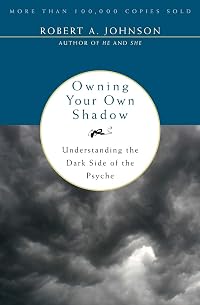
Owning Your Own Shadow: Understanding the Dark Side of the Psyche
by Robert A. Johnson
On This Page
Description
A bestselling author shows how we can reclaim and make peace with the "shadow" side of our personality.Tags
Recommendations






Member Reviews
My first reaction to this book was that it oversimplified. But perhaps its purpose really is to make a very complicated concept accessable to a large number of people. Johnson is no doubt Christian- and Western-centric, and he lets that slip in a few places, which undermines his message. That being said, there are quite a few true gems of insight here, and it's well worth the read.
loc. 315: “Jung used to say that we can be grateful for our enemies, for their darkness allows us to escape our own.
“Heaping abuse [on those who abuse us] does great damage - not only to others but to us as well, for as we project our shadow we give away an essential ingredient of our own psychology. We need to connect with this dark side for our own development, and we have no business flinging it at others, trying to palm off these awkward and unwanted feelings. The difficulty is that most of us live in an intricate web of shadow exchange that robs both parties of their potential wholeness. The shadow also contains a good deal of energy, and it is the cornerstone of our vitality. A very cultured individual with an equally strong show more shadow has a great deal of personal power. William Blake spoke about the need to reconcile these two parts of the self. He said we should go to heaven for form and to hell for energy - and marry the two. When we can face our inner heaven and our inner hell, this is the highest form of creativity.”
loc 333: “Goethe’s FAUST, perhaps the greatest example in literature of the meeting of ego and shadow, is about a pale, dried-up professor who has come to the point of suicide because of the unlivable distance between his ego and his shadow … Faust meets his equally impossible shadow, Mephistopheles, who appears as his lordship, the devil. The explosion of energy at the meeting is extreme. Yet they persevere and their long, vivid story is our best instruction in the reception of ego and shadow.”
loc 366: a lengthy quote from Jungian analyst and Episcopal priest Jack Sanford:
“The ego is … primarily engaged in its own defense and the furtherance of its own ambitions. Everything that interferes with it must be repressed. the [repressed] elements … become the shadow. Often these are basically positive qualities.
“There are, in my view, two ‘shadows”: (1) the dark side of the ego, which is careful hidden from itself and which the ego will not acknowledge unless forced to by life’s difficulties, and (2) that which has been repressed in us lest it interfere with our egocentricity and, however devilish it may seem, is basically connected to the Self.
“In a showdown God [Self] favors the shadow over the ego, for the shadow, with all of its dangerousness, is closer to the center and more genuine.”
Hence the maddening preference shown to the prodigal son while the dutiful son is sidelined … excellently expressed in Tennessee Williams’ play “Cat on a Hot Tin Roof.” show less
“Heaping abuse [on those who abuse us] does great damage - not only to others but to us as well, for as we project our shadow we give away an essential ingredient of our own psychology. We need to connect with this dark side for our own development, and we have no business flinging it at others, trying to palm off these awkward and unwanted feelings. The difficulty is that most of us live in an intricate web of shadow exchange that robs both parties of their potential wholeness. The shadow also contains a good deal of energy, and it is the cornerstone of our vitality. A very cultured individual with an equally strong show more shadow has a great deal of personal power. William Blake spoke about the need to reconcile these two parts of the self. He said we should go to heaven for form and to hell for energy - and marry the two. When we can face our inner heaven and our inner hell, this is the highest form of creativity.”
loc 333: “Goethe’s FAUST, perhaps the greatest example in literature of the meeting of ego and shadow, is about a pale, dried-up professor who has come to the point of suicide because of the unlivable distance between his ego and his shadow … Faust meets his equally impossible shadow, Mephistopheles, who appears as his lordship, the devil. The explosion of energy at the meeting is extreme. Yet they persevere and their long, vivid story is our best instruction in the reception of ego and shadow.”
loc 366: a lengthy quote from Jungian analyst and Episcopal priest Jack Sanford:
“The ego is … primarily engaged in its own defense and the furtherance of its own ambitions. Everything that interferes with it must be repressed. the [repressed] elements … become the shadow. Often these are basically positive qualities.
“There are, in my view, two ‘shadows”: (1) the dark side of the ego, which is careful hidden from itself and which the ego will not acknowledge unless forced to by life’s difficulties, and (2) that which has been repressed in us lest it interfere with our egocentricity and, however devilish it may seem, is basically connected to the Self.
“In a showdown God [Self] favors the shadow over the ego, for the shadow, with all of its dangerousness, is closer to the center and more genuine.”
Hence the maddening preference shown to the prodigal son while the dutiful son is sidelined … excellently expressed in Tennessee Williams’ play “Cat on a Hot Tin Roof.” show less
Ratings
Members
- Recently Added By
Lists

Men's healing resources
751 works; 1 member
Author Information

25+ Works 5,171 Members
Robert A. Johnson is a noted lecturer and Jungian analyst in private practice in San Diego, California
Common Knowledge
- Original publication date
- 1991
Classifications
Statistics
- Members
- 741
- Popularity
- 38,251
- Reviews
- 2
- Rating
- (3.74)
- Languages
- Chinese, English, Italian, Portuguese
- Media
- Paper, Ebook
- ISBNs
- 8
- ASINs
- 6