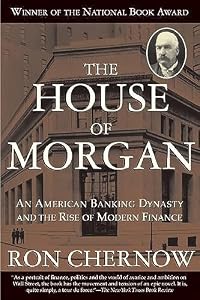
The House of Morgan: An American Banking Dynasty and the Rise of Modern Finance
by Ron Chernow
On This Page
Description
Winner of the National Book Award and now considered a classic, The House of Morgan is the most ambitious history ever written about an American banking dynasty. Acclaimed by the Wall Street Journal as "brilliantly researched and written," the book tells the rich, panoramic story of four generations of Morgans and the powerful, secretive firms they spawned. It is the definitive account of the rise of the modern financial world. A gripping history of banking and the booms and busts that show more shaped the world on both sides of the Atlantic, The House of Morgan traces the trajectory of the J. P. Morgan empire from its obscure beginnings in Victorian London to the crash of 1987. Ron Chernow paints a fascinating portrait of the private saga of the Morgans and the rarefied world of the American and British elite in which they moved. Based on extensive interviews and access to the family and business archives, The House of Morgan is an investigative masterpiece, a compelling account of a remarkable institution and the men who ran it, and an essential book for understanding the money and power behind the major historical events of the last 150 years. show lessTags
Recommendations




Member Reviews
Accounting, money... these are ancient, fundamental, as rooted in the essential structure of reality as arithmetic. Or maybe not.
This book traces the Morgan bank from its prehistory with George Peabody in 1839 England up until 1989, with the absorption of the British branch into Deutsche Bank and with the two American branches, Morgan Guaranty and Morgan Stanley, become competing colossi. Chernow does a great job of showing the coupling between the evolution of the bank(s) and the world.
A cornerstone of Darwin's evolutionary theory is that biological species are not universal eternal essences like the Platonic solids, but instead are historical accidents to the core. New structures arise spontaneously and are then pruned severely. show more This process of co-adaptation gives rise to a marvelous display of diverse capabilities.
It seems that money, accounting, finance, are very much the same sort of affair. The marketplace is a space where great creativity and powerful pruning are constantly at play. The resulting structures are constantly evolving and historical to the core.
To understand the detailed mathematical relationships behind underwriting or leveraged buy-outs - Chernow doesn't help us with that at all; he just sketches the coarsest skeletal structure. But the details are constantly changing! We would need a yearly new edition! But instead, Chernow gives us the history. Sure, it would be wonderful to carry the story forward from 1990. The decades following have surely given us escapades and fireworks to match those of the century and a half that Chernow covers. But Chernow's book is surely as useful today as when it was written. The past twenty years grew out of the preceding century. Chernow's book gives an excellent background to help anyone understand more recent events in the world of banking.
Chernow does a splendid job of fleshing out many key characters, the top banking executives and the star performers.
Reading this book changes how I see the world. It is a transformative work. show less
This book traces the Morgan bank from its prehistory with George Peabody in 1839 England up until 1989, with the absorption of the British branch into Deutsche Bank and with the two American branches, Morgan Guaranty and Morgan Stanley, become competing colossi. Chernow does a great job of showing the coupling between the evolution of the bank(s) and the world.
A cornerstone of Darwin's evolutionary theory is that biological species are not universal eternal essences like the Platonic solids, but instead are historical accidents to the core. New structures arise spontaneously and are then pruned severely. show more This process of co-adaptation gives rise to a marvelous display of diverse capabilities.
It seems that money, accounting, finance, are very much the same sort of affair. The marketplace is a space where great creativity and powerful pruning are constantly at play. The resulting structures are constantly evolving and historical to the core.
To understand the detailed mathematical relationships behind underwriting or leveraged buy-outs - Chernow doesn't help us with that at all; he just sketches the coarsest skeletal structure. But the details are constantly changing! We would need a yearly new edition! But instead, Chernow gives us the history. Sure, it would be wonderful to carry the story forward from 1990. The decades following have surely given us escapades and fireworks to match those of the century and a half that Chernow covers. But Chernow's book is surely as useful today as when it was written. The past twenty years grew out of the preceding century. Chernow's book gives an excellent background to help anyone understand more recent events in the world of banking.
Chernow does a splendid job of fleshing out many key characters, the top banking executives and the star performers.
Reading this book changes how I see the world. It is a transformative work. show less
You can tell straight away that Chernow is going to tell you a great story, especially when he uses words like "brouhaha" to describe an economic catastrophe. There is a sly humor about his writing. How can you not smirk just a little when he writes, "Gooch was being groomed for a career of permanent subordination and forelock tugging" (p 8)? Or says things like "incorrigible Wall Street rascals" (p30)? Yet, his story is vastly inclusive and extremely informative. He takes you back before a time when each state has its own banking system and debts could be settled any which way. We watch the growth of international finance and step into a "wealth" of biographical portraits, if you excuse the pun (since we are talking about banking). I show more loved the little details; for example, the Morgans were the first private residential household to have electrical lighting in New York and a woman named Belle Greene was Pierpont's "saucy librarian." My one complaint - the book is massive. That's because the tale is massive. Chernow needs every page to tell the story. show less
Picked this book up after hearing it referenced a few times throughout Yale's 2019 DeVane Lectures "On Power and Politics". The references themselves were those curious ones that seem to blur the line between politics and big business – particularly finance. The first three quarters of the book offer a nice ratio between the Morgan family biography and the Morgan institution (the so-called House of Morgan) with more emphasis on the latter. The book splits its history up into three chronologically ordered ages which Chernow aptly named The Baronial Age, The Diplomatic Age and The Casino Age.
The Baronial Age begins in the pre-Civil War years, when the United States had little renown or respect internationally and hardly much more show more domestically. Noting that the primary financial instrument of the age was government bonds, and that the demand for these bands was a reflection of the sentiment toward the underwriter, the intricacy of finance and politics becomes apparent almost immediately.
There's also a few good tales here, particularly those concerning the insanity that was the domestic railroad industry. Stories of the coercive marketing campaigns used to lure settlers out to towns lining the tracks of each line or the recount of The Battle of the Susquehanna where two competing railroad barons hopped on two trains, on the same track, heading in opposite directions with over 1,000 other purposfully crashed in a head-on collision and then fought each other with fists and insults amongst the wreckage.
The Diplomatic Age begins shortly before the first World War where the incestuous worlds of high finance and politics are starkly revealed. As the House of Morgan ascended to international clout, proving itself to be sound in function and flush with capital, it was no longer a merchant banker or peddler of government bonds. As Chernow writes: "The Baronial Age was one of unbridled laissez-faire, marked by often unqualified hostility on the part of bankers toward government. But in the dawning of the Diplomatic Age, there would be an explicit fusion of financial and government power. In time it would be hard to disentagnle the House of Morgan from various aspects of Anglo-American policy."
Among some of the most interesting clients of the House of Morgan are those of Japan and Italy, from the end of the first World War and remaining so until US entry into the second World War. Also, hearing about global finance's interest in China and the failed attempts made by Western firms to infiltrate it.
The beginning of the Casino age begins the ossification of the financial systems as we find them today. After the second World War, the United States imposes both its political and financial preferences on the rest of the world and, as finance proves to be more universal in its appeal (less ideological baggage), and so most of the stories and drama revealed here are more akin to those sensational scandals. There's no doubt about the influence of the financial institutions on global affairs throughout, but whereas before, in the Diplomatic Age, these social and political influences were intentional, the Casino Age appears to be less concerned with the existential and more impetuously concerned with ever-increasing margins and ever-expanding markets.
Don't let the title or genre (finance) fool you, Chernow offers a fantastic historical recount of modern finance and manages to root it within the context of the Morgan family history. The biographical elements are secondary to the primary parts of Chernow's work and I think their inclusion is a nice way to track the progress through time. The final section was of the least interest to me, if only because it introduced so many new CEO's, board members, and politicians (by this time the House of Morgan existed as three independent brands and had thousands of employees) that it was hard to keep any part of the story entirely coherent. Also, since most of the functions of finance by this time had been relegated to the oversight of the Glass-Steagall, the FDIC and the SEC, most of the scandalous moments were so rooted in the impossible laws of financial regulation that they paled in comparison to the previous ages of Baron and Diplomat.
Lots of interesting history here that undoubtedly played a large part in the modern world. show less
The Baronial Age begins in the pre-Civil War years, when the United States had little renown or respect internationally and hardly much more show more domestically. Noting that the primary financial instrument of the age was government bonds, and that the demand for these bands was a reflection of the sentiment toward the underwriter, the intricacy of finance and politics becomes apparent almost immediately.
There's also a few good tales here, particularly those concerning the insanity that was the domestic railroad industry. Stories of the coercive marketing campaigns used to lure settlers out to towns lining the tracks of each line or the recount of The Battle of the Susquehanna where two competing railroad barons hopped on two trains, on the same track, heading in opposite directions with over 1,000 other purposfully crashed in a head-on collision and then fought each other with fists and insults amongst the wreckage.
The Diplomatic Age begins shortly before the first World War where the incestuous worlds of high finance and politics are starkly revealed. As the House of Morgan ascended to international clout, proving itself to be sound in function and flush with capital, it was no longer a merchant banker or peddler of government bonds. As Chernow writes: "The Baronial Age was one of unbridled laissez-faire, marked by often unqualified hostility on the part of bankers toward government. But in the dawning of the Diplomatic Age, there would be an explicit fusion of financial and government power. In time it would be hard to disentagnle the House of Morgan from various aspects of Anglo-American policy."
Among some of the most interesting clients of the House of Morgan are those of Japan and Italy, from the end of the first World War and remaining so until US entry into the second World War. Also, hearing about global finance's interest in China and the failed attempts made by Western firms to infiltrate it.
The beginning of the Casino age begins the ossification of the financial systems as we find them today. After the second World War, the United States imposes both its political and financial preferences on the rest of the world and, as finance proves to be more universal in its appeal (less ideological baggage), and so most of the stories and drama revealed here are more akin to those sensational scandals. There's no doubt about the influence of the financial institutions on global affairs throughout, but whereas before, in the Diplomatic Age, these social and political influences were intentional, the Casino Age appears to be less concerned with the existential and more impetuously concerned with ever-increasing margins and ever-expanding markets.
Don't let the title or genre (finance) fool you, Chernow offers a fantastic historical recount of modern finance and manages to root it within the context of the Morgan family history. The biographical elements are secondary to the primary parts of Chernow's work and I think their inclusion is a nice way to track the progress through time. The final section was of the least interest to me, if only because it introduced so many new CEO's, board members, and politicians (by this time the House of Morgan existed as three independent brands and had thousands of employees) that it was hard to keep any part of the story entirely coherent. Also, since most of the functions of finance by this time had been relegated to the oversight of the Glass-Steagall, the FDIC and the SEC, most of the scandalous moments were so rooted in the impossible laws of financial regulation that they paled in comparison to the previous ages of Baron and Diplomat.
Lots of interesting history here that undoubtedly played a large part in the modern world. show less
I find financial histories riveting. At first glance, I found the mammoth size of this book a bit of a deterrent, but this was not at all the case once I got into it.
"The House of Morgan" is much more than the story of a banking house—it's the story of finance, the United States, and the world, over the past 150 years.
I can't hope to summarize a book of such monumental scope over the course of this review, so instead I'll offer some snapshots.
Did you know that the bankers of yore worked four-hour days and took three months of vacation a year? Instead of the mad rush of 100-hour work weeks and exhaustion-induced suicides commonplace over the past thirty or forty years in finance, banking used to be largely a leisurely and respectable show more field.
John Pierpont Morgan was actually third in a line of financiers laying the foundation for the J. P. Morgan. The first was British-American banker George Peabody. The second was Pierpont's father, Junius Spencer Morgan. Pierpont was essentially third-generation, so he had a significant head start and a lot of inherited privilege and wealth that made his venture possible! J. P. "Jack" Morgan Jr. was Pierpont's son, and oversaw the pinnacle of Morgan eminence.
J. P. Morgan & Co. was founded in 1971 and died in 1935 with the implementation of Glass-Steagall, which split commercial and "investment" banking. After that, remnants of the Morgan empire remained, but you can't really call them J. P Morgan & Co.
One of the most fascinating stories in the book is the parallel and eventually divergent careers of Tom Lamont (financier to Mussolini and enabler of WWII) and Hjalmar Schacht (German financier, and part of the resistance against Hitler). Basically it came down to the question of is there a point when keeping a friendship easygoing needs to be sidelined to uphold a certain set of ethics or values. Lamont said no when Hjalmar said yes.
Another fascinating fact: pretty much every government defaulted on their debt at some point during the timeline covered in the book; not just "developing" countries like Brazil, but also countries like Japan and Germany. Investors today seem to think of bonds as safe, but in the historical perspective, they don't look that safe...
The book becomes a little jumbled after the split of the bank, as there’s no longer one coherent storyline. Also, there isn’t really any analysis given at the end of the book.
Overall, I found the book fascinating, and would recommend it to anyone interested in the financial history of the United States. show less
"The House of Morgan" is much more than the story of a banking house—it's the story of finance, the United States, and the world, over the past 150 years.
I can't hope to summarize a book of such monumental scope over the course of this review, so instead I'll offer some snapshots.
Did you know that the bankers of yore worked four-hour days and took three months of vacation a year? Instead of the mad rush of 100-hour work weeks and exhaustion-induced suicides commonplace over the past thirty or forty years in finance, banking used to be largely a leisurely and respectable show more field.
John Pierpont Morgan was actually third in a line of financiers laying the foundation for the J. P. Morgan. The first was British-American banker George Peabody. The second was Pierpont's father, Junius Spencer Morgan. Pierpont was essentially third-generation, so he had a significant head start and a lot of inherited privilege and wealth that made his venture possible! J. P. "Jack" Morgan Jr. was Pierpont's son, and oversaw the pinnacle of Morgan eminence.
J. P. Morgan & Co. was founded in 1971 and died in 1935 with the implementation of Glass-Steagall, which split commercial and "investment" banking. After that, remnants of the Morgan empire remained, but you can't really call them J. P Morgan & Co.
One of the most fascinating stories in the book is the parallel and eventually divergent careers of Tom Lamont (financier to Mussolini and enabler of WWII) and Hjalmar Schacht (German financier, and part of the resistance against Hitler). Basically it came down to the question of is there a point when keeping a friendship easygoing needs to be sidelined to uphold a certain set of ethics or values. Lamont said no when Hjalmar said yes.
Another fascinating fact: pretty much every government defaulted on their debt at some point during the timeline covered in the book; not just "developing" countries like Brazil, but also countries like Japan and Germany. Investors today seem to think of bonds as safe, but in the historical perspective, they don't look that safe...
The book becomes a little jumbled after the split of the bank, as there’s no longer one coherent storyline. Also, there isn’t really any analysis given at the end of the book.
Overall, I found the book fascinating, and would recommend it to anyone interested in the financial history of the United States. show less
This book takes a look at the history of banking and financial services from the 1830s up to the 1980s by examining the people and corporations that grew out of the legacy of George Peabody and his heirs, Junius Spencer Morgan (son), and John Pierpont Morgan (grandson). Not only does it cover finance, but it encompasses a wide swath of related world history. It starts as a biography of the Morgan founders and follows the family lineage through the decades.
The scope is vast. It touches on the interrelationships among a huge number of topics – the gold standard, stock markets, foreign policies, international finance, underwriting, economic panics, World Wars I, 1929 Stock Market crash, Great Depression, Glass Steagall Act (which split show more commercial and investment banking), New Deal, World War II, post-war years, Reaganomics, 1987 crash, and a number of scandals. It covers the advice given by Morgan business entities to various Presidents. It traces the evolution of the financial industry from one of the reliance on a “gentleman’s agreement” to the more recent “money is king” mentality.
I particularly enjoyed the early history from the 1870s to 1940s, and I think these are the strongest parts. It outlines the relationships between Morgan bankers and Mussolini, and the related ethical questions. After the split up of several Morgan entities, it gets a little less focused, but overall, I found it fascinating. It will appeal to readers who are interested in the history of financial services. Chernow’s writing is superb, and he does an excellent job of weaving together a compelling narrative out of what could easily have been a very dry topic.
4.5 show less
The scope is vast. It touches on the interrelationships among a huge number of topics – the gold standard, stock markets, foreign policies, international finance, underwriting, economic panics, World Wars I, 1929 Stock Market crash, Great Depression, Glass Steagall Act (which split show more commercial and investment banking), New Deal, World War II, post-war years, Reaganomics, 1987 crash, and a number of scandals. It covers the advice given by Morgan business entities to various Presidents. It traces the evolution of the financial industry from one of the reliance on a “gentleman’s agreement” to the more recent “money is king” mentality.
I particularly enjoyed the early history from the 1870s to 1940s, and I think these are the strongest parts. It outlines the relationships between Morgan bankers and Mussolini, and the related ethical questions. After the split up of several Morgan entities, it gets a little less focused, but overall, I found it fascinating. It will appeal to readers who are interested in the history of financial services. Chernow’s writing is superb, and he does an excellent job of weaving together a compelling narrative out of what could easily have been a very dry topic.
4.5 show less
Interesting 1st 200 pages on the founding of the firm and onto JP Morgan's individual personality and force of will. Then got ponderous.
I really wanted to enjoy this book. I've heard social references to the "House of Morgan" in old movies and even other books, and really thought this would be an interesting read. Chernow was new to me, but with the National Book Award under his belt for this, I thought I was safe. I guess it just wasn't meant to be.
The book is "heavy". And not just physically - because it is a BIG book - but intellectually. I enjoy non-fiction, but this was a lot more dry than I prefer, and the detailed analysis of the characters surrounding the foundation of the bank and some of the financial dealings which helped it succeed just didn't hold my interest.
Maybe if I kept going, there could have been more "development" - but I gave up barely as the bank show more was founded. When I literally fell asleep in the middle of reading a page (something I virtually never do), I figured it was time to give up the ghost.
Quality writing for sure, but maybe a little too limited an audience for me. show less
The book is "heavy". And not just physically - because it is a BIG book - but intellectually. I enjoy non-fiction, but this was a lot more dry than I prefer, and the detailed analysis of the characters surrounding the foundation of the bank and some of the financial dealings which helped it succeed just didn't hold my interest.
Maybe if I kept going, there could have been more "development" - but I gave up barely as the bank show more was founded. When I literally fell asleep in the middle of reading a page (something I virtually never do), I figured it was time to give up the ghost.
Quality writing for sure, but maybe a little too limited an audience for me. show less
Members
- Recently Added By
Published Reviews
ThingScore 88
Can a bank actually be heroic? Ron Chernow suggests as much in his exhaustive history of J.P. Morgan and its instrumental role in the development of the industrial Western economy from the late 19th century to the end of the 20th.
added by bongiovi
As a portrait of finance, politics and the world of avarice and ambition on Wall Street, the book has the movement and tension of an epic novel. It is, quite simply, a tour de force.
added by Shortride
Lists

Economix
2 works; 1 member

Modern Library 100 Best Nonfiction Books
100 works; 8 members

Which house?
423 works; 16 members

Books Read in 2024
4,623 works; 126 members

Check
18 works; 1 member
Author Information

22+ Works 22,472 Members
Educated at Yale and Cambridge University in England, Ron Chernow is a biographer who specializes in hard-hitting exposes on historical business figures. Among Chernow's early accomplishments was his unmasking of corruption in Chinatown for New York magazine in 1973. In the book The House of Morgan, winner of the National Book Award in 1990, show more Chernow outlines the extraordinary path of J.P. Morgan's empire and its influence on the American banking industry. Chernow is also the author of Titan: The Life of John D. Rockefeller, which chronicles the life and times of the richest man in the United States in the early 1900s. His other work includes The Warburgs, The Death of a Banker, Alexander Hamilton, Washington: A Life, and Grant. Chernow is regular guest on the National Public Radio programs Fresh Air with Terry Gross and All Things Considered. (Bowker Author Biography) show less
Awards and Honors
Awards
Notable Lists
Work Relationships
Common Knowledge
- Original publication date
- 1990
- People/Characters
- J. Pierpont Morgan; Henry Clay Alexander; Robert H. B. Baldwin; Stanley Baldwin; Henry Pomeroy Davison; S. Parker Gilbert (show all 16); Bob Greenhill; Edward C. Grenfell; Thomas W. Lamont; Russell C. Leffingwell; Henry Sturgis Morgan (Harry); John Pierpont Morgan, Jr. (Jack); Junius Spencer Morgan; Dwight Morrow; Lew Preston; George Whitney
- Important places
- New York, New York, USA; London, England, UK
- Important events
- Great Depression
- Epigraph
- It is necessarily a part of the business of a banker to profess a conventional respectability which is more than human. Life-long practices of this kind make them the most romantic and least realistic of men.--John Maynard... (show all) Keynes
- Dedication
- For Valerie and Israel and Ruth
- Original language
- English
- Canonical DDC/MDS
- 332.12097471
- Canonical LCC
- HG2613.N54
Classifications
Statistics
- Members
- 1,671
- Popularity
- 13,297
- Reviews
- 19
- Rating
- (3.90)
- Languages
- English, Norwegian
- Media
- Paper, Audiobook, Ebook
- ISBNs
- 18
- ASINs
- 9