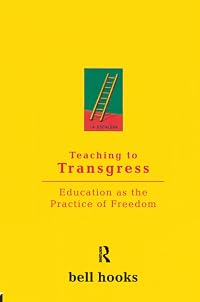
Teaching to Transgress: Education as the Practice of Freedom
by bell hooks
On This Page
Description
In Teaching to Transgress, Bell Hooks-writer, teacher, and insurgent black intellectual-writes about a new kind of education, educations as the practice of freedom. Teaching students to "transgress" against racial, sexual, and class boundaries in order to achieve the gift of freedom is, for hooks, the teacher's most important goal. Bell Hooks speaks to the heart of education today: how can we rethink teaching practices in the age of multiculturalism? What do we do about teachers who do not show more want to teach, and students who do not want to learn? How should we deal with racism and sexism in the classroom? Full of passion and politics, Teaching to Transgress combines practical knowledge of the classroom with a deeply felt connection to the world of emotions and feelings. This is the rare book about teachers and students that dares to raise critical questions about eros and rage, grief and reconciliation, and the future to teaching itself. show lessTags
Recommendations








Member Reviews
Every one of us has been a student, and most of us are also teachers (and still students) even if that isn't our job title. In this books hooks gives us the best kind of theory -- passionate, clear, centered, direct -- and shifts our ideas of what the classroom should be and do. While changing the dynamic of the classroom is at the core of the book, in these inter-related essays hooks gracefully and meaningfully weaves in personal experience, trusted sources, race, class, gender, regionalism, and history. While her focus is on the college classroom (and frequently that mid-90s women's studies classroom that is so close to my heart), her lessons apply to parents, librarians, teammates, committee members, and more. And if you are an show more actual classroom teacher? Then, my friend, let me buy you a copy of this book. show less
I bought this book because I was looking for practical guidance for creating liberatory class spaces. Although there are some practical suggestions for doing that in here, most of the book is focused on thinking about education rather than the concrete work of designing education in a liberatory way. Because I have already spent years interrogating traditional U.S. thinking about education and forming ideas about education as the practice of freedom, I found this book didn't really meet my needs. It felt like an introduction to thinking about education as liberation, which affirmed beliefs I already hold but did not push me much further in my thinking about education and liberation as I had hoped it would. I also found some sections of show more the book overly dense and repetitive.
All that being said, I do think this book could be extremely useful to educators trying to do some initial engagement with the idea of education as liberation or trying to expose teachers-in-training to this idea. show less
All that being said, I do think this book could be extremely useful to educators trying to do some initial engagement with the idea of education as liberation or trying to expose teachers-in-training to this idea. show less
This is the first book of hooks' that I've read—a collection of stand-alone essays in which she reflects on the concept of pedagogy as liberation. Essay collections are almost always a mixed bag and there are some in here that didn't work for me—the one that's structured as a dialogue between her and her writing pseudonym, or the rather uncomfortable one on eros in the classroom (that one needed a lot of teasing out and consideration of agape, philia, storge, and a hell of a lot more nuance and acknowledgement of the power differentials and potentials for abuse within what she's advocating). Yet there are other essays here which are powerful and (sadly) still relevant more than twenty years after the collection was first published. show more Definitely recommended for those doing work in the college classroom. show less
In Teaching to Transgress (1994), bell hooks offers her thoughts on an engaged pedagogy that transgresses the assembly line model of education (13) where excitement is seen as disruptive (7). For hooks, pedagogy should be full-bodied and about self-actualization, engaging students as whole beings instead of compartmentalizing them (15). She also offers her thoughts on theory and practice, calling it a "false dichotomy" (65), and claiming that the "contempt and disregard for theory undermines collective struggle to resist oppression and exploitation": theory is "necessary practice within a holistic framework of liberatory activism" (65, 69). She also critiques white feminist and critical pedagogy scholars for leaving out black voices, show more for heterosexist approaches, and for essentializing women's experiences (as the white middle class women's experience). show less
»Teaching to Transgress« hat bell hooks ihr Buch im Original genannt. Es ist der gesammelte Erfahrungsschatz einer kompetenten Lehrperson und Dozentin, die sich mit ganzem Herzen dafür einsetzt, dass Lernen funktioniert. Ihr Hauptanliegen ist es, Bildung als Praxis der Freiheit zu begreifen, als eine Art des Lernens und Lehrens, die jungen Menschen die Möglichkeit eröffnet, rassistische, sexistische und klassistische Barrieren zu durchbrechen und Grenzen zu ›überschreiten‹ – für die Autorin die wichtigste Aufgabe, das vorrangige Ziel des Lehrens.
My first bell hooks: a lot of pedagogical theory which I didn't relate to that much, but from my peripheral understanding of higher ed from my experience 10 years ago today, shockingly relevant for something that was written in 1994. I can see the influence of her work and also the continued pushback to it. I'm excited to read some of her other more universal work, but this was a starting point that I'm very grateful for.
I particularly enjoyed the dialogue around "building a teaching community," which prompted me to think critically about my own actions and how they reinforce or transgress against existing power structures. Overall this book did not feel revelationary to me but provided another perspective on power, on teaching, and on critical thinking. My biggest beef would be that I don't feel like I understand what she meant specifically by "liberatory practice" or "education as the practice of freedom." Does she mean that, by encouraging students in their development as whole human beings, you are freeing them from... something? Freeing them to be their best selves? Given how central that is to the book maybe I should have a better understanding show more after finishing it. Maybe the next time I encounter this idea, this book will have given me a good foundation for "getting it." show less
Members
- Recently Added By
Lists

Top Five Books of 2020
982 works; 350 members

Top Five Books of 2021
604 works; 181 members

Best Essay Collections
61 works; 24 members

Black Authors
384 works; 32 members

Books for Educators
164 works; 6 members

Female Author
1,235 works; 65 members

Efemeridades e Possibilidades futuras (Personal wishlist)
24 works; 1 member

Mo's Reading List
218 works; 1 member

Biblioteca de não ficção
41 works; 1 member

Schomburg Centennial Reading List
100 works; 4 members
Author Information

80+ Works 23,032 Members
A cultural critic, an intellectual, and a feminist writer, bell hooks best known for classic books including Ain't I a Woman, Bone Black, All About Love, Rock My Soul, Belonging, We Real Cool, Where We Stand, Teaching to Transgress, Teaching Community, Outlaw Culture, and Reel to Real, hooks is Distinguished Professor in Residence in Appalachian show more Studies at Berea College, and resides in her home state of Kentucky. show less
Some Editions
Awards and Honors
Work Relationships
Is contained in
Has as a study
bell hooks' Engaged Pedagogy: A Transgressive Education for Critical Consciousness by Namulundah Florence
Engaged Pedagogy: Antidisriminatorisches Lehrer und Lernen bei bell hooks by Belinda Kazeem-Kaminski
Has as a commentary on the text
Common Knowledge
- Canonical title
- Teaching to Transgress: Education as the Practice of Freedom
- Original title
- Teaching to Transgress
- Original publication date
- 1994
- Epigraph
- ". . . to being always anew, to make, to reconstruct, and to not spoil, to refuse to bureaucratize the mind, to understand and to live life as a process--live to become . . ."
--Paulo Freire - Dedication
- to all my students
especially to LaRon
who dances with angels
in gratitude for all the times we start over--begin again--
renew our joy in learning. - First words
- In the weeks before the English Department at Oberlin College was about to decide whether or not I would be granted tenure, I was haunted by dreams of running away--of disappearing--yes, of even dying.
- Quotations
- When we, as educators, allow our pedagogy to be radically changed by our recognition of a multicultural world, we can give students the education they desire and deserve. We can teach in ways that transform consciousness, cre... (show all)ating a climate of free expression that is the essence of a truly liberal arts education.
- Blurbers
- Freire, Paulo
Classifications
- Genres
- Nonfiction, General Nonfiction, Sexuality and Gender Studies
- DDC/MDS
- 370.115 — Society, government, & culture Education Education Theory of education; Meaning; Aim Objectives of Education Social Responsibility
- LCC
- LC196 .H66 — Education Special aspects of education Special aspects of education Social aspects of education Educational sociology
- BISAC
Statistics
- Members
- 1,890
- Popularity
- 11,347
- Reviews
- 20
- Rating
- (4.24)
- Languages
- 9 — Basque, English, Finnish, French, German, Italian, Spanish, Turkish, Portuguese (Portugal)
- Media
- Paper, Audiobook, Ebook
- ISBNs
- 24
- ASINs
- 7