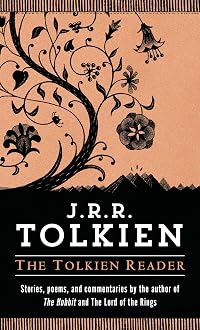
The Tolkien Reader
by J. R. R. Tolkien
On This Page
Description
Stories, poems and an essay by the author of "The Hobbit" and "The Lord of the Rings."Tags
Recommendations















Member Reviews
Last year I totally skipped my annual tradition and didn’t read a single Tolkien book during the winter months, even though I have two full boxes of them lingering in my TBR. And I didn’t even have the excuse that I didn’t know which boxes they were in; I packed my TBR smart (lol) with way too easy identification to claim accidental ignorance. So this year we’re going to try to do a Tolkien book every month for the winter, starting with November because we had a decent snow and the vibes just felt right to get into some Middle Earth fantasy! Unfortunately, the Tolkien reader was pretty horrible… It should have been an easy reintroduction, with four short works making up the volume and a range of writing styles to mix things show more up. And yet, not a single one of these pieces was a decent read… Farmer Giles of Ham felt like a silly undeveloped pseudo-mediaeval legend, Tolkien’s “classic” essay on fairy tales was a bore and failed to impart anything fascinating about the genre, the set of poems about Tom Bombadill were dull as dirt (not suitable representation at all for this fascinating character), and the “play” based on mediaeval lore was inscrutable and nonsensical. No wonder this little volume isn’t particularly popular with fans of Tolkien’s work and I rarely hear anyone gush about it. Dull, and dull again. I don’t think I’ll even keep a copy in my library for the collector’s aspect; it’s just not worth the shelf space! show less
This is a nice selection of Tolkien's writings - and Peter Beagle's introduction to the joys of Middle Earth. Samples of his scholarly work, including the brilliant On Fairy Stories show his thoughtful, penetrating, and sometimes playful, critical mind at work, as does his comparison of the Maldon poem fragment with Beowulf, analaysing the nature and limitations of chivalric ideals. Two of his own fairy stories - the extremely odd and curious Leaf By Niggle, and the more straightforward, albeit with typically Tolkeinesque humble settled folk of limited ambitions as hero, Farmer Giles Of Ham and lots of hobbity poetry, much of it featuring Tom Bombadil which is the sort of thing you will certainly like if you certainly like that sort of show more thing. I picked this up for Tolkien reading day having merely leafed idly through it over the years it's been sitting on our shelves, and a real pleasure it's been. show less
Contains the essay "On Fairy-stories", which is worth the cost of the book (and 5/5 stars) several times over. Tolkien explains his approach to what he calls "fairy-stories", which refers not just to stories for children, but to something almost, but not exactly, like what we would call "fantasy".
Nowadays, it often seems to be assumed that stories with sad endings are more realistic, more meaningful, more artistic, and/or more difficult to write. Tolkien's interpretation of the triumphant twist ("eucatastrophe") that makes a good happy ending might just change the way you think about all of that.
I keep extra copies of this book around just in case I need to give one to someone who hasn't read this essay. It's that good.
Nowadays, it often seems to be assumed that stories with sad endings are more realistic, more meaningful, more artistic, and/or more difficult to write. Tolkien's interpretation of the triumphant twist ("eucatastrophe") that makes a good happy ending might just change the way you think about all of that.
I keep extra copies of this book around just in case I need to give one to someone who hasn't read this essay. It's that good.
An odd mix of light pieces and critically important ones for understanding how [[J.R.R. Tolkien]] thought about his own work. Pleasant, lightweight reading until you reach "Leaf by Niggle" and "On Faerie-Stories".
"Leaf by Niggle" is a short story that seems to be about Tolkien's disappointments with himself as an artist: the mundane distractions that keep him from his art, his inability to realize the scope of his vision (he tried all his life to complete [The Silmarillion]), his fear that secondary creation (creative writing) was hubris against the Creator, and his fear that he would be remembered for only the least fragment of his work (Niggle is remembered for one leaf from his painting of a tree and its landscape, Tolkien feared show more being remembered only for [The Hobbit] and [The Lord of the Rings].
Think about that for a moment.
"On Faerie-Stories" is [[J.R.R. Tolkien]]'s essay on what Fantasy is and why it should be written (and read). An important view on what he thought his work would do for readers, why he wrote it, and how being a historian influenced his fiction. It has influenced [Patricia McKillip] and [Stephen R. Donaldson] and [Ursula K. LeGuin]'s book of essays [The Language of the Night] is, in part, a response to it.
If you are dying to hear Tom Bombadil's tale about "badgers and their queer ways", more Hobbit poems like Sam's "Oliphant", or read some of Tolkien's short fiction, this is the book for you. It also has two vital keys for understanding what he thought he was doing as a writer.
Highly recommended for the two works that reveal "the bones the soup came from" i.e. how he worked as an artist, a topic Tolkien (a Medievalist who invented an elaborate back-story that [The Lord of the Rings] was a medieval manuscript) usually avoided.
-Kushana show less
"Leaf by Niggle" is a short story that seems to be about Tolkien's disappointments with himself as an artist: the mundane distractions that keep him from his art, his inability to realize the scope of his vision (he tried all his life to complete [The Silmarillion]), his fear that secondary creation (creative writing) was hubris against the Creator, and his fear that he would be remembered for only the least fragment of his work (Niggle is remembered for one leaf from his painting of a tree and its landscape, Tolkien feared show more being remembered only for [The Hobbit] and [The Lord of the Rings].
Think about that for a moment.
"On Faerie-Stories" is [[J.R.R. Tolkien]]'s essay on what Fantasy is and why it should be written (and read). An important view on what he thought his work would do for readers, why he wrote it, and how being a historian influenced his fiction. It has influenced [Patricia McKillip] and [Stephen R. Donaldson] and [Ursula K. LeGuin]'s book of essays [The Language of the Night] is, in part, a response to it.
If you are dying to hear Tom Bombadil's tale about "badgers and their queer ways", more Hobbit poems like Sam's "Oliphant", or read some of Tolkien's short fiction, this is the book for you. It also has two vital keys for understanding what he thought he was doing as a writer.
Highly recommended for the two works that reveal "the bones the soup came from" i.e. how he worked as an artist, a topic Tolkien (a Medievalist who invented an elaborate back-story that [The Lord of the Rings] was a medieval manuscript) usually avoided.
-Kushana show less
Another wonderful addition to any Tolkien lover's collection. This little book is especially interesting because it has a non-fiction essay about the fantasy, or rather more specifically "faerie" genre of literature, which gives insight into some of Tolkien's motivations behind his writing. It also includes a faerie story following the critical essay, a short play about a battle in England in 991 AD, an origin story of an old kingdom in Cornwall, and then a collection of poetry related to, and written by characters of, The Lord of the Rings. So is a smattering of different things that would appeal to all readers who enjoy Tolkien.
People know Tolkien as the writer of The Hobbit and The Lord of the Rings Trilogy. In 1966, Ballantine books collected some of his shorter works to serve as a paperback introduction for those who had not yet read his Ring Trilogy.
Peter Beagle wrote a fine introduction to this volume. It was amusing to read his biographical blurb which described him as the author of A Fine and Private Place which was "published in 1960, and was extremely well received" (xvi). (Of course, he went on to write the much more famous The Last Unicorn.)
The works collected are a true miscellany, both in content and in style. "The Homecoming of Beorhtnoth Beorhthelm's Son" is a somber fragment of a play where two battle-weary soldiers pick through the bodies of show more their comrades by lamplight to find their war-leader. "Farmer Giles of Ham," in contrast, is a comic fantasy story about a lowly farmer who becomes a dragon master. This story is suitable for younger readers. "The Adventures of Tom Bombadil" is a collection of sixteen poems written during the third age of Middle Earth.
The highlight of this collection is "Tree and Leaf". After a lengthy essay on the nature of fairy stories which gives the reader insight into Tolkien's thought process, the story "Tree and Leaf" is a powerful account of a man—a painter—who spends his whole life putting off the future (and his neighbour) in order to paint the perfect leaf. When he is finally forced to go on his journey, he realizes his true role in the world and in the world to come. Reading from a Christian perspective, this story was very moving!
The works collected between these covers are so diverse, only a devoted Tolkien fan would be interested in reading them all. If that's you, then enjoy! show less
Peter Beagle wrote a fine introduction to this volume. It was amusing to read his biographical blurb which described him as the author of A Fine and Private Place which was "published in 1960, and was extremely well received" (xvi). (Of course, he went on to write the much more famous The Last Unicorn.)
The works collected are a true miscellany, both in content and in style. "The Homecoming of Beorhtnoth Beorhthelm's Son" is a somber fragment of a play where two battle-weary soldiers pick through the bodies of show more their comrades by lamplight to find their war-leader. "Farmer Giles of Ham," in contrast, is a comic fantasy story about a lowly farmer who becomes a dragon master. This story is suitable for younger readers. "The Adventures of Tom Bombadil" is a collection of sixteen poems written during the third age of Middle Earth.
The highlight of this collection is "Tree and Leaf". After a lengthy essay on the nature of fairy stories which gives the reader insight into Tolkien's thought process, the story "Tree and Leaf" is a powerful account of a man—a painter—who spends his whole life putting off the future (and his neighbour) in order to paint the perfect leaf. When he is finally forced to go on his journey, he realizes his true role in the world and in the world to come. Reading from a Christian perspective, this story was very moving!
The works collected between these covers are so diverse, only a devoted Tolkien fan would be interested in reading them all. If that's you, then enjoy! show less
This is a collection of shorter pieces by Tolkien and an essay "Tolkien's Magic Ring" by Peter Beagle, author of The Last Unicorn. The Beagle essay on Lord of the Rings is decent, the sort of thing you see in introductions to books, even if I didn't find it particularly insightful. "The Homecoming of Beorhtnoth, Beorhthelm's Son" is a short verse play by Tolkien inspired by an Old English poem, "The Battle of Maldon." I found Tolkien's afterward on that poem and the mindset of the Anglo Saxon nobility more interesting than his play itself, if again, not memorably brilliant. "The Adventures of Tom Bombadil" are ballads based on the character in Lord of the Rings. By and large I loved that epic, I've read it through three times and show more watched the film based on the trilogy about as many times. But this embodies what I disliked most in it, both the poems sprinkled throughout which I found uninspired and tedious, and the character Tom Bombadil, for whom I felt the same. Yes, I get it--he's a force of nature and thus the one being uncorruptible by the ring, but I wanted to put a spork through my eyes when reading about him and Goldberry.
That leaves two pieces that I think alone do make the book worth buying and reading. First, there's "Tree and Leaf"--an extended essay about fairy tales and a short story written by Tolkien in the genre, "Leaf by Niggle." The essay was... interesting, and shows Tolkien's resemblance to his fellow Inkling C.S. Lewis in how it deals with mythology and Christianity and the nostalgia for a rural, pre-Industrial Britain. "Leaf by Niggle" read more C.S. Lewis than Tolkien actually, because it's so obviously Christian allegory, despite the fact that in one foreword to Lord of the Rings Tolkien claimed not to like allegory. And that leaves what I find the prize of the book, "Farmer Giles of Ham" a whimsical and charming tale of knights, giants and dragons with more in common with the spirit of The Hobbit than Lord of the Rings. show less
That leaves two pieces that I think alone do make the book worth buying and reading. First, there's "Tree and Leaf"--an extended essay about fairy tales and a short story written by Tolkien in the genre, "Leaf by Niggle." The essay was... interesting, and shows Tolkien's resemblance to his fellow Inkling C.S. Lewis in how it deals with mythology and Christianity and the nostalgia for a rural, pre-Industrial Britain. "Leaf by Niggle" read more C.S. Lewis than Tolkien actually, because it's so obviously Christian allegory, despite the fact that in one foreword to Lord of the Rings Tolkien claimed not to like allegory. And that leaves what I find the prize of the book, "Farmer Giles of Ham" a whimsical and charming tale of knights, giants and dragons with more in common with the spirit of The Hobbit than Lord of the Rings. show less
Members
- Recently Added By
Lists

Ballantine Adult Fantasy Series
85 works; 8 members

Unread books
1,063 works; 87 members

PRC 2015 Years 7&8
50 works; 1 member

Books Read in 2018
4,360 works; 110 members

Books Read in 2025
4,091 works; 97 members
Author Information

605+ Works 517,723 Members
A writer of fantasies, Tolkien, a professor of language and literature at Oxford University, was always intrigued by early English and the imaginative use of language. In his greatest story, the trilogy The Lord of the Rings (1954--56), Tolkien invented a language with vocabulary, grammar, syntax, even poetry of its own. Though readers have show more created various possible allegorical interpretations, Tolkien has said: "It is not about anything but itself. (Certainly it has no allegorical intentions, general, particular or topical, moral, religious or political.)" In The Adventures of Tom Bombadil (1962), Tolkien tells the story of the "master of wood, water, and hill," a jolly teller of tales and singer of songs, one of the multitude of characters in his romance, saga, epic, or fairy tales about his country of the Hobbits. Tolkien was also a formidable medieval scholar, as evidenced by his work, Beowulf: The Monster and the Critics (1936) and his edition of Anciene Wisse: English Text of the Anciene Riwle. Among his works published posthumously, are The Legend of Sigurd and Gudrún and The Fall of Arthur, which was edited by his son, Christopher. In 2013, his title, TheHobbit (Movie Tie-In) made The New York Times Best Seller List. (Bowker Author Biography) show less
Some Editions
Series
Belongs to Publisher Series
dtv (11457)
Work Relationships
Is contained in
Contains
Common Knowledge
- Canonical title
- The Tolkien Reader
- Original title
- The Tolkien Reader
- Alternate titles
- The Tolkien Reader: Stories, poems, and commentary by the author of "The Hobbit" and "The Lord of the Rings"
- Original publication date
- 1966 (collection) (collection)
- People/Characters
- Tom Bombadil; Goldberry; Niggle; Parish [in Leaf by Niggle]
- Important places
- Middle-earth
- Epigraph
- Three Rings for the Elven-kings under the sky,/Seven for the Dwarf-lords in their halls of stone,/Nine for Mortal Men, doomed to die,/One for the Dark Lord on his dark throne/In the Land of Mordor where the Shadows lie./One R... (show all)ing to rule them all, One Ring to find them,/One Ring to bring them all and in the darkness bind them/In the Land of Mordor where the Shadows lie.
- First words
- In August of the year 991, in the reign of Aethelred II, a battle was fought near Maldon in Essex.
- Last words
- (Click to show. Warning: May contain spoilers.)Year still after year flows / down the Seven Rivers; / cloud passes, sunlight glows, / reed and willow quivers / at morn and eve, but never more / westward ships have waded / in mortal waters as before, / and their song has faded.
- Original language
- English
- Disambiguation notice
- The German edition "Das Tolkien-Lesebuch" is not exactly just a translation of "The Tolkien Reader". It does include some chapters of "The Lord of the Rings" and also some of Tolkien's letters.
Please do not combine!... (show all)>
Classifications
- Genres
- Fantasy, Fiction and Literature
- DDC/MDS
- 828.91209 — Literature & rhetoric English & Old English literatures English miscellaneous writings English miscellaneous writings 1900- English miscellaneous writings 1900-1999 English miscellaneous writings 1900-1945 Individual authors not limited to or chiefly identified with one specific form.
- LCC
- PZ3 .T576 — Language and Literature Fiction and juvenile belles lettres Fiction and juvenile belles lettres Fiction in English
- BISAC
Statistics
- Members
- 4,159
- Popularity
- 3,695
- Reviews
- 22
- Rating
- (3.94)
- Languages
- Dutch, English, Italian
- Media
- Paper
- ISBNs
- 11
- ASINs
- 38