On This Page
Description
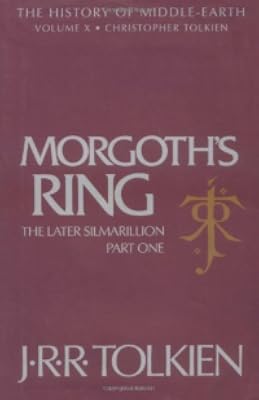
In Morgoth's Ring, the tenth volume of The History of Middle-earth and the first of two companion volumes, Christopher Tolkien describes and documents the legends of the Elder Days, as they were evolved and transformed by his father in the years before he completed The Lord of the Rings. The text of the Annals of Aman, the "Blessed Land" in the far West, is given in full. And in writings never before published, we can see the nature of the problems that J.R.R. Tolkien explored in his later show more years as new and radical ideas, portending upheaval in the heart of the mythology. At this time Tokien sought to redefine the old legends, and wrote of the nature and destiny of Elves, the idea of Elvish rebirth, the origins of the Orcs, and the Fall of Men. His meditation of mortality and immortality as represented in the lives of Men and Elves led to another major writing at this time, the "Debate of Finrod and Andreth," which is reproduced here in full. "Above all," Christopher Tolkien writes in his foreward, "the power and significance of Melkor-Morgoth...was enlarged to become the ground and source of the corruption of Arda." This book indeed is all about Morgoth. Incomparably greater than the power of Sauron, concentrated in the One Ring, Morgoth's power (Tolkien wrote) was dispersed into the very matter of Arda: "The whole of Middle-earth was Morgoth's Ring.". show lessTags
Recommendations





Member Reviews
http://nwhyte.livejournal.com/1982337.html
Having moved through the process of revisiting the compilation of The Lord of the Rings, the History of Middle-Earth now starts into Tolkien's later working through of his mythology. I found a lot of this material very interesting and it is a shame that more of it did not find its way into the published Silmarillion, particularly the "Annals of Aman" which brings much more detail to the early days of relations between the Valar and the Elves. Tolkien also gave a lot of thought to the question of Elvish death and immortality; there's a series of reworkings of what happened to Finwë's first wife Míriel, and also a long dialogue between Finrod and an early wise-woman, Andreth (Beren's show more great-aunt), about these issues. There's also the series of hints about Elvish sexuality, and some interesting speculation about the origin of Orcs. Binding the whole thing together is the question of Morgoth/Melkor's means and motivation; the title Morgoth's Ring is supplied by Christopher Tolkien, basically to suggest that the impact Morgoth's creative power had on Middle-Earth was similar to that of Sauron on the Rings of Power - Middle-Earth itself is therefore Morgoth's Ring in a way.
It is unusual that one could say this of the tenth book in a series of twelve, but I think I would actually recommend Morgoth's Ring rather strongly to Tolkien fans who have not tried any of the History of Middle-Earth series and are interested in giving one of the volumes a try. show less
Having moved through the process of revisiting the compilation of The Lord of the Rings, the History of Middle-Earth now starts into Tolkien's later working through of his mythology. I found a lot of this material very interesting and it is a shame that more of it did not find its way into the published Silmarillion, particularly the "Annals of Aman" which brings much more detail to the early days of relations between the Valar and the Elves. Tolkien also gave a lot of thought to the question of Elvish death and immortality; there's a series of reworkings of what happened to Finwë's first wife Míriel, and also a long dialogue between Finrod and an early wise-woman, Andreth (Beren's show more great-aunt), about these issues. There's also the series of hints about Elvish sexuality, and some interesting speculation about the origin of Orcs. Binding the whole thing together is the question of Morgoth/Melkor's means and motivation; the title Morgoth's Ring is supplied by Christopher Tolkien, basically to suggest that the impact Morgoth's creative power had on Middle-Earth was similar to that of Sauron on the Rings of Power - Middle-Earth itself is therefore Morgoth's Ring in a way.
It is unusual that one could say this of the tenth book in a series of twelve, but I think I would actually recommend Morgoth's Ring rather strongly to Tolkien fans who have not tried any of the History of Middle-Earth series and are interested in giving one of the volumes a try. show less
Read the "Athrabeth Finrod ah Andreth" for a class at the Mythgard Institute. Good stuff.
As with other History of Middle-Earth volumes, I'm not always keen on Christopher Tolkien's commentary. I get that his father had a lot of drafts of things, but I think Christopher is sometimes more vague and convoluted than necessary.
As with other History of Middle-Earth volumes, I'm not always keen on Christopher Tolkien's commentary. I get that his father had a lot of drafts of things, but I think Christopher is sometimes more vague and convoluted than necessary.
Vol. 10. Christopher Tolkien systematizes his father's papers.
Não lido
Ratings
Members
- Recently Added By
Lists

LOTR wishlist
9 works; 1 member
Author Information

605+ Works 517,857 Members
A writer of fantasies, Tolkien, a professor of language and literature at Oxford University, was always intrigued by early English and the imaginative use of language. In his greatest story, the trilogy The Lord of the Rings (1954--56), Tolkien invented a language with vocabulary, grammar, syntax, even poetry of its own. Though readers have show more created various possible allegorical interpretations, Tolkien has said: "It is not about anything but itself. (Certainly it has no allegorical intentions, general, particular or topical, moral, religious or political.)" In The Adventures of Tom Bombadil (1962), Tolkien tells the story of the "master of wood, water, and hill," a jolly teller of tales and singer of songs, one of the multitude of characters in his romance, saga, epic, or fairy tales about his country of the Hobbits. Tolkien was also a formidable medieval scholar, as evidenced by his work, Beowulf: The Monster and the Critics (1936) and his edition of Anciene Wisse: English Text of the Anciene Riwle. Among his works published posthumously, are The Legend of Sigurd and Gudrún and The Fall of Arthur, which was edited by his son, Christopher. In 2013, his title, TheHobbit (Movie Tie-In) made The New York Times Best Seller List. (Bowker Author Biography) show less
All Editions
Some Editions
Series

Work Relationships
Is contained in
Common Knowledge
- Canonical title
- Morgoth's Ring: The Later Silmarillion, Part One
- Original publication date
- 1993-09-23
- People/Characters
- Finrod Felagund; Andreth; Morgoth Bauglir; Melkor; Finwe; Miriel
- Important places
- Middle-earth; Arda
- Original language
- English
Classifications
Statistics
- Members
- 1,228
- Popularity
- 20,139
- Reviews
- 4
- Rating
- (4.10)
- Languages
- English, Spanish
- Media
- Paper, Ebook
- ISBNs
- 10
- UPCs
- 1
- ASINs
- 5