On This Page
Description
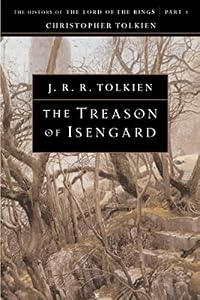
The Treason of Isengard is the seventh volume in Christopher Tolkien's History of Middle-earth and the second in his account of the evolution of The Lord of the Rings. This book follows the long halt in the darkness of the Mines of Moria (which ended The Return of the Shadow) and traces the tale into new lands south and east of the Misty Mountains. Tolkien introduces us to Lothlorien, land of the elves, where we meet the Ents, the Riders of Rohan, and Saruman the White in the fortress of show more Isengard. In brief outlines and penciled drafts dashed down on scraps of paper are the first entry of Galadriel; the earliest ides of the history of Gondor; and the original meeting of Aragorn with Eowyn, its significance destined to be wholly transformed. Conceptions of what lay ahead dissolve as the story takes its own paths, as in the account of the capture of Frodo and his rescue by Sam Gamgee from Minas Morgul, written long before J.R.R. Tolkien actually reached that point in the writing of The Lord of the Rings. A chief feature of the book is a full account of the original Map, with drawings of successive phases, which was long the basis and accompaniment of the emerging geography of Middle-earth. An appendix describes the Runic alphabets of the time, with illustrations of the forms and an analysis of the Runes used in the Book of Mazarbul found beside Balin's tomb in Moria. show lessTags
Recommendations







Member Reviews
http://nwhyte.livejournal.com/1849441.html
The most interesting point for me was that Frodo and Sam's path to Mordor, and even back to the Shire, emerged in Tolkien's thinking much earlier than the story of the others after the death of Boromir. He seems to almost make up the tale of Gimli, Legolas and Aragorn as he goes along, and I must admit it's not the most satisfying part of the book (and was the most messed around with by Peter Jackson for the film). In the middle of this, however, the Treebeard chapter stands out as a coming together of long-simmering ideas for Tolkien, who was fascinated by trees and forests and had been dropping foreshadowing references to Treebeard into his drafts without really thinking them through.
Tolkien show more took great care over names. It's a bit jarring to read "Trotter" instead of "Strider", "Ingolf" instead of "Aragorn" and "Ondor" instead of "Gondor", but I think it's not just familiarity with the final product - the eventually chosen names are genuinely better. There are a very few exceptions - Tolkien was not happy with "Osgiliath", and I think rightly so, but didn't find a good alternative. Irish readers find it amusing that one of Treebeard's fellow elder Ents is named Finglas; this name is there in the very first draft.
I noted with interest that all the early examples of runes - basically Gandalf's messages left at Bree and scrawled at Weathertop - use the good old-fashioned futhark, rather than what we came to know as the Cirth. The switch was made while composing the inscription on Balin's tomb in Moria, and implemented consistently after that. The development of the runes shows off Tolkien's deep knowledge of phonetics; you would expect him to have some familiarity with the subject as a philologist, but clearly it was a profound fascination. (Do you pronounce the 'o's differently in 'Lord' and 'Moria'? I don't, but Tolkien evidently did, going by his first drafts.)
Anyway, much enjoying this reconstruction of how the classic came to be. show less
The most interesting point for me was that Frodo and Sam's path to Mordor, and even back to the Shire, emerged in Tolkien's thinking much earlier than the story of the others after the death of Boromir. He seems to almost make up the tale of Gimli, Legolas and Aragorn as he goes along, and I must admit it's not the most satisfying part of the book (and was the most messed around with by Peter Jackson for the film). In the middle of this, however, the Treebeard chapter stands out as a coming together of long-simmering ideas for Tolkien, who was fascinated by trees and forests and had been dropping foreshadowing references to Treebeard into his drafts without really thinking them through.
Tolkien show more took great care over names. It's a bit jarring to read "Trotter" instead of "Strider", "Ingolf" instead of "Aragorn" and "Ondor" instead of "Gondor", but I think it's not just familiarity with the final product - the eventually chosen names are genuinely better. There are a very few exceptions - Tolkien was not happy with "Osgiliath", and I think rightly so, but didn't find a good alternative. Irish readers find it amusing that one of Treebeard's fellow elder Ents is named Finglas; this name is there in the very first draft.
I noted with interest that all the early examples of runes - basically Gandalf's messages left at Bree and scrawled at Weathertop - use the good old-fashioned futhark, rather than what we came to know as the Cirth. The switch was made while composing the inscription on Balin's tomb in Moria, and implemented consistently after that. The development of the runes shows off Tolkien's deep knowledge of phonetics; you would expect him to have some familiarity with the subject as a philologist, but clearly it was a profound fascination. (Do you pronounce the 'o's differently in 'Lord' and 'Moria'? I don't, but Tolkien evidently did, going by his first drafts.)
Anyway, much enjoying this reconstruction of how the classic came to be. show less
This is a wonderful series, but the subtitled "series within the series"- the study of The Lord of the Rings, has to be my favorite part. These books are rather hard to find, so I was thrilled when I found this lone copy in a Barnes and Noble! A wonderful series for a Tolkien/Lord of the Rings reader!
Christopher Tolkien systematizes his father's papers.
Will read, someday.
Não lido
Inklings, fantasy, literary history
Ratings
Members
- Recently Added By
Lists

LOTR wishlist
9 works; 1 member
Author Information

587+ Works 510,619 Members
A writer of fantasies, Tolkien, a professor of language and literature at Oxford University, was always intrigued by early English and the imaginative use of language. In his greatest story, the trilogy The Lord of the Rings (1954--56), Tolkien invented a language with vocabulary, grammar, syntax, even poetry of its own. Though readers have show more created various possible allegorical interpretations, Tolkien has said: "It is not about anything but itself. (Certainly it has no allegorical intentions, general, particular or topical, moral, religious or political.)" In The Adventures of Tom Bombadil (1962), Tolkien tells the story of the "master of wood, water, and hill," a jolly teller of tales and singer of songs, one of the multitude of characters in his romance, saga, epic, or fairy tales about his country of the Hobbits. Tolkien was also a formidable medieval scholar, as evidenced by his work, Beowulf: The Monster and the Critics (1936) and his edition of Anciene Wisse: English Text of the Anciene Riwle. Among his works published posthumously, are The Legend of Sigurd and Gudrún and The Fall of Arthur, which was edited by his son, Christopher. In 2013, his title, TheHobbit (Movie Tie-In) made The New York Times Best Seller List. (Bowker Author Biography) show less
All Editions
Some Editions
Series

Work Relationships
Is contained in
Common Knowledge
- Canonical title
- The Treason of Isengard
- Original title
- The Treason of Isengard
- Original publication date
- 1989-09-07
- People/Characters
- Saruman the White; Galadriel; Aragorn II; Éowyn; Frodo Baggins; Samwise Gamgee (show all 8); Adelard Took; Amroth
- Important places
- Middle-earth; Misty Mountains; Lothlórien; Isengard; Gondor; Minas Morgul (show all 10); Anduin; Bag End, Hobbiton, The Shire; Barad-dûr; Beleriand
- Important events
- Battle of Five Armies; The Council of Elrond; Destruction of Isengard
- First words
- I GANDALF'S DELAY
In The Return of the Shadow, after citing and discussing the remarkable notes and plot-outlines bearing the date August 1939 (Chapter XXII: 'New Uncertainties and New Projections'), I turned to the contin... (show all)uation of the story at Rivendell and after, as far as Moria. - Last words
- (Click to show. Warning: May contain spoilers.)The green stone in the south was borne on Theoden's brow (p. 444), beneath his white hair, and it was Eowyn who would stand in the shadow of the dark throne within his hall.
- Original language
- English
- Disambiguation notice
- CAUTION: Two of J. R. R. Tolkien's published books are titled The Treason of Isengard. One is Book III of "The Lord of the Rings" when published in a 7-volume set (that is, each constituent "Book" is a separate volume,... (show all) with the Appendices as the seventh volume). The other is Volume VII in "The History of Middle-Earth" series edited by Christopher Tolkien. This LT Work is Volume VII in "The History of Middle-Earth" series.
Classifications
Statistics
- Members
- 1,761
- Popularity
- 12,405
- Reviews
- 6
- Rating
- (3.94)
- Languages
- English, Hungarian, Polish, Spanish
- Media
- Paper, Ebook
- ISBNs
- 16
- UPCs
- 2
- ASINs
- 9