Surrender or Starve: Travels in Ethiopia, Sudan, Somalia, and Eritrea
by Robert D. Kaplan
On This Page
Description
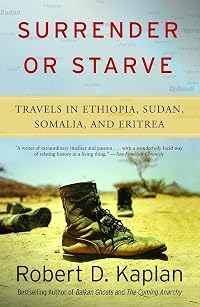
Famine in the Horn is both a tool and an aspect of ethnic conflict, with the Ethiopian Amharas of the central highlands pitted against the Eritreans and Tigreans of the north. The overwhelming majority of U.S. journalists have reported on Ethiopia from one side only-that of the Amharas in Addis Ababa. The author wants to show the story from the other side, in order to redress a grievous imbalance in news coverage. To get people excited, you sometimes have to light a fire, and that was the show more author's intention. This book covers the period from late 1984 to the early part of 1987. In late 1987, the famine returned, mainly for the very reasons cited inside. show lessTags
Recommendations



































Member Reviews
“Surrender or Starve” (1988) is one of the first, if not the first, book by American Robert Kaplan, long one of my favourite current affairs writers (although his latest books are less successful, in my view). This one deals with the famines in the Horn of Africa in the 1980s, and rather eloquently makes the point that these famines were instruments of war, not just acts of Gods, but that reporting by Western media was one-sided, focused on starving children rather than the real issues – issues that were long being denied or ignored by those comfortably based in Addis Ababa. He breaks a lance for the Tigrean and Eritrean independence fighters that opposed the Ethiopian Derg – the brutal communist elite – and he exposes the show more naivety of US foreign policy, focused on winning hearts through humanitarian relief, as opposed to the cold-hearted but strategically superior Soviet approach of militarily supporting the communist elite.
Great book, well researched and well written. The problem is that it is passé, Eritrea is now an independent state and Tigreans rule Ethiopia after having defeated the Derg; even the Soviet Union doesn’t exist anymore. Yet, from an historical point of view, well worth it, if only to provide an insight in the African ruler’s psyche. show less
Great book, well researched and well written. The problem is that it is passé, Eritrea is now an independent state and Tigreans rule Ethiopia after having defeated the Derg; even the Soviet Union doesn’t exist anymore. Yet, from an historical point of view, well worth it, if only to provide an insight in the African ruler’s psyche. show less
This is a much more compelling book to read than the more pedestrian A History of Ethiopia by Harold Marcus. Perhaps because it deals with more recent history. Kaplan is particularly enamored with the leadership of the Tigrayan People's Liberation Front, which is where the current President of Ethiopia, Meles Zenawi, came from. And there was promise when Kaplan wrote this book in 2003. Since then, alas, the Ethiopian leadership has devolved into the same old, same old. Meles would appear to have almost no popular support among the people, and yet garnered 98.6 percent of the vote in the last election. Ethiopian politics is about staying in power, no matter what. As in most African countries, this means making your friends rich and show more making your enemies suffer. Kaplan points out persuasively that starvation is not the natural order of things, but a political tool that is wielded by most of the governments in the Horn of Africa. You see the truth of this just be reading the news of the day in Sudan, Yemen, and Somalia. show less
Kaplan addresses the famines of the Horn of Africa with subtlety but his argument beats us over the head again and again with the fact that regimes of the region don't care about the people we're starving, and American aid just supports these governments. Still, he doesn't provide that compelling case for doing nothing. The book does illuminate, though, why Sudan's government doesn't do anything about Darfur, and doesn't really care about America's protests.The 2003 edition of this book does nothing to update it except to include a now also-outdated look at Eritrea after independence.
Robert D. Kaplan travels to a little-known corner of the globe to document the little-known but brutal conflict between Ethiopia and separationist Eritrea. Kaplan makes the conflict and the famines deliberately created by the Ethiopian government easy to understand. Unfortunately, the objectivity (and enjoyability) of the book is marred by Kaplan's own editorializing about the need for the U.S. to become involved in the war as a method of fighting Communism.
I read this well after the situation had started in Ethiopia and Somalia. It was good information after the fact, but I had read several other good accounts by the time I read this.
The politics of relief efforts in the horn of Africa.
Members
- Recently Added By
Lists

World
18 works; 1 member
Author Information

36+ Works 10,088 Members
Journalist Robert D. Kaplan is a contributing editor The Atlantic Monthly. He has traveled extensively, and his journeys through Yugoslavia and America have produced, respectively, Balkan Ghosts (which was nominated for a Pulitzer Prize) and An Empire Wilderness. Kapan is also the author of Monsoon: The Indian Ocean and the Future of American show more Power (Random House, 2010) and The Revenge of Geography (Random House, 2012) Kaplan has lectured at the FBI, the National Security Agency, the Pentagon's Joint Staff, major universities, the CIA, and business forums. (Bowker Author Biography) show less
Awards and Honors
Common Knowledge
Classifications
Statistics
- Members
- 213
- Popularity
- 153,746
- Reviews
- 8
- Rating
- (3.70)
- Languages
- English, Spanish
- Media
- Paper, Ebook
- ISBNs
- 7
- ASINs
- 1