On This Page
Description
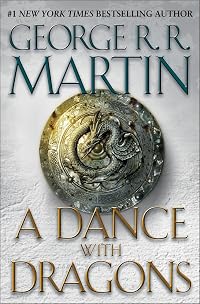
New threats emerge to endanger the future of the Seven Kingdoms, as Daenerys Targaryen, ruling in the East, fights off a multitude of enemies, while Jon Snow, Lord Commander of the Night's Watch, faces his foes both in the Watch and beyond the great Wallof ice and stone.Tags
Recommendations


Member Recommendations
kraaivrouw It's the first in the series and all should be read.
181

Member Reviews
As crows feast over the carrion of southern Westeros, in the steadily wintery North and the sun-soaked far east of Slaver’s Bay there is A Dance with Dragons both literally and figuratively. After waiting five years in between the fourth and fifth installments of A Song of Ice and Fire, George R.R. Martin brought back the stories of Jon Snow, Tyrion Lannister, and Daenerys Targaryen after a ten year wait after finishing A Storm of Swords. As with A Feast for Crows, this book shows how new leaders handle responsibility and the results of their actions.
While the previous book had a feeling of intimate focus, A Dance with Dragons returned to the grand scale that had given Martin’s series one of its biggest appeals. The majority of the show more book takes place in North or Meereen, whether in the city or traveling towards it. At the Wall, Jon has to juggle the needs of the Stannis Baratheon, the Night’s Watch itself, the Wildlings, and more importantly the Others who look to take advantage of men divided against one another. Just a little south, the Boltons and Freys look to secure the North as Theon Greyjoy reeks out an existence within the confines of Winterfell all the while as his sister Asha marches with Stannis as the coming of winter hits hard without knowing that Davos Seaworth has discovered that ‘the north remembers’. Tyrion’s escape from King’s Landing and his eventual journey to the far east of Slaver’s Bay is full of soul searching, the need to survive, and finally the thrill of political intrigue especially as he sends another Dragon west towards Westeros. Wherein Meereen, Dany is finding ruling a conquered city challenging especially after confining her dragons and must compromise to bring peace from her foes within the city walls all the while enemies approach without as well as several friends.
The much lamented “Meereenese Knot” that Martin talked during the writing of A Dance with Dragons, is the area of the book in which many are dissatisfied, including myself to an extent. In all honesty, the majority of Dany’s chapters were my least favorite of the entire book which made me not look forward to anything related to Meereen until after she had ridden out of the city in style. Once Dany had left, in her place came Barristan Selmy who seemed to get things moving with a little help from Quentyn Martell. Although the later character’s story was a fiery catastrophe, Barristan made me look forward to seeing Meereen again as things were actually happening. Given the issues and personal dilemmas that Dany was facing, it felt that it was parallel with Jon however Martin seemed to write Jon’s chapters better than Dany’s which made Meereen a slog until she left and when she did her chapters improved dramatically.
The first 60% of A Dance with Dragons takes place at the same time as A Feast for Crows and it isn’t until the final two-fifths of the book that the entire epic feels whole again as previous POV characters Cersei, Jaime, and Victarion make important appearances. However there is one important new character making a first appearance in this book that could considerably change the political landscape of Westeros for better or ill as The Winds of Winter hit the continent.
After a wait of five and ten years respectively for this installment and for a lot of these characters, A Dance with Dragons is a very good book. Although one major point of view character’s chapters are not up to par with those from previous books, the great writing of other major and secondary characters more than makes up for it resulting in a harrowing and thrilling latter part of the second act of A Song of Ice and Fire. show less
While the previous book had a feeling of intimate focus, A Dance with Dragons returned to the grand scale that had given Martin’s series one of its biggest appeals. The majority of the show more book takes place in North or Meereen, whether in the city or traveling towards it. At the Wall, Jon has to juggle the needs of the Stannis Baratheon, the Night’s Watch itself, the Wildlings, and more importantly the Others who look to take advantage of men divided against one another. Just a little south, the Boltons and Freys look to secure the North as Theon Greyjoy reeks out an existence within the confines of Winterfell all the while as his sister Asha marches with Stannis as the coming of winter hits hard without knowing that Davos Seaworth has discovered that ‘the north remembers’. Tyrion’s escape from King’s Landing and his eventual journey to the far east of Slaver’s Bay is full of soul searching, the need to survive, and finally the thrill of political intrigue especially as he sends another Dragon west towards Westeros. Wherein Meereen, Dany is finding ruling a conquered city challenging especially after confining her dragons and must compromise to bring peace from her foes within the city walls all the while enemies approach without as well as several friends.
The much lamented “Meereenese Knot” that Martin talked during the writing of A Dance with Dragons, is the area of the book in which many are dissatisfied, including myself to an extent. In all honesty, the majority of Dany’s chapters were my least favorite of the entire book which made me not look forward to anything related to Meereen until after she had ridden out of the city in style. Once Dany had left, in her place came Barristan Selmy who seemed to get things moving with a little help from Quentyn Martell. Although the later character’s story was a fiery catastrophe, Barristan made me look forward to seeing Meereen again as things were actually happening. Given the issues and personal dilemmas that Dany was facing, it felt that it was parallel with Jon however Martin seemed to write Jon’s chapters better than Dany’s which made Meereen a slog until she left and when she did her chapters improved dramatically.
The first 60% of A Dance with Dragons takes place at the same time as A Feast for Crows and it isn’t until the final two-fifths of the book that the entire epic feels whole again as previous POV characters Cersei, Jaime, and Victarion make important appearances. However there is one important new character making a first appearance in this book that could considerably change the political landscape of Westeros for better or ill as The Winds of Winter hit the continent.
After a wait of five and ten years respectively for this installment and for a lot of these characters, A Dance with Dragons is a very good book. Although one major point of view character’s chapters are not up to par with those from previous books, the great writing of other major and secondary characters more than makes up for it resulting in a harrowing and thrilling latter part of the second act of A Song of Ice and Fire. show less
I pre-ordered A Dance With Dragons and read all 957 pages (from prologue to epilogue, hardcover) in a week. Now I have mixed feelings. Some of the story was very satisfying, especially in regards to Tyrion and Bran. Some of it progressed slowly or stalled. Theon got served a heaping pile of justice, but it went on for too many chapters. Half of this novel follows minor characters through machinations that are only tangential to the overall plot, which made for a frustrating experience, despite the high quality of the writing. I was tempted to flip through pages to get back to a favorite character. My tolerance for over-description is very high, so my impatience worries me. If I was tempted to skip parts, I imagine that some readers will show more drop the series after this book.
The fourth and fifth books are actually one volume, a fact which in and of itself signals a slower pace. The new plot developments are interesting and well worth reading, but they're interspersed between myriad rich descriptions of palaces, dungeons, exotic feasts, and outlandish warriors. Otherworldly descriptions are part of the appeal of fantastic fiction, of course, yet they lose a bit of magic when they fail to propel the plot forward. Without story tension, the outlandish details become merely a list of curiosities.
The first three books in this series seem fast-paced because each chapter had a situational change, or value change. Each chapter ended with a new plot development. By contrast, A Dance With Dragons contains many chapters which only deliver new environmental details without new plot developments. These areas could have been reduced. Several chapters contained a single new character insight or plot development, which could have been boiled down to a paragraph of exposition or dialogue. This is especially true for the scenes taking place in the land of Dorne, and to a lesser extent, the Greyjoy fleet, the city of Meereen, and the Dreadfort/Winterfell. I don't think it was necessary to go into the point of view of Areo Hotah or Arys Oakheart at all.
The names of minor characters are overwhelming in some places, particularly in the Daenerys chapters. While the complexity of her political situation is admirably realistic, the names are tedious and hard to remember. Instead of listing every noble family in Meereen, only the most important one should have been mentioned, with the rest summed up as "noble families." The same would be true for various sell-sword companies. Most readers will have enough trouble distinguishing between the Second Sons, the Brazen Beasts, and the Golden Company, let alone remembering the names of multiple officers in each one.
I get the uncomfortable sense that George R.R. Martin is losing focus on his epic, shying away from the meat of the overarching story, either out of fear that he won't be able to give it a satisfying wrap-up, or because he's reveling in the rich environment and losing his path in his own creativity. If the plot spins out of control, buried beneath the weight of subplots, some readers might shrug and say "it's impossible to control an epic." Other blockbuster and best-selling epics have ended in disappointment. The Star Wars movie franchise took a nosedive, and many readers would agree that the same tragedy befell the Wheel of Time series and the Dark Tower series.
I think it's possible for the next Song of Ice and Fire book to match the stride of the first three. As a writer of an epic series (five books completed so far), I understand the temptation to discover and explore new details within my created universe. Creation is fun. It's addictive. Self-editing, on the other hand, is a painful and difficult chore. Creators want to share every detail of their invention, and set out to impress their audience ... but sometimes readers are bored by a scene that the author found absolutely riveting. This is when objective criticism becomes essential. Right now, I feel fortunate to have two "neo-pro" advantages. One is that I can get objective criticism. The other is that I don't have to rush through edits due to deadline pressures from a publishing house. I keep wondering what obstacles George R.R. Martin is facing, in regards to critiques and deadline expectations.
Anyway, I'm hooked on this series, and rooting for the sympathetic characters who've managed to survive so many battles and treacheries. In a dark world where the strong rule and the meek get slaughtered, one can't help but admire Tyrion the dwarf, Bran the cripple, Sam the coward, and ugly Brienne. Then there's Daenerys, whose brother sold her into slavery, and Arya, who believes herself an orphan among foreigners, and Jon Snow, who believes himself unwanted by the family who raised him. These characters are far more complex and compelling than the typical heroes of epic fantasy. George R.R. Martin has a formidable talent for creating unique characters, and a knack for setting up dire situations and then twisting the plot in surprising, unpredictable ways.
The first three books had me on the edge of my seat, turning pages. These latest two books are a comfortable return to the world where wights walk and familial schisms lead to global warfare, and they might be connective tissue to an awe-inspiring grand finale. The first book has practically become a modern classic and inspired a popular HBO miniseries. If this series ends as strongly as it began, it will earn a place among classics, worthy of study and influential on western culture.
This review was originally published on my blog, with in-depth analysis and copious spoilers. show less
The fourth and fifth books are actually one volume, a fact which in and of itself signals a slower pace. The new plot developments are interesting and well worth reading, but they're interspersed between myriad rich descriptions of palaces, dungeons, exotic feasts, and outlandish warriors. Otherworldly descriptions are part of the appeal of fantastic fiction, of course, yet they lose a bit of magic when they fail to propel the plot forward. Without story tension, the outlandish details become merely a list of curiosities.
The first three books in this series seem fast-paced because each chapter had a situational change, or value change. Each chapter ended with a new plot development. By contrast, A Dance With Dragons contains many chapters which only deliver new environmental details without new plot developments. These areas could have been reduced. Several chapters contained a single new character insight or plot development, which could have been boiled down to a paragraph of exposition or dialogue. This is especially true for the scenes taking place in the land of Dorne, and to a lesser extent, the Greyjoy fleet, the city of Meereen, and the Dreadfort/Winterfell. I don't think it was necessary to go into the point of view of Areo Hotah or Arys Oakheart at all.
The names of minor characters are overwhelming in some places, particularly in the Daenerys chapters. While the complexity of her political situation is admirably realistic, the names are tedious and hard to remember. Instead of listing every noble family in Meereen, only the most important one should have been mentioned, with the rest summed up as "noble families." The same would be true for various sell-sword companies. Most readers will have enough trouble distinguishing between the Second Sons, the Brazen Beasts, and the Golden Company, let alone remembering the names of multiple officers in each one.
I get the uncomfortable sense that George R.R. Martin is losing focus on his epic, shying away from the meat of the overarching story, either out of fear that he won't be able to give it a satisfying wrap-up, or because he's reveling in the rich environment and losing his path in his own creativity. If the plot spins out of control, buried beneath the weight of subplots, some readers might shrug and say "it's impossible to control an epic." Other blockbuster and best-selling epics have ended in disappointment. The Star Wars movie franchise took a nosedive, and many readers would agree that the same tragedy befell the Wheel of Time series and the Dark Tower series.
I think it's possible for the next Song of Ice and Fire book to match the stride of the first three. As a writer of an epic series (five books completed so far), I understand the temptation to discover and explore new details within my created universe. Creation is fun. It's addictive. Self-editing, on the other hand, is a painful and difficult chore. Creators want to share every detail of their invention, and set out to impress their audience ... but sometimes readers are bored by a scene that the author found absolutely riveting. This is when objective criticism becomes essential. Right now, I feel fortunate to have two "neo-pro" advantages. One is that I can get objective criticism. The other is that I don't have to rush through edits due to deadline pressures from a publishing house. I keep wondering what obstacles George R.R. Martin is facing, in regards to critiques and deadline expectations.
Anyway, I'm hooked on this series, and rooting for the sympathetic characters who've managed to survive so many battles and treacheries. In a dark world where the strong rule and the meek get slaughtered, one can't help but admire Tyrion the dwarf, Bran the cripple, Sam the coward, and ugly Brienne. Then there's Daenerys, whose brother sold her into slavery, and Arya, who believes herself an orphan among foreigners, and Jon Snow, who believes himself unwanted by the family who raised him. These characters are far more complex and compelling than the typical heroes of epic fantasy. George R.R. Martin has a formidable talent for creating unique characters, and a knack for setting up dire situations and then twisting the plot in surprising, unpredictable ways.
The first three books had me on the edge of my seat, turning pages. These latest two books are a comfortable return to the world where wights walk and familial schisms lead to global warfare, and they might be connective tissue to an awe-inspiring grand finale. The first book has practically become a modern classic and inspired a popular HBO miniseries. If this series ends as strongly as it began, it will earn a place among classics, worthy of study and influential on western culture.
This review was originally published on my blog, with in-depth analysis and copious spoilers. show less
I am in love with this series, but HATE HATE HATE to see that it will now be forever and a day until the next installment comes out, and then forever and a day after that! Why is it that I decide to love a series that I can enjoy well into my retirement? Sigh.
In any case, Martin does what he does, in a VERY MUCH drawn out way by getting you hooked on a particular storyline and just when you've got all the characters right in your mind, he switches scenes. Gotta love it. I have to say, for the first time, I really got into the storyline of Daenerys. Yes, I know she's been in every book. Yes, I know she already has a following, but I haven't really loved her until this book and loved her I did! I can't wait for the next one, if only to show more read her part! I'm not sure if it's her that I love, or if it's the dragons, but hope that they all make major appearances in the books to come.
As for the other characters - still adore Tyrion. Who wouldn't, really? HE RIDES A PIG - who'd have ever thought up that storyline? His responses are the snappy humorous ones that are needed between all the cold and ice that's going on around the storylines. I looked forward to his chapters as they appeared to be so much more lighthearted, even with plotting and killing happening all around him.
Jon Snow, while a fan favorite, has never really held my interest. This book was more of the same. He is just making choices that no one likes and justifying them in his own head. Arrogant, in my opinion. I like Ghost, though, and would like him to connect with the other direwolves.
My one major concern with this book is that we get too many glimpses into minor characters. Not sure if it's foreshadowing for future books or not (and I guess no one knows that yet), but it is truly annoying when there are PAGES AND PAGES of characters in an appendix already. It's not the easiest to figure out, and by the time you do, some of them seem to already be killed off! show less
In any case, Martin does what he does, in a VERY MUCH drawn out way by getting you hooked on a particular storyline and just when you've got all the characters right in your mind, he switches scenes. Gotta love it. I have to say, for the first time, I really got into the storyline of Daenerys. Yes, I know she's been in every book. Yes, I know she already has a following, but I haven't really loved her until this book and loved her I did! I can't wait for the next one, if only to show more read her part! I'm not sure if it's her that I love, or if it's the dragons, but hope that they all make major appearances in the books to come.
As for the other characters - still adore Tyrion. Who wouldn't, really? HE RIDES A PIG - who'd have ever thought up that storyline? His responses are the snappy humorous ones that are needed between all the cold and ice that's going on around the storylines. I looked forward to his chapters as they appeared to be so much more lighthearted, even with plotting and killing happening all around him.
Jon Snow, while a fan favorite, has never really held my interest. This book was more of the same. He is just making choices that no one likes and justifying them in his own head. Arrogant, in my opinion. I like Ghost, though, and would like him to connect with the other direwolves.
My one major concern with this book is that we get too many glimpses into minor characters. Not sure if it's foreshadowing for future books or not (and I guess no one knows that yet), but it is truly annoying when there are PAGES AND PAGES of characters in an appendix already. It's not the easiest to figure out, and by the time you do, some of them seem to already be killed off! show less
’Danza de dragones’, el quinto volumen de la saga de Canción de hielo y fuego, quizás el libro más esperado de las últimas décadas, continúa exactamente donde terminó ‘Tormenta de espadas’. Porque, en realidad, no sigue a ‘Festín de cuervos’, ya que este y ‘Danza de dragones’ están intrínsecamente unidos, sus tramas se entrecruzan como si de un único libro se tratase. Esto mismo ya lo explicaba George Martin, que el manuscrito que tenía entre manos había aumentado tanto en páginas, que decidió dividirlo en dos grandes partes. Para muchos ‘Festín de cuervos’ es una novela fallida, o si no decepcionante. Para mí no es así. Creo que se juntaron dos hechos: por una parte, que superar ‘Tormenta de show more espadas’ era muy difícil, ya que este volumen es prácticamente insuperable; y también tuvo mucho que ver el que los fans nos encontramos, o más bien lo contrario, que echamos en falta, a los personajes más carismáticos. Imagino que si se hubiese publicado un supervolumen con la unión de ‘Festín de cuervos’ y ’Danza de dragones’, la opinión sería otra.
A estas alturas es innecesario hablar del argumento de Canción de hielo y fuego, e incluso puede ser peligroso por si se escapa alguna sorpresa. Así que compañero o compañera, si has llegado a este libro, estás de suerte, porque te vas a encontrar todo lo que echaste en falta en ‘Festín de cuervos’ y mucho más. El juego de tronos se muestra en todo su esplendor, con traiciones, nuevas apariciones y sorpresas por doquier, que Martin maneja con maestría, como si de piezas de ajedrez o de sitrang se tratase.
Los escenarios se multiplican, y Martin nos describe mucho más de los países del Este, algo que se echaba en falta. Martin se gusta, y nos lleva con él por ríos, mar y tierra, por barco y carreta, por grandes ciudades y por pequeños feudos, por posadas, castillos o prostíbulos, degustando desde venado y caballo, hasta las comidas más exóticas, encontrándonos por el camino escaramuzas y combates, etc.
Como es habitual en todos los libros, ni los buenos son tan buenos, ni los malos lo son tanto, contrastes y ambigüedades que enriquecen enormemente la lectura, y que hacen que te crees tu propia opinión sobre personajes y situaciones, con lo que Martin (¡maldito!) te hace sufrir con lo que va sucediendo.
Tras leer ’Danza de dragones’, puedo decir que Martin ha vuelto con fuerza, y que está varios escalones por encima del resto. show less
A estas alturas es innecesario hablar del argumento de Canción de hielo y fuego, e incluso puede ser peligroso por si se escapa alguna sorpresa. Así que compañero o compañera, si has llegado a este libro, estás de suerte, porque te vas a encontrar todo lo que echaste en falta en ‘Festín de cuervos’ y mucho más. El juego de tronos se muestra en todo su esplendor, con traiciones, nuevas apariciones y sorpresas por doquier, que Martin maneja con maestría, como si de piezas de ajedrez o de sitrang se tratase.
Los escenarios se multiplican, y Martin nos describe mucho más de los países del Este, algo que se echaba en falta. Martin se gusta, y nos lleva con él por ríos, mar y tierra, por barco y carreta, por grandes ciudades y por pequeños feudos, por posadas, castillos o prostíbulos, degustando desde venado y caballo, hasta las comidas más exóticas, encontrándonos por el camino escaramuzas y combates, etc.
Como es habitual en todos los libros, ni los buenos son tan buenos, ni los malos lo son tanto, contrastes y ambigüedades que enriquecen enormemente la lectura, y que hacen que te crees tu propia opinión sobre personajes y situaciones, con lo que Martin (¡maldito!) te hace sufrir con lo que va sucediendo.
Tras leer ’Danza de dragones’, puedo decir que Martin ha vuelto con fuerza, y que está varios escalones por encima del resto. show less
The dragon stirs, but does not fly.
I finished A Feast for Crows and immediately flipped to the author's note. Martin promised: "The next book, A Dance with Dragons, will focus on the characters who were not in this volume." Tyrion, Daenerys, Jon, Bran. The names I had been missing for 800 pages. So I did what any impatient reader would do: I picked up A Dance with Dragons the same day and kept going. No waiting.
And for the first hundred pages, I felt the same frustration I had with Feast: more new faces, more slow travel, more politics that seemed to circle in place. But somewhere around the two‑hundredth page, something shifted. The dragon stirred. Not in a grand explosion, but in small moments: a dwarf remembering a joke he once show more told, a queen cutting her hand on a dragon's tooth, a bastard son burning his hand on a lantern. By the end, I was no longer frustrated. I was exhausted, hopeful, and desperate for the next book. The same state I have been in for years; except now I understand why the wait has been so long for everyone else.
What it is:
A Dance with Dragons runs parallel to A Feast for Crows in time, then moves beyond. It covers the north and the east, the characters who were missing from Feast. In the frozen North, Jon Snow is the new Lord Commander of the Night's Watch, trying to hold together a crumbling Wall while wildlings pour through, the army of the dead grows, and his own brothers scheme against him. Across the Narrow Sea, Daenerys Targaryen has conquered the slave city of Meereen, but ruling is harder than conquering. She is trapped between a violent insurgency, a plague, and her own dragons, who grow wilder by the day. And Tyrion Lannister, having fled King's Landing after killing his father, travels eastward, drunk, bitter, and searching for a reason to live. And perhaps for the dragon queen.
Meanwhile, Bran Stark journeys deeper into the roots of the world, learning secrets that will change everything. Theon Greyjoy, broken and renamed "Reek," endures unspeakable cruelty in the dungeons of the Boltons. And a new prince of Dorne sets sail for Meereen, carrying a marriage proposal and a hidden dagger.
Why it works (even when it frustrates):
1. Tyrion is back. After his absence in Feast, being inside Tyrion's head again feels like reuniting with a lost friend. But this is not the witty, scheming Tyrion of King's Landing. He is depressed, self‑destructive, and occasionally cruel. Martin dares to make him unlikeable for long stretches. And yet, his dark humor survives. His journey down the Rhoyne River with a mysterious half‑mad knight is some of the best writing in the entire series.
2. Daenerys's arc is a masterclass in the difficulty of rule. In A Storm of Swords, she freed slaves and conquered cities. In Dance, she has to govern, and governance is ugly. She compromises with former slavers. She chains her dragons. She marries a man she does not love for peace. Her chapters are slow, frustrating, and necessary. By the end, when she finally makes a choice, you will understand why she does it. And you will cheer.
3. Jon Snow becomes a leader. No longer the brooding outsider, Jon is forced to make impossible decisions: let wildlings through the Wall? Risk war with the Boltons? Execute a friend for treason? His chapters are tense, morally gray, and build toward an ending that made me shout at the page. (You will know it when you get there.)
4. Theon's redemption arc is heartbreaking. The man who betrayed Robb Stark in A Clash of Kings is reduced to a trembling, toothless wreck. Martin does not let you forget his crimes, but he also forces you to see him as a victim. His chapters in Winterfell, written in a fractured, desperate voice, are the most psychologically intense in the book.
5. The world expands further. We see the ruined city of Old Valyria from a distance. We sail through the foggy, haunted canals of Braavos. We descend into a cave beneath a frozen weirwood tree where time works differently. The sense of ancient, forgotten magic is stronger here than anywhere else in the series.
6. The prose is confident. Martin has been writing these characters for decades. His dialogue snaps. His battle scenes (there are two major ones) are brutal and clear. And his quiet moments—Tyrion playing cyvasse with a young prince, Jon burning his hand on a lantern, Daenerys flying Drogon for the first time are as memorable as any fight.
Where it stumbles (and why it is not five stars for me):
1. The pacing is glacial in the middle. The book is over 1,000 pages, and large sections feel like setup for The Winds of Winter. Tyrion's journey down the Rhoyne, while beautifully written, goes on for chapters without advancing the plot. Daenerys's Meereenese politics become repetitive: "I want peace. The Harpy's Sons kill another freedman. I compromise again. Nothing changes." You will feel her frustration. That is intentional. But it is still frustrating to read.
2. Too many new characters in the east. Tyrion meets a prince, a sellsword, a priest, a dwarf‑hunting lady. Daenerys adds a mercenary captain, a noble hostage, a green‑grace. Some of them are memorable (the knight with the shaved head), others blur together. The appendix groans.
3. The parallel timeline with Feast creates redundancy. Because Dance covers the same time period as Feast for the first two‑thirds, you will get news of events you already witnessed from a different angle. For example, you will hear about Cersei's walk of atonement through the eyes of a new character. It is interesting, but it also slows the momentum.
4. The ending is a collection of cliffhangers. Several major plotlines stop mid‑action. One character is stabbed. Another is surrounded by enemies. A third rides off into the unknown. Martin has acknowledged that he intended to write a big battle scene for the end, but cut it to Winds because the book was too long. As a result, Dance feels incomplete- a bridge, not a destination.
5. A few plotlines go nowhere. There is a young prince who spends the entire book traveling to Daenerys, and then... nothing. A certain dwarf meets a certain queen in the final pages, but their conversation is cut short. You will feel the absence of the concluding chapters that Martin promised but could not deliver.
What it does better than any other book in the series:
1. The psychological depth. Theon's chapters alone are worth the price of entry. Jon's struggle with leadership is painfully real. Daenerys's loneliness, even surrounded by thousands, is palpable. Tyrion's despair is not glamorous: he is drunk, suicidal, and cruel. Martin does not romanticize suffering.
2. The magic returns. After Feast was almost entirely magic‑free, Dance brings back warging, greensight, fire visions, and a dragon that remembers its mother. The final third of the book has a sequence involving a pit fight and an escaped dragon that is pure adrenaline.
3. The thematic ambition. A Dance with Dragons asks: Can you change your nature? Theon tries. Tyrion tries. Daenerys tries to be a peacemaker instead of a conqueror. Jon tries to be a leader instead of a lone wolf. The answer is messy. Some succeed, some fail, and some are destroyed by the attempt.
Who should read this:
Anyone who has made it through A Feast for Crows and still wants more.
Readers who love deep character studies, even at the cost of plot momentum.
Those who are patient with slow‑burn storytelling.
Fans of dragons, wargs, and the creeping supernatural.
Who should skip it:
If you were frustrated by the lack of resolution in Feast (this is worse).
If you need a finished series (the wait continues).
If slow, introspective middle sections bore you.
Final verdict:
A Dance with Dragons is the hardest book in the series to evaluate. It contains some of Martin's best writing (Theon, Jon, the dragon pit) and some of his most indulgent excesses (Meereenese politics, Tyrion's endless river journey). It is incomplete; a massive setup for a payoff that is still years away. And yet, I love it. Because after spending 1,200 pages with these characters, I cannot abandon them. Even when the plot stalls, the characters grow. Even when the pacing drags, the prose rewards.
Four stars. For the prince who learned his name. For the queen who flew. For the dwarf who still has a conscience, buried deep. And for the wall that fell, not of ice, but of trust.
Now I sit with the rest of you, staring at the horizon, refreshing news pages, and wondering if The Winds of Winter will arrive before I grow too old to read it by candlelight. The wait is what it is. But the five books I have already read? They have made the waiting bearable.
P.S. If you want a smoother reading experience, look up the "Boiled Leather" order that combines Feast and Dance chronologically. It is a better book that way. If you read them separately, read Feast first, then Dance, and know that the final third of Dance is where the magic happens. show less
I finished A Feast for Crows and immediately flipped to the author's note. Martin promised: "The next book, A Dance with Dragons, will focus on the characters who were not in this volume." Tyrion, Daenerys, Jon, Bran. The names I had been missing for 800 pages. So I did what any impatient reader would do: I picked up A Dance with Dragons the same day and kept going. No waiting.
And for the first hundred pages, I felt the same frustration I had with Feast: more new faces, more slow travel, more politics that seemed to circle in place. But somewhere around the two‑hundredth page, something shifted. The dragon stirred. Not in a grand explosion, but in small moments: a dwarf remembering a joke he once show more told, a queen cutting her hand on a dragon's tooth, a bastard son burning his hand on a lantern. By the end, I was no longer frustrated. I was exhausted, hopeful, and desperate for the next book. The same state I have been in for years; except now I understand why the wait has been so long for everyone else.
What it is:
A Dance with Dragons runs parallel to A Feast for Crows in time, then moves beyond. It covers the north and the east, the characters who were missing from Feast. In the frozen North, Jon Snow is the new Lord Commander of the Night's Watch, trying to hold together a crumbling Wall while wildlings pour through, the army of the dead grows, and his own brothers scheme against him. Across the Narrow Sea, Daenerys Targaryen has conquered the slave city of Meereen, but ruling is harder than conquering. She is trapped between a violent insurgency, a plague, and her own dragons, who grow wilder by the day. And Tyrion Lannister, having fled King's Landing after killing his father, travels eastward, drunk, bitter, and searching for a reason to live. And perhaps for the dragon queen.
Meanwhile, Bran Stark journeys deeper into the roots of the world, learning secrets that will change everything. Theon Greyjoy, broken and renamed "Reek," endures unspeakable cruelty in the dungeons of the Boltons. And a new prince of Dorne sets sail for Meereen, carrying a marriage proposal and a hidden dagger.
Why it works (even when it frustrates):
1. Tyrion is back. After his absence in Feast, being inside Tyrion's head again feels like reuniting with a lost friend. But this is not the witty, scheming Tyrion of King's Landing. He is depressed, self‑destructive, and occasionally cruel. Martin dares to make him unlikeable for long stretches. And yet, his dark humor survives. His journey down the Rhoyne River with a mysterious half‑mad knight is some of the best writing in the entire series.
2. Daenerys's arc is a masterclass in the difficulty of rule. In A Storm of Swords, she freed slaves and conquered cities. In Dance, she has to govern, and governance is ugly. She compromises with former slavers. She chains her dragons. She marries a man she does not love for peace. Her chapters are slow, frustrating, and necessary. By the end, when she finally makes a choice, you will understand why she does it. And you will cheer.
3. Jon Snow becomes a leader. No longer the brooding outsider, Jon is forced to make impossible decisions: let wildlings through the Wall? Risk war with the Boltons? Execute a friend for treason? His chapters are tense, morally gray, and build toward an ending that made me shout at the page. (You will know it when you get there.)
4. Theon's redemption arc is heartbreaking. The man who betrayed Robb Stark in A Clash of Kings is reduced to a trembling, toothless wreck. Martin does not let you forget his crimes, but he also forces you to see him as a victim. His chapters in Winterfell, written in a fractured, desperate voice, are the most psychologically intense in the book.
5. The world expands further. We see the ruined city of Old Valyria from a distance. We sail through the foggy, haunted canals of Braavos. We descend into a cave beneath a frozen weirwood tree where time works differently. The sense of ancient, forgotten magic is stronger here than anywhere else in the series.
6. The prose is confident. Martin has been writing these characters for decades. His dialogue snaps. His battle scenes (there are two major ones) are brutal and clear. And his quiet moments—Tyrion playing cyvasse with a young prince, Jon burning his hand on a lantern, Daenerys flying Drogon for the first time are as memorable as any fight.
Where it stumbles (and why it is not five stars for me):
1. The pacing is glacial in the middle. The book is over 1,000 pages, and large sections feel like setup for The Winds of Winter. Tyrion's journey down the Rhoyne, while beautifully written, goes on for chapters without advancing the plot. Daenerys's Meereenese politics become repetitive: "I want peace. The Harpy's Sons kill another freedman. I compromise again. Nothing changes." You will feel her frustration. That is intentional. But it is still frustrating to read.
2. Too many new characters in the east. Tyrion meets a prince, a sellsword, a priest, a dwarf‑hunting lady. Daenerys adds a mercenary captain, a noble hostage, a green‑grace. Some of them are memorable (the knight with the shaved head), others blur together. The appendix groans.
3. The parallel timeline with Feast creates redundancy. Because Dance covers the same time period as Feast for the first two‑thirds, you will get news of events you already witnessed from a different angle. For example, you will hear about Cersei's walk of atonement through the eyes of a new character. It is interesting, but it also slows the momentum.
4. The ending is a collection of cliffhangers. Several major plotlines stop mid‑action. One character is stabbed. Another is surrounded by enemies. A third rides off into the unknown. Martin has acknowledged that he intended to write a big battle scene for the end, but cut it to Winds because the book was too long. As a result, Dance feels incomplete- a bridge, not a destination.
5. A few plotlines go nowhere. There is a young prince who spends the entire book traveling to Daenerys, and then... nothing. A certain dwarf meets a certain queen in the final pages, but their conversation is cut short. You will feel the absence of the concluding chapters that Martin promised but could not deliver.
What it does better than any other book in the series:
1. The psychological depth. Theon's chapters alone are worth the price of entry. Jon's struggle with leadership is painfully real. Daenerys's loneliness, even surrounded by thousands, is palpable. Tyrion's despair is not glamorous: he is drunk, suicidal, and cruel. Martin does not romanticize suffering.
2. The magic returns. After Feast was almost entirely magic‑free, Dance brings back warging, greensight, fire visions, and a dragon that remembers its mother. The final third of the book has a sequence involving a pit fight and an escaped dragon that is pure adrenaline.
3. The thematic ambition. A Dance with Dragons asks: Can you change your nature? Theon tries. Tyrion tries. Daenerys tries to be a peacemaker instead of a conqueror. Jon tries to be a leader instead of a lone wolf. The answer is messy. Some succeed, some fail, and some are destroyed by the attempt.
Who should read this:
Anyone who has made it through A Feast for Crows and still wants more.
Readers who love deep character studies, even at the cost of plot momentum.
Those who are patient with slow‑burn storytelling.
Fans of dragons, wargs, and the creeping supernatural.
Who should skip it:
If you were frustrated by the lack of resolution in Feast (this is worse).
If you need a finished series (the wait continues).
If slow, introspective middle sections bore you.
Final verdict:
A Dance with Dragons is the hardest book in the series to evaluate. It contains some of Martin's best writing (Theon, Jon, the dragon pit) and some of his most indulgent excesses (Meereenese politics, Tyrion's endless river journey). It is incomplete; a massive setup for a payoff that is still years away. And yet, I love it. Because after spending 1,200 pages with these characters, I cannot abandon them. Even when the plot stalls, the characters grow. Even when the pacing drags, the prose rewards.
Four stars. For the prince who learned his name. For the queen who flew. For the dwarf who still has a conscience, buried deep. And for the wall that fell, not of ice, but of trust.
Now I sit with the rest of you, staring at the horizon, refreshing news pages, and wondering if The Winds of Winter will arrive before I grow too old to read it by candlelight. The wait is what it is. But the five books I have already read? They have made the waiting bearable.
P.S. If you want a smoother reading experience, look up the "Boiled Leather" order that combines Feast and Dance chronologically. It is a better book that way. If you read them separately, read Feast first, then Dance, and know that the final third of Dance is where the magic happens. show less
3.5 Stars. I enjoyed this a tiny bit less than the previous books in the series though my reasons for that are completely due to personal preferences, the quality of the storytelling hasn’t dropped off, there’s still plenty of character growth and big moments (including some cliffhangers that will hopefully go a different way from the television series to keep things extra interesting).
Like book four, this focuses on some, not all, of the main characters, which became a personal preference issue for me. I found myself really missing the emotional attachment I felt to and the entertainment value of certain people. I struggled with some chapters featuring characters I’m not as familiar with or as invested in, though, to be fair, it show more wasn’t like they were just taking up space, they were moving the story forward and adding new layers to it which is absolutely important, it’s just like I said, have a fondness for certain characters and in their absence the book didn’t capture my attention quite as completely as others in the series have.
Anyone who reads these books knows there are a plethora of references to and instances of rape, which, I don’t know for certain but I’m guessing is probably pretty realistic for the time period, it’s just a lot at times, like in this book, Tyrion (a character I do love) spends an awful lot of time talking about how he’d very much like to rape his sister, which is a lot to absorb. That’s where my other personal preference issue comes in. Normally I can count on the powerful pro-active heroines of this series to kind of offer some counter-balance to the rapey misogynistic stuff of these stories, but because of the situations Dany, Cersei, Arya, Brienne, etc., all found themselves in over the course of this novel, I just felt like I didn’t get enough powerful female moments which this series generally excels at and I realize that’s all due to circumstances of the story, still, it’s an aspect I really love and missed to some degree.
All that said, it’s still a really great book and I remain in awe of George R.R. Martin’s ability to craft these books of such epic detail and ginormous casts of character, it must be crazy challenging to keep it all straight in his head. show less
Like book four, this focuses on some, not all, of the main characters, which became a personal preference issue for me. I found myself really missing the emotional attachment I felt to and the entertainment value of certain people. I struggled with some chapters featuring characters I’m not as familiar with or as invested in, though, to be fair, it show more wasn’t like they were just taking up space, they were moving the story forward and adding new layers to it which is absolutely important, it’s just like I said, have a fondness for certain characters and in their absence the book didn’t capture my attention quite as completely as others in the series have.
Anyone who reads these books knows there are a plethora of references to and instances of rape, which, I don’t know for certain but I’m guessing is probably pretty realistic for the time period, it’s just a lot at times, like in this book, Tyrion (a character I do love) spends an awful lot of time talking about how he’d very much like to rape his sister, which is a lot to absorb. That’s where my other personal preference issue comes in. Normally I can count on the powerful pro-active heroines of this series to kind of offer some counter-balance to the rapey misogynistic stuff of these stories, but because of the situations Dany, Cersei, Arya, Brienne, etc., all found themselves in over the course of this novel, I just felt like I didn’t get enough powerful female moments which this series generally excels at and I realize that’s all due to circumstances of the story, still, it’s an aspect I really love and missed to some degree.
All that said, it’s still a really great book and I remain in awe of George R.R. Martin’s ability to craft these books of such epic detail and ginormous casts of character, it must be crazy challenging to keep it all straight in his head. show less
Reading Martin reminds me of having my eyes dilated.
Seriously, it's getting frustrating to the point of being not worth it. This book, the fifth in the series, is basically a 400-500 page novel crammed into nearly 2,000. I'm not opposed to reading a book that long, but there needs to be a reason. Martin seems to have run out of reasons. I'm telling you right now-- this series will end like the Sopranos. Ain't nobody gonna be happy, 'cause he's out of ideas.
I say this book is like having your eyes dilated because all you ever read in the myriad chapters is the periphery of what's going on. Until the last 100 pages, there is precious little of consequence, and less of interest. I was excited after picking up the fourth book because I show more thought maybe I had been premature in my dismissing it, but now I see that Martin really is a one-trick pony. He can make you care about a character, then kill that character without warning. No big deal, and I'm not one of those who threatens to not read anything he writes because of that. That's part of medieval living--people die, and often the "good" ones die first. So what. But we're kept intentionally in the dark and it seems as if Martin is determined to fill page after page after page with inconsequential trivia without one indication that something is going on elsewhere. It's the literary equivalent of jumping out at someone from a darkened hallway. Easy to get a reaction, but as likely to piss someone off.
I swear to god, he spent nearly half a page describing the various badges on knights' shields very near the end of the book. Why? Who knows. Because he could? I told my wife that Martin was developing Harry Potter syndrome, wherein his books are getting longer even while he seems to be running out of plot. I noticed this reading the last few Harry Potter books-- so much development of things that served very little importance, or at least in disproportion to the amount of page space. In ADWD, we get stupid, pointless chapters of tedious detail about how one group is traveling to Meereen to meet up with Daenerys, only to be convinced by Tyrion to return to Westeros. Meanwhile, we learn nothing new about anything, except that maybe the Targaryens weren't quite as wiped out as previously believed.
I imagine there is no shortage of Martin sycophants out their saying "Oh, but he's building a world out of scratch, you need time and pages for world-building." No. Reading Martin is like reading a random generator engine. He has all the little sprinkles of fantasy genre, without any of the thought behind it. Change the spellings of common names to make them "foreign"? Check. Dust off the dictionary of obscure English words? Check. Ape the feudal and chivalric systems of Europe/England? Check. Ding ding! Fantasy.
What really pisses me off about this is that he has good ideas, they just get lost in the shuffle. There is just enough drama to keep one engaged, though I found the trick wasn't to read each word, but to skim and read the dialog. Frequently, anything that isn't being spoken just isn't that important. Likely, he's describing food, or weapons, or listing names. There was one chapter devoted to the movement of wildlings through the Wall. People walking in a line, through a tunnel. For the whole chapter. Riveting. Then, to keep us interested, he hints at something of consequence getting ready to happen, and that was the clearest indication that the chapter was coming to a close.
At the end of this book (and no sooner! you could literally skip to the last 200 pages and not be particularly lost) there are some interesting occurrences, but often it seems like Martin only has the one well to go to-- kill major characters. It was upsetting, but after a while no longer a surprise and honestly, more than a bit lazy. Seriously, mix it up a little bit. I suppose I should have seen it coming with the constant reference to the song "Rains of Castamere" by Tyrion and others.
Yes, I likely will finish the series (that is, if Martin finishes the series). It's good enough that after the investment, I feel I need to see it through. Still, It will have to remain summer reading, as I can't waste this much time reading something this insubstantial for this many pages when I have other things to do. Martin would be wise to get to the point a bit, instead of submitting every precious word for publication. I'm sure there are some who never want to leave the world he's "created," just like there are those who never want to leave the world of Harry Potter. But four books in and it's becoming too frustrating. Pages after hundreds of pages with nothing happening is like only being able to see clearly through your peripheral vision after dilation. Not a lot of fun and leaving you in the end to be impatient for it to all be over. show less
Seriously, it's getting frustrating to the point of being not worth it. This book, the fifth in the series, is basically a 400-500 page novel crammed into nearly 2,000. I'm not opposed to reading a book that long, but there needs to be a reason. Martin seems to have run out of reasons. I'm telling you right now-- this series will end like the Sopranos. Ain't nobody gonna be happy, 'cause he's out of ideas.
I say this book is like having your eyes dilated because all you ever read in the myriad chapters is the periphery of what's going on. Until the last 100 pages, there is precious little of consequence, and less of interest. I was excited after picking up the fourth book because I show more thought maybe I had been premature in my dismissing it, but now I see that Martin really is a one-trick pony. He can make you care about a character, then kill that character without warning. No big deal, and I'm not one of those who threatens to not read anything he writes because of that. That's part of medieval living--people die, and often the "good" ones die first. So what. But we're kept intentionally in the dark and it seems as if Martin is determined to fill page after page after page with inconsequential trivia without one indication that something is going on elsewhere. It's the literary equivalent of jumping out at someone from a darkened hallway. Easy to get a reaction, but as likely to piss someone off.
I swear to god, he spent nearly half a page describing the various badges on knights' shields very near the end of the book. Why? Who knows. Because he could? I told my wife that Martin was developing Harry Potter syndrome, wherein his books are getting longer even while he seems to be running out of plot. I noticed this reading the last few Harry Potter books-- so much development of things that served very little importance, or at least in disproportion to the amount of page space. In ADWD, we get stupid, pointless chapters of tedious detail about how one group is traveling to Meereen to meet up with Daenerys, only to be convinced by Tyrion to return to Westeros. Meanwhile, we learn nothing new about anything, except that maybe the Targaryens weren't quite as wiped out as previously believed.
I imagine there is no shortage of Martin sycophants out their saying "Oh, but he's building a world out of scratch, you need time and pages for world-building." No. Reading Martin is like reading a random generator engine. He has all the little sprinkles of fantasy genre, without any of the thought behind it. Change the spellings of common names to make them "foreign"? Check. Dust off the dictionary of obscure English words? Check. Ape the feudal and chivalric systems of Europe/England? Check. Ding ding! Fantasy.
What really pisses me off about this is that he has good ideas, they just get lost in the shuffle. There is just enough drama to keep one engaged, though I found the trick wasn't to read each word, but to skim and read the dialog. Frequently, anything that isn't being spoken just isn't that important. Likely, he's describing food, or weapons, or listing names. There was one chapter devoted to the movement of wildlings through the Wall. People walking in a line, through a tunnel. For the whole chapter. Riveting. Then, to keep us interested, he hints at something of consequence getting ready to happen, and that was the clearest indication that the chapter was coming to a close.
At the end of this book (and no sooner! you could literally skip to the last 200 pages and not be particularly lost) there are some interesting occurrences, but often it seems like Martin only has the one well to go to-- kill major characters. It was upsetting, but after a while no longer a surprise and honestly, more than a bit lazy. Seriously, mix it up a little bit. I suppose I should have seen it coming with the constant reference to the song "Rains of Castamere" by Tyrion and others.
Yes, I likely will finish the series (that is, if Martin finishes the series). It's good enough that after the investment, I feel I need to see it through. Still, It will have to remain summer reading, as I can't waste this much time reading something this insubstantial for this many pages when I have other things to do. Martin would be wise to get to the point a bit, instead of submitting every precious word for publication. I'm sure there are some who never want to leave the world he's "created," just like there are those who never want to leave the world of Harry Potter. But four books in and it's becoming too frustrating. Pages after hundreds of pages with nothing happening is like only being able to see clearly through your peripheral vision after dilation. Not a lot of fun and leaving you in the end to be impatient for it to all be over. show less
Members
- Recently Added By
Published Reviews
ThingScore 63
It's terrible. Martin has taken the concept of the pot-boiler to an extreme — it's a novel where nothing happens other than continual seething, roiling turmoil. He whipsaws the reader through a dozen different, complex story lines where characters struggle to survive in a world wrecked by civil war — one other problem is that I'd hit a chapter about some minor character from the previous show more four books, and struggled to remember who the heck this person is, and why I'm supposed to care — and again, nothing is resolved. Well, not quite: major characters are brutally killed, if they're male, and graphically and degradingly humiliated into irrelevance if they're female. I guess that's a resolution, all right — perhaps the last book will be a lovingly detailed description of a graveyard, draped with naked women mourning? show less
added by jimroberts
Martin remains boundlessly creative, sketching out intricately realized new civilizations, societies, religions, and factions on one continent while continuing to complicate the established political agendas on another. No part of his world ever feels like an afterthought or an easy fantasy cliché.
added by paradoxosalpha
Even so, “A Dance With Dragons,” for its bounty of adventure, is more about Mr. Martin marshaling his forces in anticipation of the cycle’s final two books.
added by DieFledermaus
Lists

Best Fantasy Novels
821 works; 361 members

NPRs your picks: top 100 Sci-Fi/Fantasy books
297 works; 80 members
Favourite High Fantasy Books
113 works; 23 members
Favorite Long Books
330 works; 42 members

Favourite Fantasy Books of the 21st Century
51 works; 6 members

Favourite Books
1,819 works; 308 members

Best War Stories
87 works; 16 members

Books I've Read More Than Once
602 works; 49 members

Books Read in 2014
2,343 works; 89 members

Top Five Books of 2016
795 works; 229 members

Books with Twins
175 works; 12 members

Books Read in 2016
4,666 works; 197 members

Mind Expanding Books by hackerkid
581 works; 8 members

Fantastical/Mythological Creatures in the Title
37 works; 2 members

LGBTQ+ Speculative Fiction
821 works; 51 members

Huxley's Reading Log 2018
37 works; 1 member

Books Read in 2011
684 works; 19 members

2010s
241 works; 3 members

Books I may read for February 2012 TIOLI
23 works; 5 members

Read in 2016
107 works; 7 members

infjsarah's wishlist
408 works; 2 members

Books Read in 2012
816 works; 34 members

Read in 2014
334 works; 11 members

Books Read in 2012 (Numbered)
168 works; 6 members

el
1,139 works; 1 member

Here There Be Dragons
143 works; 23 members

Best 21st Century Books (So Far)
670 works; 86 members
Talk Discussions
Past Discussions
Somebody had to do it . . . are you dancing with dragons? in FantasyFans (February 2022)
Dance of Dragons gets a publication date. in FantasyFans (January 2012)
Author Information

721+ Works 243,840 Members
George R. R. Martin was born on September 20, 1948 in Bayonne, New Jersey. He began writing at an early age, selling monster stories for pennies to neighborhood children. He received B.S. and M.S. degrees in Journalism from Northwestern University. In 1986, he worked as a story editor for the CBS series The Twilight Zone. He was also an executive show more story consultant, producer and co-supervising producer for CBS's Beauty and the Beast. In 1970, he sold the story The Hero to Galaxy magazine. Since becoming a full-time writer in 1979, he has written many novels, stories, and series including A Song for Lya, Portraits of His Children, The Pear-Shaped Man, and the Song of Ice and Fire series. He has won numerous awards including five Locus Awards, three Hugo Awards and two Nebula awards. In 2013 he made The New York Times Best Seller List with his titles A Dance with Dragons and A Game of Thrones: a Clash of Kings, a Storm of Swords, a Feast for Crows. His title's Rogues and The Ice Dragon made the New York Times List in 2014. Martin's title, A Knight of Seven Kingdoms, A Song of Fire and Ice novel, made the New York Times bestseller list in 2015. He is number 4 on the Hollywood Reporter's '25 Most Powerful Authors' 2016 list. (Bowker Author Biography) show less
All Editions
Some Editions
Awards and Honors
Awards
Distinctions
Notable Lists
Series

Work Relationships
Is contained in
Contains
Common Knowledge
- Canonical title
- A Dance With Dragons; A Dance with Dragons
- Original title
- A Dance with Dragons
- Original publication date
- 2011-07-12
- People/Characters
- Daenerys Targaryen; Jon Snow; Tyrion Lannister; Melisandre; Missandei; Arya Stark (aka Cat of the Canals) (show all 13); Brandon "Bran" Stark; Hodor; Meera Reed; Jojen Reed; Cersei Lannister; Theon Greyjoy; Jaime Lannister
- Important places
- Westeros (fictional); The Wall (fictional); Free Cities (fictional); Slaver's Bay (fictional); Seven Kingdoms (fictional)
- Important events
- War of the Five Kings
- Related movies
- Game of Thrones (2011 | IMDb)
- Dedication*
- Ce volume est pour mes fans
pour Lodey, Trebla, Stego, Pod,
Caress, Yags, X-Ray et Mr. X,
Kate, Chataya, Mormont, Mich,
Jamie, Vanessa, Ro,
pour Stubby, Louise, Agravaine,
Wert, Malt, Jo,
Mouse, Te... (show all)lisiane, Blackfyre,
Bronn Stone, Coyote's Daughter
et le reste des cinglés et des folles furieuses de
la Confrérie sans Bannières
pour les sorciers de mon site web
Elio et Linda, seigneurs de Westeros,
Winter et Fabio de WIC,
et Gibbs de Dragonstone, à l'origine de tout
pour les hommes et les femmes d'Asshai en Espagne
qui nous ont chanté un ours et une gente damoiselle
et les fabuleux fans d'Italie
qui m'ont tant donné de vin
pour mes lecteurs de Finlande, Allemagne,
Brésil, Portugal, France et Pays-Bas
et tous les autres pays lointains
où vous attendiez cette danse
et pour tous les amis et les fans
qu'il me reste encore à rencontrer
Merci de votre patience - First words
- The night was rank with the smell of man.
- Quotations
- "Soon comes the pale mare, and after her the others. Kraken and dark flame, lion and griffin, the sun's son and the mummer's dragon. Trust none of them. Remember the Undying. Beware the perfumed seneschal."
"A reader lives a thousand lives before he dies .... The man who never reads lives only one."
Women do not forget. Women do not forgive.
Give me priests who are fat and corrupt and cynical ... the sort who like to sit on soft satin cushions, nibble sweetmeats, and diddle little boys. It's the ones who believe in gods who make the trouble.
There are ghosts in Winterfell. And I am one of them.
Men's lives have meaning, not their deaths. - Last words
- (Click to show. Warning: May contain spoilers.)And in their hands, the daggers.
- Publisher's editor
- Groell, Anne Lesley
- Blurbers
- Grossman, Lev
- Original language
- English
- Canonical DDC/MDS
- 813.6
- Canonical LCC
- PS3563.A7239
*Some information comes from Common Knowledge in other languages. Click "Edit" for more information.
Classifications
Statistics
- Members
- 20,427
- Popularity
- 280
- Reviews
- 492
- Rating
- (4.05)
- Languages
- 19 — Catalan, Chinese, Czech, Danish, Dutch, English, Finnish, French, German, Hebrew, Hungarian, Italian, Japanese, Norwegian (Bokmål), Romanian, Slovenian, Spanish, Swedish, Portuguese (Portugal)
- Media
- Paper, Audiobook, Ebook
- ISBNs
- 102
- ASINs
- 45