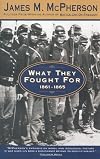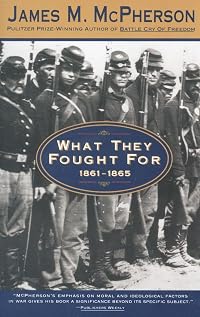
What They Fought For, 1861-1865
by James M. McPherson
Walter Lynwood Fleming Lectures in Southern History (1994)
On This Page
Description
What They Fought For, 1861-1865, by the renowned historian James M. McPherson, is an exceptional discourse on the Civil War, a colloquy among the very men who risked their lives in that conflict. McPherson draws on the letters or diaries of nearly one thousand Union and Confederate soldiers in investigating what motivated those who fought the Civil War. His conclusion that most of them felt a keen sense of patriotic and ideological commitment counters the prevailing belief that Civil War show more soldiers had little or no idea of what they were fighting for. McPherson points out that the armies of the Civil War were the most literate in history up to that time (80 percent of Confederates, 90 percent of white Unionists) and consisted mainly of volunteers rather than draftees or long-service regulars. Moreover, these soldiers lived in the world's most politicized and democratic society, and throughout the conflict they continued to read newspapers, vote in state and national elections, and openly discuss ideological issues. Their letters home were not subject to censorship, nor were the soldiers discouraged from keeping diaries; in both genres, they commented - often with great candor and eloquence - on a wide variety of issues connected with their war experience. What McPherson learned from these writings was that liberty and republicanism formed the ideological core of the cause for which soldiers of both sides fought. Confederates and Unionists alike saw themselves as custodians of the legacy of 1776, and the Civil War as a test of whether they were worthy of the heritage of liberty bequeathed to them by the founding fathers. McPherson first considers the Confederates' articulation of their reasons for fighting, quoting liberally from among the letters and diaries of 374 soldiers. He then uses excerpts from the writings of 562 Union soldiers in describing the range of thought and feeling concerning their part in the war. Finally, he looks at both sides' perceptions of the importance of slavery to the war, including the double paradox of southerners fighting for the freedom to hold slaves while the Emancipation Proclamation caused bitter differences of opinion among northern troops. In What They Fought For, which originated as the fifty-fifth series of Walter Lynwood Fleming Lectures, McPherson has taken individual voices - brave or fearful, resigned or full of hope, merciless or touched with compassion - and placed them in the great and terrible choir of a country divided against itself. The result is both an impressive scholarly tour de force and a lively, highly accessible account of the sentiments of both northern and southern soldiers during the national trauma of the Civil War. show lessTags
Recommendations














Member Reviews
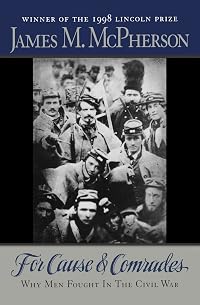
An interesting short read, What They Fought For is the publication of three lectures that later became the larger work, For Cause and Comrades. Having combed through the letters and journals of nearly a thousand Union and Confederate soldiers, McPherson illuminates the ideals and motivations that drove the men into war and hardened their resolve over the years. He explores the themes of patriotism, liberty, slavery, invasion and defense, and the legacy of American Revolution, among others.
McPherson explores the reasons Union soldiers fought, the reasons Confederate soldiers fought, and attitudes of both sides towards slavery. An easy read while still being very informative. A precursor to a longer book titled For Cause and Comrades : Why Men Fought in the Civil War.
Ratings
Members
- Recently Added By
Author Information

67+ Works 16,564 Members
James M. McPherson is the author of Battle Cry of Freedom: The Civil War Era, which won a Pulitzer Prize in history, and For Cause and Comrades: Why Men Fought in the Civil War, a Lincoln Prize winner. He is the George Henry Davis Professor of American History at Princeton University in New Jersey, where he also lives. His newest book, entitled show more Abraham Lincoln, celebrates the 200th anniversary of Lincoln's birth with a short, but detailed look at this president's life. (Bowker Author Biography) James M. McPherson, McPherson was born in 1936 and received a Ph.D. from Johns Hopkins University in 1963. He began teaching at Princeton University in the mid 1960's and is the author of several articles, reviews and essays on the Civil War, specifically focusing on the role of slaves in their own liberation and the activities of the abolitionists. His earliest work, "The Struggle for Equality," studied the activities of the Abolitionist movement following the Emancipation Proclamation. "Battle Cry of Freedom" won the Pulitzer Prize for History in 1989. "Drawn With the Sword" (1996) is a collection of essays, with one entitled "The War that Never Goes Away," that is introduced by a passage from Abraham Lincoln's second inaugural address on March 4, 1865 from which its title came: "Fondly do we hope - and fervently do we pray - that this mighty scourge of war may speedily pass away. Yet, if God wills that it continue, until all the wealth piled by the bond-man's two hundred and fifty years of unrequited toil shall be sunk, and until every drop of blood drawn with the lash, shall be paid by another drawn with the sword, as was said three thousand years ago, so still it must be said, 'the judgments of the Lord, are true and righteous altogether.'" "From Limited to Total War: 1861-1865" shows the depth of the political and social transformation brought about during the Civil War. It told how the human cost of the Civil War exceeded that of any country during World War I and explains the background to Lincoln's announcement of the Emancipation Proclamation, in 1862. The book also recounts the exploits of the Fifty-fourth Massachusetts Volunteer Infantry, one of the first black regiments organized in the Civil War, and their attack on Fort Wagner in July 1863. It pays tribute to Robert Gould Shaw, the white commanding officer of the regiment, who died in the attack and was buried in a mass grave with many of his men. Professor McPherson's writings are not just about the middle decades of the nineteenth century but are also about the last decades of the twentieth century. The political turmoil prior to the Civil War, the violence of the war, Lincoln's legacy and the impeachment of Andrew Johnson shed some light on contemporary events. (Bowker Author Biography) show less
Series

Common Knowledge
- Canonical title
- What They Fought For, 1861-1865
Classifications
- Genres
- Nonfiction, History, General Nonfiction
- DDC/MDS
- 973.711 — History & geography History of North America United States Civil War Era (1857-1865) James Buchanan (1857-1861) Causes
- LCC
- E459 .M24 — History of the United States United States Civil War period, 1861-1865 Lincoln's administrations, 1861-April 15, 1865
- BISAC
Statistics
- Members
- 348
- Popularity
- 90,734
- Reviews
- 2
- Rating
- (3.73)
- Languages
- English
- Media
- Paper, Ebook
- ISBNs
- 4
- ASINs
- 3