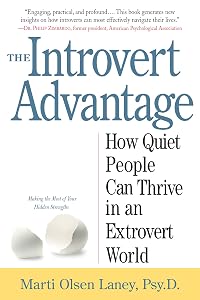
The Introvert Advantage: How to Thrive in an Extrovert World
by Marti Olsen Laney
On This Page
Description
An insightful, empowering guide to making the most of your hidden strengths.Are you energized by spending time alone? In meetings, do you need to be asked for your opinions and ideas? Do you tend to notice details that other people miss? Is your ideal celebration a small get-together rather than a big party? Do you often feel like a tortoise surrounded by hares?
The good news is, you're an introvert. The better news is that by celebrating the inner strengths and uniqueness of being show more introverted, The Introvert Advantage shows introverts how to work with instead of against their temperament to enjoy a well-lived life. Covering relationships, parenting—including parenting an introverted child—socializing, and the workplace, here are coping strategies, tactics for managing energy, and hundreds of valuable tips for not only surviving but truly thriving in an extrovert world.
"Filled with Aha! moments of recognition, Dr. Laney's book will help millions of introverts understand why they are misunderstood, learn to appreciate who they are, and develop a just-right life in a world where extroverts once ruled." —Paul D. Tieger, coauthor of Do What You Are
"In a world of shock jocks, screaming rock stars, and sensational journalism, this book dispels the myth that only the loud and flamboyant get ahead. Its clear, step-by-step advice will help introverts recognize and capitalize on their unique strengths." —Dr. Bernardo J. Carducci, author of Shyness: A Bold New Approach
. show less
Tags
Recommendations










Member Recommendations
Member Reviews
It's hard to believe that there are some non-fiction books that one can simply tear through like a trashy thriller or a novel of mystery and suspense. This is one of them. It's a highly readable look at the world of introverts written by an introvert, and it ably discusses the challenges that introverts face in a society that places a higher value on extroverted qualities (speaking one's mind, doing all sorts of things, being a social butterfly, etc.). The book is divided in three distinct parts. The first defines an introvert and discusses how they are perceived and whether people are born to be introverted or extroverted. The second talks about four different aspects of the extroverted world that pose great challenges for introverts: show more relationships, parenting, socializing, and working. The third discusses how introverts can learn to set their own priorities and parameters in order to feel more comfortable in their own skin, and the last chapter provides techniques on how to become a temporary extrovert when required (as the author points out, you can go right back to being an introvert when you're finished).
I always figured I was an introvert, and indeed I scored on the "Pretty darn introverted" level in the self-assessment found in Chapter 1, but reading this book also made me realize just how far I've come in my life, in terms of social situations especially. (For example, I have mustered up the courage to ask for autographs from musicians I like. A few years ago that would have been unthinkable.) But of course there's always room for improvement, and so I found the chapters on socializing and working to be particularly helpful., especially the sections that talked about speaking one's mind and offering opinions without being prompted. The book is littered with helpful real-life examples of introverts, concrete suggestions for moving forward in one's life, and the tone is friendly without trying too hard to be funny.
This is a worthy addition to an introvert's bookshelves. I borrowed my copy from the library but will likely buy my own for future reference. show less
I always figured I was an introvert, and indeed I scored on the "Pretty darn introverted" level in the self-assessment found in Chapter 1, but reading this book also made me realize just how far I've come in my life, in terms of social situations especially. (For example, I have mustered up the courage to ask for autographs from musicians I like. A few years ago that would have been unthinkable.) But of course there's always room for improvement, and so I found the chapters on socializing and working to be particularly helpful., especially the sections that talked about speaking one's mind and offering opinions without being prompted. The book is littered with helpful real-life examples of introverts, concrete suggestions for moving forward in one's life, and the tone is friendly without trying too hard to be funny.
This is a worthy addition to an introvert's bookshelves. I borrowed my copy from the library but will likely buy my own for future reference. show less
Wow. Just wow.
I learned a lot about how my brain works, specifically how it works differently from extroverted folks' brains. This book is also full of lots of tips on how to thrive and be yourself in our extrovert-biased society. She describes many of the things that are normal for introverts, based just on how our brains are wired - in these descriptions, I found SO MANY things that I've always thought were really, deeply, wrong with me. And hey, look at that. Not wrong with me at all. Normal for an introvert! Similar experience with a lot of her tips. Many (but not all) of the tips are things I've already figured out and have been doing to various degrees for many years. Some of these things, I've always felt like a freak for doing. show more I'm working on changing the way I think about all of this. The way I think about me.
I strongly recommend this book to all of my introverted family and friends. The more introverted you are, the more I recommend it. It might not be a bad read for my extrovert friends, either. Have a peek at what we may not be able to tell you about ourselves. :)
Life-changing. If I can retain it. :) show less
I learned a lot about how my brain works, specifically how it works differently from extroverted folks' brains. This book is also full of lots of tips on how to thrive and be yourself in our extrovert-biased society. She describes many of the things that are normal for introverts, based just on how our brains are wired - in these descriptions, I found SO MANY things that I've always thought were really, deeply, wrong with me. And hey, look at that. Not wrong with me at all. Normal for an introvert! Similar experience with a lot of her tips. Many (but not all) of the tips are things I've already figured out and have been doing to various degrees for many years. Some of these things, I've always felt like a freak for doing. show more I'm working on changing the way I think about all of this. The way I think about me.
I strongly recommend this book to all of my introverted family and friends. The more introverted you are, the more I recommend it. It might not be a bad read for my extrovert friends, either. Have a peek at what we may not be able to tell you about ourselves. :)
Life-changing. If I can retain it. :) show less
There were many things in this book that resonated with me. Living among extroverts, I find myself comparing myself and trying to be like them. Or I find myself feeling guilty for my need to be alone and process life. Yet reading this I realize God has made me a certain way, and that introversion is not a bad thing. There is actually a physiological reality in my brain that makes me the way I am!
Laney gives some practical advice for being an introvert. Some things I have already instinctively learned, but some were new. One of my favorites is strategies for going to a large group gathering such as a party. I recently used her sea urchin strategy when I found myself walking into a party where I knew everyone, but I still had the initial show more pang of anxiety, "where do I start? what do I say?" Instead, I just smiled at my own awkward feelings inside, knowing, "hey this is me" and then I found a good location to sit and just wait for, as Laney describes, the flow of people to come to me. Like an anemone attaches itself on a rock waiting for the current to bring along food, you can plant yourself in location waiting for people you can invite into pleasant, meaningful conversation. What a better way to enjoy talking to friends rather than trying to act like an extrovert, who actually enjoys going from person to person engaging in small talk! (My nightmare!)
I also enjoyed the chapter on the brain. It gives me some comfort to know there is a reason why I can't always think of what to say on the spot, or why I have trouble articulating myself in a moment's notice.
If you feel like you are an introvert (and there is a spectrum from super introversion to a little bit of introversion), this book will be very validating. If you love an introvert, this will help you understand them better. show less
Laney gives some practical advice for being an introvert. Some things I have already instinctively learned, but some were new. One of my favorites is strategies for going to a large group gathering such as a party. I recently used her sea urchin strategy when I found myself walking into a party where I knew everyone, but I still had the initial show more pang of anxiety, "where do I start? what do I say?" Instead, I just smiled at my own awkward feelings inside, knowing, "hey this is me" and then I found a good location to sit and just wait for, as Laney describes, the flow of people to come to me. Like an anemone attaches itself on a rock waiting for the current to bring along food, you can plant yourself in location waiting for people you can invite into pleasant, meaningful conversation. What a better way to enjoy talking to friends rather than trying to act like an extrovert, who actually enjoys going from person to person engaging in small talk! (My nightmare!)
I also enjoyed the chapter on the brain. It gives me some comfort to know there is a reason why I can't always think of what to say on the spot, or why I have trouble articulating myself in a moment's notice.
If you feel like you are an introvert (and there is a spectrum from super introversion to a little bit of introversion), this book will be very validating. If you love an introvert, this will help you understand them better. show less
Both encouraging and frustrating. Good to see Introverts championed, and some interesting examples of possible Introvert problems with suggested solutions, and real life anecdotes.
On the other hand, the author seems to confuse Introversion with the NF (Idealist/catalyst) temperament at times, and some of what is written wouldn't apply at all to - for instance - ISFP or ISTP Introverts.
I'd say five stars for the first half, which looked at Introversion in general, but only three for the second half, where the discussion was more about the INFP personality type - interesting though it was, but confusing to anyone who doesn't know about the Myers-Briggs/Jungian types. So four overall.
Certainly recommended to Extraverts who are show more struggling to understand their Introverted colleagues or loved ones. show less
On the other hand, the author seems to confuse Introversion with the NF (Idealist/catalyst) temperament at times, and some of what is written wouldn't apply at all to - for instance - ISFP or ISTP Introverts.
I'd say five stars for the first half, which looked at Introversion in general, but only three for the second half, where the discussion was more about the INFP personality type - interesting though it was, but confusing to anyone who doesn't know about the Myers-Briggs/Jungian types. So four overall.
Certainly recommended to Extraverts who are show more struggling to understand their Introverted colleagues or loved ones. show less
The Introvert Advantage: How Quiet People Can Thrive in an Extrovert World is written by psychologist Marti Olsen Laney, who is herself an introvert. She observes that we live in a culture that values extroversion, and cites Dr. David Myers, who identified extroversion as a prerequisite trait for happiness in his book The Pursuit of Happiness. So, what is an introvert to do? Being very much an introvert myself, I was curious to find out what the book had to say.
The book begins by describing some of the differences between introverts and extroverts. The major difference being that introverts draw energy from the internal world, while extroverts are externally energized. Introversion is sometimes confused with social anxiety, schizoid show more personality traits, or being a highly sensitive person, but the author outlines how these are all distinct. The author observes that introverts tend to be concerned about how others are impacted by their actions, and may feel guilty that they have mistreated others when in fact they haven’t. They may also tend to think that the things they find bothersome, such as interruptions, are bothersome to everyone.
The book also covers some of the biological differences that may exist between introverts and extroverts, including differences in blood flow patterns in the brain and neurotransmitter activation. The parasympathetic nervous system (responsible for resting and digesting-type activities) appears to be more dominant in introverts.
The second section of the book considers how introverts can adapt in an extroverted world. Suggestions are given for navigating relationships, parenting, socializing, and the work environment. For those who aren’t sure if they are introverted or not, this section may be helpful as it characterizes typical introverted reactions in these types of situations. I found some of the points made in the chapter on work quite interesting. The author says that extroverts need to be told in detail what introverts are doing at work because otherwise they might not think anything is happening. This surprised me, but perhaps it’s because, as an introvert, I’ve simply been missing the boat. The author also suggested that an introvert’s openness to others’ opinions may be misconstrued as a lack of conviction in their own beliefs. Interesting. Other things didn’t ring true for me personally, such a dread of deadlines.
The final section was on “coping with introversion”. The author suggested a 3-P’s approach, involving personal pacing, setting priorities, and setting parameters/boundaries. She characterized introverts as slower-paced and slow-moving, requiring careful pacing to conserve energy. I don’t find that to be a very accurate description of my own particular brand of introversion. She suggested that nurturing was important for an introvert’s delicate nature, and recommended a variety of self-care strategies including scheduling regular rest breaks, increased light exposure, aromatherapy, and exercise. While I’m all for self-care, being an introvert doesn’t necessarily make me a delicate flower (tulip is the specific analogy the author uses). Finally, the author presented strategies for “extroverting”, i.e. behaving in a more extroverted manner.
While the book is pro-introvert, a lot of attention is paid to making oneself extrovert-acceptable. Granted, the title gives fair warning of this, but it felt a bit off to me. There’s a fine lining between adapting to minimize personal distress and changing to be more acceptable to extroverts. While the experience of introverts is validated and strengths are identified such as the ability to reflect, the author also seemed to characterize introverts as fragile, slow, low energy, and not functioning particularly well in the world at large. It seems unlikely that this was the intent, and perhaps my reaction stems from my own decision quite a while ago that I was going to allow myself to be a proud introvert and not “play at” extroversion to suit others’ expectations. Suggesting that introverts are low energy seems to contradict the author’s earlier assertion that introverts simply find energy in different ways than extroverts.
One thing I was quite uncomfortable with was the idea of packing an introvert survival kit, consisting of what sounded like a suitcase-full of items including earplugs, snacks, water, a music player, a note card with an affirmation, a cotton ball with a soothing scent, medication for motion sickness, a parasol/umbrella, sunscreen, hand cream, lip balm, a battery-operated fan, a small spray bottle, a large-brimmed hat, sunglasses, a sweater/blanket, self-heating pocket packs, and earmuffs. To me this verged on insulting; being an introvert doesn’t mean I can’t handle being outside of the house. I carry lip balm around with me, but it has nothing whatsoever to do with my introversion. If anything, this suitcase-load would be more appropriate for when I’m depressed, except then I wouldn’t have the energy to carry it all.
I think this book could be worth a read for anyone who’s introverted and uncomfortable about it or introvert-questioning, so to speak. It offers some practical tips for fitting in with a largely extroverted world. Overall, I found it didn’t really pull me in, and I ended up skimming through some sections. I was glad I picked up a copy from the library rather than buying it.
Originally published on Mental Health at Home
https://mentalhealthathome.org/2018/03/16/book-review-the-introvert-advantage/ show less
The book begins by describing some of the differences between introverts and extroverts. The major difference being that introverts draw energy from the internal world, while extroverts are externally energized. Introversion is sometimes confused with social anxiety, schizoid show more personality traits, or being a highly sensitive person, but the author outlines how these are all distinct. The author observes that introverts tend to be concerned about how others are impacted by their actions, and may feel guilty that they have mistreated others when in fact they haven’t. They may also tend to think that the things they find bothersome, such as interruptions, are bothersome to everyone.
The book also covers some of the biological differences that may exist between introverts and extroverts, including differences in blood flow patterns in the brain and neurotransmitter activation. The parasympathetic nervous system (responsible for resting and digesting-type activities) appears to be more dominant in introverts.
The second section of the book considers how introverts can adapt in an extroverted world. Suggestions are given for navigating relationships, parenting, socializing, and the work environment. For those who aren’t sure if they are introverted or not, this section may be helpful as it characterizes typical introverted reactions in these types of situations. I found some of the points made in the chapter on work quite interesting. The author says that extroverts need to be told in detail what introverts are doing at work because otherwise they might not think anything is happening. This surprised me, but perhaps it’s because, as an introvert, I’ve simply been missing the boat. The author also suggested that an introvert’s openness to others’ opinions may be misconstrued as a lack of conviction in their own beliefs. Interesting. Other things didn’t ring true for me personally, such a dread of deadlines.
The final section was on “coping with introversion”. The author suggested a 3-P’s approach, involving personal pacing, setting priorities, and setting parameters/boundaries. She characterized introverts as slower-paced and slow-moving, requiring careful pacing to conserve energy. I don’t find that to be a very accurate description of my own particular brand of introversion. She suggested that nurturing was important for an introvert’s delicate nature, and recommended a variety of self-care strategies including scheduling regular rest breaks, increased light exposure, aromatherapy, and exercise. While I’m all for self-care, being an introvert doesn’t necessarily make me a delicate flower (tulip is the specific analogy the author uses). Finally, the author presented strategies for “extroverting”, i.e. behaving in a more extroverted manner.
While the book is pro-introvert, a lot of attention is paid to making oneself extrovert-acceptable. Granted, the title gives fair warning of this, but it felt a bit off to me. There’s a fine lining between adapting to minimize personal distress and changing to be more acceptable to extroverts. While the experience of introverts is validated and strengths are identified such as the ability to reflect, the author also seemed to characterize introverts as fragile, slow, low energy, and not functioning particularly well in the world at large. It seems unlikely that this was the intent, and perhaps my reaction stems from my own decision quite a while ago that I was going to allow myself to be a proud introvert and not “play at” extroversion to suit others’ expectations. Suggesting that introverts are low energy seems to contradict the author’s earlier assertion that introverts simply find energy in different ways than extroverts.
One thing I was quite uncomfortable with was the idea of packing an introvert survival kit, consisting of what sounded like a suitcase-full of items including earplugs, snacks, water, a music player, a note card with an affirmation, a cotton ball with a soothing scent, medication for motion sickness, a parasol/umbrella, sunscreen, hand cream, lip balm, a battery-operated fan, a small spray bottle, a large-brimmed hat, sunglasses, a sweater/blanket, self-heating pocket packs, and earmuffs. To me this verged on insulting; being an introvert doesn’t mean I can’t handle being outside of the house. I carry lip balm around with me, but it has nothing whatsoever to do with my introversion. If anything, this suitcase-load would be more appropriate for when I’m depressed, except then I wouldn’t have the energy to carry it all.
I think this book could be worth a read for anyone who’s introverted and uncomfortable about it or introvert-questioning, so to speak. It offers some practical tips for fitting in with a largely extroverted world. Overall, I found it didn’t really pull me in, and I ended up skimming through some sections. I was glad I picked up a copy from the library rather than buying it.
Originally published on Mental Health at Home
https://mentalhealthathome.org/2018/03/16/book-review-the-introvert-advantage/ show less
The title of this book is a tad misleading. While it does a good job of explaining what an introvert is and the way an introvert's mind works, it doesn't necessarily touch on any advantages. If anything, I found it to focus more on shortcomings: introverts have less energy, are more prone to stress and illness, tend to have more sensitive skin, are misunderstood, are less able to cope with things, have stricter parameters, etc.
What I gained most from the book was a clearer understanding of how my brain works. I wish there were more examples of the actual advantages of being an introvert and less of how to cope with being one.
What I gained most from the book was a clearer understanding of how my brain works. I wish there were more examples of the actual advantages of being an introvert and less of how to cope with being one.
This is one of the best books I've ever read. It is page after page of "Ah Ha!" moments. It is healing to find that many of the things that frustrate me about myself, and have previously seemed like unfair short comings, are experienced by other introverts. I feel more at home with myself now, more excepting, and happier to just be me. This is an amazing book. If you are an introvert, you really must read this.
Members
- Recently Added By
Published Reviews
ThingScore 75
If you've been called shy, a shrinking violet, or a wallflower; if your friends tease you about still waters that run deep; or if you feel that you're just not a "people" person, you may find this book very revealing. Dr. Laney, an introvert herself, convincingly explains the reasons for your behavior, and the differences between an introvert (you) and an extrovert (most of the rest of the world).
added by aevaughn
Lists

Psychology: Abuse, Grief, Self-Help
189 works; 1 member
Author Information

4 Works 1,691 Members
Marti Olsen Laney, Psy.D., is a licensed Marriage and Family Therapist. She frequently speaks on the topic of introversion (with plenty of preparation time) and also leads workshops for introverts. She and her husband live in Calabasas, California. (Bowker Author Biography)
Some Editions
Common Knowledge
- Canonical title
- The Introvert Advantage: How to Thrive in an Extrovert World
- Alternate titles
- Introvert Advantage
- Original publication date
- 2002
- People/Characters
- Carl Jung
- Dedication
- Feeling gratitude and not expressing it is like wrapping a gift and not giving it.
—William A. Ward
To my Husband of thirty-eight years, Michael,who dragged me out into extroverting and enlarged my ... (show all)universe. I dedicate this book to you for coaching me to keep breathing through the long labor of the book birthing process. And you are awarded the Highest Medal of Husbandry Honor for devoting so many hours to read page after page about introverts (more than any mortal extrovert should ever have to). Last, but not least, a final thank-you for delivering nourishing meals to me as I sat staring and pecking at my computer.
To my daughters and their families, who I love very much and who have enriched my live in countless ways:
Tynna, Brian, Alicia, and Christopher DeMellier
Kristen, Gary, Kaitlin, and Emily Parks
I also dedicate this book to all my clients who have courageously let me into their lives. - First words
- Growing up, I was often puzzled about myself.
- Last words
- (Click to show. Warning: May contain spoilers.)Remember, let your light shine.
- Blurbers
- Zimbardo, Philip; Tieger, Paul D.; Carducci, Bernardo J.
Classifications
Statistics
- Members
- 1,559
- Popularity
- 14,756
- Reviews
- 27
- Rating
- (3.80)
- Languages
- 9 — Chinese, Danish, Dutch, English, French, German, Japanese, Polish, Portuguese
- Media
- Paper, Audiobook, Ebook
- ISBNs
- 21
- UPCs
- 2
- ASINs
- 7