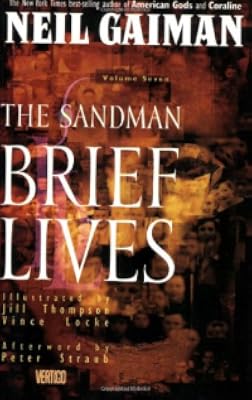
The Sandman: Brief Lives
by Neil Gaiman
The Sandman (07 (Issues 41-49)), The Sandman {1989-1996} (Collections and Selections — TPB, issues 41-49)
On This Page
Description
Older and more powerful than the gods themselves, the Endless are a dysfunctional family of cosmic beings that have ruled over the realms of dream, desire, despair, destiny, destruction, death and delirium since the beginning of time. But three hundred years ago, one of the mythical beings gave up his duties and left his realm, never to be seen again. BRIEF LIVES tells the tales of Delirium and older brother Dream on a mission to find their missing sibling, as they encounter immortal humans show more and various deities while trying to locate the prodigal Destruction. But as their adventure draws Dream into a final, tragic confrontation with his son Orpheus, the eternal being learns the true meaning of fate and consequences. show lessTags
Recommendations

















Member Reviews
It has been mentioned for several books now that there is a missing member of the Endless, who abandoned his post and his responsibilities as overseer of his realm. In Brief Lives, Delirium sets out to search for her missing brother and somehow manages to convince Dream to help her in her quest.
This one is interesting. Gaiman uses a much more straightforward plot to explore the complexities of the endless and put to bed the idea that they are all as one-dimensional as their names and roles might suggest. Delirium, a manic character that I adore for her complete and utter absurdity, was at one time Delight before 'changing,' and now we see Destruction making the case that the Endless have less purpose than they think, as he has been show more absent for 300 years and humans are just as destructive as ever.
The ending of the book has me on edge. Dream is in a mental state we have never seen him before and you get the feeling big things are coming. We are left pondering our fleeting existence, our ever-changing nature, and whether or not there is any real reason for the Endless to exist at all as anything other than sentinels, and we do it with a smile on our face having giggled so much at Delirium's dialogue. show less
This one is interesting. Gaiman uses a much more straightforward plot to explore the complexities of the endless and put to bed the idea that they are all as one-dimensional as their names and roles might suggest. Delirium, a manic character that I adore for her complete and utter absurdity, was at one time Delight before 'changing,' and now we see Destruction making the case that the Endless have less purpose than they think, as he has been show more absent for 300 years and humans are just as destructive as ever.
The ending of the book has me on edge. Dream is in a mental state we have never seen him before and you get the feeling big things are coming. We are left pondering our fleeting existence, our ever-changing nature, and whether or not there is any real reason for the Endless to exist at all as anything other than sentinels, and we do it with a smile on our face having giggled so much at Delirium's dialogue. show less
After spending six volumes establishing the permanence and indispensability of the Endless, Gaiman reverses field in Brief Lives with a story that suggests that the Endless may not be necessary at all, and not being necessary, may not be eternal. The story itself takes the form of a travel tale, with Dream and Delirium setting out on the road (literally) in search of their long lost brother Destruction. Along the way, the pair come across some individuals that we might count as extraordinarily long-lived, but for Dream, Death, and the other Endless, are merely ephemeral beings of minor consequence.
The volume starts and ends with Andros, the patriarch of the family charged by Dream with the task of guarding his son Orpheus' severed but show more immortal head. For him and his clan, their vigil has been interminably long, but it becomes clear that for Dream, their watch has been nothing more than the blink of an eye. The book shifts away from the main story several times to interludes featuring those who walk among mankind living lives that span vast numbers of generations of ordinary people. But as Death remarks when the fifteen thousand year old Bernie Capax finally dies and looks to her for reassurance that he managed to do well by living so long, he only got what everyone else gets - exactly one lifetime. Compared to the supposedly serene and unchanging lives of the Endless, no matter how long a mortal lives, one life is pretty much just as brief as another.
But Dream's journey in this book calls this alleged truth into question. In a moment of odd clarity, Delirium manages to gather her thoughts enough to start trying to seek out the missing member of the Endless, first asking Desire and Despair to help her, and when they refuse her, she turns to Dream for help. Even though she does not expect him to consent to aid her, Dream is in a funk after being dumped by his most recent love, and decides to use the quest to find Destruction as a diversion from his moody misery. And so this odd, but strangely well-matched pair set out on the road in the waking world.
Although Dream is most often matched with Death in the Sandman series, probably as a reference to the Greek myth that posits dreams as the only thing that makes sleep something different than a temporary death, pairing him with Delirium seems to be the natural match-up. The somewhat random free-association that Delirium engages in seems to be very much like the chaotic and bizarre landscape that most people find in their dreams. The two of them together find the mundane waking world to be a strange landscape, and react in very different ways. Dream regards all of those he encounters with disinterest and mild disdain, while Delirium wanders through like a careless child caught up in the excitement of a strange new place. But hidden within their characters is a common callousness, as Dream's concern after the death of their guide Ruby is that some force may be trying to impede their quest rather than remorse for the woman's death, while Delirium's only reaction is the gleeful realization that she will be allowed to drive their car. Later, Delirium's casual cruelty manifests when she off-handedly condemns a police officer who was doing nothing more than his job to a life of torment, an action that Dream does nothing to prevent or ameliorate. To the Endless, mortal lives are of no import.
The key to the story, however, is the mortal characters that populate the story. From the guardian Andros, to the long-lived but ultimately unlucky Capax, to the diminished deities Ferrell and Ishtar, to the ambitious and ill-fated Ruby, to the disembodied Orpheus, and even to the melting chocolate lovers left on Delirium's plate when she decides she isn't hungry, it is the frantic and hurried actions of the mortals that create meaning in the world. And that is the secret that Destruction seems to have discovered, and the truth that Dream knows but does not want to acknowledge - the mortals do not need the Endless, but the Endless need the mortals. Destruction is change, and Dream fears change as evidenced in this volume by his extended brooding over a love-affair gone wrong. Despite this, Dream is forced to acknowledge change, resorting to meeting with his son Orpheus for advice, even after he said he would never see him again.
Ruby, short-lived though she is, serves as a metaphor for the entire book. Despite her very short existence, she is one of the few individuals in the book who express a desire to actually do something more than continue to exist. Despite his fifteen thousand years of life, Capax has left almost no mark on the world. When he senses danger approaching, the Alder Man is content to erase his own existence in order to ensure his personal survival. Ishtar lives on faded memories of a distant past. And so on. Only Ruby wants something more than she has, wants to do something with her life, because she realizes that she only has so much time to accomplish something, and that gives her actions a sense of urgency. Despite her untimely death, she is one of the few characters in the book who seems to have truly lived instead of merely existing.
And this is what Destruction has come to understand - he isn't necessary. Humans can live their lives without the need for him to manifest change and guide their destinies. This reality is what disturbs and unnerves Dream, because if Destruction is not needed for change to happen, then Dream is not needed to make humans dream. Similarly, without Death things would still die, and without Desire, humans would still indulge their passions. But if the Endless are not necessary, that means that they can be eliminated without damaging the fabric of the universe. And this fact serves to turn the entire series upon its head, because it means that the Endless might not be as endless as the reader had been led to believe to this point.
This volume marks an important turn in the Sandman series. Dream ends up killing his own son - at his son's request - but in doing so he finally kills one of his own family members, which is what some of his siblings have been goading him to do in previous stories. We see what Delirium looked like when she was Delight, and combined with the knowledge that what had been described as the responsibilities of the Endless are not so dependent upon the existence of the Endless, the book foreshadows change in the offing. Not only that, but change that Desire, Despair, and even Dream fear. But most of all, as its title implies this volume highlights that it is not the Endless who are the critical forces in the universe, but rather it is those like Andros, whose lifespans are measured in finite numbers of days, months, and years.
This review has also been posted to my blog Dreaming About Other Worlds. show less
The volume starts and ends with Andros, the patriarch of the family charged by Dream with the task of guarding his son Orpheus' severed but show more immortal head. For him and his clan, their vigil has been interminably long, but it becomes clear that for Dream, their watch has been nothing more than the blink of an eye. The book shifts away from the main story several times to interludes featuring those who walk among mankind living lives that span vast numbers of generations of ordinary people. But as Death remarks when the fifteen thousand year old Bernie Capax finally dies and looks to her for reassurance that he managed to do well by living so long, he only got what everyone else gets - exactly one lifetime. Compared to the supposedly serene and unchanging lives of the Endless, no matter how long a mortal lives, one life is pretty much just as brief as another.
But Dream's journey in this book calls this alleged truth into question. In a moment of odd clarity, Delirium manages to gather her thoughts enough to start trying to seek out the missing member of the Endless, first asking Desire and Despair to help her, and when they refuse her, she turns to Dream for help. Even though she does not expect him to consent to aid her, Dream is in a funk after being dumped by his most recent love, and decides to use the quest to find Destruction as a diversion from his moody misery. And so this odd, but strangely well-matched pair set out on the road in the waking world.
Although Dream is most often matched with Death in the Sandman series, probably as a reference to the Greek myth that posits dreams as the only thing that makes sleep something different than a temporary death, pairing him with Delirium seems to be the natural match-up. The somewhat random free-association that Delirium engages in seems to be very much like the chaotic and bizarre landscape that most people find in their dreams. The two of them together find the mundane waking world to be a strange landscape, and react in very different ways. Dream regards all of those he encounters with disinterest and mild disdain, while Delirium wanders through like a careless child caught up in the excitement of a strange new place. But hidden within their characters is a common callousness, as Dream's concern after the death of their guide Ruby is that some force may be trying to impede their quest rather than remorse for the woman's death, while Delirium's only reaction is the gleeful realization that she will be allowed to drive their car. Later, Delirium's casual cruelty manifests when she off-handedly condemns a police officer who was doing nothing more than his job to a life of torment, an action that Dream does nothing to prevent or ameliorate. To the Endless, mortal lives are of no import.
The key to the story, however, is the mortal characters that populate the story. From the guardian Andros, to the long-lived but ultimately unlucky Capax, to the diminished deities Ferrell and Ishtar, to the ambitious and ill-fated Ruby, to the disembodied Orpheus, and even to the melting chocolate lovers left on Delirium's plate when she decides she isn't hungry, it is the frantic and hurried actions of the mortals that create meaning in the world. And that is the secret that Destruction seems to have discovered, and the truth that Dream knows but does not want to acknowledge - the mortals do not need the Endless, but the Endless need the mortals. Destruction is change, and Dream fears change as evidenced in this volume by his extended brooding over a love-affair gone wrong. Despite this, Dream is forced to acknowledge change, resorting to meeting with his son Orpheus for advice, even after he said he would never see him again.
Ruby, short-lived though she is, serves as a metaphor for the entire book. Despite her very short existence, she is one of the few individuals in the book who express a desire to actually do something more than continue to exist. Despite his fifteen thousand years of life, Capax has left almost no mark on the world. When he senses danger approaching, the Alder Man is content to erase his own existence in order to ensure his personal survival. Ishtar lives on faded memories of a distant past. And so on. Only Ruby wants something more than she has, wants to do something with her life, because she realizes that she only has so much time to accomplish something, and that gives her actions a sense of urgency. Despite her untimely death, she is one of the few characters in the book who seems to have truly lived instead of merely existing.
And this is what Destruction has come to understand - he isn't necessary. Humans can live their lives without the need for him to manifest change and guide their destinies. This reality is what disturbs and unnerves Dream, because if Destruction is not needed for change to happen, then Dream is not needed to make humans dream. Similarly, without Death things would still die, and without Desire, humans would still indulge their passions. But if the Endless are not necessary, that means that they can be eliminated without damaging the fabric of the universe. And this fact serves to turn the entire series upon its head, because it means that the Endless might not be as endless as the reader had been led to believe to this point.
This volume marks an important turn in the Sandman series. Dream ends up killing his own son - at his son's request - but in doing so he finally kills one of his own family members, which is what some of his siblings have been goading him to do in previous stories. We see what Delirium looked like when she was Delight, and combined with the knowledge that what had been described as the responsibilities of the Endless are not so dependent upon the existence of the Endless, the book foreshadows change in the offing. Not only that, but change that Desire, Despair, and even Dream fear. But most of all, as its title implies this volume highlights that it is not the Endless who are the critical forces in the universe, but rather it is those like Andros, whose lifespans are measured in finite numbers of days, months, and years.
This review has also been posted to my blog Dreaming About Other Worlds. show less
In this collection, Delirium drives the story. She takes it into her head to go searching for the family's long-lost sibling, Destruction. He departed from them over 300 years ago and Delirium hopes to find him and bring him back. She asks a few of her siblings until she arrives on Dream's doorstep. Dream has been in an emotional funk for awhile following a recent break up, and he reluctantly embraces this quest as a means of distracting himself.
Calling in some favors, Dream and Delirium embark on a cross-country road trip to track down the only leads they have: long-lived people who knew Destruction way back when. Inexplicably, these people begin dying from freak accidents and Dream realizes that there is a type of protective magic show more that is blocking them in their quest. They will have to take stranger paths if they are to find Destruction and learn his reasons for leaving them.
The excellence continues unabated in this volume. show less
Calling in some favors, Dream and Delirium embark on a cross-country road trip to track down the only leads they have: long-lived people who knew Destruction way back when. Inexplicably, these people begin dying from freak accidents and Dream realizes that there is a type of protective magic show more that is blocking them in their quest. They will have to take stranger paths if they are to find Destruction and learn his reasons for leaving them.
The excellence continues unabated in this volume. show less
Tenemos el cambio personificado (o eternificado) en Delirio, anteriormente Delicia. El cambio en Destrucción, el agente del cambio retirado que tampoco ve que su ausencia haya afectado demasiado las cosas. Y algún cambio más gordo se cuece al final, aunque habrá que esperar al siguiente tomo para saber qué es.
El argumento es simple: Delirio quiere encontrar a
Los medios que usan encontrar a Destrucción, de vacaciones en una casita con su sarcástico perro Barnabás, van a traer cola, pues Sueño tuvo que echar mano del oráculo de Orfeo, su hijo, al que abandonó a su suerte tras aquella traumática historia del descenso a los infiernos y tal. Pero bueno, esto tampoco es una sinopsis.
Delirio es la gran protagonista, y en mi opinión sólo Muerte mola más que ella, lo que es mucho decir. Se va por la tangente constantemente, dice insensateces, y es muy chachi en general, aún más cuando recupera momentáneamente la cordura cuando ve a su hermano hundido en la miseria.
En fin, poco más: es un tomo que no hace aguas por ningún sitio (salvo quizá por el hecho de que Sueño y Delirio se empeñan en convertir la búsqueda de Destrucción en una road movie en lugar de usar medios más sobrenaturales) y que nos da todavía más caracterización de personajes, cuenta una historia estupenda, y no hay deus ex machina metidos con calzador. Excelente.
Dream is moping in the wake of his latest break-up, but is willing to temporarily put things aside to accompany his sister in searching for their lost brother Destruction. While our sulky protagonist is convinced that Delirium would soon lose interest in her quest, the increasing number of tragic accidents they encounter on the way, makes him suspicious.
After my numerous grumblings about Dream taking the backseat in the last few volumes, I was delighted to have him center stage once again. Having a family member in tow and more backstory, was just the icing on the cake. Yes, I could now see the merit of Orpheus' story taking up so much space in the previous volume. Not that it makes it any less boring...
There's a whole lot of character show more development to be had, and not just for Dream, who's once again confronted with how much of an arsehole he is. His siblings Delirium and Destruction, and to a lesser degree Despair, also get some rather interesting portrayals. The job responsibility motive is revisited again, this time from a more taboo point of view.
The art style is consistently improving, getting more and more appealing and detailed. I especially enjoyed discovering the various eternal siblings' realms, and finding meaning in their choice of decoration.
Score: 4.4/5 stars
For all my raving about the content, characterization and art, I found the actual reading process a bit tedious. There's a whole lot of world building and self-reflection squeezed into this volume, which at times made things seem a bit overwhelming and had me pause for quite a while after each chapter. Though perhaps that's not such a bad thing...
Like most fantasy lovers, I've also tuned in to watch the recent Netflix adaptation. While I was basking in my withdrawal symptoms, I realized that I didn't in fact need to succumb to them, seeing as I own all volumes of the comic books, and could thus make progress at my own pace. And boy did I love this one! Bring in the next installment!
=============
Review of volume 1: Preludes & Nocturnes
Review of volume 2: The Doll's House
Review of volume 3: Dream Country
Review of volume 4: Season of Mists
Review of volume 5: A Game of You
Review of volume 6: Fables & Reflections
Review of volume 8: World's End show less
After my numerous grumblings about Dream taking the backseat in the last few volumes, I was delighted to have him center stage once again. Having a family member in tow and more backstory, was just the icing on the cake. Yes, I could now see the merit of Orpheus' story taking up so much space in the previous volume. Not that it makes it any less boring...
There's a whole lot of character show more development to be had, and not just for Dream, who's once again confronted with how much of an arsehole he is. His siblings Delirium and Destruction, and to a lesser degree Despair, also get some rather interesting portrayals. The job responsibility motive is revisited again, this time from a more taboo point of view.
The art style is consistently improving, getting more and more appealing and detailed. I especially enjoyed discovering the various eternal siblings' realms, and finding meaning in their choice of decoration.
Score: 4.4/5 stars
For all my raving about the content, characterization and art, I found the actual reading process a bit tedious. There's a whole lot of world building and self-reflection squeezed into this volume, which at times made things seem a bit overwhelming and had me pause for quite a while after each chapter. Though perhaps that's not such a bad thing...
Like most fantasy lovers, I've also tuned in to watch the recent Netflix adaptation. While I was basking in my withdrawal symptoms, I realized that I didn't in fact need to succumb to them, seeing as I own all volumes of the comic books, and could thus make progress at my own pace. And boy did I love this one! Bring in the next installment!
=============
Review of volume 1: Preludes & Nocturnes
Review of volume 2: The Doll's House
Review of volume 3: Dream Country
Review of volume 4: Season of Mists
Review of volume 5: A Game of You
Review of volume 6: Fables & Reflections
Review of volume 8: World's End show less
I know I am sounding like a broken record as I read through this series, raving as I do after each one, but truly, The Sandman Vol 7: Brief Lives is something special. The book tells one story, and what a story. This is a comprehensive look at the dysfunctional family of the Endless as youngest sister, Delirium, approaches her siblings to find someone to accompany her in a search for their missing brother, Destruction. This brother opted to drop out of the family and his responsibilities over 300 years ago. Dream is the only sibling to agree to accompany her. He goes not because he wants to find Destruction, but simply to take his mind off a failed love affair.
My chief delight in this book was the character of Delirium. She brought to show more mind a hyper-active three year old with every thought that goes through her head popping out of her mouth. She is charming, humorous and I imagine rather tiring to be around after a while. And although her thoughts are scattered and seemingly random, every now and again she utters a simple truth with clarity and depth. She was the perfect foil to Dream with her spontaneity and child like wonder against his controlled quietness.
From rundown strip clubs to ancient Greek temples, this story carries you along and all the while you are absorbing Gaiman’s philosophy on life, change and the gods that we hold above all. I have noticed in his work a recurring theme on these patterns of life and what happens to gods when they are no longer needed. Is immortality actually for forever or does it fade in the wake of non-belief.
The Sandman Vol. 7: Brief Lives is quite simply a masterpiece and I can’t even begin to imagine what will follow. But I definitely have my fingers crossed for more Delirium and more Barnabas, another favorite character from this volume. show less
My chief delight in this book was the character of Delirium. She brought to show more mind a hyper-active three year old with every thought that goes through her head popping out of her mouth. She is charming, humorous and I imagine rather tiring to be around after a while. And although her thoughts are scattered and seemingly random, every now and again she utters a simple truth with clarity and depth. She was the perfect foil to Dream with her spontaneity and child like wonder against his controlled quietness.
From rundown strip clubs to ancient Greek temples, this story carries you along and all the while you are absorbing Gaiman’s philosophy on life, change and the gods that we hold above all. I have noticed in his work a recurring theme on these patterns of life and what happens to gods when they are no longer needed. Is immortality actually for forever or does it fade in the wake of non-belief.
The Sandman Vol. 7: Brief Lives is quite simply a masterpiece and I can’t even begin to imagine what will follow. But I definitely have my fingers crossed for more Delirium and more Barnabas, another favorite character from this volume. show less
The Sandman, as written by Neil Gaiman and penciled and inked by a phenomonal cast (Sam Keith, Mike Dringenberg, and so many more) has a justified place in the list of all-time greatest works in comic book history. We can and should revise our assessment of art when the artist has failed us, but the experience of Sandman is a work of many hearts, all of them carrying their own secret pain, and one of them is me.
Members
- Recently Added By
Lists

NPRs your picks: top 100 Sci-Fi/Fantasy books
297 works; 80 members

Best Science Fiction Comics and Graphic Novels
144 works; 11 members

Slipstream or Interstitial Fiction
160 works; 19 members

Best Pern Books
79 works; 11 members

Best Fantasy Novels
821 works; 358 members
Speculative Fiction to Read
706 works; 32 members

Books Read in 2012
816 works; 31 members

Books Read in 2022
5,166 works; 112 members

Books Read in 2023
5,547 works; 145 members

Overdue Podcast
806 works; 9 members
Author Information

Neil Gaiman was born in Portchester, England on November 10, 1960. He worked as a journalist and freelance writer for a time, before deciding to try his hand at comic books. Some of his work has appeared in publications such as Time Out, The Sunday Times, Punch, and The Observer. His first comic endeavor was the graphic novel series The Sandman. show more The series has won every major industry award including nine Will Eisner Comic Industry Awards, three Harvey Awards, and the 1991 World Fantasy Award for best short story, making it the first comic ever to win a literary award. He writes both children and adult books. His adult books include The Ocean at the End of the Lane, which won a British National Book Awards, and the Locus Award for Best Fantasy Novel for 2014; Stardust, which won the Mythopoeic Award as best novel for adults in 1999; American Gods, which won the Hugo, Nebula, Bram Stoker, SFX, and Locus awards; Anansi Boys; Trigger Warning: Short Fictions and Disturbances; and The View from the Cheap Seats: Selected Nonfiction, which is a New York Times Bestseller. His children's books include The Day I Swapped My Dad for Two Goldfish; Coraline, which won the Elizabeth Burr/Worzalla, the BSFA, the Hugo, the Nebula, and the Bram Stoker awards; The Wolves in the Walls; Odd and the Frost Giants; The Graveyard Book, which won the Newbery Award in 2009 and The Sandman: Overture which won the 2016 Hugo Awards Best Graphic Story. (Bowker Author Biography) show less
All Editions
Awards and Honors
Notable Lists
Series

The Sandman
11 works (07 (Issues 41-49))

The Sandman {1989-1996}
76 works (Collections and Selections — TPB, issues 41-49)
Belongs to Publisher Series
Work Relationships
Is contained in
Contains
Has as a reference guide/companion
Has as a supplement
Common Knowledge
- Canonical title
- The Sandman: Brief Lives
- Alternate titles
- The Sandman Vol. 07: Brief Lives; The Sandman: Brief Lives, Volume Seven; The Sandman: Brief Lives, Vol. 7
- Original publication date
- 1994-06-28
- People/Characters
- Etain of the second look; Ishtar (deity); Orpheus; Delirium of the Endless; Desire of the Endless; Destruction of the Endless (show all 13); Dream; Andros; Ruby; Death of the Endless; Barnabas [Sandman]; Lucien [Sandman]; Morpheus
- Important places
- Greece; London, England, UK; The Dreaming; Destiny's Garden
- Epigraph
- As he laye unravelling in the agonie of death, the Standers-by could hear him say softly, I have seen the Glories of the world.
john aubrey
the minutes of lives - Dedication
- for Bob and Allison on the occasion of their engagement
Pete and Dana on the occasion of their wedding.
Beth and Chris, on the occasion of my dedicating a book to them.
Neil
for Basil
jill t.
to Mom ... (show all)and Dad for their encouragement and support
and to Khrysta for helping me through the rough times.
vince - First words
- It is, of course, a miracle.
- Quotations
- The priests of Orpheus have had thousands of years to learn the art of misdirection.
I know how gods begin, Roger. We start as dreams. Then we walk out of dreams into the land. We are worshipped and loved, and take power to ourselves. And then one day there's no one left to worship us.
And in the end, each... (show all) little god and goddess takes its last journey back into dreams...and what comes after, not even we knows. - Last words
- (Click to show. Warning: May contain spoilers.)It is going to be a beautiful day.
- Publisher's editor
- Berger, Karen
- Original language
- English US
Classifications
- Genres
- Graphic Novels & Comics, Fiction and Literature, Horror
- DDC/MDS
- 741.5973 — Arts & recreation Drawing & decorative arts Drawing Comic books, graphic novels, fotonovelas, cartoons, caricatures, comic strips History, geographic treatment, biography North American United States (General)
- LCC
- PN6728 .S26 .G35 — Language and Literature Literature (General) Literature (General) Collections of general literature Comic books, strips, etc.
- BISAC
Statistics
- Members
- 5,780
- Popularity
- 2,251
- Reviews
- 78
- Rating
- (4.46)
- Languages
- 11 — Czech, English, Finnish, French, German, Italian, Polish, Russian, Spanish, Turkish, Portuguese (Portugal)
- Media
- Paper, Ebook
- ISBNs
- 37
- UPCs
- 1
- ASINs
- 15