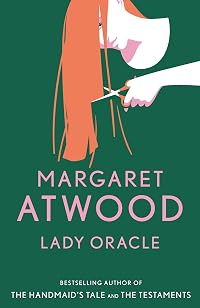
Lady Oracle
by Margaret Atwood
On This Page
Description
Joan Foster is the bored wife of a myopic ban-the-bomber. She takes off overnight as Canada's new superpoet, pens lurid gothics on the sly, attracts a blackmailing reporter, skids cheerfully in and out of menacing plots, hair-raising traps, and passionate trysts, and lands dead and well in Terremoto, Italy. In this remarkable, poetic, and magical novel, Margaret Atwood proves yet again why she is considered to be one of the most important and accomplished writers of our time.Tags
Recommendations











Member Recommendations

Member Reviews
While Margaret Atwood of the middle period (1986-2000) is one of my favourite writers, her novels written in the 21st century have been very disappointing. Finally, I get to meet a younger Margaret, and here she appears quite distinct from the two incarnations I am familiar with.
In Lady Oracle the tone is much lighter than in her major works, irony and humour take the upper hand, the darkness is kind of present yet unimportant. What matters is a struggle of a girl/woman in a society, where her place is neatly assigned to her and where she fails to fit. Together with the author we laugh at that silly woman but laugh even more at the men around her, who always seem to know exactly what she represents and how to treat her, while in show more reality they have no clue.
It's a bit unfortunate that Margaret does not know yet where to take her story and her protagonist. But give her time - another ten years and she will have figured it out. show less
In Lady Oracle the tone is much lighter than in her major works, irony and humour take the upper hand, the darkness is kind of present yet unimportant. What matters is a struggle of a girl/woman in a society, where her place is neatly assigned to her and where she fails to fit. Together with the author we laugh at that silly woman but laugh even more at the men around her, who always seem to know exactly what she represents and how to treat her, while in show more reality they have no clue.
It's a bit unfortunate that Margaret does not know yet where to take her story and her protagonist. But give her time - another ten years and she will have figured it out. show less
I've had dreams like this - when the doctor had me on opiates. The main character has a disfunctional life, as in many Atwoods, but this time she seems to call most of it on herself. She makes her way through a web of varying fictions, until it is unclear whether the main story of her life is another fiction she is telling, or a fiction she is living.
I wasn't really sure I would love this book until the very last page. I mean, it's Atwood, and I've loved Atwood in the past, but it's been a while since I've read anything by her. Really, quite a while. Maybe college? But I'd had a flurry of love for her then, collecting several of her books and dutifully moving them from house to house as I moved on to other literary loves. But then, after Aurororama, I was looking for some new fiction to read. And I have a fiction problem. Have I told you? Jessa and I used to keep each other in balance. She would read mostly fiction and I read mostly non-fiction and we would recommend the gems we found along the way. Now she's on Berlin and we rarely chat and I don't know how to find new fiction on show more my own! So I was skulking about my bookcases, trying to find an antidote to my growing irritation with two-dimensional representations of women all around me and... of course. Atwood.
So, Lady Oracle it was. Atwood would be perfect for taking women seriously, only her character, Joan Foster, doesn't take herself terribly seriously. In fact, she is sometimes unrelatable, a few times nearly unlikeable, but there is a bit of a mystery, in that the book starts with Joan reminiscing on her faking her own death. The book is her examination of her life -- how did it come to this? Where could she possibly go from here? Her memories are juxtaposed with excerpts from her books -- Joan is a writer, primarily of bodice-rippers. In a strange way it suddenly reminds me of 1982, Janine, by Alasdair Gray, one of my favorite novels, in that both use fantasy to reveal character, and both fantasies begin to fall apart as the dreamers confront themselves and their need for the dreams.
Then in the end things fall apart so rapidly and completely that I am sure I was cringing as I read, envisioning no possibility for anything resembling a reasonable, let alone happy, ending. But, without saying how it ends, it somehow achieved a sudden clarity, and that last paragraph I could kiss Atwood for -- it is surely one of my favorite last lines of all time. show less
So, Lady Oracle it was. Atwood would be perfect for taking women seriously, only her character, Joan Foster, doesn't take herself terribly seriously. In fact, she is sometimes unrelatable, a few times nearly unlikeable, but there is a bit of a mystery, in that the book starts with Joan reminiscing on her faking her own death. The book is her examination of her life -- how did it come to this? Where could she possibly go from here? Her memories are juxtaposed with excerpts from her books -- Joan is a writer, primarily of bodice-rippers. In a strange way it suddenly reminds me of 1982, Janine, by Alasdair Gray, one of my favorite novels, in that both use fantasy to reveal character, and both fantasies begin to fall apart as the dreamers confront themselves and their need for the dreams.
Then in the end things fall apart so rapidly and completely that I am sure I was cringing as I read, envisioning no possibility for anything resembling a reasonable, let alone happy, ending. But, without saying how it ends, it somehow achieved a sudden clarity, and that last paragraph I could kiss Atwood for -- it is surely one of my favorite last lines of all time. show less
An irresistibly compelling storyline, with poignant flashbacks into the past - a girl growing up in a disturbing household, with a domineering mother and aloof father, making her turn to food for escape and all the nasty experiences that go with it - and then the unexpected and well-desired actual escape to a new life, first abroad, then back in Canada, a change of identity, dealing with weird acquaintances/partners, finding love (or resemblance of it), discovering a talent she didn't know she had, and then another, forced, escape... all this with a master touch of an accomplished author (even at the start of her novel writing!), a quality that makes you want to read on and on, enjoying the flow of the narration, with unexpected twists show more and turns, to the utmost. My only mini-grudge is with the ending, I wanted it more explicit. But otherwise, quite a read... and quite an imagination! show less
Margaret Atwood’s Lady Oracle tells the story of Joan Foster, an author who finds success rather unintentionally, by way of a book named Lady Oracle: she has been writing pulp Gothic romances under an assumed name, but hides this fact from everyone she knows.
The underlying theme of this novel, as far as I could tell, is identity. Joan is searching for hers, and ultimately rubs it out in order to survive. Then the other main characters too seem to have at least two identities, as Joan herself points out. She is a clumsy, somewhat endearing, humorous, childish woman whose one great motivation in life is ‘escape’.
The one grand success of Joan Foster’s life- her bestselling book- is unintentional, as are most of her life’s show more choices and consequences. Her ultimate choice to fake her own death seems childish, but wholely typical of her- even the ending suggests a familiarity, as though we are now so accustomed to Joan’s character that this ending seems fitting.
The novel provides some characteristically sharp and poignant insights into a woman’s self-image issues in terms of obesity. There is also a fraught and sharply-etched relationship with her mother and her girlhood companions.(The snowy ravine incident is almost identical to one from Atwood’s Cat’s Eye- hmmm.) The extremely vivid dream imagery and story-within-story method is also familiar because of Atwood’s other works. The writing is in itself excellent; none of the characters except Aunt Lou are particularly likeable, yet the layers of identity and the underlying humor, deceit, tenderness and need for validation kept me engaged.
Atwood writes with a piquancy that comes from a doubtless razor-sharp mind, one that is unhesitating in drawing out the cruelties faced by women, and in Lady Oracle, overweight women in particular. It is also interesting to come across nuggets like ‘girls didn’t wear slacks to school in those days’ and comments about her cooking - these seem anachronistic on the surface but are essentially still true if one thinks through the layers.
I didn’t enjoy this book as much as some of Atwood’s others, but it’s still a book worth reading. She is a writer of consequence, one that I admire for intellect and intensity. show less
The underlying theme of this novel, as far as I could tell, is identity. Joan is searching for hers, and ultimately rubs it out in order to survive. Then the other main characters too seem to have at least two identities, as Joan herself points out. She is a clumsy, somewhat endearing, humorous, childish woman whose one great motivation in life is ‘escape’.
The one grand success of Joan Foster’s life- her bestselling book- is unintentional, as are most of her life’s show more choices and consequences. Her ultimate choice to fake her own death seems childish, but wholely typical of her- even the ending suggests a familiarity, as though we are now so accustomed to Joan’s character that this ending seems fitting.
The novel provides some characteristically sharp and poignant insights into a woman’s self-image issues in terms of obesity. There is also a fraught and sharply-etched relationship with her mother and her girlhood companions.(The snowy ravine incident is almost identical to one from Atwood’s Cat’s Eye- hmmm.) The extremely vivid dream imagery and story-within-story method is also familiar because of Atwood’s other works. The writing is in itself excellent; none of the characters except Aunt Lou are particularly likeable, yet the layers of identity and the underlying humor, deceit, tenderness and need for validation kept me engaged.
Atwood writes with a piquancy that comes from a doubtless razor-sharp mind, one that is unhesitating in drawing out the cruelties faced by women, and in Lady Oracle, overweight women in particular. It is also interesting to come across nuggets like ‘girls didn’t wear slacks to school in those days’ and comments about her cooking - these seem anachronistic on the surface but are essentially still true if one thinks through the layers.
I didn’t enjoy this book as much as some of Atwood’s others, but it’s still a book worth reading. She is a writer of consequence, one that I admire for intellect and intensity. show less
A very strong Atwood novel, about a woman who finds her power only after she gains a lot of weight, and then loses the weight and keeps the power. Possibly not nutritionally correct by today's standards (I read it in the 80's), but it's a strong, affecting read. It made me love Atwood, and made me realize she wasn't just a histrionic proto-feminist.
This is not really a review - more a collection of thoughts about this beguiling and bewildering (at times) novel of identity, gender, and the manufacture of stories. I'm not sure I got everything there is to get out of this early Atwood work, but I did enjoy it.
Identity: Atwood plays with notions of identity and self. Some are hidden, others doubled, often misread and misunderstood. Joan Foster, the protagonist, doesn't seem to know herself for much of the book, but she knows that the person she sees reflected by the people around her is not who she is. "But hadn't my life always been double? There was always that shadowy twin, thin when I was fat, fat when I was thin, myself in silvery negative, with dark teeth and shining white show more pupils glowing in the black sunlight of that other world." (page 246)
Role of women: Joan "fails" in the traditional roles of women - daughter, mistress, wife. But what she fails at is to live up to the traditional notions of what these things are. She's ashamed of her secret role as the author of Gothic romances but she also feels like a fraud as a much-hailed author of feminist poetry. She wants a "normal" life and what is wrong with that? But, also, what IS a normal life?
Politics: This novel is quite funny, especially when Atwood pokes fun at radical politics and the people who espouse whatever radical philosophy is currently in vogue. Nationalism, communism, feminism, Fascism - it's all fair game when so much of it is empty rhetoric and blind allegiance.
Romance: Joan makes a living producing romance novels, the embodiment of traditional ideas of love stories and fairy tales. And she seems to yearn for this kind of dramatic, sweep-you-off-your-feet relationship and is willing to make all sorts of compromises to have even a hint of it ("...he had gone to a lot of trouble to find me. He'd walked at least three blocks in the rain: that meant dedication of a sort." (page 196)) She has a vivid imagination and loves the grand gesture, but also keeps these feelings hidden because they do not conform to the contemporary feminist ideal.
I don't know enough about feminist theory and gender politics to do much of this justice. Lady Oracle can be read quite easily and only as a novel about a woman searching for herself but there are also a lot of layers to be explored. I can see this work as being worthy of a re-read, as well as the spark to a lot of fascinating conversation.
"For a while I wanted to be an opera singer... Unfortunately I couldn't sing. But it always appealed to me: to be able to stand up there in front of everyone and shriek as loud as you could, about hatred and love and rage and despair, scream at the top of your lungs and have it come out music. That would be something." (page 78) show less
Identity: Atwood plays with notions of identity and self. Some are hidden, others doubled, often misread and misunderstood. Joan Foster, the protagonist, doesn't seem to know herself for much of the book, but she knows that the person she sees reflected by the people around her is not who she is. "But hadn't my life always been double? There was always that shadowy twin, thin when I was fat, fat when I was thin, myself in silvery negative, with dark teeth and shining white show more pupils glowing in the black sunlight of that other world." (page 246)
Role of women: Joan "fails" in the traditional roles of women - daughter, mistress, wife. But what she fails at is to live up to the traditional notions of what these things are. She's ashamed of her secret role as the author of Gothic romances but she also feels like a fraud as a much-hailed author of feminist poetry. She wants a "normal" life and what is wrong with that? But, also, what IS a normal life?
Politics: This novel is quite funny, especially when Atwood pokes fun at radical politics and the people who espouse whatever radical philosophy is currently in vogue. Nationalism, communism, feminism, Fascism - it's all fair game when so much of it is empty rhetoric and blind allegiance.
Romance: Joan makes a living producing romance novels, the embodiment of traditional ideas of love stories and fairy tales. And she seems to yearn for this kind of dramatic, sweep-you-off-your-feet relationship and is willing to make all sorts of compromises to have even a hint of it ("...he had gone to a lot of trouble to find me. He'd walked at least three blocks in the rain: that meant dedication of a sort." (page 196)) She has a vivid imagination and loves the grand gesture, but also keeps these feelings hidden because they do not conform to the contemporary feminist ideal.
I don't know enough about feminist theory and gender politics to do much of this justice. Lady Oracle can be read quite easily and only as a novel about a woman searching for herself but there are also a lot of layers to be explored. I can see this work as being worthy of a re-read, as well as the spark to a lot of fascinating conversation.
"For a while I wanted to be an opera singer... Unfortunately I couldn't sing. But it always appealed to me: to be able to stand up there in front of everyone and shriek as loud as you could, about hatred and love and rage and despair, scream at the top of your lungs and have it come out music. That would be something." (page 78) show less
Members
- Recently Added By
Published Reviews
ThingScore 75
Atwoodové román se odehrává v druhé polovině 20. století a politicky odráží zejména existenci západních levicových hnutí. Sama Atwoodová se aktivně hlásí k levici a patří k propagátorům ekologického života. V očích Joan jde ale o bezzubé bojůvky, kterým přes velkolepé ideály chybí konkrétní cíl i prostředky.
added by _eskarina
Bohatý děj doplňuje neodolatelný atwoodovský humor a samozřejmě i ironický feminismus. Její hrdinka se sice motá v začarovaném kruhu, své konání ale reflektuje s dokonalým odstupem: Joan se snaží řídit svůj vlastní život jako život svých romantických románových hrdinek, ale vůbec se jí to nedaří, život se jí vymyká z rukou. Každá další maska je jen show more komplikací, z níž už není cesty zpět. Snad jen ta schopnost nadhledu ji ještě drží nad vodou. A že se nedočkáme laciného happyendu, jaký by nechyběl v Joaniných románcích, či naopak nějaké konečné tragédie, je nasnadě. show less
added by _eskarina
Které já však v závěru vítězí, není vůbec jasné. Joan se v Itálii místo pocitu osvobození zmocní paranoia a fikce se životem se jí promíchá natolik, že ve snaze uchopit život do vlastních rukou praští flaškou naprosto nevinného chlápka.
added by _eskarina
Lists

20th Century Literature
1,161 works; 54 members

Female Author
1,235 works; 67 members

Female Friendship
54 works; 12 members

Most Frequently Tagged "Read in 2015"
70 works; 1 member

Books tagged "feel good"
129 works; 20 members

Swinging Seventies
255 works; 18 members

Reading Glasses Podcast
410 works; 3 members
Author Information

283+ Works 198,870 Members
Margaret Atwood was born on November 18, 1939 in Ottawa, Canada. She received a B.A. from Victoria College, University of Toronto in 1961 and an M.A. from Radcliff College in 1962. Her first book of verse, Double Persephone, was published in 1961 and was awarded the E. J. Pratt Medal. She has published numerous books of poetry, novels, story show more collections, critical work, juvenile work, and radio and teleplays. Her works include The Journals of Susanna Moodie, Power Politics, Cat's Eye, The Robber Bride, Morning in the Buried House, the MaddAdam trilogy, and The Heart Goes Last. She has won numerous awards including the Prince of Asturias Award for Literature, the Booker Prize in 2000 for The Blind Assassin, the Giller Prize and the Premio Mondello for Alias Grace, and the Governor General's Award in 1966 for The Circle Game and in 1986 for The Handmaid's Tale, which also won the very first Arthur C. Clarke Award in 1987. She won the PEN Pinter prize in 2016 for her political activism. She was awarded the 2016 PEN Pinter Prize for the outstanding literary merit of her body of work. (Bowker Author Biography) show less
Some Editions
Awards and Honors
Series
Belongs to Publisher Series
Work Relationships
Common Knowledge
- Canonical title
- Lady Oracle
- Original title
- Lady Oracle
- Original publication date
- 1976
- People/Characters
- Joan Foster (Lady Oracle | Louisa K Delacourt); Arthur; The Royal Porcupine (Chuck Brewer); Paul (Mavis Quilp); Leda Sprott (Reverend Eunice P. Revele); Felicia (show all 7); Redmond
- Important places
- Rome, Italy; Toronto, Ontario, Canada
- First words
- I planned my death carefully; unlike my life, which meandered along from one thing to another, despite my feeble attempts to control it.
- Last words
- (Click to show. Warning: May contain spoilers.)It did make a mess; but then, I don't think I'll ever be a very tidy person.
- Original language
- English
Classifications
Statistics
- Members
- 3,209
- Popularity
- 5,375
- Reviews
- 50
- Rating
- (3.59)
- Languages
- 13 — Czech, Danish, English, Estonian, Finnish, French, German, Italian, Norwegian (Bokmål), Polish, Portuguese, Spanish, Swedish
- Media
- Paper, Audiobook, Ebook
- ISBNs
- 62
- ASINs
- 23