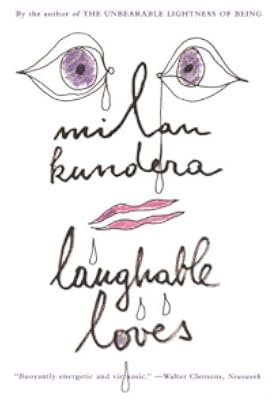
Laughable Loves
by Milan Kundera
On This Page
Description
Milan Kundera is a master of graceful illusion and illuminating surprise. In one of these stories a young man and his girlfriend pretend that she is a stranger he picked up on the road--only to become strangers to each other in reality as their game proceeds. In another a teacher fakes piety in order to seduce a devout girl, then jilts her and yearns for God. In yet another girls wait in bars, on beaches, and on station platforms for the same lover, a middle-aged Don Juan who has gone home show more to his wife. Games, fantasies, and schemes abound in all the stories while different characters react in varying ways to the sudden release of erotic impulses. show lessTags
Recommendations










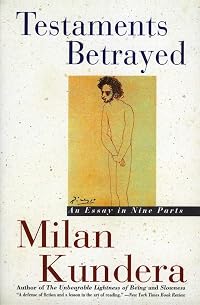




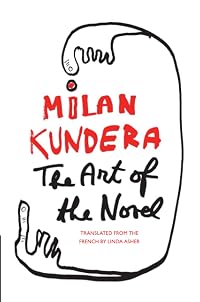

Member Reviews
Not my favorite book by Milan Kundera, but it has its moments. I like the following description of how much of the idea of the loved is a creation of the lover and the shock of having that construction adjusted:
87 "It was as if he were looking at two images through the same lens, at two images superimposed one upon the other with the one showing over the other. These two images showing through each other were telling him that everything was in the girl, that her soul was terrifyingly amorphous, that it held faithfulness and unfaithfulness, treachery and innocence, flirtatiousness and chastity. The disorderly jumble seemed disgusting to him, like the variety to be found in a pile of garbage. ...The impression that certain outlines show more delineated her as an individual was only a delusion to which the other person, the one looking was subject - namely himself. It seemed to him that the girl that he loved was a creation of his desire, his thoughts, and his faith and that the real girl now standing in front of him was hopelessly alien, hopelessly ambiguous."
And a couple of satisfying bites:
120 "unsatisfied women always bring bad luck"
24 "The past of each of us can just as easily be arranged into the biography of a beloved statesman as into that of a criminal....isolated facts...in the light of today's offense...suddenly unite into a totality of significant testimony" show less
87 "It was as if he were looking at two images through the same lens, at two images superimposed one upon the other with the one showing over the other. These two images showing through each other were telling him that everything was in the girl, that her soul was terrifyingly amorphous, that it held faithfulness and unfaithfulness, treachery and innocence, flirtatiousness and chastity. The disorderly jumble seemed disgusting to him, like the variety to be found in a pile of garbage. ...The impression that certain outlines show more delineated her as an individual was only a delusion to which the other person, the one looking was subject - namely himself. It seemed to him that the girl that he loved was a creation of his desire, his thoughts, and his faith and that the real girl now standing in front of him was hopelessly alien, hopelessly ambiguous."
And a couple of satisfying bites:
120 "unsatisfied women always bring bad luck"
24 "The past of each of us can just as easily be arranged into the biography of a beloved statesman as into that of a criminal....isolated facts...in the light of today's offense...suddenly unite into a totality of significant testimony" show less
I just came across this collection of short stories, and as a devoted Kundera fan, I quickly devoured it amidst Christmas preparations, letter writings and other more dreary readings. And what a delight! This is early Bohemian Kundera, written while he still lived in then Czechoslovakia, and it is quite evident that he has not yet matured into the thoroughly seasoned writer that produced masterpieces such as "Life is Elsewhere", "The Unbearable Lightness of Being" and "Immortality". However, this is unmistakenly literary genius in the making, and the mood throughout is simply captivating.
The themes all deal with aspects of human sexuality - mostly from a Man's view. The stories have a raw sense of humanity to them - sometimes it can be show more uncomfortable reading; however, it has an undeniably tender undercurrent. Even when a character behaves despicably, I remained sympathtic with the human behind the actions. It just feels irresistably honest, and it is quite easy to get seduced by such well-portrayed human complexities.
Among my favorite stories were "The Old Dead Must Make Room for the New Dead", which portrays the dilemma of whether to preserve a diffuse, but beatiful sensual memory or replace it with a graphic, but uglier version that will ultimately erase the former. "Edward and God" is another gem that deals with sexual longing and the fickleness of Religion (Atheism is cleverly presented just as irrational in its dogmatisms as Christianity).
Finally "The Hitchhiking Game" is a classic portrayal of how easily perceptions can be irreversibly altered.
I highly recommend this short-story collection; however, if you are reading Milan Kundera for the first time, I am tempted to recommened one of his more famous works... show less
The themes all deal with aspects of human sexuality - mostly from a Man's view. The stories have a raw sense of humanity to them - sometimes it can be show more uncomfortable reading; however, it has an undeniably tender undercurrent. Even when a character behaves despicably, I remained sympathtic with the human behind the actions. It just feels irresistably honest, and it is quite easy to get seduced by such well-portrayed human complexities.
Among my favorite stories were "The Old Dead Must Make Room for the New Dead", which portrays the dilemma of whether to preserve a diffuse, but beatiful sensual memory or replace it with a graphic, but uglier version that will ultimately erase the former. "Edward and God" is another gem that deals with sexual longing and the fickleness of Religion (Atheism is cleverly presented just as irrational in its dogmatisms as Christianity).
Finally "The Hitchhiking Game" is a classic portrayal of how easily perceptions can be irreversibly altered.
I highly recommend this short-story collection; however, if you are reading Milan Kundera for the first time, I am tempted to recommened one of his more famous works... show less
I remember reading this in the early nineties and feeling that it didn't have the resonance that the novels did, but today, I appreciate some of these much more. A little Kundera (at times) goes a longer way than a lot of Kundera.
It's been many many years since I read any Kundera, and many many years since this original Writers from the Other Europe edition landed on my TBR. I remember really liking the works by Kundera I read back in the 80s?/90s, but I had mixed feelings about this early volume of short stories, all focused on the sexual games people play. Some I found disturbing, such as "The Hitchhiking Game," in which a role-playing game goes a little too psychologically far, "Let the Old Dead Make Way for the New Dead," in which the lead male character ponders whether it's better to have a delightful memory or a less delightful reality, and "Symposium," a multi-voiced tale with some largely thoughtless cruelty. Some I found playful and thought-provoking, show more such as "Nobody Will Laugh," about a man who starts out playing a largely innocent joke which then spirals out of control, "Doctor Havel in Ten Years," which shows how our state of mind can affect reality, and "Edward and God," which satirizes both religion and atheism while showing what happens to a character who pretends belief to get a girl. The only one that I found both fun and charming, and my favorite (maybe because of the mood I'm in!) was "The Golden Apple of Continuing Desire," in which the chase is all.
In these stories, Kundera explores not only the largely male sexual psyche but also the implications of playing jokes or pretending to be someone else, probing identity. That's the part I appreciated. I also can't help but feel that some of the obsession of the characters with chasing (and getting) women helps relieve some of the political repression they are subject too (although this is almost, but not entirely, off stage in these stories). Of course Kundera has always focused on sex, mixed with philosophy, which I guess makes the sex high-minded. I think what I'm saying is that I liked Kundera better when I was younger. show less
In these stories, Kundera explores not only the largely male sexual psyche but also the implications of playing jokes or pretending to be someone else, probing identity. That's the part I appreciated. I also can't help but feel that some of the obsession of the characters with chasing (and getting) women helps relieve some of the political repression they are subject too (although this is almost, but not entirely, off stage in these stories). Of course Kundera has always focused on sex, mixed with philosophy, which I guess makes the sex high-minded. I think what I'm saying is that I liked Kundera better when I was younger. show less
absoluut boeiend, originele beschouwingen op religie, verantwoordelijkheid, relaties met mensen, relaties met dieren. Origineel geschreven ook wel. Maar hij perst al zijn gefilosofeer in de sexuele toestanden, op een gegeven moment ben je daar wel klaar mee
This collection of short stories was my introduction to Kundera, one of the authors and thinkers about whom I’ve heard so much but whose work I hadn’t yet managed to read. Many people say that Kundera likes to use his stories as backdrops for his philosophical musings, so short stories are much more suited to this aim than novel-length work where he can over-indulge and go on for too long.
The first two stories in the collection were not an auspicious start to my first Kundera experience. One of the stories focuses on a guy whose practical joke, if you will, goes a bit awry, and the other one introduces us to a man and an older woman who meet on the street years after their one-time fling. I liked nothing about them. The language show more seemed automaton-like, unnatural and not poetic at all. The stories themselves didn’t seem to have much of a point and were boring. I couldn’t detect any sharp psychological analysis that people kept saying Kundera was known for.
The only reason I kept on reading instead of abandoning it was because it moved fairly quickly, and I held out hope that maybe the other stories would be better. Good thing I did so. Starting with the third story and onward to the last one, the stories seemed to liven up for me. I’m not sure if this was because I gradually got used to Kundera’s style; maybe it really did just have to do with how specific stories resonated more with me. Sure, the language was still pretty average, but the ideas behind the stories tickled my brain and I found myself flipping page after page, smiling as each character demonstrated their foibles, played mind games on each other for kicks, deluded themselves away from certain truths, or awakened to how the effects of aging were disrupting their sense of self. Kundera is able to articulate/capture people’s psyche in such a precise way that a light bulb kept going off in my head.
So in the end, enjoying five out of seven stories is a pretty good record for a short story collection. Overall though, if this is indicative of Kundera’s style, then my reading preferences and his style aren’t quite a good fit. But I’m glad that I dipped into a bit of his work at least. show less
The first two stories in the collection were not an auspicious start to my first Kundera experience. One of the stories focuses on a guy whose practical joke, if you will, goes a bit awry, and the other one introduces us to a man and an older woman who meet on the street years after their one-time fling. I liked nothing about them. The language show more seemed automaton-like, unnatural and not poetic at all. The stories themselves didn’t seem to have much of a point and were boring. I couldn’t detect any sharp psychological analysis that people kept saying Kundera was known for.
The only reason I kept on reading instead of abandoning it was because it moved fairly quickly, and I held out hope that maybe the other stories would be better. Good thing I did so. Starting with the third story and onward to the last one, the stories seemed to liven up for me. I’m not sure if this was because I gradually got used to Kundera’s style; maybe it really did just have to do with how specific stories resonated more with me. Sure, the language was still pretty average, but the ideas behind the stories tickled my brain and I found myself flipping page after page, smiling as each character demonstrated their foibles, played mind games on each other for kicks, deluded themselves away from certain truths, or awakened to how the effects of aging were disrupting their sense of self. Kundera is able to articulate/capture people’s psyche in such a precise way that a light bulb kept going off in my head.
So in the end, enjoying five out of seven stories is a pretty good record for a short story collection. Overall though, if this is indicative of Kundera’s style, then my reading preferences and his style aren’t quite a good fit. But I’m glad that I dipped into a bit of his work at least. show less
these short stories were overall not as special as i remember unbearable lightness of being was. the stories were okay and there was some clever dialogue and some clever philosophical discussions. the prominence of sex seemed somewhat unrealistic, and i did not care for how many of the women were portrayed. the editing of the book was poor and did not add to its understanding. this may be enough kundera for me.
Members
- Recently Added By
Author Information

53+ Works 61,371 Members
One of the foremost contemporary Czech writers, Kundera is a novelist, poet, and playwright. His play The Keeper of the Keys, produced in Czechoslovakia in 1962, has long been performed in a dozen countries. His first novel, The Joke (1967), is a biting satire on the political atmosphere in Czechoslovakia in the 1950s. It tells the story of a show more young Communist whose life is ruined because of a minor indiscretion: writing a postcard to his girlfriend in which he mocks her political fervor.The Joke has been translated into a dozen languages and was made into a film, which Kundera wrote and directed. His novel Life Is Elsewhere won the 1973 Prix de Medicis for the best foreign novel. Kundera has been living in France since 1975. His books, for a long time suppressed in his native country, are once again published.The Unbearable Lightness of Being (1984), won him international fame and was a successful English-language film. In this work Kundera moves toward more universal and philosophically tinged themes, thus transforming himself from a political dissident into a writer of international significance. (Bowker Author Biography) show less
Some Editions
Awards and Honors
Distinctions
Series
Belongs to Publisher Series
Work Relationships
Common Knowledge
- Canonical title
- Laughable Loves
- Original title
- Smesné Lásky
- Original publication date
- 1968
- First words
- The needle on the gas gauge suddenly dipped toward empty and the young driver of the sports car declared that it was maddening how much gas the car ate up.
- Last words
- (Click to show. Warning: May contain spoilers.)Houd hem alstublieft altijd in uw herinnering met deze glimlach.
(Click to show. Warning: May contain spoilers.)Please, keep him in your memory with this smile. - Original language
- Czech
Classifications
- Genres
- General Fiction, Fiction and Literature
- DDC/MDS
- 891.86354 — Literature & rhetoric Literatures of other languages East Indo-European and Celtic literatures West and South Slavic languages (Bulgarian, Slovene, Polish, Czech, Slovak, Serbo-Croatian, and Macedonian) Czech Czech fiction 1900–1989 Late 20th century 1945–1989
- LCC
- PG5039.21 .U6 .S58413 — Language and Literature Slavic languages and literatures. Baltic languages. Albanian language Slavic. Baltic. Albanian Slavic Czech
- BISAC
Statistics
- Members
- 3,175
- Popularity
- 5,461
- Reviews
- 21
- Rating
- (3.74)
- Languages
- 28 — Arabic, Catalan, Chinese, Czech, Danish, Dutch, English, Estonian, Finnish, French, German, Greek, Hebrew, Hungarian, Icelandic, Italian, Japanese, Lithuanian, Norwegian (Bokmål), Polish, Portuguese, Romanian, Russian, Serbian, Croatian, Spanish, Swedish, Turkish
- Media
- Paper, Audiobook, Ebook
- ISBNs
- 110
- ASINs
- 24