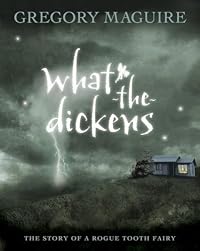
What-the-Dickens: The Story of a Rogue Tooth Fairy
by Gregory Maguire
On This Page
Description
As a terrible storm rages, ten-year-old Dinah and her brother and sister listen to their cousin Gage's tale of a newly-hatched, orphaned, skibberee, or tooth fairy, called What-the-Dickens, who hopes to find a home among the skibbereen tribe, if only he can stay out of trouble.Tags
Recommendations


Member Reviews
Firstly, I'll just say that I am a HUGE fan of Gregory Maguire. He is so inventive and capable of turning stories I think I know so well into something completely new and exciting. This is the second book by him that I've read that isn't based on a classic fairy/folk tale, the first being The Next Queen of Heaven, which I enjoyed but it certainly didn't hold the same appeal as his other books.
What-the-Dickens, however, captured me from the very beginning and never failed. Except that I didn't want it to end! It's a story within a story and both are perfectly wonderful. Dinah and Gage are each wonderful characters and the tenderness with which Gage relates the story of What-the-Dickens, the rouge tooth fairy, is heart-melting. The show more internal story, of the tooth fairies, is so creative and spellbinding that I was begging for more right along with little Dinah.
This would be a great book to read aloud with older children or to enjoy for yourself. Highly recommended.
http://www.librarything.com/topic/130721#3161152 show less
What-the-Dickens, however, captured me from the very beginning and never failed. Except that I didn't want it to end! It's a story within a story and both are perfectly wonderful. Dinah and Gage are each wonderful characters and the tenderness with which Gage relates the story of What-the-Dickens, the rouge tooth fairy, is heart-melting. The show more internal story, of the tooth fairies, is so creative and spellbinding that I was begging for more right along with little Dinah.
This would be a great book to read aloud with older children or to enjoy for yourself. Highly recommended.
http://www.librarything.com/topic/130721#3161152 show less
I finished reading this book a couple of weeks ago and I'm still thinking about it...which is usually a good sign.
First, let me reacknowledge that Maguire is not for everyone. This book continues that trend.
The overall concept sounds fairly airy and fun but at its heart, it's a lot darker than you might imagine.
There are two story threads going on throughout the novel and each one is very intriguing. The threads sometimes intertwine and even when they don't directly touch, you find yourself wondering about the balance between the two.
The story arc of the fairy creatures is highly imaginative and really a lot of fun. The reader is placed directly alongside other characters in the novel who are "hearing" the fairy tale at the same time show more that we're reading it. This juxtaposition of character and reader truly helps bring the reader into the second story arc and relate to the turmoil going on.
The second story arc, that of the children in the midst of a violent storm, is not entirely spelled out and leaves a lot to the reader's insight and imagination. I really enjoyed this aspect of the novel...the fact that Maguire trusts his readers to be smart enough to read between the line and to develop the characters and situations of the "real world" rather than rely on him to spell out every little detail.
The themes of hope, imagination and a world spoiled by adult influence are all presented very well. But it never feels like Maguire is preaching to us or standing on a soap box condemning the adults and unimaginative pessimists of the world. Rather, he is exploring the hopes and dreams of children even within bleak circumstances.
This isn't a fairy tale you should read when you're looking for a pick-me-up, but it's definitely something I'd recommend to those looking for a thought provoking story and entertaining writing. show less
First, let me reacknowledge that Maguire is not for everyone. This book continues that trend.
The overall concept sounds fairly airy and fun but at its heart, it's a lot darker than you might imagine.
There are two story threads going on throughout the novel and each one is very intriguing. The threads sometimes intertwine and even when they don't directly touch, you find yourself wondering about the balance between the two.
The story arc of the fairy creatures is highly imaginative and really a lot of fun. The reader is placed directly alongside other characters in the novel who are "hearing" the fairy tale at the same time show more that we're reading it. This juxtaposition of character and reader truly helps bring the reader into the second story arc and relate to the turmoil going on.
The second story arc, that of the children in the midst of a violent storm, is not entirely spelled out and leaves a lot to the reader's insight and imagination. I really enjoyed this aspect of the novel...the fact that Maguire trusts his readers to be smart enough to read between the line and to develop the characters and situations of the "real world" rather than rely on him to spell out every little detail.
The themes of hope, imagination and a world spoiled by adult influence are all presented very well. But it never feels like Maguire is preaching to us or standing on a soap box condemning the adults and unimaginative pessimists of the world. Rather, he is exploring the hopes and dreams of children even within bleak circumstances.
This isn't a fairy tale you should read when you're looking for a pick-me-up, but it's definitely something I'd recommend to those looking for a thought provoking story and entertaining writing. show less
It was a dark and stormy night...Mom and Dad are missing, leaving Dinah, Zeke, and Rebecca Ruth in the care of their older English teacher cousin. He helps pass away the time by telling them of his encounters with one poor orphaned tooth fairy.
This very clever take on what happens when myth meets reality is challenging enough for young but advanced readers and fantastical enough for just about any age.
A fun aside...I had just put my book down when my son came to me to show me his very first lost tooth, or rather, it's gap. He lost his tooth at school. I told him to write a letter to the Tooth Fairy, the entire time thinking 'I know Pepper and What the Dickens wouldn't accept a note in place of an actual tooth.' Maguire's story telling show more is that good. show less
This very clever take on what happens when myth meets reality is challenging enough for young but advanced readers and fantastical enough for just about any age.
A fun aside...I had just put my book down when my son came to me to show me his very first lost tooth, or rather, it's gap. He lost his tooth at school. I told him to write a letter to the Tooth Fairy, the entire time thinking 'I know Pepper and What the Dickens wouldn't accept a note in place of an actual tooth.' Maguire's story telling show more is that good. show less
Maguire is truly a brilliant author. The story of a rogue tooth fairy name What-The-Dickens. While this sounds like it would be a lighthearted story, it dives into deeper aspects. This novel portrays the importance of always being curious and asking questions, the bravery it takes to go against authoritarian figures, the need for imagination to hope for a better world. Gregory Maguire trusts his readers to be able to read between the lines and dive to find deeper meaning. I believe this story is marketed for a younger audience, but the language in it makes it that a younger audience may not have the ability to fully understand. This is surely a novel that I will be thinking about for days and/or weeks to come.
"The possibility of wishing strengthens the imagination to consider, at times, that things could improve. Could be different. They could. They might."
How did I end up here, again? Another fantastic premise; another letdown. At this point, I only have myself to blame.
A story within a story. The origin of tooth fairies. An orphan. A cat named McCavity. All of this should've been a home run. Unfortunately, the kids read like adults and the "fairies" read like workers after six straight 12-hour days at a 19th century factory.
For example, Dinah is a homeschooled ten-year-old. "Ten, and in some ways, a youngish ten, because her family lived remotely." Yet, here's how Dinah talked:
"Dinah didn't plan to say what she said next; it just came out. show more 'You were asleep, and you jumped so fast for the phone. You were hoping that phone was for you,' she observed. 'You want someone to care about what's happening to you, too--not just to us. Don't you.'"
Or, how about:
"'That's the grown-up you talking now,' said Dinah, as politely as she could. 'I don't want that part, all the shiny meaning polished up all obvious and sound-bitey, just so I can get it. Save that for Zeke. Me, I just want to find out what happened to the two skibbereen.'"
Keep in mind the Ormsbys have had no Internet. No TV. "They kept themselves apart--literally. They sequestered themselves... perched at the uphill end of the canyon... They were trying the experiment of living by gospel standards... The Ormsby family made its home a citadel against the alluring nearby world..."
Finally, there was the questionable allusions/ references. Don't get me wrong, I'm all about broadening kids' horizons, but One Hundred Years of Solitude, really? In a book that classifies itself as "Age 9 and Up"...
Maguire's stories pose, quite possibly, the greatest conundrum in my (reading) life. And, after I wrote my initial response to What-the-Dickens, I realized it'd morphed into something more than a review, so I decided to move that longer response to my blog.
2.5 stars
(One star for the idea, one star for the descriptions of McCavity, and half a star because I finished the book.) show less
How did I end up here, again? Another fantastic premise; another letdown. At this point, I only have myself to blame.
A story within a story. The origin of tooth fairies. An orphan. A cat named McCavity. All of this should've been a home run. Unfortunately, the kids read like adults and the "fairies" read like workers after six straight 12-hour days at a 19th century factory.
For example, Dinah is a homeschooled ten-year-old. "Ten, and in some ways, a youngish ten, because her family lived remotely." Yet, here's how Dinah talked:
"Dinah didn't plan to say what she said next; it just came out. show more 'You were asleep, and you jumped so fast for the phone. You were hoping that phone was for you,' she observed. 'You want someone to care about what's happening to you, too--not just to us. Don't you.'"
Or, how about:
"'That's the grown-up you talking now,' said Dinah, as politely as she could. 'I don't want that part, all the shiny meaning polished up all obvious and sound-bitey, just so I can get it. Save that for Zeke. Me, I just want to find out what happened to the two skibbereen.'"
Keep in mind the Ormsbys have had no Internet. No TV. "They kept themselves apart--literally. They sequestered themselves... perched at the uphill end of the canyon... They were trying the experiment of living by gospel standards... The Ormsby family made its home a citadel against the alluring nearby world..."
Finally, there was the questionable allusions/ references. Don't get me wrong, I'm all about broadening kids' horizons, but One Hundred Years of Solitude, really? In a book that classifies itself as "Age 9 and Up"...
Maguire's stories pose, quite possibly, the greatest conundrum in my (reading) life. And, after I wrote my initial response to What-the-Dickens, I realized it'd morphed into something more than a review, so I decided to move that longer response to my blog.
2.5 stars
(One star for the idea, one star for the descriptions of McCavity, and half a star because I finished the book.) show less
Charming. That’s the word that comes to my mind even though it sounds trite. This is a charming fable.
Told intriguingly as a tale within a tale about wee fantastical humanoids called “skibberdees” who turn out to be what we would call “tooth fairies” which was derived from a mishearing of “not true fritillary.”
Maguire does seem to have a gift with fairy tales. I began caring about the stories and the characters just a few pages in and by the time i was done, i wanted more of this world and these characters.
Told intriguingly as a tale within a tale about wee fantastical humanoids called “skibberdees” who turn out to be what we would call “tooth fairies” which was derived from a mishearing of “not true fritillary.”
Maguire does seem to have a gift with fairy tales. I began caring about the stories and the characters just a few pages in and by the time i was done, i wanted more of this world and these characters.
A terrible storm is raging, and Dinah is huddled by candlelight with her brother, sister, and cousin Gage, who is telling a very unusual tale. It’s the story of What-the-Dickens, a newly hatched orphan creature who finds he has an attraction to teeth, a crush on a cat named McCavity, and a penchant for getting into trouble. One day he happens upon a feisty girl skibberee working as an Agent of Change — trading coins for teeth — and learns of a dutiful tribe of tooth fairies to which he hopes to belong. As his tale unfolds, however, both What-the-Dickens and Dinah come to see that the world is both richer and far less sure than they ever imagined.
Members
- Recently Added By
Published Reviews
"A winner for Maguire's fans of all ages."
added by Awesomeness1
"This story contains a certain creepiness, an element that seems to thrill."
added by Awesomeness1
"Gregory Maguire does for the dark and stormy night what he did for the witches in WICKED."
added by Awesomeness1
Lists

Disasters in Fiction
3 works; 1 member
Author Information

68+ Works 80,017 Members
Gregory Maguire was born June 9, 1954 in Albany, New York. He received a B.A. from the State University of New York at Albany and a Ph.D. in English and American literature from Tufts University. He is a founder and co-director of Children's Literature New England, Incorporated, a non-profit educational charity established in 1987. He writes for show more both adults and children. His first book, The Lighting Time, was published in 1978. His adult works include Wicked, Confessions of and Ugly Stepsister, Lost, Mirror Mirror, Son of a Witch, and A Lion Among Men. The Broadway play Wicked is based on his book of the same title. His children's books include the picture book Crabby Cratchitt, the novel The Good Liar, and the Hamlet Chronicles series. (Bowker Author Biography) show less
Work Relationships
Is contained in
Common Knowledge
- Original publication date
- 2007
- People/Characters
- Dinah; Zeke; Gage; Rebecca Ruth; What-the-Dickens (fictitious creature); Pepper (fictitious creature) (show all 10); Old Flossie (fictitious creature); Dr. Ill (fictitious creature); McCavity (cat); Sylviana (fictitious creature)
- Epigraph
- It is equal to living in a tragic land
To live in a tragic time.
- Wallace Stevens, "Dry Loaf"
We live in the most brightly illuminated of dark ages.
- Paul Heins, in conversation - Dedication
- For the tempest-tossed: past, present, and to come
- First words
- By evening, when the winds rose yet again, the power began to stutter at half-strength, and the sirens to fail.
- Last words
- (Click to show. Warning: May contain spoilers.)They would have to wait and see what came true.
Classifications
Statistics
- Members
- 1,706
- Popularity
- 12,933
- Reviews
- 46
- Rating
- (3.23)
- Languages
- English, Russian
- Media
- Paper, Audiobook, Ebook
- ISBNs
- 15
- ASINs
- 8