On This Page
Description
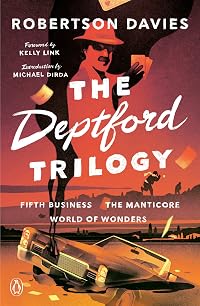
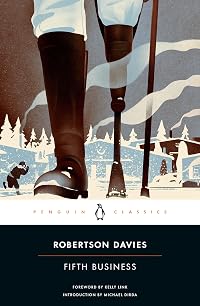
Fifth Business Ramsay is a man twice born, a man who has returned from the hell of the battle-grave at Passchendaele in World War I decorated with the Victoria Cross and destined to be caught in a no man's land where memory, history, and myth collide. As Ramsay tells his story, it begins to seem that from boyhood, he has exerted a perhaps mystical, perhaps pernicious, influence on those around him. His apparently innocent involvement in such innocuous events as the throwing of a snowball or show more the teaching of card tricks to a small boy in the end prove neither innocent nor innocuous. Fifth Business stands alone as a remarkable story told by a rational man who discovers that the marvelous is only another aspect of the real. The Manticore Around a mysterious death is woven a glittering, fantastical, cunningly contrived trilogy of novels. Luring the reader down labyrinthine tunnels of myth, history and magic, THE DEPTFORD TRILOGY provides an exhilarating antidote to a world from where 'the fear and dread and splendour of wonder have been banished'. World of Wonders This is the third novel in Davies's major work, The Deptford Trilogy. This novel tells the life story of the unfortunate boy introduced in The Fifth Business, who was spirited away from his Canadian home by one of the members of a traveling side show, the Wanless World of Wonders. show lessTags
Recommendations














Member Recommendations
by sombrio


Member Reviews
One of my very favorites and I can't quite say why--as with many of my favorite novels. Davies was a bigger believer in Jung than I am, but he certainly makes a good case for his thinking . . . and he certainly understands people really well--their petty motives for doing big things, for instance. I read this just as I moved to the northern part of the US, and I heard a lot of strong echoes of the place where I lived in the rural and urban Canada depicted here, so maybe I'm a bit prone to overrating these novels, but I urge you to dip in and see for yourself. Davies was a master.
I don't like to be prescriptive, but I do like it when literature has the readability one might associate with more middlebrow works of popular fiction. But that's just a question of bias and narrow experience. Most of my reading is middlebrow, and I cleave to it precisely because it tends to be the home of that quality of readability one craves in one's books. But why shouldn't works of literature have that quality? The people who write them are usually very, very good at what they do. More challenging works, like Ulysses, or Gravity's Rainbow or Infinite Jest tower like behemoths over everything else, blotting out the fact that a lot of literature is written to be enjoyed as an experience; more ambitious, perhaps, in terms of human show more enrichment and intellectual engagement, but fundamentally, enjoyably readable.
All of which is to say, it's nice to be reminded by someone like Robertson Davies that literature can be as readable as a thriller. Or, more accurately perhaps, that thrillers derive much of their readability from the work done in literature.
This strange, entrancing epic of Jungian archetypes loose in the first half of the 20th century begins with spiteful snowball, a premature birth, a mother damaged to the point of disgrace or sainthood and a man raised in a cloying religious community who rejects religion but not spirituality and devotes much of his life to the legends of saints and sainthood. There is a sort of lifelong friendship with the snowball-thrower and involvement with the damaged woman who he comes to regard as a saint and her long-vanished son encountered by chance in the Swiss Tyrol. It's a cunning and enthralling tale that unfolds wonderfully through the narrator's life, full of incident and adventures physical, spiritual and personal, not to mention cast of characters drawn with skill and humour and insight that is both clear-eyed as it is humane.
The Manticore begins where Fifth Business suddenly and dramatically ends, David Staunton, drunk but highly eminent lawyer, flies to Switzerland on the verge of collapse and embarks on an intense and protracted period of Jungian analysis, exploring his childhood and background, some of which has already been glimpsed in Fifth Business, and his troubled relationship with his family, most particularly his father. It is a life laid bare, the traumas and woundings and treatment that created the damaged and troubled man.
Where The Manticore shoots off from the end of Fifth Business, World Of Wonder sets out from the beginning, the terrible fate of Paul Dempster and his long, lonely, squalid and horrific journey to fame and success. Dempster embodies the Jungian Shadow. His lack of education frees him from a certain type of intellectual constraint and prejudice, opening him to a vivid, primitive powerful mode of perception. Raped and kidnapped, his childhood is spent in a carnival and in cheap vaudeville. His talent for sleight of hand illusions and mechanisms is fostered in miserably darkness, but he survives, tough and raw and auto-didactic, he is a dark mirror to David in The Manticore.
What to make of the whole thing? People are the centres of their own stories. One's actions resound and affect the lives of others for good or evil, and one has little control over which. Religion is corrupt and stifling but spirtuality is necessary for a full understanding of life, and that spirituality takes many forms and comes with its own dangers. A rich, heady, humane trilogy, and a masterpiece of 20th century literature. show less
All of which is to say, it's nice to be reminded by someone like Robertson Davies that literature can be as readable as a thriller. Or, more accurately perhaps, that thrillers derive much of their readability from the work done in literature.
This strange, entrancing epic of Jungian archetypes loose in the first half of the 20th century begins with spiteful snowball, a premature birth, a mother damaged to the point of disgrace or sainthood and a man raised in a cloying religious community who rejects religion but not spirituality and devotes much of his life to the legends of saints and sainthood. There is a sort of lifelong friendship with the snowball-thrower and involvement with the damaged woman who he comes to regard as a saint and her long-vanished son encountered by chance in the Swiss Tyrol. It's a cunning and enthralling tale that unfolds wonderfully through the narrator's life, full of incident and adventures physical, spiritual and personal, not to mention cast of characters drawn with skill and humour and insight that is both clear-eyed as it is humane.
The Manticore begins where Fifth Business suddenly and dramatically ends, David Staunton, drunk but highly eminent lawyer, flies to Switzerland on the verge of collapse and embarks on an intense and protracted period of Jungian analysis, exploring his childhood and background, some of which has already been glimpsed in Fifth Business, and his troubled relationship with his family, most particularly his father. It is a life laid bare, the traumas and woundings and treatment that created the damaged and troubled man.
Where The Manticore shoots off from the end of Fifth Business, World Of Wonder sets out from the beginning, the terrible fate of Paul Dempster and his long, lonely, squalid and horrific journey to fame and success. Dempster embodies the Jungian Shadow. His lack of education frees him from a certain type of intellectual constraint and prejudice, opening him to a vivid, primitive powerful mode of perception. Raped and kidnapped, his childhood is spent in a carnival and in cheap vaudeville. His talent for sleight of hand illusions and mechanisms is fostered in miserably darkness, but he survives, tough and raw and auto-didactic, he is a dark mirror to David in The Manticore.
What to make of the whole thing? People are the centres of their own stories. One's actions resound and affect the lives of others for good or evil, and one has little control over which. Religion is corrupt and stifling but spirtuality is necessary for a full understanding of life, and that spirituality takes many forms and comes with its own dangers. A rich, heady, humane trilogy, and a masterpiece of 20th century literature. show less
The Deptford Trilogy is my favourite book of all time. Davies weaves reality with myth, creating a world that feels both real and unreal at the same time and makes us question what we think we know about the world. All three books in the trilogy - Fifth Business, The Manticore, and World of Wonders - can be read indepentently but when read as a trilogy the pieces slide together and create an even fuller and more dramatic tale.
Fifth Business: Eight year old Dunstable Ramsey is having a dispute with his friend Boy Staunton when a frustrated Boy throws a stone-laden snowball at his friend's back. Ramsey ducks the snowball and it hits a heavily-pregnant Mrs. Dempster in the head, distroying her mind, bringing about the premature birth of show more Paul Dempster, and forever altering the lives of Ramsey and Boy. This amazing novel traces the lives of these two men from small town Canada to the killing fields of World War I and from the bawdy theatres of early 20th century South America to the business world of the burgeoning young city of Toronto, displaying the reprecussions of a single, careless act.
The Manticore: This is the most cerebral of the three novels. Boy Staunton's son, David, has grown to manhood with a law degree, a love-hate relationship with his father, and a drinking problem. He also has a deep conviction that his father's accidental death was no accident. After creating a scene and breaking down in open court, he is convinced to try a new cure for alcoholism in Europe which includes Jungian psychotherapy. A strangely soulful tale about the destructive forces within a family, making peace with the past, and forgiving our parents for not being the people we needed them to be.
World of Wonders: Davies fills in the missing years of the life of Paul Dempster and describes his self-made metamorphosis from a troubled boy into the theatrical genius known as Magnus Eisengrim. The most colourful and disturbing book of the trilogy, it is a lesson in becoming who we choose to be and embracing life as it is, rather than as we wish it was. show less
Fifth Business: Eight year old Dunstable Ramsey is having a dispute with his friend Boy Staunton when a frustrated Boy throws a stone-laden snowball at his friend's back. Ramsey ducks the snowball and it hits a heavily-pregnant Mrs. Dempster in the head, distroying her mind, bringing about the premature birth of show more Paul Dempster, and forever altering the lives of Ramsey and Boy. This amazing novel traces the lives of these two men from small town Canada to the killing fields of World War I and from the bawdy theatres of early 20th century South America to the business world of the burgeoning young city of Toronto, displaying the reprecussions of a single, careless act.
The Manticore: This is the most cerebral of the three novels. Boy Staunton's son, David, has grown to manhood with a law degree, a love-hate relationship with his father, and a drinking problem. He also has a deep conviction that his father's accidental death was no accident. After creating a scene and breaking down in open court, he is convinced to try a new cure for alcoholism in Europe which includes Jungian psychotherapy. A strangely soulful tale about the destructive forces within a family, making peace with the past, and forgiving our parents for not being the people we needed them to be.
World of Wonders: Davies fills in the missing years of the life of Paul Dempster and describes his self-made metamorphosis from a troubled boy into the theatrical genius known as Magnus Eisengrim. The most colourful and disturbing book of the trilogy, it is a lesson in becoming who we choose to be and embracing life as it is, rather than as we wish it was. show less
My first experience of Robertson Davies: very impressive. A bit like a less flashy version of Anthony Burgess: the author's games with myth, Jung, and the nature of stories are all buried within a conventional narrative framework that would be strong enough to carry any reader along by itself. Just occasionally there's a whiff of the seminar room, but Davies protects himself from getting too academic by sending up his pedantic narrator, Ramsay.
I read the omnibus edition of the trilogy.
The Deptford Trilogy is an excellent 500-page book imbedded in a more-than-800-page mediocrity.
Ostensibly, the trilogy is a history about however many people from the same small Canadian town (Deptford), which ultimately revolves around uncovering the truth about the murder (or suicide) of (Percy Boyd) Boy Staunton, wealthy sugar entrepreneur, political aspirant and indefatigable womanizer. The three parts of the trilogy are told from the perspectives of Staunton's childhood frienemy Dunstable (later, "Dunstan") Ramsay, David Staunton - Boy's son, and Magnus Eisengrim (nee Paul Dempster).
I do not think much of the work. The first part (Fifth Business) starts with great promise: Ramsay narrates, show more and draws the reader into the book effectively, reminiscing about a fight between him and Boy as 10-year-olds. The fight ends with Boy throwing a snowball (in which Boy had imbedded a large rock) at Ramsay, which Ramsay ducks, whereupon the snowball catches pregnant Mrs. Dempster in the back of the head. This causes Mrs. Dempster to go into labor; it also somewhat damages her mind.
A son is born to the Dempsters, and is named Paul. Ramsay takes it upon himself to attend to the needs of Paul and his mother, and does so actively until Paul's father (a fire-and-brimstone minister) catches Ramsay teaching Paul card tricks. For his part, Boy does not accept responsibility for his act; Ramsay lives with the guilt for the remainder of his life.
In The Manticore, narration is by Boy's son David. Boy was found in his car after having driven at high speed off a pier and into a lake. In his mouth was found the same rock he had put in the snowball he threw at Mrs. Dempster. David believes his father was murdered, but the official finding is suicide.
The third part of the trilogy (Worlds of Wonder) is told (for the most part) from the perspective of Magnus Eisengrim, a name assumed by Paul Dempster after he runs away from home. It does give an account of Paul's life, although - to be honest - by the time the reader gets to the third part, there's really little that needs to be added.
On the whole, the trilogy is full of promise, and the first book almost delivers on its promises ... but not quite. By the end of the second book a very good story has been told, although there are a few missing pieces. Any hopes that the third book would resolve everything, however, are ill-founded. Book three is almost a perfect waste of space.
To my mind, the third book simply underlines and writes in boldface problems that plague the entire trilogy: the work is at root pompous, pretentious, prolixity. This is especially true of book three. From start to finish, Worlds of Wonder is a contrivance. It serves no function that couldn't have been served by a 100-page synopsis. Take that, and remove the excess verbiage from the first two books, and you would have a 500-page incredibly entertaining book. As it is, I felt that I had been thoroughly abused by the time I finished the third book.
If you really want to enjoy the Deptford series, read the first two books and leave it at that. show less
The Deptford Trilogy is an excellent 500-page book imbedded in a more-than-800-page mediocrity.
Ostensibly, the trilogy is a history about however many people from the same small Canadian town (Deptford), which ultimately revolves around uncovering the truth about the murder (or suicide) of (Percy Boyd) Boy Staunton, wealthy sugar entrepreneur, political aspirant and indefatigable womanizer. The three parts of the trilogy are told from the perspectives of Staunton's childhood frienemy Dunstable (later, "Dunstan") Ramsay, David Staunton - Boy's son, and Magnus Eisengrim (nee Paul Dempster).
I do not think much of the work. The first part (Fifth Business) starts with great promise: Ramsay narrates, show more and draws the reader into the book effectively, reminiscing about a fight between him and Boy as 10-year-olds. The fight ends with Boy throwing a snowball (in which Boy had imbedded a large rock) at Ramsay, which Ramsay ducks, whereupon the snowball catches pregnant Mrs. Dempster in the back of the head. This causes Mrs. Dempster to go into labor; it also somewhat damages her mind.
A son is born to the Dempsters, and is named Paul. Ramsay takes it upon himself to attend to the needs of Paul and his mother, and does so actively until Paul's father (a fire-and-brimstone minister) catches Ramsay teaching Paul card tricks. For his part, Boy does not accept responsibility for his act; Ramsay lives with the guilt for the remainder of his life.
In The Manticore, narration is by Boy's son David. Boy was found in his car after having driven at high speed off a pier and into a lake. In his mouth was found the same rock he had put in the snowball he threw at Mrs. Dempster. David believes his father was murdered, but the official finding is suicide.
The third part of the trilogy (Worlds of Wonder) is told (for the most part) from the perspective of Magnus Eisengrim, a name assumed by Paul Dempster after he runs away from home. It does give an account of Paul's life, although - to be honest - by the time the reader gets to the third part, there's really little that needs to be added.
On the whole, the trilogy is full of promise, and the first book almost delivers on its promises ... but not quite. By the end of the second book a very good story has been told, although there are a few missing pieces. Any hopes that the third book would resolve everything, however, are ill-founded. Book three is almost a perfect waste of space.
To my mind, the third book simply underlines and writes in boldface problems that plague the entire trilogy: the work is at root pompous, pretentious, prolixity. This is especially true of book three. From start to finish, Worlds of Wonder is a contrivance. It serves no function that couldn't have been served by a 100-page synopsis. Take that, and remove the excess verbiage from the first two books, and you would have a 500-page incredibly entertaining book. As it is, I felt that I had been thoroughly abused by the time I finished the third book.
If you really want to enjoy the Deptford series, read the first two books and leave it at that. show less
Fifth Business is the first installment of the Deptford Trilogy by Davies and it is the story of the life of the narrator, Dunstan Ramsay. The entire story is told in the form of a letter written by Ramsay on his retirement from teaching at Colborne College, addressed to the school Headmaster. The book's title was explained by the author as a theatrical term, a character essential to the action but not a principal actor. This is made explicit in the focus of much the action on others, including Percy Boyd 'Boy' Staunton and his wife Leola, and Mrs. Dempster and her son Paul; all of whom influence and are influenced by the life of the narrator.
Davies discusses several themes in the novel, including the difference between materialism and show more spirituality. He has also created a sort of bildungsroman in the narrative of Dunstable 'Dunstan' Ramsay, who lives a life dedicated to teaching (history in a boys' school) and studying the lives of saints, becoming a hagiographer of some note. Significantly, Davies, then being an avid student of Carl Jung's ideas, deploys them in Fifth Business. Characters are clear examples of Jungian archetypes and events demonstrate Jung's idea of synchronicity. The stone thrown at Ramsay when he was a child reappears decades later in a scandalous suicide or murder. This along with the impetus in Ramsay's life of three "miracles" become the mainstays of the plot line. Finally, it is all held together by Davies attention to detail, his characterization and above all his ability to tell a good story. I expect to return to finish the Deptford Trilogy sooner rather than later. show less
Davies discusses several themes in the novel, including the difference between materialism and show more spirituality. He has also created a sort of bildungsroman in the narrative of Dunstable 'Dunstan' Ramsay, who lives a life dedicated to teaching (history in a boys' school) and studying the lives of saints, becoming a hagiographer of some note. Significantly, Davies, then being an avid student of Carl Jung's ideas, deploys them in Fifth Business. Characters are clear examples of Jungian archetypes and events demonstrate Jung's idea of synchronicity. The stone thrown at Ramsay when he was a child reappears decades later in a scandalous suicide or murder. This along with the impetus in Ramsay's life of three "miracles" become the mainstays of the plot line. Finally, it is all held together by Davies attention to detail, his characterization and above all his ability to tell a good story. I expect to return to finish the Deptford Trilogy sooner rather than later. show less
This review is for the first novel in the trilogy, Fifth Business. Robertson Davies is a master prose stylist, and I appreciated his use of language. The story is in the form of a long letter from a teacher to the headmaster of the school where he teaches. I found the story of the narrator's (Dunstable Ramsay) life and relationships with the people he grew up with to be interesting, as well as the unexpected encounters he has along the way. But the choice to present the novel as a letter written to someone else makes the events of the story seem removed and distant, so I never connected with the character. Even the amusing and tragic parts of his story seemed as though I was seeing them through a veil. The narrator more of a camera or a show more recorder, even to his own choices and experiences. This is a common flaw (to my mind) in literary fiction.
Although I enjoyed it for the most part, it felt like one long piece of exposition. I won't be reading the other other novels in this omnibus. show less
Although I enjoyed it for the most part, it felt like one long piece of exposition. I won't be reading the other other novels in this omnibus. show less
Members
- Recently Added By
Lists

The Best of Canadian Literature
235 works; 33 members

Recommend the 20 best books you've read in the last five years
2,168 works; 601 members

The Top Ten: Writers Pick Their Favorite Books
240 works; 31 members

Favorite Long Books
330 works; 42 members

20th Century Literature
1,161 works; 54 members

Magic Realism
371 works; 52 members

Unread books
1,063 works; 84 members

Folio Society
831 works; 50 members

Harold Bloom - The Western Canon: D. The Chaotic Age
833 works; 24 members
Didactic Fiction
29 works; 3 members

Best books read in 2011
200 works; 51 members

Best family sagas
244 works; 34 members

Most Popular Books Tagged Canada
34 works; 1 member

Swinging Seventies
255 works; 18 members

Mustich's 1000 Books to Read Before You Die: A Life Changing List
1,001 works; 19 members
Author Information

89+ Works 24,737 Members
William Robertson Davies was born in Thamesville, Ontario in 1913. He taught English at the University of Toronto and was an actor, journalist, and newspaper editor before winning acclaim as a novelist with Tempest-Tost, the first of his Salterton trilogy. His most famous trilogy, The Deptford Trilogy--Fifth Business, The Manticore, and World of show more Wonders--develops the earlier Salterton novels. The locale is a fictitious Ontario city that prizes its English tradition, including the Anglican Church and the genealogy of the old families. Robertson's novels have been translated into approximately 20 languages. His masterful story-telling encompasses such issues as evil, love, fear, tradition, and magic as he brings his characters to life with wisdom and humor. Robertson Davies died in 1995. (Bowker Author Biography) Robertson Davies (1913-1995) had three successive careers during the time he became an internationally acclaimed author: first as an actor with the Old Vic Company in England; then as publisher of "The Peterborough Ontario Examiner"; & finally as professor & first master of Massey College at the University of Toronto. With twelve novels & several volumes of essays & plays to his credit, Davies was the first Canadian to be inducted to the American Academy & Institute of Arts & Letters. His last novel, "The Cunning Man" (Viking 1995), was a national bestseller. (Publisher Provided) show less
Some Editions
Awards and Honors
Series

Belongs to Publisher Series
Work Relationships
Common Knowledge
- Canonical title
- The Deptford Trilogy
- Original publication date
- 1987
- People/Characters*
- Axel Springer
- Important places
- Zürich, Zürich, Switzerland; Deptford, Ontario, Canada
- Epigraph
- Fifth Business
Fifth Business ... Definition
Those roles, which being neither those of Hero nor Heroine, Confidante nor Villain, but which were nonetheless essential to bring about the Recognition or the d... (show all)énouement, were called the Fifth Business in drama and opera companies organized according to the old style; the player who acted these parts was often referrred to as Fifth Business.
--Tho. Overskou, Den Danske Skueplads - First words
- Fifth Business
My lifelong involvement with Mrs Dempster began at 5.58 o'clock p.m. on 27 December 1908, at which time I was ten years and seven months old.
The Manticore
When did you decide you should come to Zürich, Mr. Staunton?
World of Wonders
"Of course he was a charming man." - Last words
- (Click to show. Warning: May contain spoilers.)Fifth Business
And that, Headmaster, is all I have to tell you.
(Click to show. Warning: May contain spoilers.)The Manticore
But I know that not later than tomorrow I must know what face the woman wore, and what woman is to be my guide to the treasure that is mine.
(Click to show. Warning: May contain spoilers.)World of Wonders
"Egoist!"
*Some information comes from Common Knowledge in other languages. Click "Edit" for more information.
Classifications
Statistics
- Members
- 2,684
- Popularity
- 6,909
- Reviews
- 39
- Rating
- (4.35)
- Languages
- Catalan, English, Spanish, Swedish
- Media
- Paper, Ebook
- ISBNs
- 15
- UPCs
- 1
- ASINs
- 15