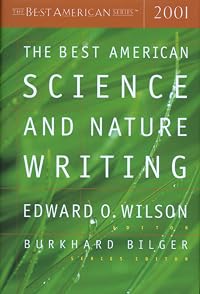
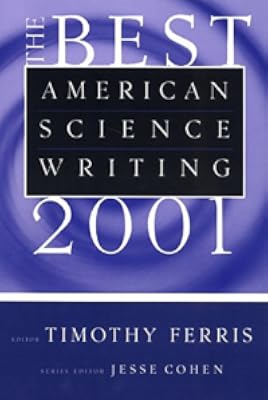
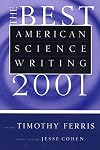
The Best American Science and Nature Writing 2001
by Edward O. Wilson (Editor), Burkhard Bilger (Series Editor)
The Best American Science and Nature Writing (2001), Best American (2001)
On This Page
Description
Also an instant bestseller in the Best American series, this second annual Best American Science and Nature Writing volume, edited by the Pulitzer Prize-winning author, scientist, and naturalist Edward O. Wilson, promises to be another "eclectic, provocative collection” (Entertainment Weekly) that is both a science reader’s dream and a nature lover’s sustenance.Tags
Recommendations
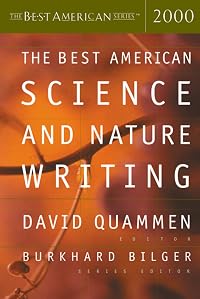
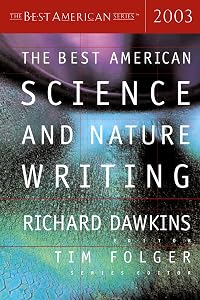
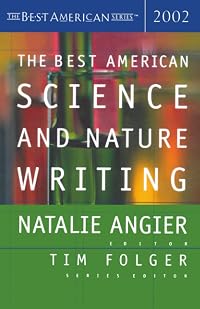
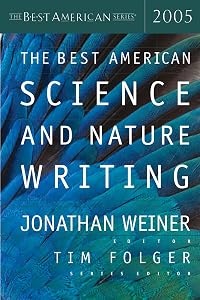








Member Recommendations
by anonymous user
Member Reviews
I read this collection of science magazine articles in 2010, ten years after the articles it contains were originally published, and there were only about four out of the twenty-two that I believe are worth commenting on. The rest are still pretty good and interesting but somehow seem to have slipped outside the zeitgeist of the current age.
Malcolm Gladwell in "Baby Steps" (New Yorker) offers counter intuitive wisdom about the importance of the first 3 years of a child's life. Basically, kids are going to develop naturally in any environment. Early bad experiences are not set in stone because the brain is plastic and can change given new opportunity in the future. This is a Gladwell article, so it's hard to know how counter-factual it show more is at the expense of the facts.
Bill Joy in "Why The Future Doesn't Need Us" (Wired) is now considered a classic essay, appearing just before the Dot-Com bust, he offers a darker vision of the future. Although nanotechnology grey goo has not come to pass, the creation of synthetic life by Craig Venter in 2010 is the very thing Joy warned about 10 years ago.
Richard Preston in "The Genome Warrior" (The New Yorker) gives a pretty detailed account of how Craig Venter and his company Celera battled through the 1990s to sequence the human genome. Lots of politics and egos involved in the race for a Noble prize and potentially fortunes of money.
Verlyn Klinkenborg in "The Best Clock in the World" (Discover) describes how atomic clocks work - amazingly, there is no single clock that keeps the world on time, there are hundreds, it is the average of them, and they are constantly being adjusted (of sorts) - precise time is an illusion.
--Review by Stephen Balbach, via CoolReading (c) 2010 cc-by-nd show less
Malcolm Gladwell in "Baby Steps" (New Yorker) offers counter intuitive wisdom about the importance of the first 3 years of a child's life. Basically, kids are going to develop naturally in any environment. Early bad experiences are not set in stone because the brain is plastic and can change given new opportunity in the future. This is a Gladwell article, so it's hard to know how counter-factual it show more is at the expense of the facts.
Bill Joy in "Why The Future Doesn't Need Us" (Wired) is now considered a classic essay, appearing just before the Dot-Com bust, he offers a darker vision of the future. Although nanotechnology grey goo has not come to pass, the creation of synthetic life by Craig Venter in 2010 is the very thing Joy warned about 10 years ago.
Richard Preston in "The Genome Warrior" (The New Yorker) gives a pretty detailed account of how Craig Venter and his company Celera battled through the 1990s to sequence the human genome. Lots of politics and egos involved in the race for a Noble prize and potentially fortunes of money.
Verlyn Klinkenborg in "The Best Clock in the World" (Discover) describes how atomic clocks work - amazingly, there is no single clock that keeps the world on time, there are hundreds, it is the average of them, and they are constantly being adjusted (of sorts) - precise time is an illusion.
--Review by Stephen Balbach, via CoolReading (c) 2010 cc-by-nd show less
This one is more Nature than Science , but that's because it's Captain E.O.'s
This one is more Nature than Science , but that's because it's Captain E.O.'s
Ratings
Members
- Recently Added By
Author Information

He was born in Birmingham, Alabama, in 1929. He is currently Pellegrino University Research Professor & Honorary Curator in Entomology of the Museum of Comparative Zoology at Harvard. He is on the Board of Directors of the Nature Conservancy, Conservation International & the American Museum of Natural History. He lives in Lexington, Massachusetts. show more (Bowker Author Biography) show less
Burkhard Bilger is a senior editor at "Discover" & a contributing editor at "Health." (Bowker Author Biography)
Series


Common Knowledge
- Canonical title
- The Best American Science and Nature Writing 2001
- Original publication date
- 2001
Classifications
- Genres
- Science & Nature, Nonfiction, Fiction and Literature
- DDC/MDS
- 808.80356 — Literature & rhetoric Literature, rhetoric & criticism Rhetoric and collections of literary texts from more than two literatures Literature Collections > By Theme Humanity General anthologies about science and medicine
- LCC
- Q1 .B47 — Science Science (General) General
- BISAC
Statistics
- Members
- 177
- Popularity
- 185,700
- Reviews
- 3
- Rating
- (3.56)
- Languages
- English
- Media
- Paper
- ISBNs
- 2
- UPCs
- 2