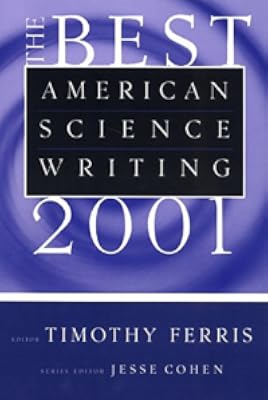
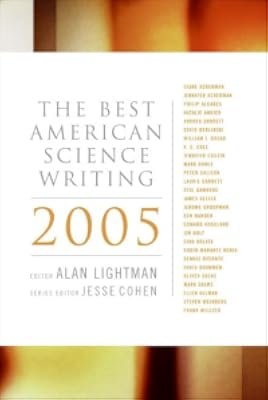
The Best American Science Writing 2001
by Timothy Ferris (Editor), Jesse Cohen (Series Editor)
The Best American Science Writing (2001), Best American (2001)
139 Members (3.44)
On This Page
Description
Gathered from the nation's leading publications by award-winning author Timothy Ferris, The Best American Science Writing 2001 is a dynamic, up-to-date collection of essays and articles by America's most prominent thinkers and writers, addressing the most controversial, socially relevant topics that recent developments in science pose. Among the contributors: Richard Preston examines the contentious business of decoding the human genome. Malcolm Gladwell follows investigators who aim to show more revolutionize birth control. Tracy Kidder profiles a modern Dr. Schweitzer. Alan Lightman laments what was lost in his transformation from astrophysicist to fiction writer. Natalie Angier makes some surprising discoveries about gender in mandrill society. Stephen Jay Gould investigates the strange contrast between the 1530 poem by a physician that gave us the name for syphilis and the poetry that can be found in the map of the pathogen's genome. Legendary physicist John Archibald Wheeler celebrates the mysteries of quantum mechanics, which still perplex a century after its discovery. And John Updike contributes a witty verse musing on a biological theme. For anyone who wants to journey to science's frontiers, understand more fully its ever-expanding role in our lives, or simply enjoy the thrill of powerful writing on fascinating topics,The Best American Science Writing 2001 is indispensable. show lessTags
Recommendations


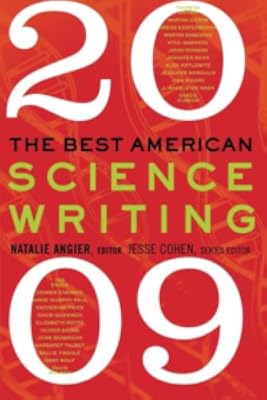
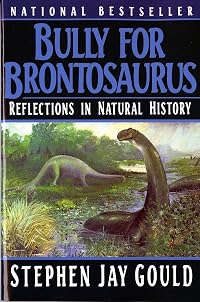

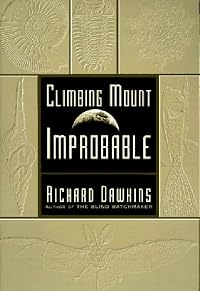

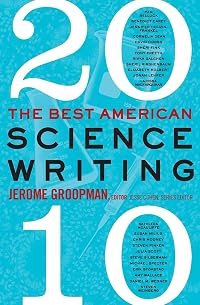
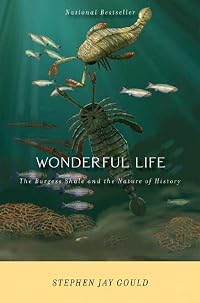
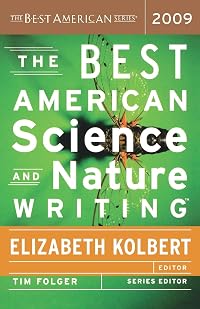
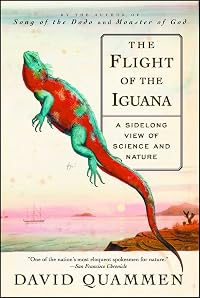
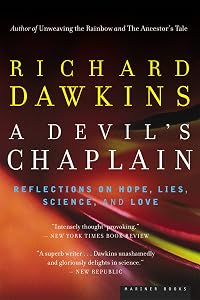
Member Recommendations
by anonymous user
Member Reviews
Members
- Recently Added By
Author Information

Timothy Ferris was born on August 29, 1944, in Miami, Florida. He graduated from Northwestern University with a B.A. in 1966 and did graduate work from 1966-1967. Ferris is the author of Coming of Age in the Milky Way, for which he was awarded the American Institute of Physics Prize and nominated for a Pulitzer Prize; The Red Limit; The Whole show more Shebang: A State of the Universe(s) Report; Galaxies; The Mind's Sky; The Science of Liberty: Democracy, Reason, and the Laws of Nature, and other popular books on astronomy and physics. He has received the American Institute of Physics Prize, the American Association for the Advancement of Science Prize, the Klumpke-Roberts Prize, and a Guggenheim Fellowship. Books by Ferris have been nominated for the National Book Award and the Pulitzer Prize. His PBS special, The Creation of the Universe, won an Emmy nomination in 1986. In addition to his books, Ferris is a former editor of Rolling Stone magazine and has authored more than 100 articles, essays, and reviews in such publications as Esquire, Nature, The New Republic, The New York Times Book Review, and Reader's Digest. He is a regular contributor to The New Yorker, writes a column for Scientific American, has served as an essayist for The MacNeil-Lehrer News Hour, and is a commentator for National Public Radio's All Things Considered. Ferris produced the Voyager phonograph record, an artifact of human civilization containing music, the sounds of Earth, and encoded photographs, that was launched aboard the Voyager spacecraft. He serves as a consultant to NASA on long-term space exploration policy. A polymath scholar, Ferris has taught in five disciplines at four universities including City University of New York and University of Southern California. Professor Ferris lives with his wife and family in San Francisco and teaches at the University of California, Berkeley, in the departments of journalism and astronomy, where he is an emeritus professor. (Bowker Author Biography) Timothy Ferris, author of seven books on astronomy, regularly contributes to such publications as The New Yorker, Life, Nature, Esquire, & The New York Times Magazine. He wrote & narrated the award-winning PBS television special "The Creation of the Universe." He lives in San Francisco, California. (Bowker Author Biography) show less
Jerome Groopman is the Dina and Raphael Recanati Chair of Medicine at Harvard Medical School, Chief of Experimental Medicine at Beth Israel Deaconess Medical Center, and author of four books, most recently Anatomy of Hope and the New York Times bestseller How Doctors Think. He has been a staff writer in medicine and biology for the New Yorker show more since 1998. Jesse Cohen is a writer and freelance editor who lives in New York City. show less
All Editions
Series


Common Knowledge
- Canonical title
- The Best American Science Writing 2001
- Original publication date
- 2001
Classifications
Statistics
- Members
- 139
- Popularity
- 235,940
- Rating
- (3.44)
- Languages
- English
- Media
- Paper
- ISBNs
- 2