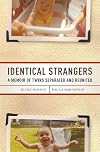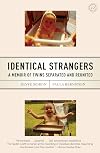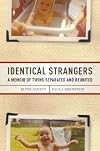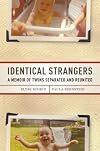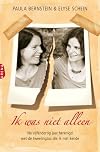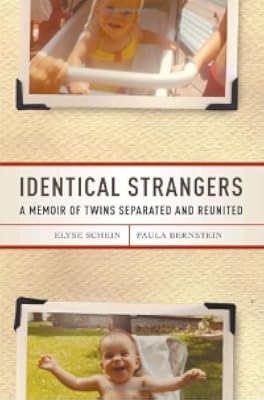
Identical Strangers: A Memoir of Twins Separated and Reunited
by Elyse Schein, Paula Bernstein
On This Page
Description
Elyse had always known she was adopted, but it wasn't until her mid-thirties that she searched for her biological mother. She was not prepared for the life-changing news: she had an identical twin sister. Not only that: she and her sister, for a time, had been part of a secret study on separated twins. Paula also knew she was adopted, but had no inclination to find her birth mother. When she answered the phone one spring afternoon, her life suddenly changed. As they take their tentative show more first steps from strangers to sisters, Paula and Elyse are also left with haunting questions. As they investigate their birth mother's past, they begin to solve the puzzle of their lives. Interweaving eye-opening studies and statistics on twin science into their narrative, they offer an intelligent and heartfelt glimpse into human nature.--From publisher description. show lessTags
Recommendations

Member Recommendations
Member Reviews
Last summer, I went to see Three Identical Strangers, a documentary about identical triplets who were separated at birth and adopted into three different families. There’s a little summary of this story in one of the ESL readers at school, a fun story about college-age boys discovering identical triplets, but the full story is a lot darker. The babies weren’t split up by accident, instead they were part of a secret sociological study on genetically identical babies raised in different homes. The data is sealed until 2066, and none of the researchers are talking, but it’s kind of implied that the triplets had a predisposition to depression, and the researchers wanted to see how different parenting styles in different show more socio-economical classes would affect that.
There were some other multiples who’d been separated through the same shady adoption agency/secret study and later found each other, including twins Paula and Elyse. (There are probably also other twins who’ve never found each other.) Paula and Elyse wrote a memoir about their experiences, Identical Strangers.
I knew the book would have a reasonably happy ending, since the sisters had enough to share to fill a book, and they obviously liked each other enough to complete a creative project together.
But the twin study is even darker in this novel. I mean, the part about people growing up without knowing their twin, or even that they had a twin, is already pretty dark. Elyse and Paula discover that their birth mother was mentally ill, and was even institutionalized while pregnant. In the documentary, it’s implied that the birth parents may gave been mentally unstable, but in this memoir, it’s clear. The birth mothers were all mentally ill, and it seems like the twin research was really on how much parenting and life experiences can affect a genetic predisposition for mental illness. How much can nurture compensate for nature? Are we doomed to our genetics?
When legitimate researchers study inherited trauma, it must be difficult to prove what comes from genetics (or epigenetics, I think?) and what comes from being raised by traumatized parents. This seems to be the central question of the twin study’s research, although, again, all of the data is sealed for decades, and no one at the adoption agency would tell Elyse and Paula the whole story. The sisters struggle with this question of what they’ve inherited too, and it’s never really resolved.
This doesn’t feel like a memoir, more like a dark scifi setting, with unwitting subjects of sinister mental experiments trying to discover what was done to them. Pregnant women with mental illness were needed for this “study”. I wonder if the adoption agency, that lied to adoptive families and to separated twins, really obtained consent from mentally ill mothers or just pressured women with mental instability into giving up their children. show less
There were some other multiples who’d been separated through the same shady adoption agency/secret study and later found each other, including twins Paula and Elyse. (There are probably also other twins who’ve never found each other.) Paula and Elyse wrote a memoir about their experiences, Identical Strangers.
I knew the book would have a reasonably happy ending, since the sisters had enough to share to fill a book, and they obviously liked each other enough to complete a creative project together.
But the twin study is even darker in this novel. I mean, the part about people growing up without knowing their twin, or even that they had a twin, is already pretty dark. Elyse and Paula discover that their birth mother was mentally ill, and was even institutionalized while pregnant. In the documentary, it’s implied that the birth parents may gave been mentally unstable, but in this memoir, it’s clear. The birth mothers were all mentally ill, and it seems like the twin research was really on how much parenting and life experiences can affect a genetic predisposition for mental illness. How much can nurture compensate for nature? Are we doomed to our genetics?
When legitimate researchers study inherited trauma, it must be difficult to prove what comes from genetics (or epigenetics, I think?) and what comes from being raised by traumatized parents. This seems to be the central question of the twin study’s research, although, again, all of the data is sealed for decades, and no one at the adoption agency would tell Elyse and Paula the whole story. The sisters struggle with this question of what they’ve inherited too, and it’s never really resolved.
This doesn’t feel like a memoir, more like a dark scifi setting, with unwitting subjects of sinister mental experiments trying to discover what was done to them. Pregnant women with mental illness were needed for this “study”. I wonder if the adoption agency, that lied to adoptive families and to separated twins, really obtained consent from mentally ill mothers or just pressured women with mental instability into giving up their children. show less
Elyse Shein and Paula Bernstein had always known they were adopted, but it was not until they were in their mid-30s that they knew they were twins. This engrossing book chronicles their discovery of each other and their quest to learn more about the circumstances of their adoption and the identity of their birth mother.
The sisters’ differences, more than their similarities, were what made this book particularly interesting to me. Their similarities, such as the fact that they both studied film, are merely uncanny, the kind of thing you alway hear about in stories of reunited twins. But it is their sometimes dramatic differences in attitude give their story extra layers, speaking not just to their different backgrounds, but also to how show more all people react to their circumstances. Schein feels robbed of an important relationship and immediately attaches to her new-found twin, but Bernstein is less certain of how she feels about their situation and what she wants now.
Had this been written by one sister, it would have felt unbalanced, and an outsider might have been too quick to impose his or own opinions on the story, looking for patterns that may or may not be significant. With each sister sharing her own thoughts and interpretations, we get both balance and immediacy, which make this an engaging read.
See my complete review at my blog. show less
The sisters’ differences, more than their similarities, were what made this book particularly interesting to me. Their similarities, such as the fact that they both studied film, are merely uncanny, the kind of thing you alway hear about in stories of reunited twins. But it is their sometimes dramatic differences in attitude give their story extra layers, speaking not just to their different backgrounds, but also to how show more all people react to their circumstances. Schein feels robbed of an important relationship and immediately attaches to her new-found twin, but Bernstein is less certain of how she feels about their situation and what she wants now.
Had this been written by one sister, it would have felt unbalanced, and an outsider might have been too quick to impose his or own opinions on the story, looking for patterns that may or may not be significant. With each sister sharing her own thoughts and interpretations, we get both balance and immediacy, which make this an engaging read.
See my complete review at my blog. show less
I don't know about you, but when I was growing up I desperately wanted to be an identical twin. So special! So...well, "unique" isn't the right word, but you know what I mean. So attention-getting. I knew some non-identical twins and that always seemed like the worst of both worlds - you have a sibling, but they don't look like you so you can't fool people or freak them out, and what if you're not the pretty one? (Ashton Kutcher has a twin brother who not only looks nothing like him, he's unusually unattractive.) When I got to know some twins well, I was impressed by their apparent mind-meld and ability to communicate with each other in shorthand. Who wouldn't want that?
So imagine finding out in your thirties that you had an identical show more twin but you were adopted by different families because some psychologist thought it was more healthy. That's what happened to the authors of this book, when one of them started researching her birth mother. They found out that they'd been part of a study to determine if mental illness was hereditary or environmental, because they were identical twin daughters of a schizophrenic woman.
One of them's a bourgeois stay at home mother in Park Slope, the other lives in Paris in a tiny apartment and supports her dreams of working in film by tutoring English students. What a wild duet! But like a lot of twins raised separately, they eerily have things in common: they're both interested in film and both have written about it, both were the editor of their school newspaper, both suffer from depression, etc.
The most interesting part of the story for me was how they built their relationship with each other. They start out thrilled that they've found each other and are instantly madly in love. They introduce each other to their families and know they'll be in each other's lives forever. After a while, each of them starts resenting the other - how weird it is to see the other's overly dramatic expressions on their own face, the pressure of having this new intense relationship. Despite their joy at being reunited, each of them had a settled life before this intimate stranger entered it. I can't help but wonder if the Parisian twin, who's constantly house-sitting in order to get out of her small apartment, and borrowing from friends, tried to get the Park Slope sister to give her money and a place to live when she came to the US.
It's a quick but fun read about a situation the rest of us can only imagine. I'm glad they either had a good ghost writer or were skillful enough to tell their story well. show less
So imagine finding out in your thirties that you had an identical show more twin but you were adopted by different families because some psychologist thought it was more healthy. That's what happened to the authors of this book, when one of them started researching her birth mother. They found out that they'd been part of a study to determine if mental illness was hereditary or environmental, because they were identical twin daughters of a schizophrenic woman.
One of them's a bourgeois stay at home mother in Park Slope, the other lives in Paris in a tiny apartment and supports her dreams of working in film by tutoring English students. What a wild duet! But like a lot of twins raised separately, they eerily have things in common: they're both interested in film and both have written about it, both were the editor of their school newspaper, both suffer from depression, etc.
The most interesting part of the story for me was how they built their relationship with each other. They start out thrilled that they've found each other and are instantly madly in love. They introduce each other to their families and know they'll be in each other's lives forever. After a while, each of them starts resenting the other - how weird it is to see the other's overly dramatic expressions on their own face, the pressure of having this new intense relationship. Despite their joy at being reunited, each of them had a settled life before this intimate stranger entered it. I can't help but wonder if the Parisian twin, who's constantly house-sitting in order to get out of her small apartment, and borrowing from friends, tried to get the Park Slope sister to give her money and a place to live when she came to the US.
It's a quick but fun read about a situation the rest of us can only imagine. I'm glad they either had a good ghost writer or were skillful enough to tell their story well. show less
Audio Version.
Why: Needed some nonfiction for my categorical challenge and wanted to try an audio book. This seemed an interesting story.
It’s about two twins, unknowingly adopted into different families, who reunite as adults, and the paths they follow to learn the circumstances of their birth and adoption. From the start I was drawn into the women’s experience. There were two readers, because the sisters alternated telling the story. A fascinating story: Elyse, an unrooted 35 y.o. American in Paris, seeks info on her birth mother and is shocked by the revelations that she had not been born alone and that her mother was mentally ill. She contacts her blithely ignorant twin, Paula (surprise!), who is a successful journalist, wife and show more mother living in NYC. They are each blown away by their similarities. As the two struggle with this huge shift in identity, history and family relationships, they begin to question why anyone would do something like purposely separate identical twin babies. They discover they were part of a study, sparking their worst Orwellian fears. They spend the next few years chasing documents and hunting down any people involved in their adoption.
Their personal story is mostly compelling, but one thing that made the book so fascinating was that they interspersed their story with reports of scientific twin studies, separated twin anecdotes and lots of musing on Nature vs. Nurture. After hearing this I don’t see how Nature can be delegated to the second tier.
These women are good writers, but there were a few things I had problems with. I think the readers did good jobs, especially contrasting Elyse’s more emotional, dramatic nature with Paula’s coolly rational one, but about halfway through the Elyse-reader really started to grate. I don’t know if she was imitating Elyse’s speech patterns, badly or well, but even the most bland statements were infused with this melodramatically mournful tone, as if she were imploring her recently flattened cat, Why, Fluffy, oh why did you cross the street. If I knew anyone who talked like that in real life, and was stuck in a car with her (I listen while I drive) I’d be sore tempted to smack her. The other thing I didn’t like was that after the initial premise was introduced there was just too much repetitive navel-gazing. Oh! You were traumatically separated after spending nine months together in the womb? Oh thank you. I didn’t get it the first twenty times. Since I couldn’t figure out a way to successfully skim ahead in an audio book without missing anything good—and it was good—I just grinned and bore it. My impressions were mostly good and I think Identical Strangers is worth a read (or listen). show less
Why: Needed some nonfiction for my categorical challenge and wanted to try an audio book. This seemed an interesting story.
It’s about two twins, unknowingly adopted into different families, who reunite as adults, and the paths they follow to learn the circumstances of their birth and adoption. From the start I was drawn into the women’s experience. There were two readers, because the sisters alternated telling the story. A fascinating story: Elyse, an unrooted 35 y.o. American in Paris, seeks info on her birth mother and is shocked by the revelations that she had not been born alone and that her mother was mentally ill. She contacts her blithely ignorant twin, Paula (surprise!), who is a successful journalist, wife and show more mother living in NYC. They are each blown away by their similarities. As the two struggle with this huge shift in identity, history and family relationships, they begin to question why anyone would do something like purposely separate identical twin babies. They discover they were part of a study, sparking their worst Orwellian fears. They spend the next few years chasing documents and hunting down any people involved in their adoption.
Their personal story is mostly compelling, but one thing that made the book so fascinating was that they interspersed their story with reports of scientific twin studies, separated twin anecdotes and lots of musing on Nature vs. Nurture. After hearing this I don’t see how Nature can be delegated to the second tier.
These women are good writers, but there were a few things I had problems with. I think the readers did good jobs, especially contrasting Elyse’s more emotional, dramatic nature with Paula’s coolly rational one, but about halfway through the Elyse-reader really started to grate. I don’t know if she was imitating Elyse’s speech patterns, badly or well, but even the most bland statements were infused with this melodramatically mournful tone, as if she were imploring her recently flattened cat, Why, Fluffy, oh why did you cross the street. If I knew anyone who talked like that in real life, and was stuck in a car with her (I listen while I drive) I’d be sore tempted to smack her. The other thing I didn’t like was that after the initial premise was introduced there was just too much repetitive navel-gazing. Oh! You were traumatically separated after spending nine months together in the womb? Oh thank you. I didn’t get it the first twenty times. Since I couldn’t figure out a way to successfully skim ahead in an audio book without missing anything good—and it was good—I just grinned and bore it. My impressions were mostly good and I think Identical Strangers is worth a read (or listen). show less
Elyse Schein and Paula Bernstein are identical twins. They were both adopted, but separately, with neither adoptive family knowing their baby was a twin. At age 35, they found each other. What followed was a rather exhaustive search to try to learn what happened. And why. What they found was more than a little bit disturbing. In the 1960s, a so-called prestigious adoption agency in New York allowed some psychologists to conduct secret experiments, ostensibly to study nature vs. nurture. 5 sets of identical twins and one set of identical triplets were separated and adopted out, then followed by visits over the next few years. Interestingly, I actually read this book back in 2010 and although I remember reading it and being intrigued and show more disturbed by their story, I didn't recall a lot of the details. I also remember reading about the triplets who found each other at age 18, several years before these twins. They were all over the media at the time.
Fast forward to earlier this year, when a documentary film was released. It is called Three Identical Strangers and is the story of the triplets. Elyse and Paula appear in it briefly but it is a current film (released this year) and more information has now been uncovered. The truth is even more disturbing than what was known when the twins wrote their book. The *experiments* also, apparently, aimed to study the heritability of mental illness, as it appears that the mothers of the twins and triplets all suffered from some form of mental illness. The people behind the studies never published their findings and worse, the files are sealed until 2066, when all of the doctors and most of the subjects will likely be dead. They have hired lawyers and tried to have the files opened, with little success.
One fact that emerged is that, in the 1960s, when this all happened, there were no laws protecting the children, no laws on the books to make what was done illegal. Unethical, for sure, but not illegal. Laws have since been created but it is a harrowing story and for the triplets, a tragic one, as well. Both this book as well as the documentary film, are well worth reading and seeing. It's fascinating but disturbing heartbreaking and it's hard not to think about it a lot. show less
Fast forward to earlier this year, when a documentary film was released. It is called Three Identical Strangers and is the story of the triplets. Elyse and Paula appear in it briefly but it is a current film (released this year) and more information has now been uncovered. The truth is even more disturbing than what was known when the twins wrote their book. The *experiments* also, apparently, aimed to study the heritability of mental illness, as it appears that the mothers of the twins and triplets all suffered from some form of mental illness. The people behind the studies never published their findings and worse, the files are sealed until 2066, when all of the doctors and most of the subjects will likely be dead. They have hired lawyers and tried to have the files opened, with little success.
One fact that emerged is that, in the 1960s, when this all happened, there were no laws protecting the children, no laws on the books to make what was done illegal. Unethical, for sure, but not illegal. Laws have since been created but it is a harrowing story and for the triplets, a tragic one, as well. Both this book as well as the documentary film, are well worth reading and seeing. It's fascinating but disturbing heartbreaking and it's hard not to think about it a lot. show less
This is a fascinating book for anyone who has ever fantasized about finding a long-lost twin...to the authors of this book, separated at birth and adopted by different families, this actually happened. What is surprising and intriguing about the book is that it is not merely a warm reunion story---it lays bare the complications of suddenly discovering someone who resembles oneself and yet remains on some level a stranger. Although it is overall a positive book, after reading it one realizes that the long-lost-twin fantasy isn't necessarily as simple or as glorious in real life as it may be in imagination.
 This review was written for LibraryThing Early Reviewers.
I watched the roller-coaster ride which is 'Three Identical Strangers', the story of triplets separated by the Louise Wise adoption agency, and so had to follow up with the written account of twins who suffered the same fate. Elyse Schein and Paula Bernstein were born in New York, 1968, to a formerly bright and promising young woman with mental health issues. Named Jean and Marian by their mother, they were given up for adoption through the prestigious Louise Wise agency, which was partaking in an 'experiment' to separate and study multiple identical siblings. The girls' adoptive parents were not told that their daughters had twins, so Elyse and Paula only discovered each other years later, when the Louise Wise scandal hit the show more headlines.
Told by both twins, this is an open and interesting account of what it's like to suddenly find a biological relative, and one who shares 100% of your DNA. They go through the stages of learning how closely their lives have followed each other to wishing, at least in Paula's case, that their lives were still their own. They also go on a quest to find out more about the twin research which separated them, and about their birth mother, which I found most compelling. The meeting with their 'uncle' is like a scene out of a true life TV movie! The many facts about twins - padding, I suspect - are interesting but not really what I wanted to read about (I laughed when the Wakefield twins got a mention, though!)
A shocking story with a happy ending, I think the film about the triplets tells the same tale with more impact. show less
Told by both twins, this is an open and interesting account of what it's like to suddenly find a biological relative, and one who shares 100% of your DNA. They go through the stages of learning how closely their lives have followed each other to wishing, at least in Paula's case, that their lives were still their own. They also go on a quest to find out more about the twin research which separated them, and about their birth mother, which I found most compelling. The meeting with their 'uncle' is like a scene out of a true life TV movie! The many facts about twins - padding, I suspect - are interesting but not really what I wanted to read about (I laughed when the Wakefield twins got a mention, though!)
A shocking story with a happy ending, I think the film about the triplets tells the same tale with more impact. show less
Members
- Recently Added By
Author Information

1 Work 534 Members

3 Works 553 Members

Paula Bernstein is a LibraryThing Author, an author who lists their personal library on LibraryThing.
Some Editions
Common Knowledge
- Original publication date
- 2007
- People/Characters
- Elyse Schein; Paula Bernstein
- Important places
- Brooklyn, New York, New York, USA; Paris, France; Oklahoma, USA
- Dedication
- For Tyler
ELYSE
To Marilyn and Bernard Bernstein,
without whom this story couldn't be told
PAULA - First words
- Imagine that a slightly different version of you walks across a room, looks you in the eye, and says hello in your voice. (Preface)
ELYSE: My mother, my adoptive mother, my real mother died when I was six, but throughout my childhood I believed that she watched over me from above.
PAULA: In one of my earliest memories, I am sitting on the brick stoop in front of my grandma's row house in the East Flatbush section of Brooklyn. - Last words
- (Click to show. Warning: May contain spoilers.)Although we don't always fit together neatly, we are missing pieces to the same puzzle.
- Publisher's editor
- Hershey, Jennifer
Classifications
- Genres
- Biography & Memoir, General Nonfiction, Nonfiction
- DDC/MDS
- 306.8750922 — Society, government, & culture Social sciences, sociology & anthropology Social Behavior - Dating, Marriage, Divorce Marriage, partnerships, unions; family Intrafamily relationships Sibling relationships
- LCC
- CT275 .B56545 .A3 — Auxiliary Sciences of History Biography Biography National biography
- BISAC
Statistics
- Members
- 534
- Popularity
- 55,808
- Reviews
- 56
- Rating
- (3.48)
- Languages
- Dutch, English, French
- Media
- Paper, Audiobook, Ebook
- ISBNs
- 14
- ASINs
- 3