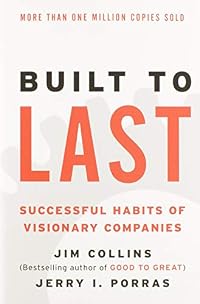
Built to Last: Successful Habits of Visionary Companies
by Jim Collins, Jerry I. Porras
Good to Great (2)
On This Page
Description
"This is not a book about charismatic visionary leaders. It is not about visionary product concepts or visionary products or visionary market insights. Nor is it about just having a corporate vision. This is a book about something far more important, enduring, and substantial. This is a book about visionary companies." So write Jim Collins and Jerry Porras in this groundbreaking book that shatters myths, provides new insights, and gives practical guidance to those who would like to build show more landmark companies that stand the test of time. Drawing upon a six-year research project at the Stanford University Graduate School of Business, Collins and Porras took eighteen truly exceptional and long-lasting companies -- they have an average age of nearly one hundred years and have outperformed the general stock market by a factor of fifteen since 1926 -- and studied each company in direct comparison to one of its top competitors. They examined the companies from their very beginnings to the present day -- as start-ups, as midsize companies, and as large corporations. Throughout, the authors asked: "What makes the truly exceptional companies different from other companies?" What separates General Electric, 3M, Merck, Wal-Mart, Hewlett-Packard, Walt Disney, and Philip Morris from their rivals? How, for example, did Procter & Gamble, which began life substantially behind rival Colgate, eventually prevail as the premier institution in its industry? How was Motorola able to move from a humble battery repair business into integrated circuits and cellular communications, while Zenith never became dominant in anything other than TVs? How did Boeing unseat McDonnell Douglas as the world's best commercial aircraft company -- what did Boeing have that McDonnell Douglas lacked? By answering such questions, Collins and Porras go beyond the incessant barrage of management buzzwords and fads of the day to discover timeless qualities that have consistently distinguished out-standing companies. They also provide inspiration to all executives and entrepreneurs by destroying the false but widely accepted idea that only charismatic visionary leaders can build visionary companies. Filled with hundreds of specific examples and organized into a coherent framework of practical concepts that can be applied by managers and entrepreneurs at all levels, Built to Last provides a master blueprint for building organizations that will prosper long into the twenty-first century and beyond. show lessTags
Recommendations








Member Reviews
Why Built to Last Endures
The book resonates because people are deeply inspired by the idea that it is possible to build something truly enduring. In a world obsessed with short-term wins, the notion of creating a great company that lasts across generations feels both rare and meaningful.
Thoughtful readers are drawn to the book’s emphasis on time-tested fundamentals. While the world changes at an accelerating pace, Built to Last reminds us that not everything should change. Core principles matter precisely because they outlast trends and management fads.
The book is especially valuable for organizations in transition. Rather than asking, “How should we change?”, it urges leaders to begin with a more fundamental question: “What do show more we stand for, and why do we exist?” Productive change, the authors argue, must be built on a preserved core.
Visionary companies themselves find validation in the book. Many organizations already operating with strong values and long-term thinking recognize their own practices reflected in its pages.
Preserve the Core, Stimulate Progress
The central idea of the book is the balance between continuity and change. Visionary companies protect their core values and purpose while allowing everything else—strategies, structures, and practices—to evolve.
This principle extends beyond business. Nations, societies, families, and individuals all require an inner core to remain stable in a chaotic world. When people rely only on external structures for security, they risk losing their sense of self when those structures collapse.
The book suggests that it is more important to understand who you are than where you are going, because direction will almost certainly change over time.
What Defines Visionary Companies
They are leaders in their industries and widely admired by knowledgeable peers.
They leave a lasting imprint on the world.
They survive multiple generations of leadership and product cycles.
They endure setbacks and mistakes, yet display exceptional resilience.
Over the long term, these companies significantly outperform both the general market and their comparison peers, demonstrating that purpose-driven organizations are not only idealistic, but highly successful.
Challenging Common Myths
Great companies do not necessarily begin with great ideas; many start with uncertainty or even failure.
Charismatic visionary leaders are not required and can sometimes harm long-term continuity.
Profit maximization is not the primary objective; visionary companies pursue profit alongside a deeper purpose—and often achieve superior financial results because of it.
There is no single “correct” set of values. What matters is how deeply values are believed and consistently lived.
Change is constant, but core ideology should remain remarkably stable over time.
Core Ideology
Core ideology consists of core values and purpose.
Core values are enduring principles that are not compromised for short-term gain.
Purpose is the organization’s fundamental reason for existence beyond making money.
In visionary companies, these elements do not require external justification and do not bend to trends.
From Ideas to Action
Visionary companies translate values into concrete mechanisms rather than relying on good intentions.
They promote leaders from within to preserve culture.
They embrace continuous improvement and deliberately create discomfort to prevent complacency.
Alignment across goals, systems, and behaviors reinforces both stability and progress.
Big Hairy Audacious Goals (BHAGs)
BHAGs are bold, clear, and emotionally engaging goals that people immediately understand.
They focus energy and provide long-term direction.
They may take the form of ambitious targets, defeating a common enemy, emulating a respected role model, or transforming an organization from within.
Evolution Over Time
Visionary companies grow through experimentation and selection, adding new initiatives while pruning what no longer serves them.
Change is typically driven from within rather than imposed by external leadership.
The goal is not comfort, but sustained vitality and renewal.
Final Reflection
Visionary companies endure because they know who they are.
They preserve their core while stimulating progress.
This lesson applies as powerfully to individuals as it does to organizations: true stability comes from a strong inner core and the courage to adapt everything else. show less
The book resonates because people are deeply inspired by the idea that it is possible to build something truly enduring. In a world obsessed with short-term wins, the notion of creating a great company that lasts across generations feels both rare and meaningful.
Thoughtful readers are drawn to the book’s emphasis on time-tested fundamentals. While the world changes at an accelerating pace, Built to Last reminds us that not everything should change. Core principles matter precisely because they outlast trends and management fads.
The book is especially valuable for organizations in transition. Rather than asking, “How should we change?”, it urges leaders to begin with a more fundamental question: “What do show more we stand for, and why do we exist?” Productive change, the authors argue, must be built on a preserved core.
Visionary companies themselves find validation in the book. Many organizations already operating with strong values and long-term thinking recognize their own practices reflected in its pages.
Preserve the Core, Stimulate Progress
The central idea of the book is the balance between continuity and change. Visionary companies protect their core values and purpose while allowing everything else—strategies, structures, and practices—to evolve.
This principle extends beyond business. Nations, societies, families, and individuals all require an inner core to remain stable in a chaotic world. When people rely only on external structures for security, they risk losing their sense of self when those structures collapse.
The book suggests that it is more important to understand who you are than where you are going, because direction will almost certainly change over time.
What Defines Visionary Companies
They are leaders in their industries and widely admired by knowledgeable peers.
They leave a lasting imprint on the world.
They survive multiple generations of leadership and product cycles.
They endure setbacks and mistakes, yet display exceptional resilience.
Over the long term, these companies significantly outperform both the general market and their comparison peers, demonstrating that purpose-driven organizations are not only idealistic, but highly successful.
Challenging Common Myths
Great companies do not necessarily begin with great ideas; many start with uncertainty or even failure.
Charismatic visionary leaders are not required and can sometimes harm long-term continuity.
Profit maximization is not the primary objective; visionary companies pursue profit alongside a deeper purpose—and often achieve superior financial results because of it.
There is no single “correct” set of values. What matters is how deeply values are believed and consistently lived.
Change is constant, but core ideology should remain remarkably stable over time.
Core Ideology
Core ideology consists of core values and purpose.
Core values are enduring principles that are not compromised for short-term gain.
Purpose is the organization’s fundamental reason for existence beyond making money.
In visionary companies, these elements do not require external justification and do not bend to trends.
From Ideas to Action
Visionary companies translate values into concrete mechanisms rather than relying on good intentions.
They promote leaders from within to preserve culture.
They embrace continuous improvement and deliberately create discomfort to prevent complacency.
Alignment across goals, systems, and behaviors reinforces both stability and progress.
Big Hairy Audacious Goals (BHAGs)
BHAGs are bold, clear, and emotionally engaging goals that people immediately understand.
They focus energy and provide long-term direction.
They may take the form of ambitious targets, defeating a common enemy, emulating a respected role model, or transforming an organization from within.
Evolution Over Time
Visionary companies grow through experimentation and selection, adding new initiatives while pruning what no longer serves them.
Change is typically driven from within rather than imposed by external leadership.
The goal is not comfort, but sustained vitality and renewal.
Final Reflection
Visionary companies endure because they know who they are.
They preserve their core while stimulating progress.
This lesson applies as powerfully to individuals as it does to organizations: true stability comes from a strong inner core and the courage to adapt everything else. show less
Some pretty decent observations and perceptions, but otherwise a bit subjective when it came to companies being used as examples. That being said, that accusation could rightly be leveled at tons of books, so I'm not sure how fair that is. Still, recommended and a fairly solid effort.
Jim Collins always leaves you with food for thought. In this book he focuses on companies who have 30 or more years of success and picks apart what makes them so different from companies who survive, but don't thrive. The answers are simple but not easy and have less to do with marketing, products or stragety and more to do with values, culture and risks.
This is on the reading list I have of best all-time business books. It's thoughtful but not on par with "In Search of Excellence" or Collin's more recent "Good to Great." Their approach is valid for picking up a list of excellent performers and comparison firms that had the same opportunity. I'm not sure these firms will continue to last (Wal-Mart is already faltering), but the authors point out it's a matter of continuing the habits. Regarding the "genius of And" I've observed that certain leaders assume this means they should try to have it all. One former co-CEO of my current firm often spoke about and did this. There is some genius in going down one path or another. Their 5 methods are: 1. Big, Hairy Audacious Goals, 2. Cult-like show more Cultures, 3. Try a Lot of Stuff and Keep What Works, 4. Home-Grown Management, 5. Good Enough Never Is. Other important points: the value of trying things (bias for action and appreciating the value of failures). Quoting Richard Carlton of 3M: "We must possess a two-fisted generating and testing [process] for ideas... Every idea evolved should have a chance to prove its worth, and this true for two reasons: 1) if it is good, we want it; 2) if it is not good, we will have purchased our insurance and peace of mind when we have proved it impractical." show less
A study of 18 pairs of companies in different product spaces, one of each pair very successful and the other not so much (as judged by returns to stock up to 1990). They find that many assumptions about what makes a company great in the long term are just 'myths'; they list 12 such popular (mis)conceptions, e.g. a charismatic leader is required (not so!), or there has to be constant churn (not really!). Great read if you are suddenly lnded with a senior role in any concern.
An innovative business book. Collins - a business school professor - decided to do an experiment using the scientific method to identify using stock performance companies that were majorly outperforming peers, then comparing them to sister companies or competitors who were performing on par with the market. From that comparison, Collins identified-through extensive, exhaustive research and interviews-the differences in the company pairings. Regardless of the findings, the model of approach and study is worth reading the book. However, the findings are very intriguing and definitely unexpected. Compelling.
Книга "Построенные навечно" исследует глубинные причины долгосрочного успеха американских корпораций. Джим Коллинз и Джерри Поррас представляют свежий взгляд на приемы работы 18 выдающихся корпораций, включая 3М, Wal Mart, Walt Disney, Boeing, Sony и Hewlett-Packard.
В рамках 6-летнего исследования под эгидой бизнес-школы Стэнфордского университета Коллинз и Поррас изучали выдающиеся компании-долгожители в непосредственном show more сравнении с их конкурентами, все время при этом задаваясь вопросом: "Что делает по-настоящему выдающиеся компании отличными от других компаний".
Наполненная сотнями конкретных примеров, представленных в виде гармоничной модели практических концепций, доступных для применения руководителями и предпринимателями всех рангов, книга может служить блестящим руководством по построению организаций, которые способны процветать на протяжении всего XXI века и далее. show less
В рамках 6-летнего исследования под эгидой бизнес-школы Стэнфордского университета Коллинз и Поррас изучали выдающиеся компании-долгожители в непосредственном show more сравнении с их конкурентами, все время при этом задаваясь вопросом: "Что делает по-настоящему выдающиеся компании отличными от других компаний".
Наполненная сотнями конкретных примеров, представленных в виде гармоничной модели практических концепций, доступных для применения руководителями и предпринимателями всех рангов, книга может служить блестящим руководством по построению организаций, которые способны процветать на протяжении всего XXI века и далее. show less
Members
- Recently Added By
Lists

My List
302 works; 1 member
Author Information

23+ Works 16,342 Members
Jim Collins holds B.S. and M.B.A. degrees from Stanford University. A visiting professor of business administration at Stanford Graduate School of Business, he is a management consultant. He has written several articles for the Harvard Business Review, Inc., Fortune magazine, California Management Review and Stanford Magazine. He is the co-author show more of Built to Last: Successful Habits of Visionary Companies; Managing the Small to Mid-Sized Firm: Readings, Cases and Instructor's Manual; Beyond Entrepreneurship; and Great by Choice. He has also worked with Hewlett Packard and McKinsey & Co. (Bowker Author Biography) show less
4 Works 3,364 Members
Awards and Honors
Notable Lists
Series

Belongs to Publisher Series
Common Knowledge
- Canonical title
- Built to Last: Successful Habits of Visionary Companies
Classifications
Statistics
- Members
- 3,350
- Popularity
- 5,023
- Reviews
- 25
- Rating
- (3.90)
- Languages
- 11 — Arabic, Chinese, Dutch, English, Estonian, Finnish, German, Polish, Russian, Spanish, Portuguese (Portugal)
- Media
- Paper, Audiobook, Ebook
- ISBNs
- 39
- UPCs
- 1
- ASINs
- 17
