On This Page
Description
Legendary science fiction author Fowler Faulkes may be dead, but his creation, the iconic Dr. Derringer, lives on in popular culture. Or, at least, the character would live on if not for Faulkes's predatory and greedy heir Hilary, who, during his time as the inflexible guardian of the estate, has created countless enemies in the relatively small community of writers of the genre. So when he is stabbed nearly to death in a room with only one door, which nobody was seen entering or exiting, show more Foulkes suspects a writer. Fearing that the assailant will return, he asks for police protection, and when more potentially-fatal encounters follow, it becomes clear to Detective Terry Marshall and his assistant, the inquisitive nun, Sister Ursula, that death awaits Mr. Foulkes around every corner. Now, they'll have to work overtime to thwart the would-be murderer-- a task that requires a deep dive into the strange, idiosyncratic world of science fiction in its early days. With characters based heavily on Anthony Boucher's friends at the Manana Literary Society, including Robert Heinlein, L. Ron Hubbard, and Jack Parsons, Rocket to the Morgue is both a classic locked room mystery and an enduring portrait of a real-life writing community. Reprinted for the first time in over thirty years, the book is a must-read for fans of mysteries and science fiction alike. show lessTags
Recommendations













Member Reviews
Science fiction is in its infancy, and one of its earliest legends is Fowler Foulkes, who created the immortal Dr. Derringer. Fowler’s son, Hilary, administers the Foulkes estate with a view to wringing every penny out of reprints, not even extending favours to the nuns who would make a Braille version for blind readers. With such a talent for making enemies, it’s not surprising that someone would try to kill Hilary. What is surprising is the locked-room nature of the attempt—and it will take all the ingenuity of Detective Marshall and his occasional confidante, Sister Ursula, to figure out who attempted-to-do-it.
This book is not only a mystery novel; it’s a portrait of the sci-fi community in the United States in the late show more 1930s. Boucher himself makes a cameo appearance, while several of his friends appear as caricatures or as composite characters. It’s a light, wry sort of mystery, both in terms of writing style and in terms of plot. I’m not really one for the locked-room mystery, because I don’t have the faintest hope of guessing whodunnit, but this story was agreeable enough. I’d recommend it if you like light Golden Age mysteries, mysteries about writers, or perhaps the Anthony Horowitz books where he is a character in his own story. (Or if you thought Horowitz’s idea a bit over the top, you might like this better, because Boucher appears only sparingly in his own book.) show less
This book is not only a mystery novel; it’s a portrait of the sci-fi community in the United States in the late show more 1930s. Boucher himself makes a cameo appearance, while several of his friends appear as caricatures or as composite characters. It’s a light, wry sort of mystery, both in terms of writing style and in terms of plot. I’m not really one for the locked-room mystery, because I don’t have the faintest hope of guessing whodunnit, but this story was agreeable enough. I’d recommend it if you like light Golden Age mysteries, mysteries about writers, or perhaps the Anthony Horowitz books where he is a character in his own story. (Or if you thought Horowitz’s idea a bit over the top, you might like this better, because Boucher appears only sparingly in his own book.) show less
Anthony Boucher is best known in SF circles as the first editor of Fantasy and Science Fiction. He pushed for higher writing standards in science fiction. Outside SF he was known as a mystery writer.
Rocket to the Morgue is NOT a science fiction mystery. It is a locked room mystery in the milieu of early (1942) California SF fandom. It is a sequel to Nine by Nine, another locked room mystery, that introduced Lieutenant Marshall and the Holmes-like nun, Sister Ursula. Reader comments are not too kind to Nine by Nine, but I found this novel to be a solid entry in the locked room canon. There are many red herrings but it plays fair.
Rocket was known for including many real science fiction authors and editors -- including Boucher -- mostly show more by reference, but sometimes lightly disguised as peripheral characters.
What I found most interesting was the appendix written in 1951 where Boucher reveals that Marshall's introduction to and eventual conversion to reading SF mirrored Boucher's personal journey.
Recommended as a fun read, if you can get past the fact that every female character is introduced by their body type. show less
Rocket to the Morgue is NOT a science fiction mystery. It is a locked room mystery in the milieu of early (1942) California SF fandom. It is a sequel to Nine by Nine, another locked room mystery, that introduced Lieutenant Marshall and the Holmes-like nun, Sister Ursula. Reader comments are not too kind to Nine by Nine, but I found this novel to be a solid entry in the locked room canon. There are many red herrings but it plays fair.
Rocket was known for including many real science fiction authors and editors -- including Boucher -- mostly show more by reference, but sometimes lightly disguised as peripheral characters.
What I found most interesting was the appendix written in 1951 where Boucher reveals that Marshall's introduction to and eventual conversion to reading SF mirrored Boucher's personal journey.
Recommended as a fun read, if you can get past the fact that every female character is introduced by their body type. show less
Anthony Boucher was one of the founders of the Mystery Writers of America and a Golden Age editor of The Magazine of Fantasy and Science Fiction. He wrote solid fiction in both genres. He was also a lifelong denizen of southern California who knew all the players in the SoCal science fiction scene of the 1930s and ‘40s. Who better, then, to write a closed-door mystery set around the Manana Club, the informal group that included sci-fi luminaries Robert Heinlein, L. Ron Hubbard, and occultist rocketeer Jack Parsons?
Boucher loved pen names. Boucher is one, but he wrote Rocket to the Morgue under the name H. H. Holmes, a pen name used by a nineteenth-century serial killer. He also conceals the real names of Manana Club members and other show more real people with pseudonyms. Fellow editor John W. Campbell, for instance, appears under one of the pen names he used in his fiction. To add to the fun, Boucher has himself—as Anthony Boucher, not H. H. Holmes—written into the plot. Wikipedia identifies Austin Carter as Heinlein, D. Vance Wimpole as Hubbard, and Dr. Hugo Chantrelle as Parsons. Other characters are less easy to identify, and it is fun to speculate, but watch out if you want to include an AI app in the game—it may invent connections with no evidence.
If you like Golden Age science fiction and how-did-they-do-it-who-done-its, you could do worse than dust off Rocket to the Morgue. show less
Boucher loved pen names. Boucher is one, but he wrote Rocket to the Morgue under the name H. H. Holmes, a pen name used by a nineteenth-century serial killer. He also conceals the real names of Manana Club members and other show more real people with pseudonyms. Fellow editor John W. Campbell, for instance, appears under one of the pen names he used in his fiction. To add to the fun, Boucher has himself—as Anthony Boucher, not H. H. Holmes—written into the plot. Wikipedia identifies Austin Carter as Heinlein, D. Vance Wimpole as Hubbard, and Dr. Hugo Chantrelle as Parsons. Other characters are less easy to identify, and it is fun to speculate, but watch out if you want to include an AI app in the game—it may invent connections with no evidence.
If you like Golden Age science fiction and how-did-they-do-it-who-done-its, you could do worse than dust off Rocket to the Morgue. show less
A Roman à clef* of Sci-Fi Writers
Review of the Penzler Publishers American Mystery Classics eBook edition (July 23, 2019) of the Duell, Sloan and Pearce hardcover original (1942).
Although Antony Boucher's Afterword tries to show more distance him from direct 1-to-1 correlations between his fictional characters in Rocket to the Morgue and the real-life science fiction authors they were based on, F. Paul Wilson's Introduction to this 2019 AMC edition states them explicitly. You can also read them in a section of the Wikipedia entry for the book.
So the fun of this is primarily the fictional depictions of authors such as Robert A. Heinlein and L. Ron Hubbard as murder suspects Austin Carter and D. Vance Wimpole in the book. The Wimpole character is already portrayed as a shifty, lecherous and unlikeable character, and this is well before the time when Hubbard invented his Scientology grift in 1953.
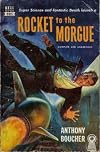
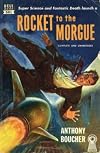
See cover at https://upload.wikimedia.org/wikipedia/en/9/92/RocketToTheMorgue.jpg
Cover of the original first edition published under the pseudonym H.H. Holmes by Duell, Sloan and Pearce in 1942. Image sourced from Wikipedia.
The detective Terry Marshal and his consultant Sister Ursula play rather minor roles throughout. It is a bit of a locked room mystery with various murder attempts on Hilary Foulkes, the son and literary executor of (fictional) sci-fi author Fowler Foulkes. Foulkes Jr. is despised by the rest of the literary community for exorbitant fees charged for the use of his father's copyright material. That scenario reminded me of the story of Stephen Joyce, the grandson of James Joyce, who held a similar iron hand over his grandfather's estate until the works entered the public domain in 2012. However, the situation in Rocket to the Morgue (1942) pre-dates the litigations and bans of the Joyce estate, which were mostly in the late 20th century.
Overall, this was goofy fun with most of the drama and interest coming from its real-world parallels.
Footnote
* From French: a novel with a key. Usually a novel where pseudonyms are used for the names of real life people. Sometimes the plot is a fictionalized version of events which actually happened. One therefore needs a "key" i.e. the secret code to identify who or what someone or something is based on.
Trivia and Links
There is a short section in this book devoted to a listing of "What If" speculative or alternate history literature, a sub-genre of fantasy and sci-fi. It was especially interesting to learn that Winston S. Churchill once wrote a speculative fiction piece If Lee Had Not Won the Battle of Gettysburg, written as if by a future historian in a world where the North had lost the American Civil War. The piece originally appeared in Scribner's Magazine in 1930 and was later collected in the anthology If It Had Happened Otherwise (1931).
This edition of Rocket to the Morgue is part of the Otto Penzler American Mystery Classics series (2018-ongoing). There is a related Goodreads Listopia here with 57 books listed as of early June 2024. There are currently 72 titles listed at the Mysterious Press online bookshop. The official website for the series at Penzler Publishers seems to show only the most recent and upcoming titles. show less
Review of the Penzler Publishers American Mystery Classics eBook edition (July 23, 2019) of the Duell, Sloan and Pearce hardcover original (1942).
This is the way it was in Southern California just before the war, when science fiction was being given its present form by such authors as Robert A. Heinlein (still the undisputed Master), Cleve Cartmill, Jack Williamson, Edmond Hamilton, Henry Kuttner, C. L. Moore, and many others. (And this is as wise a place as any to add hastily that no character in this novel is based specifically on any actual writer—nor is any character quite devoid of some factual basis.) - from the Afterword by author Antony Boucher.
Although Antony Boucher's Afterword tries to show more distance him from direct 1-to-1 correlations between his fictional characters in Rocket to the Morgue and the real-life science fiction authors they were based on, F. Paul Wilson's Introduction to this 2019 AMC edition states them explicitly. You can also read them in a section of the Wikipedia entry for the book.
So the fun of this is primarily the fictional depictions of authors such as Robert A. Heinlein and L. Ron Hubbard as murder suspects Austin Carter and D. Vance Wimpole in the book. The Wimpole character is already portrayed as a shifty, lecherous and unlikeable character, and this is well before the time when Hubbard invented his Scientology grift in 1953.
See cover at https://upload.wikimedia.org/wikipedia/en/9/92/RocketToTheMorgue.jpg
Cover of the original first edition published under the pseudonym H.H. Holmes by Duell, Sloan and Pearce in 1942. Image sourced from Wikipedia.
The detective Terry Marshal and his consultant Sister Ursula play rather minor roles throughout. It is a bit of a locked room mystery with various murder attempts on Hilary Foulkes, the son and literary executor of (fictional) sci-fi author Fowler Foulkes. Foulkes Jr. is despised by the rest of the literary community for exorbitant fees charged for the use of his father's copyright material. That scenario reminded me of the story of Stephen Joyce, the grandson of James Joyce, who held a similar iron hand over his grandfather's estate until the works entered the public domain in 2012. However, the situation in Rocket to the Morgue (1942) pre-dates the litigations and bans of the Joyce estate, which were mostly in the late 20th century.
Overall, this was goofy fun with most of the drama and interest coming from its real-world parallels.
Footnote
* From French: a novel with a key. Usually a novel where pseudonyms are used for the names of real life people. Sometimes the plot is a fictionalized version of events which actually happened. One therefore needs a "key" i.e. the secret code to identify who or what someone or something is based on.
Trivia and Links
There is a short section in this book devoted to a listing of "What If" speculative or alternate history literature, a sub-genre of fantasy and sci-fi. It was especially interesting to learn that Winston S. Churchill once wrote a speculative fiction piece If Lee Had Not Won the Battle of Gettysburg, written as if by a future historian in a world where the North had lost the American Civil War. The piece originally appeared in Scribner's Magazine in 1930 and was later collected in the anthology If It Had Happened Otherwise (1931).
This edition of Rocket to the Morgue is part of the Otto Penzler American Mystery Classics series (2018-ongoing). There is a related Goodreads Listopia here with 57 books listed as of early June 2024. There are currently 72 titles listed at the Mysterious Press online bookshop. The official website for the series at Penzler Publishers seems to show only the most recent and upcoming titles. show less
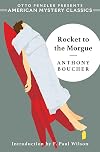
Rocket to the Morgue by Anthony Boucher is one of the classic mysteries re-printed by Penzler Publishers under their American Mystery Classics imprint. Writing in the 1940s, Boucher was known for his versatile talents within Science Fiction, Fantasy and Mystery fiction. A prolific contributor to each of these genres, Boucher utilized his familiarity with the publishing world to add depth and humor to his work. Rocket to the Morgue is a classic detective novel representative of its time with all the requisite elements: an insightful and quirky detective, a plethora of potential suspects from all levels of society, and a seemingly unsolvable locked door case to confound the police. What distinguishes this novel, however, is its setting show more within the incestuous and often cut-throat world of Los Angeles pulp fiction. Boucher provides his inside view of the experience of a writer in the pressurized atmosphere that he himself inhabited. Along the way, he does not neglect to provide a charming, fast-paced and well-plotted mystery to challenge any armchair sleuth. Delightful for its reflection of a revered era of detective fiction, and surprising for its unexpectedly modern approaches to class/gender stereotypes, Penzler Press has done a favor to modern mystery fans by introducing Rocket to the Morgue and Boucher to a new crop of readers.
Thanks to NetGalley and Penzler Press for an ARC of this book in return for an unbiased review. show less
Thanks to NetGalley and Penzler Press for an ARC of this book in return for an unbiased review. show less
A. P. White (a.k.a. Anthony Boucher) used the pen name H. H. Holmes in writing the novel Rocket to the Morgue, but he includes a character named "Anthony Boucher"! "Boucher" is not all a central figure in this murder mystery, which postpones the accomplishment of the crime until the later chapters. But he is included as an element in a milieu that the author drew from his own experience: the Los Angeles "scientifiction" scene of the early 1940s. The roman à clef elements of the novel supply various characters transposed from members of the actual Manaña Literary Society, to whom the book is also dedicated. These include Robert A. Heinlein ("Austin Carter"), L. Ron Hubbard ("D. Vance Wimpole"), Cleve Cartmill ("Matt Duncan"), Jack show more Parsons ("Hugo Chantrelle"), and Jack Williamson ("Joe Henderson"). The portrayals are loose, but recognizable. Rocket scientist Chantrelle, for example, is abstemious with respect to drink and sex, which is hardly faithful to the actual Parsons. The Hubbard-based character Wimpole is the one who is likely to inspire the most suspicion as a possible culprit.
The book is also the second written by "Holmes" to feature the nun Sister Mary Ursula as a principal sleuth, although the police lieutenant Terry Marshall -- also a continuing character -- is the main protagonist with whom readers are invited to identify. The mystery genre aspects are all self-reflectively stock elements, with much made of the "locked room" scenario. (Marshall's wife is an avid mystery reader.) These are then counterpoised to the novelty and marginality of the experimental "magazine-based" science fiction genre. I'm no wide reader of mystery fiction, but this one seems to derive its enduring interest for readers primarily from its social setting and metatextual features. show less
The book is also the second written by "Holmes" to feature the nun Sister Mary Ursula as a principal sleuth, although the police lieutenant Terry Marshall -- also a continuing character -- is the main protagonist with whom readers are invited to identify. The mystery genre aspects are all self-reflectively stock elements, with much made of the "locked room" scenario. (Marshall's wife is an avid mystery reader.) These are then counterpoised to the novelty and marginality of the experimental "magazine-based" science fiction genre. I'm no wide reader of mystery fiction, but this one seems to derive its enduring interest for readers primarily from its social setting and metatextual features. show less
Mystery in a series in which the detectives are a regular policeman and a nun. This one is interesting chiefly because the murder is set in the California science fiction writing community of the 1940s -- it is dedicated to the Manana Literary Society and especially Robert Heinlein and Cleve Cartmill. Several of the characters are based on real sf writers of the period, notably Heinlein.
Members
- Recently Added By
Lists

Haycraft Queen Cornerstones
181 works; 3 members

1943 Retro-Hugo Eligible Novels
18 works; 2 members

#JustTheFacts2021Gold
60 works; 1 member
#MysteryBingo2021Gold(Revised)
36 works; 1 member
Author Information

240+ Works 4,254 Members
Some Editions
Awards and Honors
Notable Lists
Series

Belongs to Publisher Series
Work Relationships
Common Knowledge
- Original publication date
- 1942
- Dedication
- For the Manana Literary Society and in particular for ROBERT HEINLEIN and CLEVE CARTMILL
- First words
- Leona Marshall stretched her long legs out on the bed and clasped her hands comfortably behind her red head.
- Last words
- (Click to show. Warning: May contain spoilers.)As she paused in devotion before each station of the Cross, she fingered a curious rosary which should by rights have reposed in the Black Museum of the Los Angeles Police Department.
Classifications
Statistics
- Members
- 229
- Popularity
- 142,525
- Reviews
- 7
- Rating
- (3.58)
- Languages
- English
- Media
- Paper, Ebook
- ISBNs
- 8
- ASINs
- 8