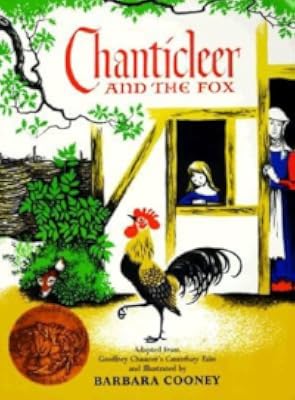
Chanticleer and the Fox
by Barbara Cooney
On This Page
Description
A sly fox tries to outwit a proud rooster through the use of flattery.Tags
Recommendations


Member Reviews
After reading Barbara Cooney’s acceptance speech for the Caldecott medal awarded to this book, I wanted to experience it for myself again. The story is a Middle Age fable with resemblance to Aesop’s The Fox and the Crow in which Chanticleer, a proud rooster, falls prey to the flattery of a predatory fox. He’s able to escape by tricking the fox in turn. I love how Cooney both preserved the style of Chaucer’s language and brought it to life with illustrations depicting the time period of the original text. There is also an adult adaptation of Chaucer’s tale that I love called The Book of the Dun Cow by Walter Wangerin, Jr.
After reading Barbara Cooney’s acceptance speech for the Caldecott medal awarded to this book, I wanted to experience it for myself again. The story is a Middle Age fable with resemblance to Aesop’s The Fox and the Crow in which Chanticleer, a proud rooster, falls prey to the flattery of a predatory fox. He’s able to escape by tricking the fox in turn. I love how Cooney both preserved the style of Chaucer’s language and brought it to life with illustrations depicting the time period of the original text. There is also an adult adaptation of Chaucer’s tale that I love called The Book of the Dun Cow by Walter Wangerin, Jr.
I could swear I've read this story before, either as a part of Aesop's Fables (especially with the moral mentioned at then end) or in one of Andrew Lang's Colour Fairy Books. But anyway, I've enjoyed other books illustrated by Barbara Cooney. However, this is one of her earlier works compared to the books I really liked (Miss Rumphius, Ox-Cart Man) so that would explain it.
It's not a bad book, a bit dated and a kid of today may wonder why a rooster has seven wives, lol. 3.5/5 stars. Out of Barbara Cooney's works, this is one of the weaker of her books.
It's not a bad book, a bit dated and a kid of today may wonder why a rooster has seven wives, lol. 3.5/5 stars. Out of Barbara Cooney's works, this is one of the weaker of her books.
Perhaps a little long-winded for today's young listeners, but it would probably make for a good family read. Despite the simple story, there are lots of discussion points.
For just one example, the widow 'had only three large sows, three cows, and also a sheep called Molly.' Then we meet Chanticleer and his harem of seven hens - so the natural question is, why didn't they count as the widow's property? (My guess would be that they're more taken-for-granted, as everyone had chickens, but to own the other animals was more notable, indicative of more success.)
And though there are lots of words, they're worth reading aloud. The rhythm and color and metaphor do help us remember the source, even if one has never actually read Chaucer.
For just one example, the widow 'had only three large sows, three cows, and also a sheep called Molly.' Then we meet Chanticleer and his harem of seven hens - so the natural question is, why didn't they count as the widow's property? (My guess would be that they're more taken-for-granted, as everyone had chickens, but to own the other animals was more notable, indicative of more success.)
And though there are lots of words, they're worth reading aloud. The rhythm and color and metaphor do help us remember the source, even if one has never actually read Chaucer.
“Chanticleer and the Fox” is about a rooster who is flattered by a fox into the woods. I didn’t feel that the illustrations added too much to the story, other than just repeating what the words had already said, but I did like the moral behind the story. This story, through its words and pictures, shows how falling so easily for someone’s flattery can land you in big trouble. The illustrations were very simple, but just detailed enough to be just what the story needs.
This simple, historic folktale from the 1400's is more like a fable because it teaches a lesson; when a fox tries to trick a proud rooster through flattery, rooster nearly dies. The primitive style illustrations show the time period by the clothing and environment; the illustrations are made by the scratchboard technique- most effective for printing in the 1950’s. This was a Caldecott winner. It can be used for discussions in art, history, moral lessons, and cause and effect.
This book is a children's version of Geoffrey Chaucer's "Nun's Priest's Tale," and is about the prized rooster on an old widow's farm. The rooster, Chanticleer has a nightmare about a fox attacking him, but the hen tell him he is just being a coward. The rooster is proven right when the fox comes and kidnaps the rooster. This story would be an excellent example of personification of animals, similes and metaphors, and story's that end with a moral. The book presents a simple story, but some of the language structures and word choices may be unfamiliar because the original story is from the 1300s.
Members
- Recently Added By
Lists

Caldecott Medal Books
91 works; 15 members

Honey For a Child's Heart
1,152 works; 25 members
Ambleside Books
459 works; 18 members

Rabbit and Fox Story Books For Children
139 works; 7 members

Ambleside Y2
33 works; 1 member

Before Austen Comes Aesop
318 works; 9 members

The Story of the World: History for the Classical Child: Activity Book Two
415 works; 2 members

Children's Picture Books
188 works; 1 member

Written and Illustrated By
805 works; 1 member

Read Aloud Revival
108 works; 4 members
Author Information

28+ Works 16,969 Members
Barbara Cooney and her twin brother were born on 6 August 1917 in Brooklyn, New York, in the Bossert Hotel. She grew up on Long Island, but spent her summers as a child in Maine. Cooney attended a boarding school as a child. Cooney graduated from Smith College in 1938 and studied lithography and etching at Art Students League in New York. Just one show more year after graduation, she had her first commission, the illustrations for Ake and His World by Bertil Malmberg. Recalling an earlier trip to Germany before the war and the horrors that she had seen there, she felt compelled to join the Women's Army Corps during the summer of 1942. She enrolled in officer training and achieved the rank of second lieutenant, but was honorably discharged the following spring because of marriage pregnancy. The couple bought a farm in Pepperell, Massachusetts where they ran a children's camp during the summer months. By this time, Cooney was illustrating several books a year and wrote one now and then. It was for her adaptation of Chaucer's The Nun Priest's Tale that she won the prestigious Caldecott Medal, the highest honor given for illustrated children's books in the United States, in 1959. Twenty-one years later, Cooney again won the Caldecott Medal for Ox-Cart Man written by Donald Hall. In 1993, Ms. Cooney deposited more than 400 pieces of original art from 21 of her books in the Northeastern Children's Literature Collection, a part of the University Libraries' Archives and Special Collections. Works from this collection and from the artist's private collection are shown in this exhibit. Miss Rumphius won the National Book Award in 1983 and inspired the creation of the Maine Library Association's Lupine Award. Cooney died on 14 March, 2000 at the age of 83. Her last book was Basket Moon published in September of 1999. (Bowker Author Biography) show less
All Editions
Awards and Honors
Work Relationships
Is a retelling of
Common Knowledge
- Canonical title
- Chanticleer and the Fox
- Original title
- Chanticleer and the Fox
- Original publication date
- 1958
- People/Characters
- Chanticleer
- Important events
- Middle Ages
- Dedication
- for Phoebe
- First words
- Once upon a time a poor widow, getting on in years, lived in a small cottage beside a grove which stood in a little valley.
- Last words
- (Click to show. Warning: May contain spoilers.)And she marched with her flock back to the yard in the little valley.
- Original language
- English
Classifications
Statistics
- Members
- 2,003
- Popularity
- 10,543
- Reviews
- 38
- Rating
- (3.78)
- Languages
- English
- Media
- Paper
- ISBNs
- 11
- ASINs
- 13