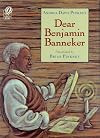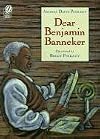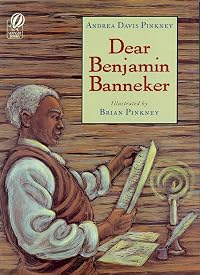
Dear Benjamin Banneker
by Andrea Davis Pinkney
On This Page
Description
Throughout his life Banneker was troubled that all blacks were not free. And so, in 1791, he wrote to Secretary of State Thomas Jefferson, who had signed the Declaration of Independence. Banneker attacked the institution of slavery and dared to call Jefferson a hypocrite for owning slaves. Jefferson responded. This is the story of Benjamin Banneker-his science, his politics, his morals, and his extraordinary correspondence with Thomas Jefferson. Illustrated in full-page scratchboard and oil show more paintings by Caldecott Honor artist Brian Pinkney. show lessTags
Recommendations

















Member Reviews
"Dear Benjamin Banneker" outlines the life of astronomer and mathematician Benjamin Banneker. Banneker was born a free person in 1731; his father was a former slave and his mother was also born free. As a child, he questioned the stars' movements in the night sky; the book illustrates Banneker's curiosity with math well in the first illustration, with a picture of him counting on his fingers. As a grown man, Banneker had little time to himself because he worked so much on the tobacco farm, but he was able to teach himself astronomy at night. After writing his first almanac, Banneker tries again and again to get it published, but many white publishers didn't think a black man could accurately create an almanac. However, James Pemberton show more gave Banneker a chance, and published his second almanac. After its publishing, Banneker wrote to the Secretary of State at the time, Thomas Jefferson. He spoke to him about the hypocrisy in fact that Jefferson wrote the Declaration of Independence to say "all men are created equal" while also owning black slaves. Banneker wanted a chance for all black people to learn and be educated just like he was able to, even if it was on his own. His 1792 almanac had sold out immediately.
This book does a very good job retelling Banneker's life in an engaging way, and I love the illustrations that accompany it. However, a significant portion of the book is dedicated to the letters between Thomas Jefferson and him. This would be fine, but the inclusion of large chunks of the original letters seems unnecessary and daunting for such a young audience. I feel the language used in these large chunks would discourage the young readers, , and book doesn't do a very good job of explaining what exactly is being said in the letters, either. I think it would be better to have used much smaller pieces of the letter, only those that are most important and easier to understand. Perhaps this would be too risky or inappropriate for a children's picture book, but I feel it would have been worthwhile to examine Jefferson's reply to Banneker, to make it known that despite his pretty words, Jefferson made no attempt to either release the slaves he owned nor to progress the fight for slavery to be abolished. Overall, I did enjoy the book and would recommend this story to a friend. show less
This book does a very good job retelling Banneker's life in an engaging way, and I love the illustrations that accompany it. However, a significant portion of the book is dedicated to the letters between Thomas Jefferson and him. This would be fine, but the inclusion of large chunks of the original letters seems unnecessary and daunting for such a young audience. I feel the language used in these large chunks would discourage the young readers, , and book doesn't do a very good job of explaining what exactly is being said in the letters, either. I think it would be better to have used much smaller pieces of the letter, only those that are most important and easier to understand. Perhaps this would be too risky or inappropriate for a children's picture book, but I feel it would have been worthwhile to examine Jefferson's reply to Banneker, to make it known that despite his pretty words, Jefferson made no attempt to either release the slaves he owned nor to progress the fight for slavery to be abolished. Overall, I did enjoy the book and would recommend this story to a friend. show less
Benjamin Banneker was a self-taught mathematician, astronomer, surveyor, farmer, inventor, author, and political activist who was born in Baltimore, Maryland in 1731 to a free African-American woman and a former slave.
As the authors explain in a forward, in 1791 Banneker wrote a letter to then Secretary of State Thomas Jefferson attacking the institution of slavery and calling Jefferson a hypocrite. (The ostensible purpose of the letter was to enclose the almanac Banneker wrote, which no one would publish but an abolitionist. You can read the full text of his letter here.)
As the authors quote from the letter, Banneker argued:
"…Sir, how pitiable is it to reflect, that although you were so fully convinced of the benevolence of the show more Father of Mankind, and of his equal and impartial distribution of these rights and privileges, which he hath conferred upon them, that you should at the same time counteract his mercies, in detaining by fraud and violence so numerous a part of my brethren, under groaning captivity and cruel oppression, that you should at the same time be found guilty of that most criminal act, which you professedly detested in others, with respect to yourselves.”
It is ironic that if Banneker were white, Jefferson would have sought him out as an intellectual soul mate. Many of Banneker’s interests mirrored those of Jefferson. Banneker even built a wooden clock by duplicating the gears of a borrowed pocket watch; Jefferson loved that kind of thing.
Jefferson responded to Banneker, claiming:
"I can add with truth that no body wishes more ardently to see a good system commenced for raising the condition both of their body & mind to what it ought to be, as fast as the imbecillity of their present existence, and other circumstance which cannot be neglected, will admit.”
[Unless, of course, it meant having to give up his own slaves.]
Washington and Jefferson did, however, hire Banneker to help survey Washington, D.C. for the new nation’s capital.
Banneker’s almanac was quite successful, and he continued to publish it each year until 1797.
The striking and powerful illustrations by Brian Pinkney were prepared as scratchboard rendering, hand-colored with oil paint.
Discussion: The story of Benjamin Banneker is truly inspirational, and Banneker is an important figure in both science and history about whom many are uninformed. However, I don’t think it was necessarily wise to use actual quotes from the correspondence of Banneker and Jefferson in a book intended for ages 5-10. The gist of the letters could have been summarized in simpler syntax to much greater effect. On the other hand, adjusting the suggested age range upward would fix the problem. show less
As the authors explain in a forward, in 1791 Banneker wrote a letter to then Secretary of State Thomas Jefferson attacking the institution of slavery and calling Jefferson a hypocrite. (The ostensible purpose of the letter was to enclose the almanac Banneker wrote, which no one would publish but an abolitionist. You can read the full text of his letter here.)
As the authors quote from the letter, Banneker argued:
"…Sir, how pitiable is it to reflect, that although you were so fully convinced of the benevolence of the show more Father of Mankind, and of his equal and impartial distribution of these rights and privileges, which he hath conferred upon them, that you should at the same time counteract his mercies, in detaining by fraud and violence so numerous a part of my brethren, under groaning captivity and cruel oppression, that you should at the same time be found guilty of that most criminal act, which you professedly detested in others, with respect to yourselves.”
It is ironic that if Banneker were white, Jefferson would have sought him out as an intellectual soul mate. Many of Banneker’s interests mirrored those of Jefferson. Banneker even built a wooden clock by duplicating the gears of a borrowed pocket watch; Jefferson loved that kind of thing.
Jefferson responded to Banneker, claiming:
"I can add with truth that no body wishes more ardently to see a good system commenced for raising the condition both of their body & mind to what it ought to be, as fast as the imbecillity of their present existence, and other circumstance which cannot be neglected, will admit.”
[Unless, of course, it meant having to give up his own slaves.]
Washington and Jefferson did, however, hire Banneker to help survey Washington, D.C. for the new nation’s capital.
Banneker’s almanac was quite successful, and he continued to publish it each year until 1797.
The striking and powerful illustrations by Brian Pinkney were prepared as scratchboard rendering, hand-colored with oil paint.
Discussion: The story of Benjamin Banneker is truly inspirational, and Banneker is an important figure in both science and history about whom many are uninformed. However, I don’t think it was necessarily wise to use actual quotes from the correspondence of Banneker and Jefferson in a book intended for ages 5-10. The gist of the letters could have been summarized in simpler syntax to much greater effect. On the other hand, adjusting the suggested age range upward would fix the problem. show less
Author Andrea Davis Pinkney and illustrator Brian Pinkney - the wife and husband team who produced such titles as Sit-In: How Four Friends Stood Up by Sitting Down and Duke Ellington: The Piano Prince and His Orchestra - present the story of Benjamin Banneker, the extraordinary eighteenth-century African-American astronomer and almanac writer, in this picture-book biography. Born free, at a time when most black people in America were held in bondage, Banneker was raised on his family's small tobacco farm in Maryland, and taught to read by his grandmother, from the family bible.
A self educated astronomer, Banneker began working on his own almanac in 1789, but was rejected by a number of publishers, until James Pemberton, of the show more Pennsylvania Society for the Abolition of Slavery, heard of his efforts, and helped him to find a publisher willing to take a chance on the first almanac to be written by a black man. Conscious of the role his own freedom played, in allowing him to develop his mind, and troubled by the fact that so many of his fellow African-Americans did not enjoy that same privilege, Banneker took the unusual step of writing to then Secretary of State, Thomas Jefferson, and posing a simple question: if he, Jefferson, truly believed the words he had penned, in the Declaration of Independence, then why did he own slaves...?
With an engaging text that presents the story of an fascinating figure from the early days of the American republic, and lovely scratch-board art - I particularly liked the depiction of the night skies - Dear Benjamin Banneker is a book I would recommend to young picture-book readers who enjoy biographical tales. show less
A self educated astronomer, Banneker began working on his own almanac in 1789, but was rejected by a number of publishers, until James Pemberton, of the show more Pennsylvania Society for the Abolition of Slavery, heard of his efforts, and helped him to find a publisher willing to take a chance on the first almanac to be written by a black man. Conscious of the role his own freedom played, in allowing him to develop his mind, and troubled by the fact that so many of his fellow African-Americans did not enjoy that same privilege, Banneker took the unusual step of writing to then Secretary of State, Thomas Jefferson, and posing a simple question: if he, Jefferson, truly believed the words he had penned, in the Declaration of Independence, then why did he own slaves...?
With an engaging text that presents the story of an fascinating figure from the early days of the American republic, and lovely scratch-board art - I particularly liked the depiction of the night skies - Dear Benjamin Banneker is a book I would recommend to young picture-book readers who enjoy biographical tales. show less
Most people think of Benjamin Franklin when they reflect on almanacs written during the 1700s but this beautifully illustrated book introduces another author of almanacs during the late 1700s. The book gives an account of the achievements of Benjamin Banneker. Benjamin Banneker lived during a time when many people believed that African Americans were not as intelligent as other Americans. Banneker didn’t let the perspectives of others stop him from studying astronomy and overcoming obstacles to reach his goal. This is a great book for anyone who may feel they can not accomplish their dreams because of setbacks or other peoples beliefs of their abilities.
This story held both a heavy historical and educational value. Reading the story of Banneker's life and effort to not only publish his almanac but to be recognized as a free, educated black man fighting for the rights of others was inspiring. He went so far as to even write to Thomas Jefferson to address a very important question as to why if Thomas Jefferson, who stated that everyone had rights of "life, liberty and the pursuit of happiness" - though it did not apply to the slaves that even he owned. Prior reading this book, I did not know who he was and learned that his was born to a free parents that owned a farm, wrote an almanac not once but twice before it was published, was in communications with Thomas Jefferson, argued against show more slavery and became a symbol of the betterment of America, and did not live to see the abolition of it. show less
Retelling: Benjamin Banneker was one of very few, landowning African Americans born free in Virginia in 1731. His mother taught him to read from the bible, the only book she had. Between his arduous duties on the family tobacco farm, Banneker studied the sky and used his findings to publish an almanac. His almanac was published by abolitionists and gained popularity. He famously wrote to Thomas Jefferson encouraging him to be true to his words and free his own slaves. Thomas Jefferson replied.
Thoughts and Feelings: Benjamin Banneker was fifty-seven when he started teaching himself astronomy and that's back when people didn't live as long as they do today. I will remember that fact the next time someone tells me they're too old to learn show more something. show less
Thoughts and Feelings: Benjamin Banneker was fifty-seven when he started teaching himself astronomy and that's back when people didn't live as long as they do today. I will remember that fact the next time someone tells me they're too old to learn show more something. show less
Benjamin was born free, and he worked on a tobacco farm with his parents. When he was 21, he worked harder to maintain the farm his parents left him. After many years, he began to study astronomy. He had a few astronomy books, but he mostly taught himself to study the movements of the stars. Benjamin wanted to create his almanac. An almanac had the cycles of the sun, seasons, and weather. Benjamin created an almanac, but no one wanted to publish it for him because he was African American. Eventually he sent an almanac to Thomas Jefferson, and a letter criticizing slavery. Thomas Jefferson responded to Benjamin and published his almanac. The almanac sold out quickly, and Benjamin sold his farm. It is always a pleasure to read books by show more Andrea Davis Pinkney because her stories always keep me interested. The story gave me background about Benjamin, and provided letters that Benjamin wrote to Thomas Jefferson. This book will be great for children, because they can learn more about African American History. I would provide some type of math activity for students. show less
Members
- Recently Added By
Lists

Beautiful Feet Books
304 works; 7 members
Author Information

59+ Works 12,615 Members
All Editions
Awards and Honors
Common Knowledge
- Canonical title
- Dear Benjamin Banneker
- Original publication date
- 1994
- People/Characters
- Benjamin Banneker; Thomas Jefferson
- First words
- No slave master ever ruled over Benjamin Banneker as he was growing up in Maryland along the Patapsco River.
- Last words
- (Click to show. Warning: May contain spoilers.)But his almanacs and the letter he wrote to Thomas Jefferson showed everybody that all men are indeed created equal.
Classifications
Statistics
- Members
- 900
- Popularity
- 29,863
- Reviews
- 12
- Rating
- (4.22)
- Languages
- English
- Media
- Paper, Ebook
- ISBNs
- 10
- ASINs
- 3