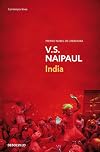
India: A Million Mutinies Now
by V. S. Naipaul
On This Page
Description
The Nobel Prize-winning author delivers an impassioned and prescient travelogue of his journeys through his ancestral homeland. • “An intricate, splendid, and utterly memorable book.” — The New York Times Book Review Arising out of Naipaul’s lifelong obsession and passion for a country that is at once his and totally alien, India: A Million Mutinies Now relates the stories of many of the people he met traveling there more than fifty years ago. He explores how they have been show more steered by the innumerable frictions present in Indian society—the contradictions and compromises of religious faith, the whim and chaos of random political forces. This book represents Naipaul’s last word on his homeland, complementing his two other India travelogues, An Area of Darkness and India: A Wounded Civilization. show lessTags
Recommendations






















Member Recommendations
Member Reviews
The third book of V.S. Naipaul on India, written 26 years after the first one in 1962 and 13 after the second in 1975, again shifts its writing premises and tackles its subject with a distinctly different approach from the other two books: While those had held up India to some kind of standard and measured it against that (the reality usually falling spectacularly short), India: A Milltion Mutinies Now attempts to take India entirely on its own terms, to not present it as viewed from the distance of an observer or analyst but to let it speak for itself, in its own words. And quite literally so: Most of this book consists of interviews Naipaul led with a large variety of people he met while travelling. There still are passages of show more anecdotes and descriptions like in An Area of Darkness or of analysis like in India: A Wounded Civilization, but the bulk of of India: A Milltion Mutinies Now simply consists of people talking to Naipaul.
And of course it is not as simple as that: Immediacy is something hard to achieve and Naipaul, being the perceptive and scrupulous writer that he is, knows that very well, never forgetting to remind us that most of the interviews he presents us with have been filtered through translation. He constantly mentions and name-drops his translators until one gets the feeling that he is surrounded by them like a shark by pilot fish. Or maybe rather a turtle than a shark, for as has been often remarked, India: A Million Mutinies Now is not as biting in its criticism as the earlier books, seems even mellow in comparison. Personally, though, I think that first appearances are a bit deceptive here – a lot of this seeming mellowness is owed to the basic decision of presenting India and its people in their own words, and Naipaul hence chosing to let his interview partners destroy themselves rather than taking them apart by his commentary. He frequently shows that he can be as trenchant and incisive (not to mention nasty) as ever; and one cannot help but wonder whether the hopeful view of India’s future is really his or that of the people he interviews. Naipaul certainly perceives India in 1988 as a country in unrest and motion (the “million mutinies” of the title), seething with conflict and potentialities, but for my part I would be hesitant to say just how optimistic he really is about where this may lead for India’s future.
In any case, this is also is the by far longest of the three books, and at the same the most tightly structured: Each of its parts has its emphasis an a particular group or juxtaposition of groups (Sena, brahmin / anti-brahmin, scientists, boxwallah / Maoists, Sikh) each of which is located in a particular region centered around a city (Bombay, Goa, Bangalore, Madras, Calcutta, Chandigarh). And the latter is not just contingent, but touches an essential of those groups and the people that speak for them in this book – India: A Million Mutinies Now is as much a book about space as it is about people. About real as well as symbolical space and particularly the ways in which they intersect, as in the case of the high Sena official who prefers living in a small worker’s tenement because it puts him in contact with other people while a bourgeois apartment leaves him isolated. Again and again Naipaul emphasises the way architecture and spatial environment shape and influence social space, the people who live in an area, and again and again Naipaul returns to the cramped living conditions, many people sharing a small space, something that can be both a blessing and a curse: “He would show both places to me later from the roof terrace: the drama of small spaces and short distances, the settings themselves always accessible afterwards, never really out of sight, and perhaps for this reason cleansed (like stage sets) of the emotions they had once held.” The Indian people are defined by the spaces they grew up and live in, whether they confine themselves within them, try to break free of them or attempt to change them.
All of this fits together so very neatly that it immediately raises suspicion, and I believe is intended to: Paradoxically, this most experience-saturated and immediate of Naipaul’s books on India is also the most literary; and just by the way he has arranged his material, the author never lets us forget that this is not a simple reporting of facts but has been filtered and transformed into a work of art – the formal equivalent to the cloud of translators surrounding Naipaul on his forages into Indian life, both indicating a distance between Naipaul (and the reader) and his material, Entfremdung as well as Verfremdung, alienation both as being a stranger in a strange land as well as literary distancing technique.
In the final chapter of the book, Naipaul becomes his own tourist attraction when he returns to the hotel in Kashmir where he stayed for several months in 1962 and which he wrote about extensively in An Area of Darkness. His second visit is both nostalgic and merciless, the sepia colouring of memory never quite glossing over the continued disparagement of the people he encounters, nor the keen awareness of his own ridiculousness in these surroundings, among those people If this was a novel, it would be a metafictional twist, but with this being a travel book one has to wonder if there might be such a thing as meta-non-fiction and whether Naipaul may not have invented it. Whatever you want to call it, it marks the brilliant conclusion to a brilliant trilogy of travel books which deserve to be read as such even if one has no interest for their subject matter. show less
And of course it is not as simple as that: Immediacy is something hard to achieve and Naipaul, being the perceptive and scrupulous writer that he is, knows that very well, never forgetting to remind us that most of the interviews he presents us with have been filtered through translation. He constantly mentions and name-drops his translators until one gets the feeling that he is surrounded by them like a shark by pilot fish. Or maybe rather a turtle than a shark, for as has been often remarked, India: A Million Mutinies Now is not as biting in its criticism as the earlier books, seems even mellow in comparison. Personally, though, I think that first appearances are a bit deceptive here – a lot of this seeming mellowness is owed to the basic decision of presenting India and its people in their own words, and Naipaul hence chosing to let his interview partners destroy themselves rather than taking them apart by his commentary. He frequently shows that he can be as trenchant and incisive (not to mention nasty) as ever; and one cannot help but wonder whether the hopeful view of India’s future is really his or that of the people he interviews. Naipaul certainly perceives India in 1988 as a country in unrest and motion (the “million mutinies” of the title), seething with conflict and potentialities, but for my part I would be hesitant to say just how optimistic he really is about where this may lead for India’s future.
In any case, this is also is the by far longest of the three books, and at the same the most tightly structured: Each of its parts has its emphasis an a particular group or juxtaposition of groups (Sena, brahmin / anti-brahmin, scientists, boxwallah / Maoists, Sikh) each of which is located in a particular region centered around a city (Bombay, Goa, Bangalore, Madras, Calcutta, Chandigarh). And the latter is not just contingent, but touches an essential of those groups and the people that speak for them in this book – India: A Million Mutinies Now is as much a book about space as it is about people. About real as well as symbolical space and particularly the ways in which they intersect, as in the case of the high Sena official who prefers living in a small worker’s tenement because it puts him in contact with other people while a bourgeois apartment leaves him isolated. Again and again Naipaul emphasises the way architecture and spatial environment shape and influence social space, the people who live in an area, and again and again Naipaul returns to the cramped living conditions, many people sharing a small space, something that can be both a blessing and a curse: “He would show both places to me later from the roof terrace: the drama of small spaces and short distances, the settings themselves always accessible afterwards, never really out of sight, and perhaps for this reason cleansed (like stage sets) of the emotions they had once held.” The Indian people are defined by the spaces they grew up and live in, whether they confine themselves within them, try to break free of them or attempt to change them.
All of this fits together so very neatly that it immediately raises suspicion, and I believe is intended to: Paradoxically, this most experience-saturated and immediate of Naipaul’s books on India is also the most literary; and just by the way he has arranged his material, the author never lets us forget that this is not a simple reporting of facts but has been filtered and transformed into a work of art – the formal equivalent to the cloud of translators surrounding Naipaul on his forages into Indian life, both indicating a distance between Naipaul (and the reader) and his material, Entfremdung as well as Verfremdung, alienation both as being a stranger in a strange land as well as literary distancing technique.
In the final chapter of the book, Naipaul becomes his own tourist attraction when he returns to the hotel in Kashmir where he stayed for several months in 1962 and which he wrote about extensively in An Area of Darkness. His second visit is both nostalgic and merciless, the sepia colouring of memory never quite glossing over the continued disparagement of the people he encounters, nor the keen awareness of his own ridiculousness in these surroundings, among those people If this was a novel, it would be a metafictional twist, but with this being a travel book one has to wonder if there might be such a thing as meta-non-fiction and whether Naipaul may not have invented it. Whatever you want to call it, it marks the brilliant conclusion to a brilliant trilogy of travel books which deserve to be read as such even if one has no interest for their subject matter. show less
l'unico scrittore-nobel che non mi abbia mai deluso. Duro e ferrigno, non distoglie mai gli occhi dalla realtà perchè non sembra esserne capace. Quindi nessuna consolazione, neanche dai buoni sentimenti.
Le sue molteplici 'India', raccontate con una una lingua ricca e asciutta (è possibile?) si scolpiscono nella mente per sempre. Questo sopra a tutti. Più che una lettura un'esperienza
Le sue molteplici 'India', raccontate con una una lingua ricca e asciutta (è possibile?) si scolpiscono nella mente per sempre. Questo sopra a tutti. Più che una lettura un'esperienza
A few years ago, there was a television show by Israeli journalist Rino Tzror, who would usually go to some neglected part of the country and try to understand the big problems of the country by talking with the local people. He always made sure to talk to the people who weren't always heard on the news - not with ministers, and speakers, and celebrities, but with the actual people who lived through the events, and through them he tried to understand the silent undertones that shaped the important events that were happening below the surface.
When I read Naipaul's book, I felt like I was reading an extra-long episode of Tzror's show, taking place in India. He has a very similar style, talking with the simple people, looking for silent show more undercurrents that are not obvious from outside, but shape the long-term developments of the world. All that is written in an excellent style, and not once throughout the (quite long) book did I feel bored or tired.
I knew next to nothing about India before reading this book and I still knew very little after it, but it definitely improved my understanding of it. Hindu and Marathi nationalism, the troubles of the Dalit, the politics of the Sikhs - while I obviously didn't become an expert on any of those, I got an introduction that helped me make a little more sense of that giant country. For anyone looking for a little look at a fascinating country that in the west we don't usually hear much about, I definitely recommend this. show less
When I read Naipaul's book, I felt like I was reading an extra-long episode of Tzror's show, taking place in India. He has a very similar style, talking with the simple people, looking for silent show more undercurrents that are not obvious from outside, but shape the long-term developments of the world. All that is written in an excellent style, and not once throughout the (quite long) book did I feel bored or tired.
I knew next to nothing about India before reading this book and I still knew very little after it, but it definitely improved my understanding of it. Hindu and Marathi nationalism, the troubles of the Dalit, the politics of the Sikhs - while I obviously didn't become an expert on any of those, I got an introduction that helped me make a little more sense of that giant country. For anyone looking for a little look at a fascinating country that in the west we don't usually hear much about, I definitely recommend this. show less
This book is surprisingly more objective and less visceral than "A wounded civilization". Several things must have happened,
- Someone must have given him a piece of their mind and made him see reason
- He must have after some introspection arrived at that reason
I cannot still forgive him for his insensitive comments and opinions in his previous work so for me he will still remain what I have mentioned in my earlier comments.
This book is actually a very interesting read. It is surprisingly more detailed and descriptive than his previous works. His analysis of the Southern Dravidian movement made for some especially interstesting reading. In fact, the whole book so far has been thus. His detailed conversations and observations from show more people all over the country, representing a wide strata of society. I wish such common sense had prevailed in his earlier work about India. show less
- Someone must have given him a piece of their mind and made him see reason
- He must have after some introspection arrived at that reason
I cannot still forgive him for his insensitive comments and opinions in his previous work so for me he will still remain what I have mentioned in my earlier comments.
This book is actually a very interesting read. It is surprisingly more detailed and descriptive than his previous works. His analysis of the Southern Dravidian movement made for some especially interstesting reading. In fact, the whole book so far has been thus. His detailed conversations and observations from show more people all over the country, representing a wide strata of society. I wish such common sense had prevailed in his earlier work about India. show less
This book is surprisingly more objective and less visceral than "A wounded civilization". Several things must have happened,
- Someone must have given him a piece of their mind and made him see reason
- He must have after some introspection arrived at that reason
I cannot still forgive him for his insensitive comments and opinions in his previous work so for me he will still remain what I have mentioned in my earlier comments.
This book is actually a very interesting read. It is surprisingly more detailed and descriptive than his previous works. His analysis of the Southern Dravidian movement made for some especially interstesting reading. In fact, the whole book so far has been thus. His detailed conversations and observations from show more people all over the country, representing a wide strata of society. I wish such common sense had prevailed in his earlier work about India. show less
- Someone must have given him a piece of their mind and made him see reason
- He must have after some introspection arrived at that reason
I cannot still forgive him for his insensitive comments and opinions in his previous work so for me he will still remain what I have mentioned in my earlier comments.
This book is actually a very interesting read. It is surprisingly more detailed and descriptive than his previous works. His analysis of the Southern Dravidian movement made for some especially interstesting reading. In fact, the whole book so far has been thus. His detailed conversations and observations from show more people all over the country, representing a wide strata of society. I wish such common sense had prevailed in his earlier work about India. show less
This book does an amazing job at painting a picture of the then modern day India. India really captures the feeling of the country.
Ratings
Members
- Recently Added By
Lists

Non-Fiction Worth Reading
1,015 works; 261 members
Author Information

96+ Works 25,789 Members
Vidiadhar Surajprasad Naipaul was born of Indian ancestry in Chaguanas, Trinidad on August 17, 1932. He was educated at University College, Oxford and lived in Great Britain since 1950. From 1954 to 1956, he edited a radio program on literature for the British Broadcasting Corporation's Caribbean Service. His first novel, The Mystic Masseur, was show more published in 1957. His other novels included A House for Mr. Biswas, A Bend in the River, Guerrillas, and Half a Life. In a Free State won the Booker Prize in 1971. He started writing nonfiction in the 1960s. His first nonfiction book, The Middle Passage, was published in 1962. His other nonfiction works included An Area of Darkness, Among the Believers, Beyond Belief, and A Turn in the South. He was knighted in 1990 and received the Nobel Prize in Literature in 2001. He died on August 11, 2018 at the age of 85. (Bowker Author Biography) show less
Awards and Honors
Series
Belongs to Publisher Series
Grote ABC (743)
Common Knowledge
- Canonical title*
- India. Un milione di rivolte
- Original title
- India: a Million Mutinies Now
- Original publication date
- 1990
- Important places
- India
- First words*
- Bombay è la folla. Ma quella mattina, mentre dall'aeroporto mi dirigevo verso la città, cominciai a sospettare che la gente sui marciapiedi e sulla strada fosse particolarmente numerosa e che stava accadendo qualcosa di inu... (show all)suale.
- Last words*
- (Click to show. Warning: May contain spoilers.)Proprio il giorno prima, disse Paritosh, avevano incominciato a smantellare il ghetto in cui avevano vissuto per tante settimane. Gli aveva dato una stretta al cuore.
- Original language*
- Inglés
*Some information comes from Common Knowledge in other languages. Click "Edit" for more information.
Classifications
- Genres
- Travel, Nonfiction, General Nonfiction
- DDC/MDS
- 915.40452 — History & geography Geography & travel Geography of and travel in Asia India and neighboring south Asian countries Travel; guidebooks 1971– 1977-1999
- LCC
- DS414.2 .N35 — History of Europe, Asia, Africa and Oceania Asia History of Asia India (Bharat)
- BISAC
Statistics
- Members
- 926
- Popularity
- 28,727
- Reviews
- 6
- Rating
- (3.62)
- Languages
- 10 — Dutch, English, French, Hebrew, Italian, Japanese, Polish, Portuguese (Portugal), Spanish, Swedish
- Media
- Paper, Audiobook, Ebook
- ISBNs
- 37
- ASINs
- 9