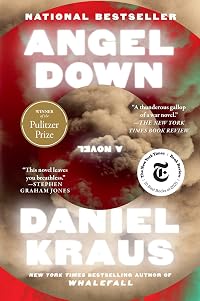
Angel Down
by Daniel Kraus
On This Page
Description
"The critically acclaimed author of the "crazily enjoyable" (The New York Times) Whalefall returns with an immersive, cinematic novel about five World War I soldiers who stumble upon a fallen angel that could hold the key to ending the war. Private Cyril Bagger has managed to survive the unspeakable horrors of the Great War through his wits and deception, swindling fellow soldiers at every opportunity. But his survival instincts are put to the ultimate test when he and four other grunts are show more given a deadly mission: venture into the perilous No Man's Land to euthanize a wounded comrade. What they find amid the ruined battlefield, however, is not a man in need of mercy but a fallen angel, seemingly struck down by artillery fire. This celestial being may hold the key to ending the brutal conflict, but only if the soldiers can suppress their individual desires and work together. As jealousy, greed, and paranoia take hold, the group is torn apart by their inner demons, threatening to turn their angelic encounter into a descent into hell. Angel Down plunges you into the heart of World War I and weaves a polyphonic tale of survival, supernatural wonder, and moral conflict"-- show lessTags
Recommendations































Member Recommendations
jscape2000 A pair of dark comedies amid the horrors of war. Memorable protagonists, a wide ensemble, and possible divine intervention.
Member Reviews
Tragic events elbow a scheming draft dodger onto WWI’s carcass filled killing grounds where he drags his sorry ass over mud, blood and mutilated body parts to euthanize a screaming, suffering, squaddie, and upon reaching the wretched soul, finds instead, an injured angel exuding an intense beam of light which, ominously, guides the aim of Kraut cannon-shot toward her, and all of this tale is told with one never-ending sentence, no periods, none, but a million craved commas allow one to catch a breath. Have to say, I recommend this one.
Rating: 4.5* of five
The Publisher Says: The critically acclaimed author of the “crazily enjoyable” (The New York Times) Whalefall returns with an immersive, cinematic novel about five World War I soldiers who stumble upon a fallen angel that could hold the key to ending the war.
Private Cyril Bagger has managed to survive the unspeakable horrors of the Great War through his wits and deception, swindling fellow soldiers at every opportunity. But his survival instincts are put to the ultimate test when he and four other grunts are given a deadly venture into the perilous No Man’s Land to euthanize a wounded comrade.
What they find amid the ruined battlefield, however, is not a man in need of mercy but a fallen angel, seemingly struck show more down by artillery fire. This celestial being may hold the key to ending the brutal conflict, but only if the soldiers can suppress their individual desires and work together. As jealousy, greed, and paranoia take hold, the group is torn apart by their inner demons, threatening to turn their angelic encounter into a descent into hell.
Angel Down plunges you into the heart of World War I and weaves a polyphonic tale of survival, supernatural wonder, and moral conflict.
I RECEIVED A DRC FROM THE PUBLISHER VIA NETGALLEY. THANK YOU.
My Review: I learned early in life that humans are vile, irredeemable homunculi, ruled by hatred, greed, and envy. Church was a solid training ground, thank you Jesus. So the story of the men in this tale wasn't a revelation or a surprise, nor an insulting calumny on humankind. It merely felt like I was hearing from a cheerier, more forgiving soul-sibling of mine.
Did anyone I know read Ducks, Newburyport? That hugely long sentence has a smaller sibling now in Kraus's latest, weird-stop-full-out toccata for literary pipe organ. It's about greed and hate and jealous loathing and fear...it's about humans trying to cope with transcendent realities while in the mire of fantastical pestilential mud. It's what your soul wants and your body resists while you can't even see a yard ahead because you need not to be slaughtered.
Unlike Lucy Ellmann's genius work of transcendence in the quotidian...I'm too intimidated to review it, there's just too much in there I want to read aloud to you!...this sentence is more compressible. It feels like Author Kraus did what Warhol did in Empire...turned on the camera after framing the shot then went away...but the point of this story is not to watch as time passes but watch as feelings, desires, emotions pass. It's a Zen in-joke. It's the kind of technique that some bounce off hard. It's meant to enable you as reader to get inside a flow of experiences of reality without ever feeling you are limited to just one. White space is your resting point; the absence of periods/full stops is your clue to the emotional reality of the Great War these people are utterly mired in, consumed by, entrapped entombed enmeshed inside.
The experiences are all, mental emotional psychical transcendent one and all, all of them are brutal and honest and unsentimentally crudely Earthy. In the midst of a grinding torturous killing machine with no end to the horror pain cruelty waste dehumanization, how else could they be? An angel from God in Her Heaven wounded and suffering? A divine being in need? A war experience that encompasses this! An actual angel laid low and so accessible to the traumatized men in need of a miracle....
So now, this being the case, what do these men do? Why do they hesitate or even reject doing the "obvious" and stopping the War? but a nagging voice insists it’s a miracle, which only pisses him off, he’ll be goddamned if he’s going to start believing in miracles here in hell
Bagger is our PoV. He is not one bit better than he is forced to be. He is canny, savvy to the ways of the world; he has a limited intellect, and if he has a soul, I saw no evidence of it. Arno, his foil, is Lumpenproletariat on legs, though more redeemable in my eyes than Bagger.
So how to explain my four and a half stars, when everything I've said either points all the way up or all the way down? I'm missing one key thing to make it the holotype war-fantasy story to rule them all: Why? Within the story, the why? never comes. I understand it's deliberate, it's a choice not a lapse. I still think a "why"...why Bagger, why now, why angel not demon...anchors a story set in a brutally real setting better than a lingering question does.
Gore, wickedness, horror, and all, it's one of my favorite reads of 2025. show less
The Publisher Says: The critically acclaimed author of the “crazily enjoyable” (The New York Times) Whalefall returns with an immersive, cinematic novel about five World War I soldiers who stumble upon a fallen angel that could hold the key to ending the war.
Private Cyril Bagger has managed to survive the unspeakable horrors of the Great War through his wits and deception, swindling fellow soldiers at every opportunity. But his survival instincts are put to the ultimate test when he and four other grunts are given a deadly venture into the perilous No Man’s Land to euthanize a wounded comrade.
What they find amid the ruined battlefield, however, is not a man in need of mercy but a fallen angel, seemingly struck show more down by artillery fire. This celestial being may hold the key to ending the brutal conflict, but only if the soldiers can suppress their individual desires and work together. As jealousy, greed, and paranoia take hold, the group is torn apart by their inner demons, threatening to turn their angelic encounter into a descent into hell.
Angel Down plunges you into the heart of World War I and weaves a polyphonic tale of survival, supernatural wonder, and moral conflict.
I RECEIVED A DRC FROM THE PUBLISHER VIA NETGALLEY. THANK YOU.
My Review: I learned early in life that humans are vile, irredeemable homunculi, ruled by hatred, greed, and envy. Church was a solid training ground, thank you Jesus. So the story of the men in this tale wasn't a revelation or a surprise, nor an insulting calumny on humankind. It merely felt like I was hearing from a cheerier, more forgiving soul-sibling of mine.
Did anyone I know read Ducks, Newburyport? That hugely long sentence has a smaller sibling now in Kraus's latest, weird-stop-full-out toccata for literary pipe organ. It's about greed and hate and jealous loathing and fear...it's about humans trying to cope with transcendent realities while in the mire of fantastical pestilential mud. It's what your soul wants and your body resists while you can't even see a yard ahead because you need not to be slaughtered.
Unlike Lucy Ellmann's genius work of transcendence in the quotidian...I'm too intimidated to review it, there's just too much in there I want to read aloud to you!...this sentence is more compressible. It feels like Author Kraus did what Warhol did in Empire...turned on the camera after framing the shot then went away...but the point of this story is not to watch as time passes but watch as feelings, desires, emotions pass. It's a Zen in-joke. It's the kind of technique that some bounce off hard. It's meant to enable you as reader to get inside a flow of experiences of reality without ever feeling you are limited to just one. White space is your resting point; the absence of periods/full stops is your clue to the emotional reality of the Great War these people are utterly mired in, consumed by, entrapped entombed enmeshed inside.
The experiences are all, mental emotional psychical transcendent one and all, all of them are brutal and honest and unsentimentally crudely Earthy. In the midst of a grinding torturous killing machine with no end to the horror pain cruelty waste dehumanization, how else could they be? An angel from God in Her Heaven wounded and suffering? A divine being in need? A war experience that encompasses this! An actual angel laid low and so accessible to the traumatized men in need of a miracle....
So now, this being the case, what do these men do? Why do they hesitate or even reject doing the "obvious" and stopping the War? but a nagging voice insists it’s a miracle, which only pisses him off, he’ll be goddamned if he’s going to start believing in miracles here in hell
Bagger is our PoV. He is not one bit better than he is forced to be. He is canny, savvy to the ways of the world; he has a limited intellect, and if he has a soul, I saw no evidence of it. Arno, his foil, is Lumpenproletariat on legs, though more redeemable in my eyes than Bagger.
So how to explain my four and a half stars, when everything I've said either points all the way up or all the way down? I'm missing one key thing to make it the holotype war-fantasy story to rule them all: Why? Within the story, the why? never comes. I understand it's deliberate, it's a choice not a lapse. I still think a "why"...why Bagger, why now, why angel not demon...anchors a story set in a brutally real setting better than a lingering question does.
Gore, wickedness, horror, and all, it's one of my favorite reads of 2025. show less
In “Angel Down,” Daniel Kraus delivers a surreal and deeply unsettling anti-war novel that combines lyrical prose with scenes of almost unbearable brutality. The result is a fever dream of trench warfare in which mud, blood, greed, and superstition merge into something mythic and grotesque. Kraus creates a world where humanity appears trapped in an endless cycle of violence, unable—or unwilling—to escape its own appetite for destruction.
The protagonist, Bagger, is an especially compelling creation. He is the son of a bishop lost in the sinking of the Lusitania. Yet Bagger has rejected his father’s religion and all forms of altruism. Before the war, he survived by cheating at cards and exploiting others. Once drafted, he show more continues to evade danger whenever possible. Bagger initially seems almost irredeemable. He is selfish, cynical, and emotionally hollow. Yet Kraus wisely avoids making him a cartoonish figure. Beneath the greed and cowardice lies a damaged man whose moral instincts have not been entirely extinguished.
The novel’s central episode begins with a bizarre mission ordered by a power-hungry, physically damaged, and possibly insane general. Bagger and four other soldiers are ordered into no man’s land to silence a wounded man crying for help. Even this grim task becomes corrupted when the men decide who must go using a rigged game of rock, paper, scissors. Bagger cheats, naturally, but unexpectedly chooses to accompany the innocent young loser. That small act of reluctant decency becomes the hinge upon which the novel turns.
What they discover in the barbed wire is not a wounded soldier, but a fallen angel. From that moment forward, the novel abandons realism and plunges fully into hallucination and allegory. The angel becomes an object of obsession. The soldiers and general alike project onto her their desires for power, love, family, transcendence, or salvation. She appears capable of granting their wishes, yet every gift demands a terrible price, usually measured in suffering and death.
The imagery throughout the novel is extraordinary. Kraus writes with a lyrical intensity that often contrasts sharply with the horror he depicts. His trench warfare scenes are revolting in their physical detail, yet they possess a strange poetic beauty. Decaying body parts are everywhere, mud drowns men, and violence becomes almost overwhelming. The language itself reflects the chaos surrounding the characters, contributing to an increasingly dreamlike atmosphere.
At times, the novel’s hallucinatory structure threatens to overwhelm its meaning. As the plot grows stranger and more chaotic, the symbolism of the angel becomes elusive. She seems to represent many things simultaneously—faith, temptation, hope, war, human desire, even technological destruction. Because Kraus resists reducing her to a single interpretation, readers searching for a clear allegorical message may find the novel frustratingly opaque. Yet that uncertainty may be precisely Kraus’s point. War is chaotic. It destroys coherence, morality, and certainty. In this case, humanity cannot even encounter the divine without immediately seeking to possess, exploit, or weaponize it. Ultimately, Kraus suggests that killing not only persisted throughout history but has evolved to become easier, more technological, but more spiritually empty. This vision of humanity seems profoundly grim.
Still, Kraus leaves behind a faint glimmer of ambiguity. The angel’s fascination with Bagger’s unexpected moment of selflessness hints that even within a ruined soul, the capacity for compassion survives. That possibility never becomes sentimental or redemptive, but it prevents the novel from collapsing entirely into nihilism. The ending leaves the reader suspended between despair and hope, uncertain whether humanity is doomed to endless violence or merely unable to imagine another path. The final words are: “and, and, and…” echoing a level of uncertainty that leaves one questioning the future of humanity.
This is not an easy novel to interpret or endure. Its grotesque imagery, surreal narrative turns, and relentless darkness make it deeply unsettling. But it is also daring, imaginative, and hauntingly original. It is a novel interested in exposing the spiritual corruption that violence unleashes within the human soul. show less
The protagonist, Bagger, is an especially compelling creation. He is the son of a bishop lost in the sinking of the Lusitania. Yet Bagger has rejected his father’s religion and all forms of altruism. Before the war, he survived by cheating at cards and exploiting others. Once drafted, he show more continues to evade danger whenever possible. Bagger initially seems almost irredeemable. He is selfish, cynical, and emotionally hollow. Yet Kraus wisely avoids making him a cartoonish figure. Beneath the greed and cowardice lies a damaged man whose moral instincts have not been entirely extinguished.
The novel’s central episode begins with a bizarre mission ordered by a power-hungry, physically damaged, and possibly insane general. Bagger and four other soldiers are ordered into no man’s land to silence a wounded man crying for help. Even this grim task becomes corrupted when the men decide who must go using a rigged game of rock, paper, scissors. Bagger cheats, naturally, but unexpectedly chooses to accompany the innocent young loser. That small act of reluctant decency becomes the hinge upon which the novel turns.
What they discover in the barbed wire is not a wounded soldier, but a fallen angel. From that moment forward, the novel abandons realism and plunges fully into hallucination and allegory. The angel becomes an object of obsession. The soldiers and general alike project onto her their desires for power, love, family, transcendence, or salvation. She appears capable of granting their wishes, yet every gift demands a terrible price, usually measured in suffering and death.
The imagery throughout the novel is extraordinary. Kraus writes with a lyrical intensity that often contrasts sharply with the horror he depicts. His trench warfare scenes are revolting in their physical detail, yet they possess a strange poetic beauty. Decaying body parts are everywhere, mud drowns men, and violence becomes almost overwhelming. The language itself reflects the chaos surrounding the characters, contributing to an increasingly dreamlike atmosphere.
At times, the novel’s hallucinatory structure threatens to overwhelm its meaning. As the plot grows stranger and more chaotic, the symbolism of the angel becomes elusive. She seems to represent many things simultaneously—faith, temptation, hope, war, human desire, even technological destruction. Because Kraus resists reducing her to a single interpretation, readers searching for a clear allegorical message may find the novel frustratingly opaque. Yet that uncertainty may be precisely Kraus’s point. War is chaotic. It destroys coherence, morality, and certainty. In this case, humanity cannot even encounter the divine without immediately seeking to possess, exploit, or weaponize it. Ultimately, Kraus suggests that killing not only persisted throughout history but has evolved to become easier, more technological, but more spiritually empty. This vision of humanity seems profoundly grim.
Still, Kraus leaves behind a faint glimmer of ambiguity. The angel’s fascination with Bagger’s unexpected moment of selflessness hints that even within a ruined soul, the capacity for compassion survives. That possibility never becomes sentimental or redemptive, but it prevents the novel from collapsing entirely into nihilism. The ending leaves the reader suspended between despair and hope, uncertain whether humanity is doomed to endless violence or merely unable to imagine another path. The final words are: “and, and, and…” echoing a level of uncertainty that leaves one questioning the future of humanity.
This is not an easy novel to interpret or endure. Its grotesque imagery, surreal narrative turns, and relentless darkness make it deeply unsettling. But it is also daring, imaginative, and hauntingly original. It is a novel interested in exposing the spiritual corruption that violence unleashes within the human soul. show less
In Angel Down, Cyril Bagger, a WWI doughboy on a grave-digging detail, finds a winged woman wounded and trapped in the barbed wire. He and his squad carry her across the battle-scarred no man’s land with the notion that if they can get her to headquarters, the brass will figure out how she can help them win the war. She is not a greeting-card angel, and she may even be an instrument of vengeance.
Daniel Kraus is not shy about his literary ambitions. The book begins in the middle of a sentence that does not end until the page. For all that, it is as accessible as a Hemingway novel. Here is a taste from the opening passage:
“and Cyril Bagger considers himself lucky, he ought to be topped off, gone west, bumped, clicked it, pushing show more daisies, a new landowner, napooed, just plain dead, not only dead but scattered around in globs, for the last thing he saw was a shell dropping on top of him with the noise of colliding freight trains, a jim-dandy of a shot from Fritzy the Hun, and kind of ironic, seeing how the whole reason Bagger prefers burial duty is artillery shells can’t reach this far” show less
Daniel Kraus is not shy about his literary ambitions. The book begins in the middle of a sentence that does not end until the page. For all that, it is as accessible as a Hemingway novel. Here is a taste from the opening passage:
“and Cyril Bagger considers himself lucky, he ought to be topped off, gone west, bumped, clicked it, pushing show more daisies, a new landowner, napooed, just plain dead, not only dead but scattered around in globs, for the last thing he saw was a shell dropping on top of him with the noise of colliding freight trains, a jim-dandy of a shot from Fritzy the Hun, and kind of ironic, seeing how the whole reason Bagger prefers burial duty is artillery shells can’t reach this far” show less
Angel Down is a powerful book, powerfully written, describing horrific scenes of trench warfare in France during World War I. The main character is PFC Cyril Bagger, who considers himself lucky. Back in the states he made a living as a bit of a con artist scamming people out of their money, and now as a soldier in this seemingly forever war, he continues to scam others so that he can be a body bagger, digging graves rather than one of the front line fighters. “Bagger steps back, way back, keeping to latrine and burial duties, where flying lead doesn’t whistle past one’s ears but rather whines like late-summer mosquitoes, “
At the start of the novel, one of the German artillery shells explodes seemingly right on top of him, but show more the body that he’s carrying must somehow protect him and once again, he considers himself lucky, well as lucky as one can be in the Argonne Forest (the deadliest American military campaign in history.)
But the conflict in the novel is not so much the war, (though the guttural descriptions are as gruesome as any I’ve read, )the plot centers on a haunting shriek and wail of someone off in the distance, obviously in pain. Their inept Major General Lyon Reis sends five men to go take care of the scream, seemingly telling them to put a bullet into the soldier to put him out of his misery, but the twist in the novel and this is not so much a spoiler (remember the title) is that the scream comes from an angel, an angel shot down and caught in the barb wire.
What follows as the plot of the novel is the reaction each man has to the angel and the sell your soul type decision Cyril has to make.
It should be noted that the writing is gruesome, body parts, empty eye sockets, blood mixed with mud everywhere, and in a unique style of being all one sentence. “and Bagger, already weighed down in mud and blood, further heavies in the dreary certainty that the shriek won’t ever end, just like the war won’t ever end, like the carnage won’t ever end, it’s a sentence in a book careening without periods, gasping with too many commas, a sentence that, once begun, can’t ever be stopped, a sentence doomed to loop back on itself to form a terrible black wheel that, sooner or later, will drag each and every person to their grave, “
Excellent character descriptions, and depictions of battle-worn friendships are nicely interwoven with informative historical details and thoughtful philosophical questions. Highly recommend reading this winner of the Pulitzer Prize.
Lines:
Bagger has developed a sommelier palate for the tart fizz of brachial blood, the fudgy sorghum of femoral, the meaty sludge of heart wounds, the rancid reek of any gut juice at all, and the warm salt lick of arterial blood he now licks from his lips,
and now the fly, also named Uncle Sam, lives in Bagger’s chest, all that’s left of Bagger’s father, and though Bagger’s tried to drown the fly with moonshine, incinerate him with cigarettes, even dope him with opium, Uncle Sam’s a tough little bastard, but at least Bagger has him trapped, and one day the shamefly, as Bagger thinks of him, will die, and with it will go that pestering nip of shame, that filmy wing flutter of guilt, and Bagger’s life will be launched anew,
Bagger’s guts thicken like they do anytime he sees Arno, the kid’s fourteen, lied about his age to some Nebraska National Guardsfuck trying to make quota, and ever since has been a tick sucked to the 172nd’s underbelly, devoid of skills but too damn small for the Germans to hit, and Bagger resents the kid, really goddamn resents him, the kid complicates Bagger’s otherwise flawless loathing for everyone out here, there’s not even any point in swindling Arno, the kid doesn’t have a penny to his name, and Bagger also loves seeing Lewis Arno, and there’s nothing he hates more than love,
Private Vincent Goodspeed, a man he knows only by reputation, but who exudes a squirmy, squirrelish air, as thin as birch bark stripped from a tree and topped with a tight bowl of blond hair and the steel-rimmed pince-nez of Woodrow Wilson, so tightly applied the spectacles dig grooves into the sides of his nose,
Hugh Popkin is slow, he talks slow, he moves slow, look how long it takes him to follow Reis’s gesture, his huge mouth drawbridging down to reveal the worst case of trench mouth Bagger’s ever seen, gums hotdog red and swollen around gray teeth so guttered by ulcers they look as long as fingers,
Ben Veck, Bagger identified Veck as the anvil of their life raft the moment he entered the crater,…. and Veck arrived damaged, he’d seen battle to a degree the Butcher Birds haven’t, it’s clear from the way his eyes ping side to side, the wormy vein in his forehead, the contorted way he creeps, as if every step is certain to trigger a mine, and the truth is, Bagger doesn’t feel safe around a man that jittery strapped to combustible tanks,
and the lie goes like this, Bagger tells himself, you deal this one card honestly, my boy, this one single card cleanly off the top of the deck, and maybe all the bad deals of the past will be pardoned,
and more astounding is his willingness to fight Popkin over the angel, a devotion he’s only ever heard from new parents and young lovers, the two biggest categories of sucker that exist, but now he gets it, it’s a release to feel so strongly, this is the point of a purpose, the purpose his father wanted for him, the purpose Uncle Sam wants for him, too,
so the strange band footslogs, drained and starved, across a pitted, plundered country, one man, one beast, one boy, one centaur, and one angel, pitchforking corpses,
Bagger vomits up what feels like a jellyfish with a gasoline kick, one spark and he’ll be as torched as the dinner rat,
while the husband keeps on jabbering with breath so foul Bagger looks straight at him, and the pleased husband grins, showing the mouse tail stuck between his front teeth, which makes Bagger realize those rocks and sticks were deadfall traps, this old couple has been living off squashed mice,
and what if Honest Abe knew what he was talking about when he’d coined the better angels of our natures, what if he meant it literally, that our judgment at the holy gates is based on how we treat angels when chancing upon them, maybe your angel looks like a woman in a red dress, maybe it looks like a puppy, as long as the being is defenseless it serves as a test of benevolence, maybe that’s what’s happening, Cyril Bagger is being fucking tested, drilled in empathy as he was once drilled in warfare,
what he’s wanted has been violence, just think back to Rochambeau, the symbols he used to win, and how Goodspeed fell to scissors, and was scissored by shrapnel, and Popkin fell to rock, and was buried in the rock of a falling wall, and Veck fell to paper, and perished after finding Reis’s paper note,
Genesis incorrect after all, life doesn’t beget life, it’s death that begets death, so foundational a principle it has become civilization’s engine, an inferno of grief that, nut by screw by rivet, is refashioned into outrage and hysteria and vengeance and moral polarity, a cycle perfected by the so-called War to End All Wars, which, Bagger understands with horror, is really the War to Begin All Wars,
and only at this scale can Bagger see that Earth is a naked giant balled up in agony, shot in the stomach, the drops of her blood coagulating into ill-fated galaxies,
and the suspension cables of Old Man Bagger’s flabby neck sway as he begins to murmur, and to hear, Private Bagger has to lean into the vision so far that he feels the sticky peach of summer sun and feels the caress of living leaves, and hears Old Man Bagger whisper to the tree, “You were right about everything,” show less
At the start of the novel, one of the German artillery shells explodes seemingly right on top of him, but show more the body that he’s carrying must somehow protect him and once again, he considers himself lucky, well as lucky as one can be in the Argonne Forest (the deadliest American military campaign in history.)
But the conflict in the novel is not so much the war, (though the guttural descriptions are as gruesome as any I’ve read, )the plot centers on a haunting shriek and wail of someone off in the distance, obviously in pain. Their inept Major General Lyon Reis sends five men to go take care of the scream, seemingly telling them to put a bullet into the soldier to put him out of his misery, but the twist in the novel and this is not so much a spoiler (remember the title) is that the scream comes from an angel, an angel shot down and caught in the barb wire.
What follows as the plot of the novel is the reaction each man has to the angel and the sell your soul type decision Cyril has to make.
It should be noted that the writing is gruesome, body parts, empty eye sockets, blood mixed with mud everywhere, and in a unique style of being all one sentence. “and Bagger, already weighed down in mud and blood, further heavies in the dreary certainty that the shriek won’t ever end, just like the war won’t ever end, like the carnage won’t ever end, it’s a sentence in a book careening without periods, gasping with too many commas, a sentence that, once begun, can’t ever be stopped, a sentence doomed to loop back on itself to form a terrible black wheel that, sooner or later, will drag each and every person to their grave, “
Excellent character descriptions, and depictions of battle-worn friendships are nicely interwoven with informative historical details and thoughtful philosophical questions. Highly recommend reading this winner of the Pulitzer Prize.
Lines:
Bagger has developed a sommelier palate for the tart fizz of brachial blood, the fudgy sorghum of femoral, the meaty sludge of heart wounds, the rancid reek of any gut juice at all, and the warm salt lick of arterial blood he now licks from his lips,
and now the fly, also named Uncle Sam, lives in Bagger’s chest, all that’s left of Bagger’s father, and though Bagger’s tried to drown the fly with moonshine, incinerate him with cigarettes, even dope him with opium, Uncle Sam’s a tough little bastard, but at least Bagger has him trapped, and one day the shamefly, as Bagger thinks of him, will die, and with it will go that pestering nip of shame, that filmy wing flutter of guilt, and Bagger’s life will be launched anew,
Bagger’s guts thicken like they do anytime he sees Arno, the kid’s fourteen, lied about his age to some Nebraska National Guardsfuck trying to make quota, and ever since has been a tick sucked to the 172nd’s underbelly, devoid of skills but too damn small for the Germans to hit, and Bagger resents the kid, really goddamn resents him, the kid complicates Bagger’s otherwise flawless loathing for everyone out here, there’s not even any point in swindling Arno, the kid doesn’t have a penny to his name, and Bagger also loves seeing Lewis Arno, and there’s nothing he hates more than love,
Private Vincent Goodspeed, a man he knows only by reputation, but who exudes a squirmy, squirrelish air, as thin as birch bark stripped from a tree and topped with a tight bowl of blond hair and the steel-rimmed pince-nez of Woodrow Wilson, so tightly applied the spectacles dig grooves into the sides of his nose,
Hugh Popkin is slow, he talks slow, he moves slow, look how long it takes him to follow Reis’s gesture, his huge mouth drawbridging down to reveal the worst case of trench mouth Bagger’s ever seen, gums hotdog red and swollen around gray teeth so guttered by ulcers they look as long as fingers,
Ben Veck, Bagger identified Veck as the anvil of their life raft the moment he entered the crater,…. and Veck arrived damaged, he’d seen battle to a degree the Butcher Birds haven’t, it’s clear from the way his eyes ping side to side, the wormy vein in his forehead, the contorted way he creeps, as if every step is certain to trigger a mine, and the truth is, Bagger doesn’t feel safe around a man that jittery strapped to combustible tanks,
and the lie goes like this, Bagger tells himself, you deal this one card honestly, my boy, this one single card cleanly off the top of the deck, and maybe all the bad deals of the past will be pardoned,
and more astounding is his willingness to fight Popkin over the angel, a devotion he’s only ever heard from new parents and young lovers, the two biggest categories of sucker that exist, but now he gets it, it’s a release to feel so strongly, this is the point of a purpose, the purpose his father wanted for him, the purpose Uncle Sam wants for him, too,
so the strange band footslogs, drained and starved, across a pitted, plundered country, one man, one beast, one boy, one centaur, and one angel, pitchforking corpses,
Bagger vomits up what feels like a jellyfish with a gasoline kick, one spark and he’ll be as torched as the dinner rat,
while the husband keeps on jabbering with breath so foul Bagger looks straight at him, and the pleased husband grins, showing the mouse tail stuck between his front teeth, which makes Bagger realize those rocks and sticks were deadfall traps, this old couple has been living off squashed mice,
and what if Honest Abe knew what he was talking about when he’d coined the better angels of our natures, what if he meant it literally, that our judgment at the holy gates is based on how we treat angels when chancing upon them, maybe your angel looks like a woman in a red dress, maybe it looks like a puppy, as long as the being is defenseless it serves as a test of benevolence, maybe that’s what’s happening, Cyril Bagger is being fucking tested, drilled in empathy as he was once drilled in warfare,
what he’s wanted has been violence, just think back to Rochambeau, the symbols he used to win, and how Goodspeed fell to scissors, and was scissored by shrapnel, and Popkin fell to rock, and was buried in the rock of a falling wall, and Veck fell to paper, and perished after finding Reis’s paper note,
Genesis incorrect after all, life doesn’t beget life, it’s death that begets death, so foundational a principle it has become civilization’s engine, an inferno of grief that, nut by screw by rivet, is refashioned into outrage and hysteria and vengeance and moral polarity, a cycle perfected by the so-called War to End All Wars, which, Bagger understands with horror, is really the War to Begin All Wars,
and only at this scale can Bagger see that Earth is a naked giant balled up in agony, shot in the stomach, the drops of her blood coagulating into ill-fated galaxies,
and the suspension cables of Old Man Bagger’s flabby neck sway as he begins to murmur, and to hear, Private Bagger has to lean into the vision so far that he feels the sticky peach of summer sun and feels the caress of living leaves, and hears Old Man Bagger whisper to the tree, “You were right about everything,” show less
I was not emotionally prepared for Daniel Kraus’ 2025 book, Angel Down. I can’t remember what drove me to pick it up in the first place, although it lives firmly within my wheelhouse. Man’s inhumanity to man? Check. The utter indifference of heaven? Check. Biblical allusions that don’t turn out like what you’ve been led to believe. Oh, yea.
Had I looked up Kraus’ CV before jumping in, I would have noticed his bona fides as a past collaborator with such masters of the filmic horror genre no less than George A. Romero and Guillermo del Toro. Even so, I should have been tipped off by the cover blurb by one of my favorite authors of this decade, Stephen Graham Jones.
There is a scene in Jones’ The Only Good Indian that show more still haunts me five years after I read it. Perhaps the saving grace of the depth of real horror that Kraus serves up from the trenches of the Western Front is that the senses become so overwhelmed that nothing sticks. In the immortal words of Johnny Cash, speaking on yet another war, Drive on, it don’t mean nothin’. Can you become shell-shocked from a novel?
My favorite stories all have a memorable anti-hero, this book has five… well, four and a total innocent that is unfairly lumped in with the rest. These doughboys are saddled with a suicide mission precisely due to their expendability. Their vainglorious commanding officer, the only character that rings a little hollow, sends the mismatched quintet out to the middle of No Man’s Land as the division retreats as a way to rid himself of them all in one fell swoop.
The relentless style that Kraus employs, as if the entire book were one run-on sentence, propels the reader headlong through the narrative, as if you, too, were scrambling over the broken pieces of men and machines in a desperate bid to save… oneself? A wayward angel? All of mankind? In the end, the effect is one of exhausted fatalism. “Them that die’ll be the lucky ones,” as Robert Louis Stevenson’s Long John Silver famously stated.
Krause is capable of dark flights of poetic abstraction as well, as best shown when our final anti-hero is driven into the center of the Earth, to Hell itself, in a peek behind the curtain that rivals the mechanical dread of Ken Kesey’s Combine, the machine behind the scene in One Flew Over the Cuckoo's Nest. show less
Had I looked up Kraus’ CV before jumping in, I would have noticed his bona fides as a past collaborator with such masters of the filmic horror genre no less than George A. Romero and Guillermo del Toro. Even so, I should have been tipped off by the cover blurb by one of my favorite authors of this decade, Stephen Graham Jones.
There is a scene in Jones’ The Only Good Indian that show more still haunts me five years after I read it. Perhaps the saving grace of the depth of real horror that Kraus serves up from the trenches of the Western Front is that the senses become so overwhelmed that nothing sticks. In the immortal words of Johnny Cash, speaking on yet another war, Drive on, it don’t mean nothin’. Can you become shell-shocked from a novel?
My favorite stories all have a memorable anti-hero, this book has five… well, four and a total innocent that is unfairly lumped in with the rest. These doughboys are saddled with a suicide mission precisely due to their expendability. Their vainglorious commanding officer, the only character that rings a little hollow, sends the mismatched quintet out to the middle of No Man’s Land as the division retreats as a way to rid himself of them all in one fell swoop.
The relentless style that Kraus employs, as if the entire book were one run-on sentence, propels the reader headlong through the narrative, as if you, too, were scrambling over the broken pieces of men and machines in a desperate bid to save… oneself? A wayward angel? All of mankind? In the end, the effect is one of exhausted fatalism. “Them that die’ll be the lucky ones,” as Robert Louis Stevenson’s Long John Silver famously stated.
Krause is capable of dark flights of poetic abstraction as well, as best shown when our final anti-hero is driven into the center of the Earth, to Hell itself, in a peek behind the curtain that rivals the mechanical dread of Ken Kesey’s Combine, the machine behind the scene in One Flew Over the Cuckoo's Nest. show less
A novel that, in some ways, due to the horrors it describes and how it describes them, bears a certain resemblance to All Quiet on the Western Front. What is the creature that the group of army rejects find instead of the wounded soldier they are sent to relieve of his pain (a polite way of describing the coup de grâce)? Outwardly, it is a woman, seemingly unable to move, who does not speak, but from whose mouth comes a blinding light. This creature unleashes uncontrollable desires in the soldiers and anyone else who finds themselves near it, and it soon becomes clear that it has the ability to perform miracles by granting wishes. As always, however, more tears are shed in the world for fulfilled desires, and the encounter with the show more angelic being turns into a descent into hell. The only one immune seems to be Private Cyril Bagger, who has survived the war by carefully avoiding any situation of possible danger, but isn't his apparent impassivity and devotion an even worse form of hubris? show less
Members
- Recently Added By
Lists

Books Read in 2026
2,037 works; 68 members

Pulitzer Prize Winners for Fiction
102 works; 54 members

Library List - Pulitzer
18 works; 1 member
Author Information

35+ Works 4,265 Members
Awards and Honors
Awards
Distinctions
Notable Lists
Common Knowledge
- Canonical title
- Angel Down
- Original publication date
- 2025
- People/Characters
- Cyril Bagger; Lewis Arno; Lyon Reis; Vincent Goodspeed; Hugh Popkin; Ben Veck
- Dedication
- Dedicated to
MICAEL RYZY,
BROTHER-IN-ARMS.
Classifications
Statistics
- Members
- 442
- Popularity
- 69,545
- Reviews
- 16
- Rating
- (3.92)
- Languages
- English
- Media
- Paper, Audiobook, Ebook
- ISBNs
- 9
- ASINs
- 2