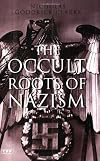
The Occult Roots of Nazism: Secret Aryan Cults and Their Influence on Nazi Ideology
by Nicholas Goodrick-Clarke
On This Page
Description
Nearly half a century after the defeat of the Third Reich, Nazism remains a subject of extensive historical inquiry, general interest, and, alarmingly, a source of inspiration for resurgent fascism in Europe. Goodrick-Clarke's powerful and timely book traces the intellectual roots of Nazism back to a number of influential occult and millenarian sects in the Habsburg Empire during its waning years. These sects combined notions of popular nationalism with an advocacy of Aryan racism and a show more proclaimed need for German world-rule. This book provides the first serious account of the way in which Nazism was influenced by powerful millenarian and occult sects that thrived in Germany and Austria almost fifty years before the rise to power of Adolf Hitler. These millenarian sects (principally the Ariosophists) espoused a mixture of popular nationalism, Aryan racism, and occultism to support their advocacy of German world-rule. Over time their ideas and symbols, filtered through nationalist-racist groups associated with the infant Nazi party, came to exert a strong influence on Himmler's SS. The fantasies thus fueled were played out with terrifying consequences in the realities structured into the Third Reich: Auschwitz, Sobibor, and Treblinka, the hellish museums of Nazi apocalypse, had psychic roots reaching back to millenial visions of occult sects. Beyond what the TImes Literary Supplement calls an intriguing study of apocalyptic fantasies, this bizarre and fascinating story contains lessons we cannot afford to ignore. show lessTags
Recommendations


































Member Reviews
Nazis. They just refuse to go away, don't they? Why are people still so fascinated with them? In this respect, the somewhat salacious title seems to play into this fascination, combining as it does with the suggestion of secret evil cults intend on world domination. There is that, to an extent, but Goodrich-Clarke's book is actually a well-researched, sober, in fact quite dry treatment of the influence of religion and spirituality on the rise of Nazism. It begins with the 18th century pagan renaissance and interest in occult matters, and traces it through the various Germanic cults, societies and social movements that would have influenced the milieu in which young Hitler grew up. As I say, all this is quite dry, and it takes some show more determination for the casual reader to get to the end of it. As to what point such readers will draw from it, it's difficult to say. Nazism seemed to have no one point of origin, and it's plausible to argue that it was a hodgepodge of various political, philosophical and spiritual influences, from the kooky and cranky to the mainstream and respectable, all topped off with a dash of ad hoc opportunism. Whatever your take, the main moral of the book would seem to be that Nazism cannot be dismissed as the influence of irrational fringe elements, because such influences also underpin the mainstream - albeit less visibly.
Gareth Southwell is a philosopher, writer and illustrator. show less
Gareth Southwell is a philosopher, writer and illustrator. show less
All over the place. Author finally concludes that, Himmler aside, there were no occult roots to Nazism, and in fact the Nazis outlawed most of these groups. At most, according to the author, occult movements within Germany and Austria shared a similar Weltanschauung, but that no evidence exists to support the argument that Nazism had occult roots.
An excellent book which gives a very detailed look into the lives and thoughts many major players of nordic philosophy, magic, and religion, which in turn sharply influenced many of the leaders of the third reich. I would consider this an essential book for the period. The only problem I had was the occasional slip here and there where the author stops being objective and says what he really thinks. Pet peeve, perhaps, but some of the comments had me scribbling all over the margins in response LOL. But nonetheless a well put together book which I am sure I will come back to many times in the future.
Ratings
Members
- Recently Added By
Author Information

Nicholas Goodrick-Clarke is the author of several books on modern history and politics. His book, The Occult Roots of Nazism, has remained in print since its publication in 1985 and has been translated into eight languages
Some Editions
Common Knowledge
- Original publication date
- 1985
- People/Characters
- Guido von List; Jorg Lanz von Liebenfels; Freidrich Oskar Wannieck; Blasius von Schuma; Philipp Stauff; Bernhard Koerner (show all 14); Theodor Fritsch; Rudolf von Sebottendorf; Herbert Reichstein; Frodi Ingolfson Wehrmann; Gregor Schwartz-Bostunitsch; Rudolf John Gorsleben; Karl Maria Wiligut; SS-Oberfuhrer Weisthor
- Important places
- Wewelsburg, North Rhine-Westphalia, Germany; Germany
- First words
- The Austrian state in which both List and Lanz came of age and first formulated their ideas was the product of three major political changes at the end of the 1860's.
- Last words
- (Click to show. Warning: May contain spoilers.)With the growth of religious nationalism in the late twentieth century, an understanding of the preconditions for such apocalyptic remains a crucial factor in global security.
- Blurbers
- Storr, Anthony
Classifications
- Genres
- Nonfiction, History, Religion & Spirituality, General Nonfiction
- DDC/MDS
- 320.5330943 — Society, government, & culture Political science Types of Government Political ideologies Radicalism, collectivism, fascism Fascism Standard subdivisions History, geographic treatment, biography Europe Germany, Austria, and Central Europe
- LCC
- DD256.5 .O29 — History of Europe, Asia, Africa and Oceania Germany History of Germany History By period Modern, 1519- 19th-20th centuries Revolution and Republic, 1918- Hitler, 1933-1945. National socialism Period of World War II, 1939-1945
- BISAC
Statistics
- Members
- 445
- Popularity
- 69,136
- Reviews
- 3
- Rating
- (3.75)
- Languages
- 7 — Czech, English, French, German, Italian, Polish, Portuguese
- Media
- Paper, Ebook
- ISBNs
- 17
- ASINs
- 5