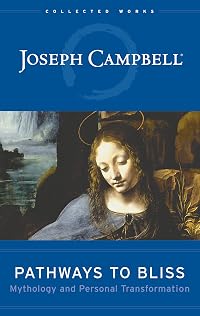
Pathways to Bliss: Mythology and Personal Transformation
by Joseph Campbell
On This Page
Description
Joseph Campbell famously defined myth as "other people's religion." But he also said that one of the basic functions of myth is to help each individual through the journey of life, providing a sort of travel guide or map to reach fulfillment -- or, as he called it, bliss. For Campbell, many of the world's most powerful myths support the individual's heroic path toward bliss. InPathways to Bliss, Campbell examines this personal, psychological side of myth. Like his classic best-selling show more booksMyths to Live By andThe Power of Myth,Pathways to Bliss draws from Campbell's popular lectures and dialogues, which highlight his remarkable storytelling and ability to apply the larger themes of world mythology to personal growth and the quest for transformation. Here he anchors mythology's symbolic wisdom to the individual, applying the most poetic mythical metaphors to the challenges of our daily lives. Campbell dwells on life's important questions. Combining cross-cultural stories with the teachings of modern psychology, he examines the ways in which our myths shape and enrich our lives and shows how myth can help each of us truly identify and follow our bliss. show lessTags
Recommendations









Member Reviews
Ever since Bill Moyers’s TV series, “Joseph Campbell and The Power of Myth,” aired in the 1980s, I have been a fan of Joseph Campbell. I have completely read some of his books and perused many others. The Joseph Campbell Foundation began in 1991, just a few years after Campbell’s death. One of its goals is to keep Campbell’s works in print. This volume, Pathways to Bliss: Mythology and Personal Transformation, is a collection that David Kudler created from the Campbell archive, building out many of the chapters from Campbell’s public lectures. Because I have re-watched “The Power of Myth” so many times, I can hear Campbell’s voice with his particular emphases and inflections as I read these previously oral documents. show more
Kudler cultivated a set of works that focus more on the “hows” and “how-tos” than most of Campbell’s published works. For example, he explains “Today, we don’t have the stasis that is required for the formation of a mythic tradition. The rolling stone gathers no moss. Myth is moss So now you’ve got to do it yourself, ad lib” (xxiii), and “You can get some clues from earlier traditions. But they have to be taken as clues. As many a wise man has said, ‘You can’t wear another person’s hat’” (xxiv).
Campbell takes his audiences through the major persons and ideas in both Eastern and Western philosophy and psychology, aligning Freud’s big concepts with those of Jung and those of the Eastern traditions, including kuṇḍalinī yoga.
Most of these lectures were given in the 1960s and 1970s. They have some moments that were very much “of their time.” One that stood out to me is Campbell’s dismissal of Maslow’s Hierarchy of Needs. He posits that people should focus less on “survival, security, personal relationships, prestige [and] self-development” (89) in order to follow their bliss and a more spiritual existence. There’s a flippancy in this, whether intended or not, of a privileged white man who brushes over the idea that people can’t “follow their bliss,” if they are hungry, cold, and have no place to live.
Nevertheless, Campbell says many smart things about how Western religions (particularly, not exclusively) do not adapt well with the passage of time: “one of the great calamities of contemporary life is that the religions we inherited have insisted on the concrete historicity of their symbols” (88). I enjoyed coming back to Campbell’s slow and methodical style of teaching after many years of not reading his works. I especially identified with this statement: “Alan Watts once asked me what spiritual practice I followed. I told him, ‘I underline books’” (138). show less
Kudler cultivated a set of works that focus more on the “hows” and “how-tos” than most of Campbell’s published works. For example, he explains “Today, we don’t have the stasis that is required for the formation of a mythic tradition. The rolling stone gathers no moss. Myth is moss So now you’ve got to do it yourself, ad lib” (xxiii), and “You can get some clues from earlier traditions. But they have to be taken as clues. As many a wise man has said, ‘You can’t wear another person’s hat’” (xxiv).
Campbell takes his audiences through the major persons and ideas in both Eastern and Western philosophy and psychology, aligning Freud’s big concepts with those of Jung and those of the Eastern traditions, including kuṇḍalinī yoga.
Most of these lectures were given in the 1960s and 1970s. They have some moments that were very much “of their time.” One that stood out to me is Campbell’s dismissal of Maslow’s Hierarchy of Needs. He posits that people should focus less on “survival, security, personal relationships, prestige [and] self-development” (89) in order to follow their bliss and a more spiritual existence. There’s a flippancy in this, whether intended or not, of a privileged white man who brushes over the idea that people can’t “follow their bliss,” if they are hungry, cold, and have no place to live.
Nevertheless, Campbell says many smart things about how Western religions (particularly, not exclusively) do not adapt well with the passage of time: “one of the great calamities of contemporary life is that the religions we inherited have insisted on the concrete historicity of their symbols” (88). I enjoyed coming back to Campbell’s slow and methodical style of teaching after many years of not reading his works. I especially identified with this statement: “Alan Watts once asked me what spiritual practice I followed. I told him, ‘I underline books’” (138). show less
More of a self-help and psychology book than an anthropology book on myth, however it really clarifies the relationship of the individual psyche and the society to myth and folklore. I think far too many people study myth through a historical/anthropological/fiction lens rather than as a present psychological power. This book brings myth into the personal realm instead of the historical fairly well. I don't agree with some of his understandings of Jung however and I think he misrepresents a few of Jung's theories but it's not really important for the purpose of this book.
This book is classic Campbell, and more approachable than his officially authored books. “Pathways” is part of The Joseph Campbell Collection, a series of books edited together from various lectures, manuscripts, and articles over the course of two decades. It carries the engaging tones and rhythms of his lectures and is a fun and easy read.
I first picked up this book in hopes of finding a guide to practical guide to applying Campbell’s ideas. While the book offers very little of this, there are one or two short sections which offer a taste of just that. That, in addition to the insight that Campbell offers to understanding psychology, society, and the symbols of the soul, makes this and incredibly satisfying read.
I first picked up this book in hopes of finding a guide to practical guide to applying Campbell’s ideas. While the book offers very little of this, there are one or two short sections which offer a taste of just that. That, in addition to the insight that Campbell offers to understanding psychology, society, and the symbols of the soul, makes this and incredibly satisfying read.
This was fascinating - the material itself, and the way it was presented. I learned a lot.
Hate the title; love the book.
Ratings
Members
- Recently Added By
Lists

Story/Myth Reading List
25 works; 1 member
Author Information

201+ Works 41,643 Members
Joseph Campbell was born in White Plains, New York on March 26, 1904. He received a B.A. in English literature in 1925 and an M.A. in Medieval literature in 1927 from Columbia University. He was awarded a Proudfit Traveling Fellowship to continue his studies at the University of Paris. After he had received and rejected an offer to teach at his show more high school alma mater, his Fellowship was renewed, and he traveled to Germany to resume his studies at the University of Munich. During the year he was housemaster of Canterbury School, he sold his first short story, Strictly Platonic, to Liberty magazine. In 1934, he accepted a position in the literature department at Sarah Lawrence College, a post he would retain until retiring in 1972. During his lifetime, he wrote more than 40 books including The Hero with a Thousand Faces, The Mythic Image, the four-volume The Masks of God, and The Power of Myth with Bill Moyers. During the 1940s and 1950s, he collaborated with Swami Nikhilananda on translations of the Upanishads and The Gospel of Sri Ramakrishna. He received several awards including National Institute of Arts and Letters Award for Contributions to Creative Literature and the 1985 National Arts Club Gold Medal of Honor in Literature. He died after a brief struggle with cancer on October 30, 1987. (Bowker Author Biography) show less
Series
Belongs to Publisher Series
Common Knowledge
- Original publication date
- 2004
- Epigraph
- To know others is wisdom;
To know yourself is enlightenment
To master others requires force;
To master yourself requires true strength.
-Lao-tzu, Tao-te-Ching, chapter 33 - First words
- Traditionally, the first function of a living mythology is to reconcile consciousness to the preconditions of its own existence; that is to say, to the nature of life.
- Last words
- (Click to show. Warning: May contain spoilers.)And she had a husband who was willing to help her see it happen.
- Original language
- English
Classifications
- Genres
- Nonfiction, Religion & Spirituality, General Nonfiction
- DDC/MDS
- 201.3019 — Religion The Bible & Christianity Religious mythology, general classes of religion, interreligious relations and attitudes, social theology Mythology and mythological foundations Mythology and mythological foundations - standard subdivisions
- LCC
- BL315 .C275 — Philosophy, Psychology and Religion Religions. Mythology. Rationalism Religions. Mythology. Rationalism The myth. Comparative mythology
- BISAC
Statistics
- Members
- 596
- Popularity
- 49,262
- Reviews
- 5
- Rating
- (4.35)
- Languages
- 5 — Dutch, English, Italian, Portuguese, Slovenian
- Media
- Paper, Audiobook, Ebook
- ISBNs
- 11
- ASINs
- 3