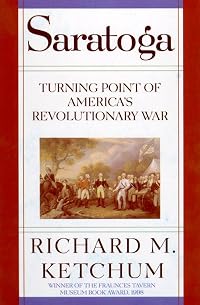
Saratoga, Turning Point of America's Revolutionary War
by Richard M. Ketchum
On This Page
Description
Draws from the diaries and letters of participants to tell the story of the Revolutionary War battle of Saratoga, New York in 1777, a campaign that proved to the be the turning point in the fight for independence.Tags
Recommendations







Member Reviews
If Montreal-Richelieu River-Lake Champlain-Hudson River- Albany-New York City was the critical campaign axis of the American Revolutionary War; and the Battle of Saratoga was the turning point of the American Revolutionary War; then Benedict Arnold was the most important general of the American Revolutionary War. Richard Ketchum doesn’t state this explicitly in Saratoga, but it’s an observation it’s easy to make. Arnold deserves at least half the credit for the seizure of Fort Ticonderoga in 1775, which enabled Washington to drive the British out of Boston (by hauling siege guns captured there to positions covering the city). Then, in 1776, Arnold’s patched-together lake fleet delayed Sir Guy Carleton long enough to force his show more retreat back to Montreal before the winter set in (which says something about winter in upstate New York – it’s bad enough to scare Canadians). Finally, in 1777, Arnold fortified himself with a dipper of straight rum (which, in turn, says something about American army headquarters – there were open kegs of rum with dippers in them for all comers), disobeyed direct orders from Horatio Gates, lead a manic charge on the Breymann Redoubt, and crushed Burgoyne’s last hope of flanking American forces and getting to Albany. Were it not for the unfortunate business with Major Andre and West Point – if, for example, Arnold had died from his severe wounds at Saratoga – there would be as many streets, cities, towns, and counties named after him as Washington.
Like many of the events in the American Revolution, it must have been difficult for the British to figure out exactly what whet wrong with the Saratoga campaign. The British and German regular troops were certainly better than the American Continentals, and vastly better than the militia. General Burgoyne may not have been Napoleon, but he seems to have been much better than Horatio Gates. Burgoyne’s secondary commanders – Simon Fraser and Baron von Riesdesel – were clearly superior to their equivalents on the American side (with the possible exception of Arnold). So what happened? Ketchum actually doesn’t offer a lot of analysis, preferring to let the events tell the tale – from these it seems Burgoyne came down with “victory disease”. The initial successes against the Americans – the evacuation of Fort Ticonderoga, the “Gibraltar of the North”, with scarcely a shot fired; the panicked flight of the Americans; the capture of massive amounts of American supplies at Skenesborough – all seemed to point to talking Albany and linking with Howe as “just a matter of marching”, to use a phrase from a later war.
Things unraveled so gradually that there isn’t a particular point where you can say “Here’s where Britain lost America”. Burgoyne’s original plan was to take Fort Ticonderoga then continue his supply line south using Lake George. However, the portage route between Lake George and Lake Champlain isn’t at the extreme southern end of Lake Champlain; it’s about 5 miles north on the west side. That’s what Fort Ticonderoga was supposed to be guarding; not the southern exit to Lake Champlain, but the portage connection to Lake George. The Americans had built a bridge across the lake at Fort Ticonderoga, and they evacuated across that bridge. The bridge was supposed be destroyed or guarded but in their panic the Americans neglected to do either (an American cannon crew had been posted at the far end of the bridge; the redcoats found them unconscious, with an empty cask of Madeira). Burgoyne’s pursuit of the American army took him east, away from Lake George; to get back there he would have had to break off pursuit and reverse his marching order. He later said such a retrograde movement would affect his troops’ morale. On the map, it was short to continue overland, since Lake George angles to the west; unfortunately it’s a world more work to cut through forest than float down a lake.
The next mistake was the diversion to Bennington. Burgoyne, already beginning to short of supplies, sent a column of Hessians into Vermont to capture horses and food rumored to be stockpiled at a lightly guarded depot. What he got instead was Brigadier John Stark and the New Hampshire Militia, who, by using the annoying American habit of shooting from cover instead of fighting in the open, took 56 casualties in exchange for killing or capturing 365 Germans.
By now, Burgoyne had learned that Howe was not marching on Albany; instead, he was sailing to Philadelphia. The militarily wise thing to do would have been retreat back to Fort Ticonderoga, or even all the way back to Montreal. Unfortunately, one of the means Burgoyne had used to wangle his command was criticism of Carleton for not pressing on in 1776. So Burgoyne continued slowly south, in the face of American woodsmen continually cutting down trees to block the road (which could only be called a road in the first place by an optimist). In the meantime, the American army was building in front. They eventually clashed at a place called Freeman’s Farm (despite the popular name, there was no single battle of Saratoga – Burgoyne was already 9 miles south of the village of Saratoga when the first battle took place). Burgoyne technically won this battle, in the sense that the British controlled the field at the end – but lost more troops than the Americans.
The day after the Battle of Freeman’s Farm, Burgoyne received a message from Henry Clinton (ironically, very few messages were getting through American lines, but this one did) suggesting that Clinton might advance up the Hudson. Once again, Burgoyne might have been able to save his army if he had retreated; but based on the hope that Clinton was coming, Burgoyne hunkered down, fortified, and waited. Clinton did advance a short distance, captured a few river forts, burned a couple of American houses, then headed back to New York City. In the meantime, the Americans surrounded Burgoyne. He made a last attempt to break out, trying to get around the American left, but even here it wasn’t clear what he was trying to do; it was more of a reconnaissance in force than an attack, as he left a good part of his force behind to guard baggage. And it didn’t work (this is where Arnold came in against orders).
That left nothing but surrender. Burgoyne kept putting things off, hoping Something Would Turn Up – Clinton or Howe or Godzilla or something – but they didn’t. He surrendered on generous terms (so generous they were disavowed by the Continental Congress), the French declared war, and the American Revolution was won (except that it lasted another six years, but close enough).
Ketchum’s research is impressive. References include dozens of original documents; many are diaries or letters from original participants and give a “you are there” feel to the narration. There’s interesting analysis of the politics of the time, in Parliament, the French court, and the Continental Congress, and this background is the only way to explain the actions of some of the participants. Unfortunately, the military situation is not as well explained; maps of the campaign and battles are cryptic and confusing. For example, the map of the Battle of Freeman’s Farm makes it look like Learned’s Americans flanked Riedesel’s Hessians, whereas the text makes it clear that the opposite happened (in fact Riedesel’s advance on the American right allowed the British to salvage the battle for a tactical victory). This one of those cases where a few minutes with a well done board wargame would make things clearer than hundreds of pages of text.
However, overall things are well done; the look and feel of the times comes across even if details of the fighting do not. Ketchum has a whole series of Revolutionary War books and I think I’ll pick up the others. show less
Like many of the events in the American Revolution, it must have been difficult for the British to figure out exactly what whet wrong with the Saratoga campaign. The British and German regular troops were certainly better than the American Continentals, and vastly better than the militia. General Burgoyne may not have been Napoleon, but he seems to have been much better than Horatio Gates. Burgoyne’s secondary commanders – Simon Fraser and Baron von Riesdesel – were clearly superior to their equivalents on the American side (with the possible exception of Arnold). So what happened? Ketchum actually doesn’t offer a lot of analysis, preferring to let the events tell the tale – from these it seems Burgoyne came down with “victory disease”. The initial successes against the Americans – the evacuation of Fort Ticonderoga, the “Gibraltar of the North”, with scarcely a shot fired; the panicked flight of the Americans; the capture of massive amounts of American supplies at Skenesborough – all seemed to point to talking Albany and linking with Howe as “just a matter of marching”, to use a phrase from a later war.
Things unraveled so gradually that there isn’t a particular point where you can say “Here’s where Britain lost America”. Burgoyne’s original plan was to take Fort Ticonderoga then continue his supply line south using Lake George. However, the portage route between Lake George and Lake Champlain isn’t at the extreme southern end of Lake Champlain; it’s about 5 miles north on the west side. That’s what Fort Ticonderoga was supposed to be guarding; not the southern exit to Lake Champlain, but the portage connection to Lake George. The Americans had built a bridge across the lake at Fort Ticonderoga, and they evacuated across that bridge. The bridge was supposed be destroyed or guarded but in their panic the Americans neglected to do either (an American cannon crew had been posted at the far end of the bridge; the redcoats found them unconscious, with an empty cask of Madeira). Burgoyne’s pursuit of the American army took him east, away from Lake George; to get back there he would have had to break off pursuit and reverse his marching order. He later said such a retrograde movement would affect his troops’ morale. On the map, it was short to continue overland, since Lake George angles to the west; unfortunately it’s a world more work to cut through forest than float down a lake.
The next mistake was the diversion to Bennington. Burgoyne, already beginning to short of supplies, sent a column of Hessians into Vermont to capture horses and food rumored to be stockpiled at a lightly guarded depot. What he got instead was Brigadier John Stark and the New Hampshire Militia, who, by using the annoying American habit of shooting from cover instead of fighting in the open, took 56 casualties in exchange for killing or capturing 365 Germans.
By now, Burgoyne had learned that Howe was not marching on Albany; instead, he was sailing to Philadelphia. The militarily wise thing to do would have been retreat back to Fort Ticonderoga, or even all the way back to Montreal. Unfortunately, one of the means Burgoyne had used to wangle his command was criticism of Carleton for not pressing on in 1776. So Burgoyne continued slowly south, in the face of American woodsmen continually cutting down trees to block the road (which could only be called a road in the first place by an optimist). In the meantime, the American army was building in front. They eventually clashed at a place called Freeman’s Farm (despite the popular name, there was no single battle of Saratoga – Burgoyne was already 9 miles south of the village of Saratoga when the first battle took place). Burgoyne technically won this battle, in the sense that the British controlled the field at the end – but lost more troops than the Americans.
The day after the Battle of Freeman’s Farm, Burgoyne received a message from Henry Clinton (ironically, very few messages were getting through American lines, but this one did) suggesting that Clinton might advance up the Hudson. Once again, Burgoyne might have been able to save his army if he had retreated; but based on the hope that Clinton was coming, Burgoyne hunkered down, fortified, and waited. Clinton did advance a short distance, captured a few river forts, burned a couple of American houses, then headed back to New York City. In the meantime, the Americans surrounded Burgoyne. He made a last attempt to break out, trying to get around the American left, but even here it wasn’t clear what he was trying to do; it was more of a reconnaissance in force than an attack, as he left a good part of his force behind to guard baggage. And it didn’t work (this is where Arnold came in against orders).
That left nothing but surrender. Burgoyne kept putting things off, hoping Something Would Turn Up – Clinton or Howe or Godzilla or something – but they didn’t. He surrendered on generous terms (so generous they were disavowed by the Continental Congress), the French declared war, and the American Revolution was won (except that it lasted another six years, but close enough).
Ketchum’s research is impressive. References include dozens of original documents; many are diaries or letters from original participants and give a “you are there” feel to the narration. There’s interesting analysis of the politics of the time, in Parliament, the French court, and the Continental Congress, and this background is the only way to explain the actions of some of the participants. Unfortunately, the military situation is not as well explained; maps of the campaign and battles are cryptic and confusing. For example, the map of the Battle of Freeman’s Farm makes it look like Learned’s Americans flanked Riedesel’s Hessians, whereas the text makes it clear that the opposite happened (in fact Riedesel’s advance on the American right allowed the British to salvage the battle for a tactical victory). This one of those cases where a few minutes with a well done board wargame would make things clearer than hundreds of pages of text.
However, overall things are well done; the look and feel of the times comes across even if details of the fighting do not. Ketchum has a whole series of Revolutionary War books and I think I’ll pick up the others. show less
Very nice read, well written and nicely paced. Ketchum's writing is accessible and threaded with nice visual spice pacing the story well.
Good for those who want battle details. I enjoyed the occasional letter or diary entry and even a couple of female voices
Ketcham weaves his tale beginning with the fall of Fort Ticonderoga and progressing through the surrender of Burgoyne's army. He introduces the fascinating characters, and paints a gripping picture of the blood soaked events. A great story, well told.
Solid retelling of the story of Burgoyne's 'Northern Campaign' of 1777. (July 18, 1777, NH answers Ira Allen's cry for help: "Within days, 25 companies - almost fifteen hundred men - signed up to follow him (Stark), some of them walking out of a church service to enlist when they heard of his appointment. That number was more than 10% of the males over 16 in NH; in one town some 36% of the eligible men volunteered.")
Ratings
Members
- Recently Added By
Lists

Best U.S. History Books (1754-1828)
363 works; 18 members
Author Information

34+ Works 2,641 Members
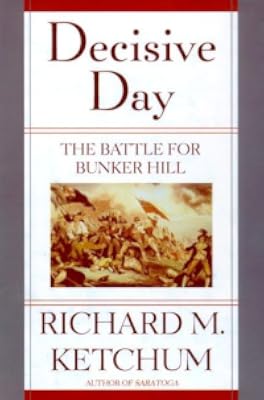
Richard M. Ketchum was born in Pittsburgh, Pennsylvania on March 15, 1922. He received a degree in American history from Yale University in 1943. After college, he served as commander of a Navy submarine chaser in the Atlantic. He owned an advertising agency until 1951, when he joined the United States Information Agency, eventually becoming show more director of overseas publications. He was hired by American Heritage in 1956 and co-founded Country Journal, where he also served as editor. He wrote several history books including Decisive Day: The Battle for Bunker Hill, Saratoga: Turning Point of America's Revolutionary War, and The Borrowed Years, 1938-1941. He died on January 12, 2012 at the age of 89. (Bowker Author Biography) show less
Awards and Honors
Awards
Common Knowledge
- Canonical title
- Saratoga, Turning Point of America's Revolutionary War
- Original publication date
- 1997
- People/Characters
- John Burgoyne, AKA Gentleman Johnny (General); Benedict Arnold; Horatio Gates; Daniel Morgan; Simon Fraser; Henry Clinton
- Important places
- Saratoga, New York, USA; New York, USA; Bennington, Vermont, USA
- Important events
- American Revolution (1775 | 1783); Saratoga Campaign (1777); Battle of Saratoga
- Dedication
- To Bobs, as ever,
and the memory of three friends
who understand that history is us
Bruce Catton
Allan Nevins
and my father, George Ketchum - First words
- At Saratoga, the British campaign that was supposed to crush America's rebellion ended instead in a surrender that changed the history of the world.
- Last words
- (Click to show. Warning: May contain spoilers.)The scouts brought her back to headquarters at PAwlet, and on November 28, 1777, Captain Allen gave the woman a highly unusual letter that suggested what some of these young men had in mind when they turned out to fight Burgoyne's army of invasion:
To whom it may concern. Know ye that whereas Dinah Mattis a negro woman with nancey her Child of two months old was taken Prissnor on Lake Champlain... by a scout under my command, and according to a Resolve passed by the Honorable Continental Congress that all [prisoners] belong to the Captaivators thereof I being conscientious that it is not right in the sight of god to keep Slaves... I do therefore give the said Dinah mattis and Nancey her child [their] freedom to pass and repass any where through the United States of America... as though she was born free, without being Mollested by any Person or Persons...
(signed) Ebenezer Allen Capt." - Original language
- English
- Disambiguation notice
- 1997: Saratoga : turning point of America's Revolutionary War / Richard M. Ketchum.
Classifications
Statistics
- Members
- 442
- Popularity
- 69,301
- Reviews
- 5
- Rating
- (3.94)
- Languages
- English
- Media
- Paper, Ebook
- ISBNs
- 4
- ASINs
- 5