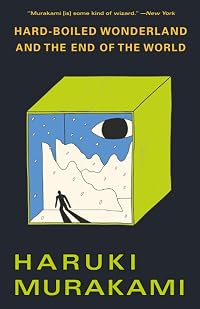
Hard-Boiled Wonderland and the End of the World (abridged)
by Haruki Murakami
On This Page
Description
The last surviving victim of an experiment that implanted the subjects' heads with electrodes that decipher coded messages is the unnamed narrator. Half the chapters are set in Tokyo, where the narrator negotiates underground worlds populated by INKlings, dodges opponents of both sides of a raging high-tech infowar, and engages in an affair with a beautiful librarian with a gargantuan appetite. In alternating chapters he tries to reunite with his mind and his shadow, from which he has been show more severed by the grim, dark "replacement" consciousness implanted in him by a dotty neurophysiologist. Both worlds share the unearthly theme of unicorn skulls that moan and glow. show lessTags
Recommendations


Member Reviews
Love the title, hated the content. I didn't make it more than 30% in due to my absolute loathing for the narrator.
Loathing, unadulterated loathing
For your tone, your voice, your posing
Let's just say
I loathe it all!
How you describe women--it's your male gaze
It sends my anger right into a blaze
With simple utter loathing...
Seriously, just that first opening, in which he considers the "fat, beautiful" woman he's following. He comments that fat, beautiful women make him uncomfortable because he's not sure how to evaluate them--because obviously, all women must be evaluated in terms of their sexual desirability--after all, isn't that what women are for? He then proceeds to denigrate her for her eating habits while still considering her a show more sexual object--obviously, she's an ill-trained beast. Some man should take her in hand and whip her into shape so she can fulfil her primary function.
GRRRRRRRR.
Other than that little detail, I find the narrative, with its constant repetition (e.g. "Do you like sandwiches?" "Yes, I like sandwiches." "I'm glad you like sandwiches." etc), its fatuous flights of fancy (e.g. the Darwinian extinction of sound), and its tiresome characters (e.g. the airheaded ice-cream eating librarian or the "fat, beautiful girl" who attempts to sell herself to our dear narrator) just don't do anything for me. I'd love someone of the Literati to explain all of the horrifically idiotic pseudoscience blasted out in dry, obnoxious infodumps by the various characters. I hate, hate, hate bad pseudoscience. I didn't really mind the shadowless dream-reader, but I really, really hate the other guy. Murakami gives his narrator a really twisted obsession with women eating, somehow directly tying it into their sexuality. Fat or thin, all women are weirdly evaluated by their eating habits as well as their weight.
Yep, I get that I'm supposed to find the narrator obnoxious and that he's channeling the hardboiled vibe. Yes, I understand it's Literature and that somehow it magically achieves Snob Factor and that I should read the farce as something greater. Yes, I understand that disliking this book makes me an impatient, shallow, coarse, and lower-class reader (seriously, read the positive reviews...that's what they say about us lower beings who don't "understand" this book.) I don't care. It's not for me. show less
Loathing, unadulterated loathing
For your tone, your voice, your posing
Let's just say
I loathe it all!
How you describe women--it's your male gaze
It sends my anger right into a blaze
With simple utter loathing...
Seriously, just that first opening, in which he considers the "fat, beautiful" woman he's following. He comments that fat, beautiful women make him uncomfortable because he's not sure how to evaluate them--because obviously, all women must be evaluated in terms of their sexual desirability--after all, isn't that what women are for? He then proceeds to denigrate her for her eating habits while still considering her a show more sexual object--obviously, she's an ill-trained beast. Some man should take her in hand and whip her into shape so she can fulfil her primary function.
GRRRRRRRR.
Other than that little detail, I find the narrative, with its constant repetition (e.g. "Do you like sandwiches?" "Yes, I like sandwiches." "I'm glad you like sandwiches." etc), its fatuous flights of fancy (e.g. the Darwinian extinction of sound), and its tiresome characters (e.g. the airheaded ice-cream eating librarian or the "fat, beautiful girl" who attempts to sell herself to our dear narrator) just don't do anything for me. I'd love someone of the Literati to explain all of the horrifically idiotic pseudoscience blasted out in dry, obnoxious infodumps by the various characters. I hate, hate, hate bad pseudoscience. I didn't really mind the shadowless dream-reader, but I really, really hate the other guy. Murakami gives his narrator a really twisted obsession with women eating, somehow directly tying it into their sexuality. Fat or thin, all women are weirdly evaluated by their eating habits as well as their weight.
Yep, I get that I'm supposed to find the narrator obnoxious and that he's channeling the hardboiled vibe. Yes, I understand it's Literature and that somehow it magically achieves Snob Factor and that I should read the farce as something greater. Yes, I understand that disliking this book makes me an impatient, shallow, coarse, and lower-class reader (seriously, read the positive reviews...that's what they say about us lower beings who don't "understand" this book.) I don't care. It's not for me. show less
My favorite Murakami novel. Poetic and hallucinogenic at the same time, the protagonist whose job is being a 'dreamreader' carries data locked in his head, but, unlike William Gibson's cyberpunk novel Johnny Mnemonic, the secrets are accessible, encoded in a subconscious dream-world, 'the town', with stolen shadows and mystical beasts. The novel alternates chapters of this enigmatic and ominous subconscious world with the bizarre techno espionage thriller of the conscious world. Strange and beautiful.
This novel alternates between downright cringy, barely readable parts and sequences filled with poise and remarkable observations.
It is quite typical of Murakami to soar above the clouds on one page and plumb sewer depths on the next. In Hard-Boiled Wonderland he outdoes himself in this regard.
Grandfather-granddaughter sequences are so incredibly bad one has a feeling the author must have done these caricatures on purpose - possibly in order to achieve a sharper contrast with the rest.
The End of the World chapters are generally quite good but not consistently so. Some of the best imagery is there.
And then there is the main character - the same misfit we met in other works of the author. Despite some superficial differences, he is the show more guy we saw in A Wild Sheep Chase or in The Wind-Up Bird Chronicle. He no longer smokes or irons shirts, instead he drinks bad whiskey and cooks complicated meals. He is deeply dissatisfied with the dimensionless existence in a modern consumerist world, looks for some tidbits of meaning in music (not only jazz, this time we have some Bob Dylan and some Bach as well) and in the nineteenth century Russian literature. Turgenev is given some prominence here but as usual Murakami cannot do without his beloved brothers. It is in Alyosha's words that we can phrase the central idea of this novel: "you are going to have a miserable future, but overall you'll have a happy life"
Indeed, with a clear view of a personal or collective end of the world one comes to realize: "some limited happiness had been granted this limited life". Should we really expect more? show less
It is quite typical of Murakami to soar above the clouds on one page and plumb sewer depths on the next. In Hard-Boiled Wonderland he outdoes himself in this regard.
Grandfather-granddaughter sequences are so incredibly bad one has a feeling the author must have done these caricatures on purpose - possibly in order to achieve a sharper contrast with the rest.
The End of the World chapters are generally quite good but not consistently so. Some of the best imagery is there.
And then there is the main character - the same misfit we met in other works of the author. Despite some superficial differences, he is the show more guy we saw in A Wild Sheep Chase or in The Wind-Up Bird Chronicle. He no longer smokes or irons shirts, instead he drinks bad whiskey and cooks complicated meals. He is deeply dissatisfied with the dimensionless existence in a modern consumerist world, looks for some tidbits of meaning in music (not only jazz, this time we have some Bob Dylan and some Bach as well) and in the nineteenth century Russian literature. Turgenev is given some prominence here but as usual Murakami cannot do without his beloved brothers. It is in Alyosha's words that we can phrase the central idea of this novel: "you are going to have a miserable future, but overall you'll have a happy life"
Indeed, with a clear view of a personal or collective end of the world one comes to realize: "some limited happiness had been granted this limited life". Should we really expect more? show less
With a birfurcated narrative that spends time in two separate realities, one almost-real with odd science fiction overtones and the other a dreamy but slightly sinister fantasy that might be a utopia or might be some sort of entropic hell, this reminded me of Iain Banks' Walking On Glass. What starts off as mysterious forays into slightly alien worlds filled with oddness and danger and conspiracy, turns, magically, in the the end to a meditation on mortality and eternity, and though the ending is unknowable, the imponderable and inevitable human confrontation with the certainty of one and the seeming impossiblity of the other is a powerful and moving modern evocation of the human condition.
Hard-Boiled Wonderland and The End of the World
"Do you really expect me to know what's going on?"
The two stories are told in alternating chapters. HBW is a gritty urban cybercrime and infowar adventure, where Calcutecs hired by the System are programmed to shuffle data outside their consciousness, to encrypt it, and Semiotecs from the Factory try to steal it. It’s told in the past tense. TEotW is set in a Town that feels folkloric, enclosed by a perfect Wall, where no one has a shadow, and golden “beasts” (unicorns) are let in every day and sent out each night. It’s told in the present tense by a newcomer who has been assigned the role of Dreamreader.
At first, they seem utterly unconnected, except for being opposites: realistic show more and mythical, dystopian and utopian, hot and cold. But gradually HBW becomes a little more fantastical and TEotW rather less utopian, and you notice trivial things cropping up in both: librarians; unicorn skulls; the end of the world; the fact no one has a name, merely a title or description; paperclips, and synaesthesia (smells triggering memories and musical notes triggering colours).
It’s a novel of balance in the telling as well: always a page-turner, but never confusing; intriguingly puzzling, but dropping just enough timely clues for the reader to anticipate the connections.
The two strands dance ever closer together, but the fact they don’t definitively merge in a crystal-clear solution was perfect.
"There are things that cannot and should not be explained."
Image: “City at the Night” by Guy Billout (Source)
Ponder
The stories whizzed by, but there’s depth as well as the more obvious breadth.
Shadows
In HBW, any shadows are metaphorical, but they’re central to TEotW where, as in older stories (see Connections, below), they are associated with self, mind, soul, and memory.
Memory
“As you create memories, you’re creating a parallel word.”
“In this Town, memory is unreliable and uncertain.”
When the world is weird, you need memories to assess reality, but which realities are you comparing?
Relativism
“Without the despair of loss, there is no hope.”
I remember the Eureka moment when I realised that if there was no evil in the world, the least good would become the new evil. (But why didn’t I extrapolate and use that as justification for not striving to be good?) Even though a child can figure that out, a master storyteller like Murakami can burnish multiple facets of the idea to great and twisty effect.
“In time your mind will not matter. It will go, and with it goes all sense of loss, all sense of sorrow.”
God figure
“I cannot forsake the people and place and things I have created.”
The Professor is a clear god figureand possibly has the power to apply a sort of predestination in his subjects , but there’s another, less obvious one.
Death or immortality?
“Maybe you can’t die here, but you will not be living.”
If you had 24 hours to live, you’d want more time, and to use it wisely (not drying someone else’s clothes in a laundromat), but maybe there’s another way? Opposites, again.Ask Zeno. But in stories, there’s always a price to pay.
Sound
I think there’s more to this theme than I “got”. The Professor is researching sound-removal that’s more powerful than mere white noise, many musical names are dropped, and a character’s memory loss includes music (but they experience colours associated with notes). And then there’s this exquisite multisensory evocation of the sound of the horn that is used to summon and expel the beasts:
“The gentle tones spread through me… Navigating the darkling streets like a pale transparent fish, down cobbled arcades, past the enclosures of houses… It cuts through invisible airborne sediments of time, quietly penetrating the furthest reaches of the Town.”
Image: The novel has metafictional aspects, layered like a Matryoshka doll - or like the house that contained this painting of a dolls’ house that has paintings on its walls. “Dolls’ House of Petronella Oortman” by Jacob Appel, c1710 (Source)
Quibbles
“The wiggling of her bulbous behind… reminds me of a head of Chinese cabbage in a wet skirt.”
The Professor’s 17-year old granddaughter is frequently referred to as "the chubby girl", though she’s also described as being attractive, despite being obese. Thirty five years later, it reads uncomfortably. However, she is actually a strong, intelligent, independent heroine in her own right, so I think it reflects the unsavoury thinking of the narrator more than the author.
There are a few unsubtle, overlong, and comically gobbledigook-filled infodumps. The technical details of what the Professor is doing are intriguing and extraordinary, but it’s not essential to comprehend every detail.
The relationship that is most central to the difficult decisions and dramatic revelations of the final chapters was not one I could really believe in.
Connections
Just a few that occurred to me. I’m sure there are many many others, especially in cyber/noir genre:
• Kafka’s The Castle also has a new arrival to a strange, enclosed town, where even the snow is sinister. See my review HERE.
• Peake’s Gormenghast books also portray an almost mythical walled town, subject to archaic ritual, the reasons for which are lost in time, and which it may be impossible to leave:
“There is nowhere else... you will only tread a circle... everything comes to Gormenghast.”
“There is no beyond.” (from TEotW)
See my review HERE.
• Le Guin’s The Ones Who Walked Away from Omelas from 1973 offers a key to Murakami’s tale.
“This is the price of your perfection.” (from HBWaTEotW)
See my review HERE.
• Hans Christian Andersen’s The Shadow is one of many older stories about people being separated from their shadows. See my review of that, which mentions three others, HERE.
• Apatt's excellent review of this, here, mentions Miéville's The City and The City, which I reviewed HERE. Good spot!
• Most obviously, because of the title, but perhaps least relevantly in terms of plot, Lewis Carroll’s Alice's Adventures in Wonderland.
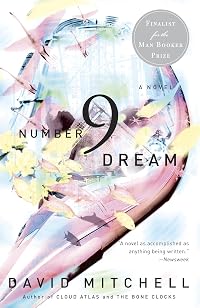
• David Mitchell cites Murakami as a major influence, and as his own books are all connected into a uber-book, it’s relevant to mention him here. Number9Dream is the closest to HBW (see my old, brief review HERE), though it may be even closer to other Murakamis I haven’t yet read.
Many novelists, composers, musicians, and their works - classical and contemporary - are mentioned throughout.
With the right director and a large budget, it would make an excellent film or video game - and HBW a theme park ride.
Image: Figure running into(?) tunnel (Source)
Quotes
• “The morning sun tore through the clouds… the frosty breath of more than a thousand beasts dancing whitely in the air.”
• “As the autumn deepens, the fathomless lakes of their eyes assume an ever more sorrowful hue.” [The beasts]
• "I cannot stay in this place, yet I do not want to leave."
• “The voice of the light remains ever so faint; images quiet as ancient constellations float across the dome of my dawning mind. They are indistinct fragments that never merge into a sensate picture.” [Dreamreading]
• “A mosaic of winter sky shows between the branches.”
• “The problem is, the Town is perfectly wrong. Every last thing is skewed, so that the total distortion is seamless.”
• “A huge black net of sleep that had been poised in ambush fell over me.”
• “Sex is an extremely subtle undertaking, unlike going to the department store on a Sunday to buy a thermos.” show less
"Do you really expect me to know what's going on?"
The two stories are told in alternating chapters. HBW is a gritty urban cybercrime and infowar adventure, where Calcutecs hired by the System are programmed to shuffle data outside their consciousness, to encrypt it, and Semiotecs from the Factory try to steal it. It’s told in the past tense. TEotW is set in a Town that feels folkloric, enclosed by a perfect Wall, where no one has a shadow, and golden “beasts” (unicorns) are let in every day and sent out each night. It’s told in the present tense by a newcomer who has been assigned the role of Dreamreader.
At first, they seem utterly unconnected, except for being opposites: realistic show more and mythical, dystopian and utopian, hot and cold. But gradually HBW becomes a little more fantastical and TEotW rather less utopian, and you notice trivial things cropping up in both: librarians; unicorn skulls; the end of the world; the fact no one has a name, merely a title or description; paperclips, and synaesthesia (smells triggering memories and musical notes triggering colours).
It’s a novel of balance in the telling as well: always a page-turner, but never confusing; intriguingly puzzling, but dropping just enough timely clues for the reader to anticipate the connections.
The two strands dance ever closer together, but the fact they don’t definitively merge in a crystal-clear solution was perfect.
"There are things that cannot and should not be explained."
Image: “City at the Night” by Guy Billout (Source)
Ponder
The stories whizzed by, but there’s depth as well as the more obvious breadth.
Shadows
In HBW, any shadows are metaphorical, but they’re central to TEotW where, as in older stories (see Connections, below), they are associated with self, mind, soul, and memory.
Memory
“As you create memories, you’re creating a parallel word.”
“In this Town, memory is unreliable and uncertain.”
When the world is weird, you need memories to assess reality, but which realities are you comparing?
Relativism
“Without the despair of loss, there is no hope.”
I remember the Eureka moment when I realised that if there was no evil in the world, the least good would become the new evil. (But why didn’t I extrapolate and use that as justification for not striving to be good?) Even though a child can figure that out, a master storyteller like Murakami can burnish multiple facets of the idea to great and twisty effect.
“In time your mind will not matter. It will go, and with it goes all sense of loss, all sense of sorrow.”
God figure
“I cannot forsake the people and place and things I have created.”
The Professor is a clear god figure
Death or immortality?
“Maybe you can’t die here, but you will not be living.”
If you had 24 hours to live, you’d want more time, and to use it wisely (not drying someone else’s clothes in a laundromat), but maybe there’s another way? Opposites, again.
Sound
I think there’s more to this theme than I “got”. The Professor is researching sound-removal that’s more powerful than mere white noise, many musical names are dropped, and a character’s memory loss includes music (but they experience colours associated with notes). And then there’s this exquisite multisensory evocation of the sound of the horn that is used to summon and expel the beasts:
“The gentle tones spread through me… Navigating the darkling streets like a pale transparent fish, down cobbled arcades, past the enclosures of houses… It cuts through invisible airborne sediments of time, quietly penetrating the furthest reaches of the Town.”
Image: The novel has metafictional aspects, layered like a Matryoshka doll - or like the house that contained this painting of a dolls’ house that has paintings on its walls. “Dolls’ House of Petronella Oortman” by Jacob Appel, c1710 (Source)
Quibbles
“The wiggling of her bulbous behind… reminds me of a head of Chinese cabbage in a wet skirt.”
The Professor’s 17-year old granddaughter is frequently referred to as "the chubby girl", though she’s also described as being attractive, despite being obese. Thirty five years later, it reads uncomfortably. However, she is actually a strong, intelligent, independent heroine in her own right, so I think it reflects the unsavoury thinking of the narrator more than the author.
There are a few unsubtle, overlong, and comically gobbledigook-filled infodumps. The technical details of what the Professor is doing are intriguing and extraordinary, but it’s not essential to comprehend every detail.
The relationship that is most central to the difficult decisions and dramatic revelations of the final chapters was not one I could really believe in.
Connections
Just a few that occurred to me. I’m sure there are many many others, especially in cyber/noir genre:
• Kafka’s The Castle also has a new arrival to a strange, enclosed town, where even the snow is sinister. See my review HERE.
• Peake’s Gormenghast books also portray an almost mythical walled town, subject to archaic ritual, the reasons for which are lost in time, and which it may be impossible to leave:
“There is nowhere else... you will only tread a circle... everything comes to Gormenghast.”
“There is no beyond.” (from TEotW)
See my review HERE.
• Le Guin’s The Ones Who Walked Away from Omelas from 1973 offers a key to Murakami’s tale.
“This is the price of your perfection.” (from HBWaTEotW)
See my review HERE.
• Hans Christian Andersen’s The Shadow is one of many older stories about people being separated from their shadows. See my review of that, which mentions three others, HERE.
• Apatt's excellent review of this, here, mentions Miéville's The City and The City, which I reviewed HERE. Good spot!
• Most obviously, because of the title, but perhaps least relevantly in terms of plot, Lewis Carroll’s Alice's Adventures in Wonderland.
• David Mitchell cites Murakami as a major influence, and as his own books are all connected into a uber-book, it’s relevant to mention him here. Number9Dream is the closest to HBW (see my old, brief review HERE), though it may be even closer to other Murakamis I haven’t yet read.
Many novelists, composers, musicians, and their works - classical and contemporary - are mentioned throughout.
With the right director and a large budget, it would make an excellent film or video game - and HBW a theme park ride.
Image: Figure running into(?) tunnel (Source)
Quotes
• “The morning sun tore through the clouds… the frosty breath of more than a thousand beasts dancing whitely in the air.”
• “As the autumn deepens, the fathomless lakes of their eyes assume an ever more sorrowful hue.” [The beasts]
• "I cannot stay in this place, yet I do not want to leave."
• “The voice of the light remains ever so faint; images quiet as ancient constellations float across the dome of my dawning mind. They are indistinct fragments that never merge into a sensate picture.” [Dreamreading]
• “A mosaic of winter sky shows between the branches.”
• “The problem is, the Town is perfectly wrong. Every last thing is skewed, so that the total distortion is seamless.”
• “A huge black net of sleep that had been poised in ambush fell over me.”
• “Sex is an extremely subtle undertaking, unlike going to the department store on a Sunday to buy a thermos.” show less
As with all Murakami novels for me, I think reading him is zen practice. It's about the journey, not the plot. I can have no fucking clue what's going on in one moment, think I've grasped the corner of the hem of the whole in another, have a profound life-altering epiphany a moment later, and then be utterly and hopelessly lost the next. Kinda like life itself. The thing about it, though, is that Murakami's worlds are such fertile places that I don't mind taking the ride even if I have no idea where its going. And if I choose to view my own world and life through a Wonderland lens, I don't mind taking the ride, either.
This is my first Murakami novel, though I went into it with some presumption that I would enjoy it as Heibane Renmei is one of my favorite anime of all time. Even if it is only *very* loosely based on the more magical realism skewing of the two so called parallel narratives. Given the (in English) temporal/tense difference in the narratives and the (in Japanese)difference in the pronouns I personally wonder how 'parallel' they truly are. I don't know if it would be so for everyone, but for me at least this combined with my fondness for cyberpunk and pulp noir probably make this the perfect entry point for Murakami, as I'm told its certainly one of the more scifi leaning of his books.
As mentioned, we have two parallel narratives, show more involving...aspects...of the same protagonist, one a less than crunchy cyberpunk noir (no chummers or cyberspace here) and one set in a strange firmly magically realistic world. Deeply exploring the nature of consciousness through a rather limited cast of characters, and from what I'm told a pretty typical for Murakami amount of drinking and innuendo, this books was beautifully written from start to finish. "Unclose your mind. You are not a prisoner. You are a bird in flight, searching the skies for dreams."
I've seen an argument that too much magical realism bleeds through for this to be 'true cyberpunk', but given the genre's various founders distaste what it became in terms of stereotypes I think that assertion is on shaky ground. Besides the obvious parallels to Johnny Mnemonic, I definitely see a lot of shared character with Pat Cadigan. And I can't imagine a current day Stephenson or Gibson being anything but in love with this. I also rarely see it mentioned, but especially when we find out enough about the Town to understand how it functions within its own reality, there are some clear shades of Omelas going on here.
After reading this, I'm disappointed it took me so long to pick up a Murakami book, admittedly in part because he was caught up in the hipster craze that included everyone reading Gravity's Rainbow and made me somewhat skeptical. I'm eagerly looking forward to the recent...companion piece...? The City and Its Uncertain Wall. show less
As mentioned, we have two parallel narratives, show more involving...aspects...of the same protagonist, one a less than crunchy cyberpunk noir (no chummers or cyberspace here) and one set in a strange firmly magically realistic world. Deeply exploring the nature of consciousness through a rather limited cast of characters, and from what I'm told a pretty typical for Murakami amount of drinking and innuendo, this books was beautifully written from start to finish. "Unclose your mind. You are not a prisoner. You are a bird in flight, searching the skies for dreams."
I've seen an argument that too much magical realism bleeds through for this to be 'true cyberpunk', but given the genre's various founders distaste what it became in terms of stereotypes I think that assertion is on shaky ground. Besides the obvious parallels to Johnny Mnemonic, I definitely see a lot of shared character with Pat Cadigan. And I can't imagine a current day Stephenson or Gibson being anything but in love with this. I also rarely see it mentioned, but especially when we find out enough about the Town to understand how it functions within its own reality, there are some clear shades of Omelas going on here.
After reading this, I'm disappointed it took me so long to pick up a Murakami book, admittedly in part because he was caught up in the hipster craze that included everyone reading Gravity's Rainbow and made me somewhat skeptical. I'm eagerly looking forward to the recent...companion piece...? The City and Its Uncertain Wall. show less
Members
- Recently Added By
Lists

Magic Realism
371 works; 52 members

Recommend the 20 best books you've read in the last five years
2,168 works; 602 members

Japanese Literature
230 works; 40 members

Weird and Weirder Fiction
270 works; 35 members

Favourite Books
1,819 works; 316 members

20th Century Literature
1,161 works; 55 members

Top Five Books of 2014
1,064 works; 398 members
Haruki Murakami's Books
16 works; 5 members

Significant works of postmodern fiction
86 works; 25 members

1980s
356 works; 23 members

Reiny
17 works; 2 members

Introduction to Fantasy and Science Fiction (Proposed Reading List)
28 works; 6 members

Recommended Speculative Fiction by Women and People of Color
298 works; 45 members

Maybe This Year? Books to Look Forward To
412 works; 9 members

Books I Re-read (...and re-read... and re-read)
25 works; 2 members

recalling favorites...
105 works; 2 members

Eton's list - the books every bright 16 year-old should read
40 works; 6 members

Favorite Books in Translation
320 works; 133 members

Llibres que he llegit el 2023
38 works; 1 member

Books With the Most Memorable Titles
478 works; 158 members

Tagged Parallel Worlds
43 works; 11 members

Books Read in 2021
5,361 works; 114 members
Books Read in 2018
4,360 works; 110 members

Simulated Reality in Fiction
124 works; 7 members

Blue Pyramid 1,276 Best Books of All Time
1,248 works; 32 members

Books whose title names an object usually found in the kitchen
171 works; 14 members
Author Information

293+ Works 174,915 Members
Haruki Murakami was born on January 12, 1949 in Kyoto, Japan and studied at Tokyo's Waseda University. He opened a coffeehouse/jazz bar in the capital called Peter Cat with his wife. He became a full-time author following the publication of his first novel, Hear the Wind Sing, in 1979. He writes both fiction and non-fiction works. His fiction show more works include Norwegian Wood, Colorless Tsukuru Tazaki and His Years of Pilgrimage, The Strange Library, and Men Without Women. Several of his stories have been adapted for the stage and as films. His nonfiction works include What I Talk About When I Talk About Running. He has received numerous literary awards including the Franz Kafka Prize for Kafka on the Shore, the Yomiuri Prize for The Wind-Up Bird Chronicle, and the Jerusalem Prize. He has translated into Japanese literature written by F. Scott Fitzgerald, Raymond Carver, Truman Capote, John Irving, and Paul Theroux. (Bowker Author Biography) show less
Work Relationships
Is an abridged version of
Common Knowledge
- Canonical title
- Hard-Boiled Wonderland and the End of the World (abridged) (abridged)
- Original title
- 世界の終りとハードボイルド・ワンダーランド
- Original publication date
- 1985 (Japanese) (Japanese); 1991 (English; abridged) (English | abridged)
- Original language
- Japanese
- Disambiguation notice
- This work, Hard-Boiled Wonderland and the End of the World: A Novel (1991), is Alfred Birnbaum's abridged, first English language translation of Haruki Murakami's original novel in Japanese, 世界の終りとハード... (show all)ボイルド・ワンダーランド (1985). Please distinguish it from:
- the original novel;
- Jay Rubin's new, unabridged English translation (2024); and
- other language translations that are not known to be abridged.
Classifications
- Genres
- Fiction and Literature, General Fiction, Science Fiction
- DDC/MDS
- 895.635 — Literature & rhetoric Literatures of other languages Literatures of East and Southeast Asia Japanese Japanese fiction 1945–2000
- LCC
- PL856 .U673 .S4513 — Language and Literature Languages and literatures of Eastern Asia, Africa, Oceania Languages of Eastern Asia, Africa, Oceania Japanese language and literature Japanese literature Individual authors and works
- BISAC
Statistics
- Members
- 9,305
- Popularity
- 1,132
- Reviews
- 179
- Rating
- (4.12)
- Languages
- 5 — English, German, Japanese, Romanian, Russian
- Media
- Paper, Audiobook, Ebook
- ISBNs
- 14
- ASINs
- 23