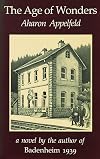
The Age of Wonders
by Aharon Appelfeld
On This Page
Description
Describes the response of two generations of a Jewish family to the anti-Semitism of the Nazis in an Austrian town.Tags
Recommendations























Member Reviews
I found this to be a well-written yet sad story about a Jewish boy’s experiences in Austria prior to World War II. Although the boy’s Father was a well-known writer and secular Jew, that made no difference to the boy and his family as attitudes toward Jews declined in the pre-war years. Later the boy, now a grown man, returned from his current home in Jerusalem to visit the town in which he grew up. That turned out to be a melancholy and unsatisfactory experience.
Appelfeld does an amazing job of pulling the reader into the emotional space of the protagonist, although it’s a place the reader might rather not be. Reading books of this kind tend to be depressing yet I feel compelled to read them. This one, like others of show more Appelfeld’s I’ve read, deals with pre-WWII antisemitism, a topic which makes me uncomfortable. The atmosphere presented in the book felt so true that it frightened me. I was actually relieved when the story ended so Bruno could return to Jerusalem. show less
Appelfeld does an amazing job of pulling the reader into the emotional space of the protagonist, although it’s a place the reader might rather not be. Reading books of this kind tend to be depressing yet I feel compelled to read them. This one, like others of show more Appelfeld’s I’ve read, deals with pre-WWII antisemitism, a topic which makes me uncomfortable. The atmosphere presented in the book felt so true that it frightened me. I was actually relieved when the story ended so Bruno could return to Jerusalem. show less
Impressionistic view of small town Austria--1938, 1968. Very like Badenheim 1939: dreamy, spooky, very depressing.
A beautiful book, the Godine edition in hardcover is matchless.
Aharon Appelfeld beschrijft zijn jeugd in en terugkeer als oudere naar zijn Oostenrijkse geboortedorp in Het tijdperk der wonderen. A trip down memory lane, van het Oostenrijk in de jaren '30 van de 20e eeuw, waarin de joden meer en meer als plaag worden gezien door alle lagen van de bevolking. Vader Appelfeld, tot voor kort een gevierd schrijver, wordt stapsgewijs verdreven naar de positie van paria. Eén van de terugkerende thema's is een treinreis van ogenschijnlijk niets naar nergens. De worsteling van veel toenmalige joden met de vraag naar het joods zijn, religieus of alleen etnisch, waard om geofferd te worden in een zo wonderlijk en onbegrijpelijke tijd. Deel 1 eindigt met de dood van de plaatselijke rabbi en het transport naar show more een concentratiekamp van van Bruno's ouders. In deel 2 keert Bruno, na de oorlog naar Jeruzalem getrokken, terug naar zijn geboortedorp en tracht er herinneringen op te halen en bekenden te ontmoeten. Appelfeld wil begrijpen waarom de joden gehaat worden en wat het nut van zijn volk is.
In alle mildheid treedt hij zijn voormalige landgenoten tegemoet en concludeert, dat de joden nodig zijn voor de liefde en dat joods zijn niet geloochend of vergeten kan worden. Het waanzinnige van het antisemisme, maar ook de keuzes van joden zelf in deze tijden hebben her en der tot ontsporingen geleid, relaties verstoord en tot haat en nijd geleid. Appelfeld schreef deze indrukwekkende roman in 1978, maar pas in 2008 werd het uit het Hebreeuws vertaald door Kees Meiling. Zonder op de gebeurtenissen in de concentratiekampen in te gaan, of de wereld te groot te maken wint deze tweeluik aan kracht en steekt het boven gemiddelde oorlogsromans uit. show less
In alle mildheid treedt hij zijn voormalige landgenoten tegemoet en concludeert, dat de joden nodig zijn voor de liefde en dat joods zijn niet geloochend of vergeten kan worden. Het waanzinnige van het antisemisme, maar ook de keuzes van joden zelf in deze tijden hebben her en der tot ontsporingen geleid, relaties verstoord en tot haat en nijd geleid. Appelfeld schreef deze indrukwekkende roman in 1978, maar pas in 2008 werd het uit het Hebreeuws vertaald door Kees Meiling. Zonder op de gebeurtenissen in de concentratiekampen in te gaan, of de wereld te groot te maken wint deze tweeluik aan kracht en steekt het boven gemiddelde oorlogsromans uit. show less
Aug 3, 2008Dutch
Ratings
Members
- Recently Added By
Lists

Jewish Books
367 works; 24 members
Author Information

77+ Works 3,682 Members
Aharon Appelfeld was born in a town near Czernowitz, Romania on February 16, 1932. When he was 8 years old, he and his father endured a forced march to a labor camp in Ukraine. He escaped the camp and spent the next three years as a shepherd working for various peasants and always concealing his Jewish identity. He then joined the Soviet Army as a show more cook's helper. After World War II, he spent months in a refugee camp in Italy before going to Palestine in 1946. He worked on a kibbutz, fought in the 1948 Arab-Israeli war, and studied philosophy at Hebrew University. The Holocaust was the main subject of his books. His first novel, The Skin and the Gown, was published in 1971. His other works include Badenheim 1939, The Age of Wonders, To the Land of the Cattails, The Healer, The Immortal Bartfuss, For Every Sin, and Writing and the Holocaust. He received the Israel Prize for literature, The Prime Minister's Prize for Creative Writing, and two Anne Frank Literary Prizes. He taught Hebrew literature for many years at Ben-Gurion University of the Negev, in Beersheba. He died on January 4, 2018 at the age of 85. (Bowker Author Biography) show less
Awards and Honors
Series
Belongs to Publisher Series
Common Knowledge
- People/Characters
- Bruno
Classifications
- Genres
- Fiction and Literature, General Fiction
- DDC/MDS
- 892.4 — Literature & rhetoric Literatures of other languages Afro-Asiatic literatures Jewish, Israeli, and Hebrew
- LCC
- PJ5054 .A755 .T613 — Language and Literature Oriental languages and literatures Oriental philology and literature Hebrew Literature Individual authors and works
- BISAC
Statistics
- Members
- 189
- Popularity
- 174,232
- Reviews
- 4
- Rating
- (3.61)
- Languages
- 7 — Dutch, English, Estonian, French, German, Hebrew, Norwegian (Bokmål)
- Media
- Paper
- ISBNs
- 14
- ASINs
- 3